


JEE Mains · Chemistry · STD 12 - D and f- block elements
- JEE Mains 2026
- Medium
- Numerical
Identify the metal ions among \(Co ^{2+}, Ni ^{2+}, Fe ^{2+}, V ^{3+}\) and \(Ti ^{2+}\) having a spin-only magnetic moment value more than 3.0 BM . The sum of unpaired electrons present in the high spin octahedral complexes formed by those metal ions is ______.
Pick an option to check your answer.
Answer & Solution
Correct Answer
(A) 7
Step-by-step Solution
Detailed explanation
\(V^{3+}=(A r)_{18} 3 d^2\)
\(Ti ^{2+}=( Ar )_{18} 3 d^2\)
\(Ni ^{2+}=( Ar )_{18} 3 d^8\)
\(Fe ^{2+}=( Ar )_{18} 3 d^6\)
\(Co ^{2+}=( Ar )_{18} 3 d^7\)
Only for \(Fe ^{2+}\) and \(Co ^{2+} \mu\) is more than 3.0 B.M.
\(Fe ^{2+} 3 d^6\)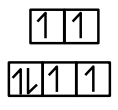 \(n =4, \mu>3\)
\(Co ^{2+} 3 d^7\)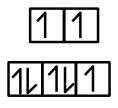 \(n =3, \mu>3\)
\(\therefore\) Number of unpaired electrons = 4 + 3 = 7
\(Ti ^{2+}=( Ar )_{18} 3 d^2\)
\(Ni ^{2+}=( Ar )_{18} 3 d^8\)
\(Fe ^{2+}=( Ar )_{18} 3 d^6\)
\(Co ^{2+}=( Ar )_{18} 3 d^7\)
Only for \(Fe ^{2+}\) and \(Co ^{2+} \mu\) is more than 3.0 B.M.
\(Fe ^{2+} 3 d^6\)
\(n =4, \mu>3\)\(Co ^{2+} 3 d^7\)
\(n =3, \mu>3\)\(\therefore\) Number of unpaired electrons = 4 + 3 = 7
More questions from Chemistry
- For an ideal solution of two components \(A\) and \(B\), which of the following is true?JEE Mains 2014 Medium
- Reduction potential of ions are given below:
The correct order of their oxidising power is _______.\(ClO_4^{-}\) \(IO_4^{-}\) \(BrO_4^{-}\) \(E^{\circ}=1.19 V\) \(E^{\circ}=1.65 V\) \(E^{\circ}=1.74 V\) JEE Mains 2024 Hard - The oxidation states of \('P'\) in \(\mathrm{H}_{4} \mathrm{P}_{2} \mathrm{O}_{7}, \mathrm{H}_{4} \mathrm{P}_{2} \mathrm{O}_{5}\) and \(\mathrm{H}_{4} \mathrm{P}_{2} \mathrm{O}_{6}\), respectively, are:JEE Mains 2021 Hard
- The total number of unpaired electrons present in the \(d^3\), \(d^4\) (low spin), \(d^5\) (high spin), \(d^6\) (high spin) and \(d^7\) (low spin) octahedral complex systems is _______.JEE Mains 2026 Medium
- A metal surface is exposed to \(500\, \mathrm{~nm}\) radiation. The threshold frequency of the metal for photoelectric current is \(4.3 \times 10^{14}\, \mathrm{~Hz}\). The velocity of ejected electron is \(.......\,\times 10^{5} \mathrm{~ms}^{-1}\) (Nearest integer) [Use : \(\left.\mathrm{h}=6.63 \times 10^{-34}\, \mathrm{Js}, \mathrm{m}_{\mathrm{e}}=9.0 \times 10^{-31}\, \mathrm{~kg}\right]\)JEE Mains 2021 Medium
- In the Claisen-Schmidt reaction to prepare, dibenzalacetone from 5.3 g of benzaldehyde, a total of 3.51 g of product was obtained. The percentage yield in this reaction was ______ %.JEE Mains 2025 Medium
More PYQs from JEE Mains
- The electric field intensity produced by the radiation coming from a \(100\, W\) bulb at a distance of \(3\, m\) is \(E\). The electric field intensity produced by the radiation coming from \(60\, W\) at the same distance is \(\sqrt{\frac{x}{5}} E\). Where the value of \(x=......... .\)JEE Mains 2021 Hard
- If solubility product of \(Z{r_3}{\left( {P{O_4}} \right)_4}\) is denoted by \(K_{SP}\) and its molar solubility is denoted by \(S\), then which of the following relation between \(S\) and \(K_{SP}\) is correct?JEE Mains 2019 Hard
- A uniformly tapering conical wire is made from a material of Young's modulus \(Y\) and has a normal, unextended length \(L.\) The radii, at the upper and lower ends of this conical wire, have values \(R\) and \(3R,\) respectively. The upper end of the wire is fixed to a rigid support and a mass \(M\) is suspended from its lower end. The equilibrium extended length, of this wire, would equalJEE Mains 2016 Hard
- Two point charges \(-4 \mu c\) and \(4 \mu c\), constituting an electric dipole, are placed at \((-9,0,0) \mathrm{cm}\) and \((9,0,0) \mathrm{cm}\) in a uniform electric field of strength \(10^4 \mathrm{NC}^{-1}\). The work done on the dipole in rotating it from the equilibrium through \(180^{\circ}\) is :JEE Mains 2025 Hard
- A sinusoidal voltage \(V(t) = 100\,sin\,(500t)\) is applied across a pure inductance of \(L = 0.02\,H.\) The current through the coil isJEE Mains 2014 Medium
- A big drop is formed by coalescing \(1000\) small identical drops of water. If \(E_1\) be the total surface energy of \(1000\) small drops of water and \(E_2\) be the surface energy of single big drop of water, the \(E_1\) : \(\mathrm{E}_2\) is \(\mathrm{x}: 1\) where \(x\) = _____.JEE Mains 2024 Hard