


Questions
20 questionsShowing 1–20 of 20 questions
-
- (A) 70
- (B) 75
- (C) 78
- (D) 80
Show answer and solution
Correct Answer: (C)
We have considered
\(E _{\left[ Sn ( OH )_6\right]^{2-} / HSnO _2^{-}}^{ o }=-0.9 V\)
\(Pt \left| HSnO _2^{-}(aq ),\left[ Sn ( OH )_6\right]^{2-}( aq ), OH ^{-}( aq )\right| Bi _2 O _3(s) \\ | Bi ( s )|\)
\(\quad \quad\quad0.5 M \quad\quad\quad 0.05 M\)
\(E _{\text {cell }}^{\circ}=+0.9-0.44=0.46 V\)
Oxidation Half :
\(HSnO _2^{-}+ H _2 O +3 OH ^{-} \rightarrow\left[ Sn ( OH )_6\right]^{2-}+2 e ^{-}\)
Reduction Half :
\(\frac{ Bi _2 O _3+3 H _2 O +6 e ^{-} \rightarrow 2 Bi +6 OH ^{-}}{3 HSnO _2^{-}( aq )+ Bi _2 O _3(s)+6 H _2 O +3 OH ^{-}( aq )}\)
\(\rightarrow 3\left[ Sn ( OH )_6\right]^{-}( aq )+2 Bi ( s )\)
\(E _{\text {cell }}= E _{\text {cell }}^{ o }-\frac{0.059}{6} \log \frac{(0.5)^3}{(0.05)^3 \times\left[ OH ^{-}\right]^3}\)
\(0.2353=0.46-\frac{0.059}{6} \times 3 \log \left[\frac{10}{\left[ OH ^{-}\right]}\right]\)
\(\log \left[\frac{10}{ OH ^{-}}\right]=\frac{2 \times 0.2247}{0.059}=7.6\)
\(I + pOH =7.6\)
\(pOH =6.6\)
\(pH =14-6.6=7.4\)
\(pH = pK _{ a _1}+\log \frac{\left[ HCO _3^{-}\right]}{\left[ H _2 CO _3\right]}\)
\(7.4=6.11+\log \frac{5 x}{20}\)
\(1.29=\log \frac{x}{4}\)
\(\frac{x}{4}=19.5\)
\(x=78\) -
- (A) 0
- (B) 1
- (C) 2
- (D) 4
Show answer and solution
Correct Answer: (C)
Given standard reduction potentials:
\(E^{\ominus}_{M^{x+}/M} = +0.15\) V
\(E^{\ominus}_{Fe^{3+}/Fe} = -0.036\) V
Since \(E^{\ominus}_{M^{x+}/M} > E^{\ominus}_{Fe^{3+}/Fe}\), reduction occurs at the \(M^{x+}/M\) electrode (cathode) and oxidation occurs at the \(Fe^{3+}/Fe\) electrode (anode).
Cathode reaction: \((M^{x+} + x e^{-} \rightarrow M) \times 3\)
Anode reaction: \((Fe \rightarrow Fe^{3+} + 3 e^{-}) \times x\)
Overall balanced cell reaction:
\(3 M^{x+} + x Fe \rightarrow 3 M + x Fe^{3+}\)
The number of electrons transferred in the balanced reaction is \(n = 3x\).
Standard cell potential \(E^{\ominus}_{cell}\) is:
\(E^{\ominus}_{cell} = E^{\ominus}_{cathode} - E^{\ominus}_{anode}\)
\(E^{\ominus}_{cell} = 0.15 - (-0.036) = 0.186\) V
Using the Nernst equation:
\(E_{cell} = E^{\ominus}_{cell} - \dfrac{2.303RT}{nF} \log Q\)
Substitute the given values (\(E_{cell} = 0.2057\) V, \(Q = 10^{-2}\), and \(\dfrac{2.303RT}{F} = 0.059\) V):
\(0.2057 = 0.186 - \dfrac{0.059}{3x} \log(10^{-2})\)
\(0.2057 - 0.186 = -\dfrac{0.059}{3x} \times (-2)\)
\(0.0197 = \dfrac{0.118}{3x}\)
\(3x = \dfrac{0.118}{0.0197}\)
\(3x \approx 6\)
\(x = 2\)
Answer: \(2\) -
- (A) Overall reaction \(Fe(s) + 2OH^-(aq) + 2AgBr(s) \rightleftharpoons Fe(OH)_2(s) + 2Ag(s) + 2Br^-(aq)\)
- (B) \(E^\theta_{cell} = -0.95\) V
- (C) Fe is reduced in the electrochemical cell
- (D) \(E^\theta_{cell}\) is an extensive property
Show answer and solution
Correct Answer: (A)
For a spontaneous reaction, the cell potential \(E^{\theta}_{cell}\) must be positive. The half-cell with the higher standard reduction potential acts as the cathode (reduction), and the one with the lower standard reduction potential acts as the anode (oxidation).
Given standard reduction potentials:
\(E^{\theta}_{AgBr/Ag} = +0.07\) V
\(E^{\theta}_{Fe(OH)_2/Fe} = -0.88\) V
Since \(+0.07\) V \(> -0.88\) V, \(AgBr\) undergoes reduction at the cathode and \(Fe\) undergoes oxidation at the anode.
Cathode reaction: \(2AgBr(s) + 2e^{-} \rightarrow 2Ag(s) + 2Br^{-}(aq)\)
Anode reaction: \(Fe(s) + 2OH^{-}(aq) \rightarrow Fe(OH)_2(s) + 2e^{-}\)
Overall cell reaction:
\(Fe(s) + 2OH^{-}(aq) + 2AgBr(s) \rightleftharpoons Fe(OH)_2(s) + 2Ag(s) + 2Br^{-}(aq)\)
Standard cell potential:
\(E^{\theta}_{cell} = E^{\theta}_{cathode} - E^{\theta}_{anode} = 0.07 - (-0.88) = +0.95\) V
\(E^{\theta}_{cell}\) is an intensive property, and \(Fe\) is oxidized in the cell. Thus, only the overall reaction given in the first option is correct.
Answer: Overall reaction \(Fe(s) + 2OH^-(aq) + 2AgBr(s) \rightleftharpoons Fe(OH)_2(s) + 2Ag(s) + 2Br^-(aq)\) -
- (A) 10
- (B) 15
- (C) 20
- (D) 25
Show answer and solution
Correct Answer: (B)
The conductivity (specific conductance), \(\kappa\), is given by the product of conductance and cell constant:
\(\kappa = G \times G^*\)
\(\kappa = 1.9 \times 10^{-3} \text{ S} \times 1.3 \text{ cm}^{-1} = 2.47 \times 10^{-3} \text{ S cm}^{-1}\)
The molar conductivity, \(\Lambda_m\), is related to the conductivity and molarity \(C\) by the formula:
\(\Lambda_m = \dfrac{\kappa \times 1000}{C}\)
Substituting the given values:
\(123.5 = \dfrac{2.47 \times 10^{-3} \times 1000}{C}\)
\(123.5 = \dfrac{2.47}{C}\)
\(C = \dfrac{2.47}{123.5} = 0.02 \text{ mol L}^{-1}\)
Molarity \(C\) can also be expressed in terms of mass percentage \(x\) (w/w), density \(d\), and molar mass \(M\):
\(C = \dfrac{x \times d \times 10}{M}\)
Substituting the known values (\(d = 1.0 \text{ g mL}^{-1}\), \(M = 75 \text{ g mol}^{-1}\)):
\(0.02 = \dfrac{x \times 1.0 \times 10}{75}\)
\(1.5 = 10x\)
\(x = 0.15\)
Expressing \(x\) in the required format:
\(x = 15 \times 10^{-2}\)
The value is \(15\).
Answer: \(15\) -
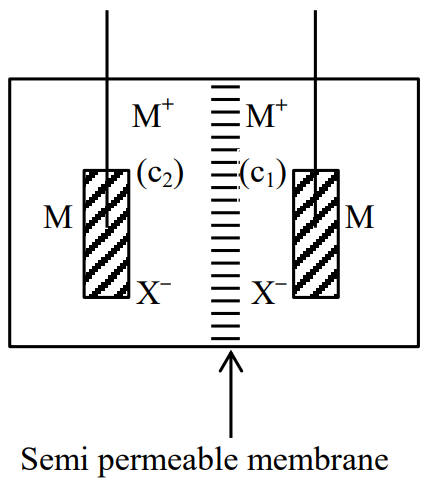
- (A) If \( c_{1} \) is present at anode, then \( c_{1} = c_{2} \)
- (B) If \( c_{1} \) is present at cathode, then \( c_{1} < c_{2} \)
- (C) If \( c_{1} \) is present at cathode, then \( c_{1} > c_{2} \)
- (D) If \( c_{1} \) is present at anode, then \( c_{1} > c_{2} \)
Show answer and solution
Correct Answer: (C)
(1) If \(C _1\) is at anode ⇒ cell reaction
\( M^{+}(C_{2}) \rightarrow M^{+}(C_{1}) \)
\( E_{cell} = -0.059 \log \frac{C_{1}}{C_{2}} \)
\(\therefore E_{cell} > 0 \Rightarrow C_{1} < C_{2} \)
(2) If \( C_{1} \) is at cathode
\( M^{+}(C_{1}) \rightarrow M^{+}(C_{2}) \)
\( E_{cell} = -0.059 \log \frac{C_{2}}{C_{1}} > 0 \)
\( C_{2} < C_{1} \) -
- (A) 2
- (B) 4
- (C) 6
- (D) 8
Show answer and solution
Correct Answer: (B)
For spontaneity \(E_{cell} > 0\).
At limiting condition:
\(E_{oxi}(anode) = -E_{red}(cathode)\)
\(H_{2}O \rightarrow 2H^{+} + \frac{1}{2}O_{2} + 2e^{-}\)
\(E = E ^{\circ}-\frac{0.059}{2} \log \left[\frac{\left[ H ^{+}\right]^2 \times P _{ O _2}^{1 / 2}}{1}\right]\)
\(-0.997 = -1.23 + 0.059 \times pH\)
\(pH = 3.94\)
\(pH \simeq 4\) -
- (A) \(\dfrac{10^6 x^2}{\alpha^2(x_1 + x_2 - 2x_3)^2}\)
- (B) \(\dfrac{x^2}{(x_1 + x_2 - 2x_3)^2}\)
- (C) \(\dfrac{\alpha^2(x_1 + x_2 - 2x_3)^2}{10^6 x^2}\)
- (D) \(\dfrac{x^2}{(x_1 + x_2 + 2x_3)^2}\)
Show answer and solution
Correct Answer: (A)
Using Kohlrausch's law of independent migration of ions, the limiting molar conductivity of \(\text{BaSO}_4\) is given by:
\(\Lambda^{\circ}_m(\text{BaSO}_4) = \Lambda^{\circ}_m(\text{BaCl}_2) + \Lambda^{\circ}_m(\text{H}_2\text{SO}_4) - 2\Lambda^{\circ}_m(\text{HCl})\)
Substituting the given values:
\(\Lambda^{\circ}_m(\text{BaSO}_4) = x_1 + x_2 - 2x_3\)
For a sparingly soluble salt, the solubility \(S\) (in mol L\(^{-1}\)) is related to its conductivity \(\kappa\) (in S cm\(^{-1}\)) and molar conductivity \(\Lambda_m\) (in S cm\(^2\) mol\(^{-1}\)) by the relation:
\(\Lambda_m = \dfrac{\kappa \times 1000}{S}\)
Given that \(\kappa = x\) and \(\Lambda_m = \Lambda^{\circ}_m\) (which implies complete dissociation, meaning the degree of dissociation \(\alpha = 1\)), we get:
\(S = \dfrac{1000 x}{x_1 + x_2 - 2x_3}\)
The solubility product \(K_{sp}\) for \(\text{BaSO}_4\) (which dissociates into \(\text{Ba}^{2+}\) and \(\text{SO}_4^{2-}\)) is:
\(K_{sp} = S^2 = \left( \dfrac{1000 x}{x_1 + x_2 - 2x_3} \right)^2 = \dfrac{10^6 x^2}{(x_1 + x_2 - 2x_3)^2}\)
Since \(\alpha = 1\), this expression is equivalent to \(\dfrac{10^6 x^2}{\alpha^2(x_1 + x_2 - 2x_3)^2}\).
Answer: \(\dfrac{10^6 x^2}{\alpha^2(x_1 + x_2 - 2x_3)^2}\) -
- (A) 2
- (B) 3
- (C) 4
- (D) 5
Show answer and solution
Correct Answer: (C)
\(E_{cell}^{\circ} = -0.44 - (-0.90)\)
\(= +0.46 V\)
Applying Nernst equation :-
\(E_{\text {cell }}=E_{\text {cell }}^{\circ}-\frac{0.06}{n} \log Q\)
\(E _{\text {cell }}=0.46-\frac{0.06}{6} \log 10^6\)
\(E _{\text {cell }}=4 \times 10^{-1}\)
\(x = 4\) -
- (A) 6
- (B) 12
- (C) 24
- (D) 8
Show answer and solution
Correct Answer: (C)
\( 3BH_{4}^{-}+4ClO_{3}^{-} \rightarrow 4Cl^{-}+3H_{2}BO_{3}^{-}+3H_{2}O \)
n -factor \(=8\)
moles \(=3\)
\(\therefore n =3 \times 8=24\) -
- (A) \(Al > Cr > Fe^{2+} > Co^{2+}\)
- (B) \(Al > Fe^{2+} > Cr > Co^{2+}\)
- (C) \(Al > Cr > Co^{2+} > Fe^{2+}\)
- (D) \(Cr > Fe^{2+} > Al > Co^{2+}\)
Show answer and solution
Correct Answer: (A)
Reducing power \(\propto \frac{1}{\text { Reduction potential }}\) -
- (A) -560
- (B) -565
- (C) -570
- (D) -575
Show answer and solution
Correct Answer: (A)
Explanation:
Let us compute the change in volume step-by-step based on the Electrochemistry and Chemical Thermodynamics principles in the NCERT Class 12 Chemistry textbook:
Step 1: Determine the standard cell potential (\(E^\circ_{cell}\))
Both given equations are written as reduction half-reactions. The half-reaction with the larger reduction potential occurs at the cathode, while the other is reversed to serve as the oxidation reaction at the anode:
- Cathode (Reduction): \(\frac{3}{2}O_2 + 6H^+ + 6e^- \rightarrow 3H_2O \quad E^\circ_{red} = 1.23\text{ V}\)
- Anode (Oxidation): \(CH_3OH + H_2O \rightarrow CO_2 + 6H^+ + 6e^- \quad E^\circ_{ox} = -0.02\text{ V}\)
- Net Cell Reaction: \(CH_3OH + \frac{3}{2}O_2 \rightarrow CO_2 + 2H_2O\)
The standard cell potential is calculated as:
\(E^\circ_{cell} = E^\circ_{cathode} - E^\circ_{anode} = 1.23\text{ V} - 0.02\text{ V} = 1.21\text{ V}\)
Step 2: Calculate the maximum electrical work (\(W_{max}\))
The number of moles of electrons transferred (\(n\)) per mole of \(CH_3OH\) reacted is 6. Using Faraday's constant (\(F = 96500\text{ C mol}^{-1}\)):
\(W_{max} = nFE^\circ_{cell} = 6 \times 96500 \times 1.21 = 700590\text{ J}\)
Step 3: Find the actual work derived (\(W_{actual}\))
Because the cell operates at 80% efficiency, the actual energy available to perform external work is:
\(W_{actual} = 0.80 \times 700590\text{ J} = 560472\text{ J}\)
Step 4: Calculate the volume change (\(\Delta V\)) during compression
The electrical energy delivered by the cell is utilized to perform work on the ideal gas during isothermal compression against a constant external pressure (\(P_{ext} = 1\text{ kPa} = 1000\text{ Pa}\)):
\(W = -P_{ext} \cdot \Delta V\)
Since work is done on the gas, \(W\) is positive:
\(560472 = -1000 \times \Delta V\)
\(\Delta V = -\frac{560472}{1000} = -560.472\text{ m}^3\)
Rounding to the nearest integer yields \(-560\text{ m}^3\).
Hence, Option A is the correct choice. -
- (A) 55
- (B) 222
- (C) 111
- (D) 148
Show answer and solution
Correct Answer: (C)
Eq of \( Cu = Eq \) of \( O_{2} \)
\(\frac{300 \times 10^{-3} \times 2}{63.54}= n _{ O _2} \times 4\)
\(2.36 \times 10^{-3}= n _{ O _2}\)
When current is further passed
\(n _{ O _2} \times 4=\frac{600 \times 28 \times 60}{96500 \times 1000}\)
\(n _{ O _2}=2.611 \times 10^{-3}\)
Total \( O_{2} \) released
\(=\left[10^{-3} \times(2.36+2.611)\right] \times 22400 ml\)
\(=111.35 ml\) -
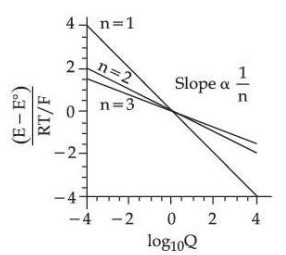
- (A) The overall reaction can be written as \(n_2\text{Red}_1 + n_1\text{Ox}_2 \rightleftharpoons n_2\text{Ox}_1^{n_1^+} + n_1\text{Red}_2^{n_2^-}\)
- (B) The electrons do not appear in the overall reaction because electrons produced at the anode are consumed at the cathode.
- (C) Here \(n\) is the number of electrons transferred in redox reaction.
- (D) If the reaction is carried out reversibly, the electrical work done is equal to the ratio of charge and potential difference through which charge is moved.
Show answer and solution
Correct Answer: (D)
For the given redox reaction, the half-cell reactions are:
Anode: \(\text{Red}_1 \rightarrow \text{Ox}_1^{n_1^+} + n_1 e^-\)
Cathode: \(\text{Ox}_2 + n_2 e^- \rightarrow \text{Red}_2^{n_2^-}\)
To obtain the overall balanced chemical equation, we multiply the anode reaction by \(n_2\) and the cathode reaction by \(n_1\) so that the number of electrons lost equals the number of electrons gained:
\(n_2\text{Red}_1 \rightarrow n_2\text{Ox}_1^{n_1^+} + n_1 n_2 e^-\)
\(n_1\text{Ox}_2 + n_1 n_2 e^- \rightarrow n_1\text{Red}_2^{n_2^-}\)
Adding these gives the overall reaction:
\(n_2\text{Red}_1 + n_1\text{Ox}_2 \rightleftharpoons n_2\text{Ox}_1^{n_1^+} + n_1\text{Red}_2^{n_2^-}\)
Thus, statement (A) is correct.
In the overall reaction, electrons do not appear because the electrons produced at the anode are exactly consumed at the cathode. Thus, statement (B) is correct.
From the Nernst equation:
\(E = E^\circ - \dfrac{RT}{nF} \ln Q = E^\circ - \dfrac{2.303 RT}{nF} \log_{10} Q\)
\(\dfrac{E - E^\circ}{RT/F} = -\dfrac{2.303}{n} \log_{10} Q\)
The graph of \(\dfrac{E - E^\circ}{RT/F}\) versus \(\log_{10} Q\) is a straight line with a slope of \(-\dfrac{2.303}{n}\), where \(n\) is the number of electrons transferred in the balanced redox reaction. Thus, statement (C) is correct.
The electrical work done by a galvanic cell is given by the product of the total charge transferred and the cell potential (potential difference), not their ratio.
\(W_{\text{electrical}} = \text{Charge} \times \text{Potential difference} = nF E_{\text{cell}}\)
Thus, statement (D) is incorrect.
Answer: If the reaction is carried out reversibly, the electrical work done is equal to the ratio of charge and potential difference through which charge is moved. -
- (A) 2
- (B) 4
- (C) 6
- (D) 8
Show answer and solution
Correct Answer: (B)
Using equation : \(\Lambda_{ m }=\Lambda^0{ }_{ m }- A \sqrt{ c }\)
\(96.1=\Lambda_{ m }^0- A \sqrt{0.04}\)
\(96.1=\Lambda_{ m }^0- A \times 0.2 \quad\ldots(1)\)
\(95.7=\Lambda_{ m }^0- A \times \sqrt{0.09}\)
\(95.7=\Lambda_m^0- A \times 0.3 \quad\ldots(2)\)
From eq. (1) and eq. (2)
\(A =4\) -
- (A) \(2X-3Y\)
- (B) \(3Y-2X\)
- (C) \(3Y+2X\)
- (D) \(Y+X\)
Show answer and solution
Correct Answer: (B)
The half-reactions and their standard Gibbs free energy changes are given by:
\(Fe^{2+} + 2e^{-} \rightarrow Fe\)
\(\Delta G^{\ominus}_{1} = -2FX\)
\(Fe^{3+} + 3e^{-} \rightarrow Fe\)
\(\Delta G^{\ominus}_{2} = -3FY\)
The required half-reaction is:
\(Fe^{3+} + e^{-} \rightarrow Fe^{2+}\)
\(\Delta G^{\ominus}_{3} = -1FE^{\ominus}_{Fe^{3+}/Fe^{2+}}\)
This reaction is obtained by subtracting the first reaction from the second reaction:
\(\Delta G^{\ominus}_{3} = \Delta G^{\ominus}_{2} - \Delta G^{\ominus}_{1}\)
\(-FE^{\ominus}_{Fe^{3+}/Fe^{2+}} = -3FY - (-2FX)\)
\(-FE^{\ominus}_{Fe^{3+}/Fe^{2+}} = -3FY + 2FX\)
\(E^{\ominus}_{Fe^{3+}/Fe^{2+}} = 3Y - 2X\)
Answer: \(3Y-2X\) -
- (A) A and B only
- (B) A and E only
- (C) B only
- (D) C, D and E only
Show answer and solution
Correct Answer: (D)
\(Cl_{aq}^{-}+Ag_{(S)}+Fe_{aq}^{+3}\rightarrow Fe_{aq}^{+2}+AgCl_{(S)}\)
\(E_{cell}=E_{cell}^{o}-\frac{0.059}{1}log\frac{[Fe^{2+}]}{[Cl^{-}][Fe^{3+}]}\) -
- (A) 2
- (B) 1
- (C) 3
- (D) 4
Show answer and solution
Correct Answer: (A)
\(K _{ a }( HQ )= C _1 \alpha_1^2 \quad\alpha_1=\frac{\lambda_{ m }( HQ )}{\lambda_{ m }^{\infty}( HQ )}\)
\(K _{ a }( HZ )= C _2 \alpha_2^2 \quad \alpha_2=\frac{\lambda_{ m }( HZ )}{\lambda_{ m }^{\infty}( HZ )}\)
\(\frac{ K _{ a }( HQ )}{ K _{ a }( HZ )}=\frac{ C _1}{ C _2} \cdot\left(\frac{\alpha_1}{\alpha_2}\right)^2=\frac{0.18}{0.02} \cdot\left[\frac{\lambda_{ m }( HQ )}{\lambda_{ m }( HZ )}\right]^2\)
\(\frac{K_a( HQ )}{K_a( HQ )}=9 \times\left(\frac{1}{30}\right)^2=\frac{1}{100}\)
\(pK _3( HQ )- pK _3( HZ )=2\) -
- (A) 200
- (B) 790
- (C) 590
- (D) 1380
Show answer and solution
Correct Answer: (A)
\(E _{ X ^{-} / MX ( s ) / M }^{ o }= E _{ M ^{+} / M }^{ o }+\frac{0.0591}{ n } \log K _{ sp }\)
\(=0.79+\frac{0.059}{1} \log 10^{-10}\)
\(=0.79-0.59\)
\(=0.20 V=200 mV\) -
- (A) \(\dfrac{2}{3.9}\)
- (B) \(\dfrac{4}{5.9}\)
- (C) \(\dfrac{2.9}{2}\)
- (D) \(\dfrac{5.9}{4}\)
Show answer and solution
Correct Answer: (B)
The cell reaction is \(Zn(s) + 2Ag^+(aq) \rightarrow Zn^{2+}(aq) + 2Ag(s)\)
The standard cell potential is given by:
\(E^\circ_{cell} = E^\circ_{cathode} - E^\circ_{anode} = 0.80 - (-0.76) = 1.56\text{ V}\)
Using the Nernst equation:
\(E_{cell} = E^\circ_{cell} - \dfrac{0.059}{n} \log \dfrac{[Zn^{2+}]}{[Ag^+]^2}\)
Substituting the given values (\(n = 2\), \([Zn^{2+}] = 1\text{ M}\), \(E_{cell} = 1.60\text{ V}\)):
\(1.60 = 1.56 - \dfrac{0.059}{2} \log \dfrac{1}{x^2}\)
\(0.04 = - \dfrac{0.059}{2} (-2 \log x)\)
\(0.04 = 0.059 \log x\)
\(\log x = \dfrac{0.04}{0.059} = \dfrac{4}{5.9}\)
Answer: \(\dfrac{4}{5.9}\) -
- (A) 2
- (B) 4
- (C) 6
- (D) 8
Show answer and solution
Correct Answer: (C)
\(pH =5\)
\(\left[ H ^{+}\right]=10^{-5}=[ HX ] \cdot \alpha\)
\(=[ HX ] \cdot \frac{\Lambda_{ m }}{\Lambda_{ m }^{\infty}}\)
\(\Lambda_{ m }=\frac{ k \times 1000}{[ HX ]}\)
\(K = G . G ^*=4 \times 10^{-5} \times \frac{15}{1}=6 \times 10^{-4} S . cm ^{-1}\)
\(\left[ H ^{+}\right]=10^{-5}=[ HX ] \times \frac{6 \times 10^{-4} \times 1000}{\Lambda_{ m }^{\infty} \times[ HX ]}\)
\(\Lambda_{ m }^{\infty}=60000 S.cm^2 mol^{-1}\)
\(\Lambda_{ m }^{\infty}=6 S . m^2 mol^{-1}\)
No questions on this page match these filters.