


Questions
20 questionsShowing 1–20 of 20 questions
-
- (A) \(10^{-6}\)
- (B) \(4 \times 10^{-4}\)
- (C) \(3 \times 10^{-5}\)
- (D) \(3 \times 10^{-3}\)
Show answer and solution
Correct Answer: (D)
The molality of the solution is given by:
\(m = \dfrac{\text{Mass of solute}}{\text{Molar mass of solute} \times \text{Mass of solvent in kg}}\)
\(m = \dfrac{19.5}{78 \times 0.5} = 0.5 \text{ mol kg}^{-1}\)
The depression in freezing point is given by:
\(\Delta T_f = i \times K_f \times m\)
Substituting the given values:
\(1 = i \times 1.86 \times 0.5\)
\(1 = i \times 0.93\)
\(i = \dfrac{1}{0.93} = \dfrac{100}{93}\)
For the dissociation of a weak acid \(HA \rightleftharpoons H^+ + A^-\), the van 't Hoff factor is \(i = 1 + \alpha\), where \(\alpha\) is the degree of dissociation.
\(1 + \alpha = \dfrac{100}{93}\)
\(\alpha = \dfrac{100}{93} - 1 = \dfrac{7}{93}\)
The acid dissociation constant \(K_a\) is given by:
\(K_a = \dfrac{C \alpha^2}{1 - \alpha}\)
Since molarity and molality have the same values, \(C = 0.5 \text{ M}\).
\(K_a = \dfrac{0.5 \times \left(\dfrac{7}{93}\right)^2}{1 - \dfrac{7}{93}}\)
\(K_a = \dfrac{0.5 \times \dfrac{49}{93^2}}{\dfrac{86}{93}} = \dfrac{0.5 \times 49}{93 \times 86}\)
\(K_a = \dfrac{24.5}{7998} \approx 3.06 \times 10^{-3}\)
The closest value is \(3 \times 10^{-3}\).
Answer: \(3 \times 10^{-3}\) -
- (A) 60
- (B) 61
- (C) 62
- (D) 63
Show answer and solution
Correct Answer: (C)
The osmotic pressure \(\pi\) of the solution is balanced by the hydrostatic pressure of the liquid column.
\(\pi = \rho g h\)
Given:
Density of solution, \(\rho = 1000 \text{ kg m}^{-3}\)
Acceleration due to gravity, \(g = 10 \text{ m s}^{-2}\)
Height difference, \(h = 80.0 \text{ mm} = 0.08 \text{ m}\)
\(\pi = 1000 \times 10 \times 0.08 = 800 \text{ Pa} = 0.8 \text{ kPa}\)
From the van 't Hoff equation for osmotic pressure:
\(\pi = C R T = \dfrac{n}{V} R T\)
Given:
Volume of solution, \(V = 1 \text{ L} = 1 \text{ dm}^3\)
Gas constant, \(R = 8.3 \text{ kPa dm}^3 \text{ K}^{-1} \text{mol}^{-1}\)
Temperature, \(T = 300 \text{ K}\)
Substituting the values:
\(0.8 = \dfrac{n}{1} \times 8.3 \times 300\)
\(n = \dfrac{0.8}{2490} \text{ mol}\)
The mass of hemoglobin is \(w = 20 \text{ g} = 0.02 \text{ kg}\).
The molar mass \(M\) in \(\text{kg mol}^{-1}\) is:
\(M = \dfrac{w}{n} = \dfrac{0.02}{\dfrac{0.8}{2490}}\)
\(M = \dfrac{0.02 \times 2490}{0.8} = \dfrac{49.8}{0.8} = 62.25 \text{ kg mol}^{-1}\)
Rounding to the nearest integer, we get \(62\).
Answer: \(62\) -
- (A) 5
- (B) 10
- (C) 15
- (D) 20
Show answer and solution
Correct Answer: (A)
From the relative lowering of vapour pressure, we have:
\(\dfrac{P^0 - P_s}{P_s} = \dfrac{n_B}{n_A}\)
where \(n_B\) is the number of moles of solute and \(n_A\) is the number of moles of solvent.
Substituting the given values:
\(\dfrac{760 - 750}{750} = \dfrac{n_B}{n_A}\)
\(\dfrac{10}{750} = \dfrac{n_B}{n_A} \Rightarrow n_A = 75 n_B\)
The elevation in boiling point is given by:
\(\Delta T_b = T_b - T_b^0 = 320 - 319.5 = 0.5\) K
We also know that \(\Delta T_b = K_b \times m\), where \(m\) is the molality of the solution.
\(m = \dfrac{n_B}{\text{Mass of solvent in kg}} = \dfrac{n_B}{0.04}\)
Substituting the values into the elevation in boiling point equation:
\(0.5 = 0.3 \times \dfrac{n_B}{0.04}\)
\(n_B = \dfrac{0.5 \times 0.04}{0.3} = \dfrac{0.02}{0.3} = \dfrac{1}{15}\) mol
Now, substituting \(n_B\) back to find the number of moles of the solvent \(n_A\):
\(n_A = 75 \times \dfrac{1}{15} = 5\) mol
Answer: \(5\) -
- (A) 1.23 atm
- (B) 2.46 atm
- (C) 0.82 atm
- (D) 1.47 atm
Show answer and solution
Correct Answer: (B)
Mass of solute 'A' = 0.3 g
Moles of solute 'A' = \( \frac{0.3g}{60g/mol} = \frac{1}{200} \) mol
Mass of solute 'B' = 0.9 g
Moles of solute 'B' = \( \frac{0.9g}{180g/mol} = \frac{1}{200} \) mol
Total molarity of all solutes
= \( \frac{2/200}{100} \times 1000 = \frac{1}{10}M \)
\( \therefore\pi = \frac{1}{10} \times 0.082 \times 300 \)
\( \pi = 2.46 \) atm. -
- (A) 3
- (B) 1
- (C) 5
- (D) 2
Show answer and solution
Correct Answer: (A)
\(\Delta T _{ b }= i \times K _{ b } \times m\)
\(0.5= i \times m \times 5\)
\(i \times m =\frac{0.5}{5}=0.1\)
\(i \times a =\frac{15}{1000}\)
(where \(a=\) moles of solute)
Now,
\(\frac{P_o-P_S}{P^o}=i X_{\text {solute }}=i \times \frac{a}{a+\frac{150}{300}}\)
\(= i \times \frac{ a }{1 / 2}=\frac{15 / 1000}{1 / 2}=\frac{30}{1000}=3 \times 10^{-2}=3\) -
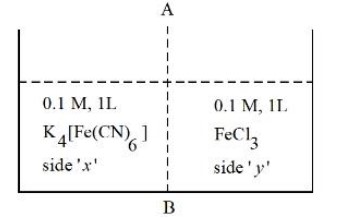
- (A) Blue color is formed on both sides.
- (B) Ionic solutes in aqueous solution can pass through semi-permeable membrane.
- (C) Solution on side '\(y\)' is hypotonic.
- (D) To cause the reverse flow of solvent during osmosis, external pressure (any value) should be applied to side '\(x\)'.
Show answer and solution
Correct Answer: (C)
For complete dissociation, the van 't Hoff factor \(i\) is equal to the number of ions produced per formula unit.
For side 'x' containing \(K_4[Fe(CN)_6]\):
\(K_4[Fe(CN)_6] \rightarrow 4K^+ + [Fe(CN)_6]^{4-}\)
Number of ions, \(i_x = 5\)
Effective concentration (osmolarity) \(= i_x \times C = 5 \times 0.1 = 0.5\) M
For side 'y' containing \(FeCl_3\):
\(FeCl_3 \rightarrow Fe^{3+} + 3Cl^-\)
Number of ions, \(i_y = 4\)
Effective concentration (osmolarity) \(= i_y \times C = 4 \times 0.1 = 0.4\) M
Since the effective concentration of side 'y' (\(0.4\) M) is less than that of side 'x' (\(0.5\) M), the solution on side 'y' has a lower osmotic pressure and is therefore hypotonic with respect to side 'x'.
Evaluating the other options:
A semi-permeable membrane (SPM) only allows solvent molecules to pass, not solute ions. Thus, \(Fe^{3+}\) and \([Fe(CN)_6]^{4-}\) cannot mix, and no blue color is formed.
To cause reverse osmosis, the external pressure applied to the hypertonic side (side 'x') must be strictly greater than the osmotic pressure difference (\(\Delta \pi = \pi_x - \pi_y\)), not just any value.
Answer: Solution on side '\(y\)' is hypotonic. -
- (A) \(1.23 \times 10^{-7}\)
- (B) \(1.17 \times 10^{-4}\)
- (C) \(9.35 \times 10^{5}\)
- (D) \(9.35 \times 10^{-5}\)
Show answer and solution
Correct Answer: (D)
\(P _{ N _2}= K _{ H } \cdot X _{ N _2}\)
\(P_{N_{2}} = 0.8 \times 10 = 8\) atm
\(8 \times 760 = 6.5 \times 10^{7} \times X_{N_{2}}\)
\(X _{ N _2}=\frac{8 \times 760}{6.5 \times 10^7}\)
\(X _{ N _2}=9.35 \times 10^{-5}\) -
- (A) 300, 200
- (B) 600, 400
- (C) 400, 300
- (D) 500, 200
Show answer and solution
Correct Answer: (D)
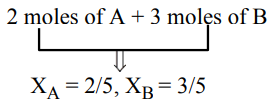
\(P_S=X_A P_A^{\circ}+X_B P_B^{\circ}\)
\(320= P _{ A }^{\circ}\left(\frac{2}{5}\right)+ P _{ B }^{\circ}\left(\frac{3}{5}\right)\)
\(2 P_{A}^{\circ}+3 P_{B}^{\circ}=1600\) ...(I)
Now 1 mole of A & 1 mole of B is added
\(X _{ A }^{\prime}=\frac{3}{7}, X _{ B }^{\prime}=\frac{4}{7}\)
\(P _{ S }^{\prime}=328.6= P _{ A }^{\circ}\left(\frac{3}{7}\right)+ P _{ B }^{\circ}\left(\frac{4}{7}\right)\)
\(3 P _{ A }^{\circ}+4 P _{ B }^{\circ}=2300.2\) ....(II)
Now eq \(( I ) \times 3-\) eq \(( II ) \times 2\)
\(6 P _{ A }^{\circ}+9 P _{ B }^{\circ}=4800\)
\(6 P _{ A }^{\circ}+8 P _{ B }^{\circ}=4600.4\)
\(P _{ B }^{\circ} \simeq 200 mm\) of Hg
\(P _{ A }^{\circ} \simeq 500 mm\) of Hg -
- (A) I < II < III < IV
- (B) III < II < I < IV
- (C) II < III < IV < I
- (D) II < III < I < IV
Show answer and solution
Correct Answer: (A)
\(\Delta T_{b} = i \cdot k_{b} \cdot m\)
For dilute solution ( \(M=m\) )Molarity \(i \times m\) (I) \(M _{\text {glucose }}=\frac{2.2}{180} \times \frac{1000}{125}=0.098\) \(0.098 \times 1\) (II) \(M _{ CaCl _2}=\frac{1.9}{111} \times \frac{1000}{250}=0.068\) \(0.068 \times 3\) (III) \(M _{\text {urea }}=\frac{9}{60} \times \frac{1000}{500}=0.3\) \(0.3 \times 1\) (IV) \(M _{ Al _2\left( SO _4\right)_2}=\frac{20.5}{342} \times \frac{1000}{750} \simeq 0.08\) \(0.08 \times 5\)
Order of \(\Delta T _{ b }= Al _2\left( SO _4\right)_3>\) Urea \(> CaCl _2>\) Glucose
So order of \(BP = Al _2\left( SO _4\right)_3>\) Urea \(> CaCl _2>\) Glucose
So Answer will be I \(<\) II \(<\) III \(<\) IV -
- (A) 70, 110
- (B) 65, 145
- (C) 60, 25
- (D) 25, 60
Show answer and solution
Correct Answer: (D)
\( (\Delta T_{b})_{PQ} = K_{b}m \)
\( 1.176 = 5 \times \frac{1}{M_{1}} \times \frac{1000}{50} \)
\( M_{1} = 85.03 \)
\( (\Delta T_{b})_{PQ_{2}} = 5 \times \frac{1}{M_{2}} \times \frac{1000}{50} = 0.689 \)
\( M_{2} = 145.13 \)
Let molar mass of \(P \& Q\) are \(M_P\) and \(M_Q\) respectively
\( M_{P} + M_{Q} = 85.03 \)
\( M_{P} + 2M_{Q} = 145.13 \)
\( M_{P} = 24.93 \approx 25 \)
\( M_{Q} = 60.1 \approx 60 \), -
- (A) Both Statement I and Statement II are true
- (B) Both Statement I and Statement II are false
- (C) Statement I is true but Statement II is false
- (D) Statement I is false but Statement II is true
Show answer and solution
Correct Answer: (A)
Statement I:
\(30\%\) (w/w) solution of methanol in CCl\(_4\) means \(30\) g of methanol is present in \(70\) g of CCl\(_4\).
Molar mass of methanol (CH\(_3\)OH) \(= 12 + 4 \times 1 + 16 = 32\) g mol\(^{-1}\)
Molar mass of CCl\(_4 = 12 + 4 \times 35.5 = 154\) g mol\(^{-1}\)
Moles of methanol \(= \dfrac{30}{32} = 0.9375\) mol
Moles of CCl\(_4 = \dfrac{70}{154} = 0.4545\) mol
Mole fraction of CCl\(_4 = \dfrac{0.4545}{0.9375 + 0.4545} = \dfrac{0.4545}{1.392} \approx 0.326 \approx 0.33\)
Thus, Statement I is true.
Statement II:
In pure methanol, molecules are held together by strong intermolecular hydrogen bonding. On adding CCl\(_4\), its molecules come between methanol molecules and break the hydrogen bonds. This decreases the intermolecular attractive forces, leading to an increase in vapour pressure. Hence, the mixture shows a positive deviation from Raoult's law.
Thus, Statement II is true.
Both Statement I and Statement II are true.
Answer: Both Statement I and Statement II are true -
- (A) Both Statement I and Statement II are true
- (B) Both Statement I and Statement II are false
- (C) Statement I is true but Statement II is false
- (D) Statement I is false but Statement II is true
Show answer and solution
Correct Answer: (D)
For Statement I:
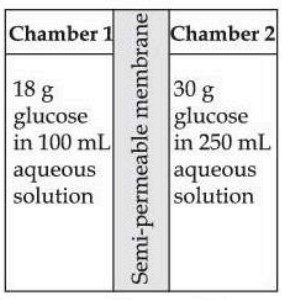
Molarity of the solution in Chamber 1 (\(M_1\)) = \(\dfrac{18 / 180}{100 / 1000} = 1\) M
Molarity of the solution in Chamber 2 (\(M_2\)) = \(\dfrac{30 / 180}{250 / 1000} = \dfrac{1/6}{1/4} = 0.667\) M
Since \(M_1 > M_2\), the solution in Chamber 1 has a higher solute concentration. During osmosis, the solvent (water) moves from the region of lower solute concentration to the region of higher solute concentration across a semi-permeable membrane. Thus, water will move from Chamber 2 to Chamber 1. Statement I is false.
For Statement II:
The osmotic pressure is given by \(\pi = iCRT\)
For \(K_2SO_4\), assuming complete dissociation (\(K_2SO_4 \rightarrow 2K^+ + SO_4^{2-}\)), the van't Hoff factor \(i = 3\).
Concentration \(C = \dfrac{50 \times 10^{-3}}{174 \times 2}\) mol/L
\(\pi = 3 \times \left( \dfrac{50 \times 10^{-3}}{174 \times 2} \right) \times 0.083 \times 300\)
\(\pi = \dfrac{3 \times 0.05 \times 24.9}{348} = \dfrac{3.735}{348} \approx 0.0107\) bar
Statement II is true.
Therefore, Statement I is false but Statement II is true.
Answer: Statement I is false but Statement II is true -
- (A) Statement I is false but Statement II is true.
- (B) Statement I is true but Statement II is false.
- (C) Both Statement I and Statement II are true.
- (D) Both Statement I and Statement II are false.
Show answer and solution
Correct Answer: (B)
\(K_{H}\) depends on the nature of gas and the solvent. -
- (A) \(9.96 \times 10^{-4}; 9.96 \times 10^{-4}; 9.96 \times 10^{-4}\)
- (B) \(9.96 \times 10^{-4}; 9.96 \times 10^{-4}; 19.92 \times 10^{-4}\)
- (C) \(4.98 \times 10^{-4}; 4.98 \times 10^{-4}; 9.96 \times 10^{-4}\)
- (D) \(4.98 \times 10^{-4}; 4.98 \times 10^{-4}; 4.98 \times 10^{-4}\)
Show answer and solution
Correct Answer: (A)
Osmotic pressure is given by \(\pi = CRT = \dfrac{w}{MV}RT\)
For solution A:
\(x = \dfrac{1}{50000 \times 0.5} \times 0.083 \times 300\)
\(x = \dfrac{1}{25000} \times 24.9 = 9.96 \times 10^{-4}\) bar
For solution B:
\(y = \dfrac{2}{50000 \times 1} \times 0.083 \times 300\)
\(y = \dfrac{2}{50000} \times 24.9 = 9.96 \times 10^{-4}\) bar
For the resultant solution (mixture of A and B):
Total mass of protein \(= 1 + 2 = 3\) g
Total volume of solution \(= 0.5 + 1 = 1.5\) L
\(z = \dfrac{3}{50000 \times 1.5} \times 0.083 \times 300\)
\(z = \dfrac{3}{75000} \times 24.9 = 9.96 \times 10^{-4}\) bar
Therefore, \(x = y = z = 9.96 \times 10^{-4}\) bar.
Answer: \(9.96 \times 10^{-4}; 9.96 \times 10^{-4}; 9.96 \times 10^{-4}\) -
- (A) 15
- (B) 30
- (C) 7.5
- (D) 58.5
Show answer and solution
Correct Answer: (A)
\(\pi= iCRT\)
\(12=2 \times C \times 0.08 \times 300\)
\(12=2 \times C \times 24\)
\(C =\frac{1}{4} mole / L\)
then strength of NaCl solution
\(=\frac{1}{4} \times 58.5 g / L\)
\(=14.625 g / L\)
\(=15 g / L\) -
- (A) 0.5217
- (B) 0.480
- (C) 0.663
- (D) 0.340
Show answer and solution
Correct Answer: (A)
\(\frac{Y_{A}}{Y_{B}}=\frac{P_{A}^{0}}{P_{B}^{0}}.\frac{X_{A}}{X_{B}}\)
\(\frac{0.8}{0.2}=\frac{55}{15}\times\frac{X_{A}}{X_{B}}\)
\(\frac{X_{A}}{X_{B}}=\frac{60}{55}=\frac{12}{11}\)
\(X_{A}=\frac{12}{23}=0.5217\) -
- (A) 100
- (B) 200
- (C) 300
- (D) 400
Show answer and solution
Correct Answer: (B)
\(X _{ A }=\frac{3}{4}, X _{ B }=\frac{1}{4}\)
\(P_S=P_A^o X_A+P_B^o X_B\)
\(500= P _{ A }^{ o } \times \frac{3}{4}+ P _{ B }^{ o } \times \frac{1}{4}\)
\(3 P _{ A }^{ o }+ P _{ B }^{ o }=2000\)\(\quad\)....(1)
Now 1 moles of A is further added so \(n _{ A }=4\) mole,
\(n _{ B }=1\) mole
\(X _{ A }^{\prime}=\frac{4}{5}, X _{ B }^{\prime}=\frac{1}{5}\)
\(P _{ s }=520= P _{ A }^{ o } \times \frac{4}{5}+ P _{ B }^{ o } \times \frac{1}{5}\)
\(4 P _{ A }^{ o }+ P _{ B }^{ o }=2600\)\(\quad\)...(2)
By equation (2) - equation (1)
\(P _{ A }^{ o }=600 mm Hg\)
\(P _{ B }^{ o }=200 mm Hg\) -
- (A) \( \frac{1.3}{8} \times \frac{W}{M} \)
- (B) \( \frac{16}{2.6} \times \frac{W}{M} \)
- (C) \( \frac{2.6}{16} \times \frac{M}{W} \)
- (D) \( \frac{1.3}{8} \times \frac{M}{W} \)
Show answer and solution
Correct Answer: (A)
P° = 640 mm Hg
\(P_S = 600 mm Hg\)
\( \Delta p = 40 \) mm Hg
moles of solute = \( \frac{W}{M} \)
\( \frac{\Delta P}{P^{\circ}}=i.X_{solute} \)
Again:
\( \Delta T_{b}=i \times k_{b} \times m \)
\( 2=i \times 0.52 \times \frac{W/M}{100} \times 1000 \)
\( i=\frac{2}{5.2} \times \frac{M}{W} \)
\(\begin{array}{l}X_{\text {solute }}=\frac{40}{640} \times \frac{1}{i}=\frac{1}{16} \times \frac{5.2}{2} \times \frac{W}{M} \\ X_{\text {solute }}=\frac{1.3}{8} \times \frac{W}{M}\end{array}\) -
- (A) \(50\%\)
- (B) \(60\%\)
- (C) \(70\%\)
- (D) \(80\%\)
Show answer and solution
Correct Answer: (D)
Moles of solute, \(n_B = 0.25\)
Moles of solvent, \(n_A = 1\)
Mole fraction of solvent, \(X_A = \dfrac{n_A}{n_A + n_B} = \dfrac{1}{1 + 0.25} = \dfrac{1}{1.25} = 0.8\)
According to Raoult's law, the vapor pressure of the solution is given by \(P_s = P^0 X_A\)
\(P_s = 0.8 P^0 = 80\% \text{ of } P^0\)
Thus, the vapor pressure of the solution is \(80\%\) of the vapor pressure of the pure solvent.
Answer: \(80\%\) -
- (A) A and B only
- (B) A and D only
- (C) A, B and D only
- (D) A, C and D only
Show answer and solution
Correct Answer: (C)
For water, the molal elevation constant \(K_b = 0.52 \text{ K kg mol}^{-1}\) and the molal depression constant \(K_f = 1.86 \text{ K kg mol}^{-1}\). Thus, \(K_b < K_f\). Statement A is incorrect.
For a solution with a given molality \(m\) of a non-volatile solute, the elevation in boiling point is \(\Delta T_b = K_b m\) and the depression in freezing point is \(\Delta T_f = K_f m\). Since \(K_b < K_f\), it follows that \(\Delta T_b < \Delta T_f\). Statement B is incorrect.
Osmotic pressure measurement is preferred for determining the molar mass of macromolecules such as proteins and polymers because the measurement is done at room temperature and the magnitude of osmotic pressure is significant even for very dilute solutions. Statement C is correct.
In benzene, benzoic acid undergoes dimerization through intermolecular hydrogen bonding, forming a cyclic dimer with two hydrogen bonds. The structure given in statement D represents a linear association with only one hydrogen bond. Statement D is incorrect.
Therefore, statements A, B, and D are incorrect.
Answer: A, B and D only
No questions on this page match these filters.