


Questions
7 questionsShowing 1–7 of 7 questions
-
- (A) 52
- (B) 56
- (C) 46
- (D) 40
Show answer and solution
Correct Answer: (A)
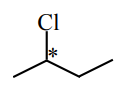 2-Chlorobutane is optically active and chiral molecule
Molecular formula \(\Rightarrow C _4 H _9 Cl\)
Molar mass \(=48+9+35.5=92.5\)
\(\% OC =\frac{48}{92.5} \times 100=51.89 \%\) -
- (A) Both Statement I and Statement II are true
- (B) Both Statement I and Statement II are false
- (C) Statement I is true but Statement II is false
- (D) Statement I is false but Statement II is true
Show answer and solution
Correct Answer: (C)
Statement I: Metamerism arises due to different alkyl chains on either side of a polyvalent functional group. In ketones, the carbonyl group (\(>C=O\)) acts as the polyvalent functional group. In \(2,6\)-diethylcyclohexanone, the alkyl groups attached to the \(\alpha\)-carbons are two ethyl groups. In \(6\)-methyl-\(2\)-n-propylcyclohexanone, the alkyl groups are a methyl group and an n-propyl group. Since the alkyl groups around the carbonyl group are different while the molecular formula remains the same, they are metamers. Thus, Statement I is true.
Statement II: For a ketone to exhibit keto-enol tautomerism, it must have at least one \(\alpha\)-hydrogen atom. In \(2,2,6,6\)-tetramethylcyclohexanone, the \(\alpha\)-carbons (C\(2\) and C\(6\)) are bonded to two methyl groups each. Since there are no \(\alpha\)-hydrogen atoms present, it cannot undergo keto-enol tautomerism. Thus, Statement II is false.
Answer: Statement I is true but Statement II is false -
- (A) Both Statement I and Statement II are false
- (B) Statement I is false but Statement II is true
- (C) Statement I is true but Statement II is false
- (D) Both Statement I and Statement II are true
Show answer and solution
Correct Answer: (D)
Both Statements are correct. -
- (A) B, C and D only
- (B) A, B and C only
- (C) A, B and E only
- (D) C, D and E only
Show answer and solution
Correct Answer: (C)
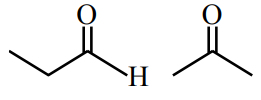 are Functional isomer
\(CH _3- CH = CH - CH _3 \& CH _3- CH _2- CH = CH _2\)
Are Positional isomer
\(CH _3- CH _2- O - CH _2- CH _3 \& CH _3- CH _2- CH _2- O - CH _3\)
are Metamer
\(CH _3- CH = CH - CH _3\) does not have optical isomer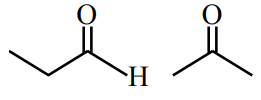 Chain isomer
-
- (A) A-III, B-I, C-IV, D-II
- (B) A-III, B-I, C-II, D-IV
- (C) A-I, B-IV, C-III, D-II
- (D) A-II, B-I, C-IV, D-III
Show answer and solution
Correct Answer: (A)
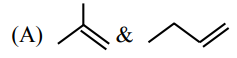
(III) Chain isomer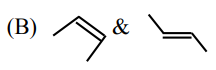
(I) Streoisomers
(IV) Functional isomers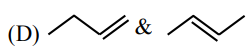
(II) Positional isomers -
- (A) \(3\)
- (B) \(4\)
- (C) \(5\)
- (D) \(6\)
Show answer and solution
Correct Answer: (B)
The structure of n-butane is \(CH_3-CH_2-CH_2-CH_3\).
Monochlorination of n-butane gives two structural isomers: 1-chlorobutane and 2-chlorobutane.
Among these, 2-chlorobutane (\(CH_3-CH_2-C^{*}HCl-CH_3\)) contains a chiral carbon atom and is optically active. Thus, the optically active compound "P" is 2-chlorobutane.
Further chlorination of 2-chlorobutane can take place at any of the four carbon atoms, yielding the following dichloro compounds (ignoring stereoisomers):
1. Chlorination at C-1: \(CH_3-CH_2-CHCl-CH_2Cl\) (1,2-dichlorobutane)
2. Chlorination at C-2: \(CH_3-CH_2-CCl_2-CH_3\) (2,2-dichlorobutane)
3. Chlorination at C-3: \(CH_3-CHCl-CHCl-CH_3\) (2,3-dichlorobutane)
4. Chlorination at C-4: \(CH_2Cl-CH_2-CHCl-CH_3\) (1,3-dichlorobutane)
Therefore, 4 structurally distinct dichloro compounds are obtained.
Answer: \(4\) -
- (A) enantiomers.
- (B) identical molecules.
- (C) diastereomers.
- (D) meso compounds.
Show answer and solution
Correct Answer: (B)
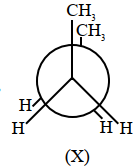
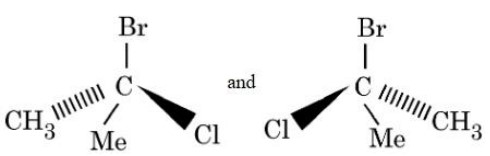
The given structures have a central carbon atom bonded to four groups: \(-\text{Br}\), \(-\text{Cl}\), \(-\text{CH}_3\), and \(-\text{Me}\).
Since \(-\text{CH}_3\) and \(-\text{Me}\) both represent the same alkyl group (methyl), the central carbon atom is bonded to two identical groups.
For a carbon atom to be a chiral center, it must be bonded to four different groups. Because this condition is not met, the central carbon is not a stereocenter and the molecule is achiral.
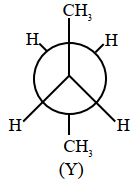
Both structures represent the same achiral compound (2-bromo-2-chloropropane) drawn in slightly different orientations. Therefore, they are identical molecules.
Answer: identical molecules.
No questions on this page match these filters.