


Questions
10 questionsShowing 1–10 of 10 questions
- 1. Amongst the following, the total number of compounds soluble in aqueous \(NaOH\) at room temperature is:
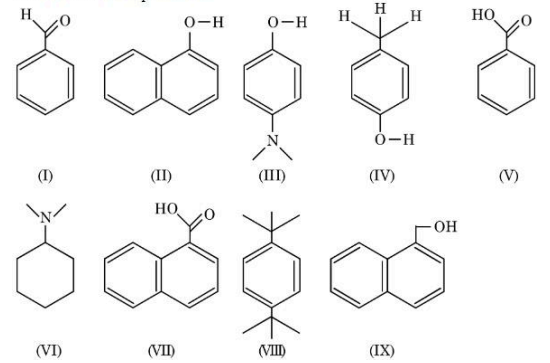 2026 Hard
- (A) \(5\)
- (B) \(4\)
- (C) \(6\)
- (D) \(3\)
Show answer and solution
Correct Answer: (A)
To determine which compounds are soluble in aqueous \(NaOH\), we need to identify the compounds that are sufficiently acidic to react with \(NaOH\) (a strong base) to form water-soluble sodium salts. Generally, carboxylic acids and phenols are acidic enough to dissolve in aqueous \(NaOH\), whereas alcohols, aldehydes, amines, and hydrocarbons are not.
Let us analyze each compound:
(I) Benzaldehyde: It is an aldehyde. It does not have an acidic proton and is insoluble in aqueous \(NaOH\).
(II) 1-Naphthol: It is a phenol derivative. Phenols are acidic and react with \(NaOH\) to form soluble phenoxide salts. (Soluble)
(III) 4-(Dimethylamino)phenol: It contains a phenolic \(-OH\) group. Despite the basic amino group, the acidic phenol group will react with \(NaOH\) to form a soluble salt. (Soluble)
(IV) p-Cresol: It is a phenol derivative. It reacts with \(NaOH\) to form a soluble sodium salt. (Soluble)
(V) Benzoic acid: It is a carboxylic acid, which is highly acidic and readily dissolves in aqueous \(NaOH\). (Soluble)
(VI) N,N-Dimethylcyclohexanamine: It is an aliphatic amine. It is basic in nature and insoluble in aqueous \(NaOH\).
(VII) 1-Naphthoic acid: It is a carboxylic acid and will dissolve in aqueous \(NaOH\). (Soluble)
(VIII) 1,4-Di-tert-butylbenzene: It is a hydrocarbon. It is neutral and insoluble in aqueous \(NaOH\).
(IX) 1-Naphthalenemethanol: It is an alcohol (benzyl-type). Alcohols are generally not acidic enough to react with aqueous \(NaOH\). (Insoluble)
The compounds soluble in aqueous \(NaOH\) are (II), (III), (IV), (V), and (VII).
Total number of soluble compounds = \(5\).
Answer: \(5\) -
- (A) 2-Chloropropanoic acid
- (B) 3-Chloropropanoic acid
- (C) 1-Chloropropane
- (D) 2-Chloropropane
Show answer and solution
Correct Answer: (A)
Step 1: Hydrolysis of the nitrile.
Propanenitrile on basic hydrolysis followed by acidic workup gives propanoic acid:
\(CH_3-CH_2-C \equiv N \xrightarrow[(ii)\ H_3O^+]{(i)\ OH^-/H_2O/\Delta} CH_3-CH_2-COOH\)
Step 2: Hell\(-\)Volhard\(-\)Zelinsky (HVZ) reaction.
Propanoic acid has an \(sp^3\) \(\alpha\)-carbon bearing two \(\alpha\)-hydrogens. In the HVZ reaction, \(Cl_2\) in the presence of red phosphorus selectively replaces one \(\alpha\)-hydrogen by chlorine, giving the \(\alpha\)-chloro acid after aqueous workup:
\(CH_3-CH_2-COOH \xrightarrow[(iv)\ H_2O]{(iii)\ Cl_2/\text{Red P}} CH_3-CH(Cl)-COOH\)
Hence, the major product \(P\) is \(2\)-chloropropanoic acid, which corresponds to option \((1)\). -
- (A) 78.21
- (B) 78.23
- (C) 78.25
- (D) 78.26
Show answer and solution
Correct Answer: (C)
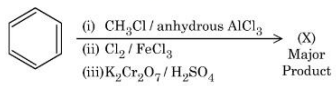
Step 1: The first reaction is a Friedel-Crafts alkylation. Benzene reacts with \(CH_3Cl\) in the presence of anhydrous \(AlCl_3\) to form toluene.
Step 2: The second reaction is electrophilic aromatic substitution. Toluene reacts with \(Cl_2\) in the presence of \(FeCl_3\) to form a mixture of o-chlorotoluene and p-chlorotoluene. Due to steric hindrance at the ortho position, the major product is p-chlorotoluene.
Step 3: The third reaction is the oxidation of the alkyl side chain. p-chlorotoluene is oxidized by \(K_2Cr_2O_7 / H_2SO_4\) to form p-chlorobenzoic acid, which is the major product \((X)\).
The molecular formula of p-chlorobenzoic acid is \(C_7H_5ClO_2\).
Molar mass of \((X) = (7 \times 12) + (5 \times 1) + 35.5 + (2 \times 16) = 84 + 5 + 35.5 + 32 = 156.5 \text{ g mol}^{-1}\).
Step 4: Reaction of p-chlorobenzoic acid with \(NaHCO_3\) liberates \(CO_2\) gas:
\(C_6H_4ClCOOH + NaHCO_3 \rightarrow C_6H_4ClCOONa + H_2O + CO_2 \uparrow\)
From the stoichiometry, \(1\) mole of p-chlorobenzoic acid produces \(1\) mole of \(CO_2\) gas.
Volume of \(CO_2\) liberated at STP = \(11.2 \text{ dm}^3\).
Moles of \(CO_2\) liberated = \(\dfrac{11.2}{22.4} = 0.5 \text{ mol}\).
Therefore, moles of p-chlorobenzoic acid reacted = \(0.5 \text{ mol}\).
Mass of \((X)\) reacted, \(P = 0.5 \text{ mol} \times 156.5 \text{ g mol}^{-1} = 78.25 \text{ g}\).
Answer: \(78.25\) - 4. Consider the following two reactions A and B.
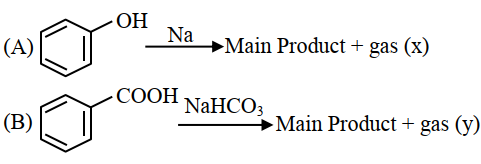
Numerical value of [molar mass of x + molar mass of y] is _____. 2026 Hard- (A) 4
- (B) 88
- (C) 46
- (D) 160
Show answer and solution
Correct Answer: (C)
\( x = H_{2} \) (gas), \( y = CO_{2} \) (gas)
Sum of molar mass = 2 + 44 = 46 -
- (A) A, C and E only
- (B) A and E only
- (C) C and E only
- (D) A, B, D and E only
Show answer and solution
Correct Answer: (A)
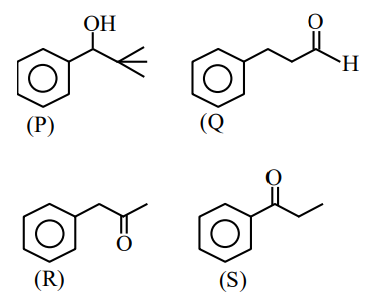
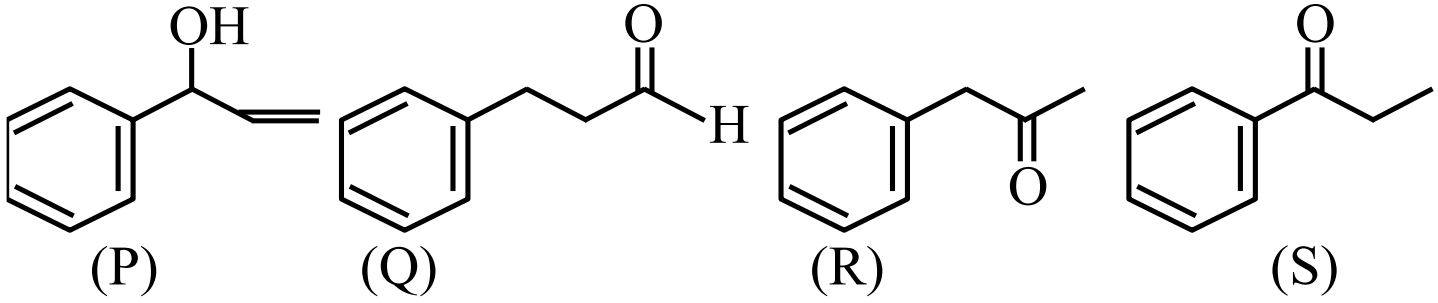
(A) Q, R, S all three give 2, 4 DNP test as they have Aldehyde/ketone group
(C) Q & R gives sooty flame
(E) Q gives Tollens reagent test -
- (A) Statement I is true but Statement II is false
- (B) Statement I is false but Statement II is true
- (C) Both Statement I and Statement II are true
- (D) Both Statement I and Statement II are false
Show answer and solution
Correct Answer: (C)
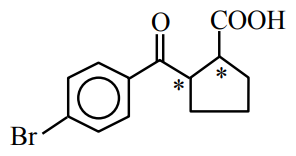
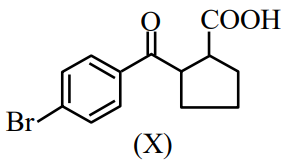
Two chiral centre and due to presence of - COOH compound dissolves in \(NaHCO _3\).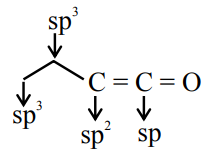
-
- (A) 6
- (B) 16
- (C) 4
- (D) 60
Show answer and solution
Correct Answer: (A)
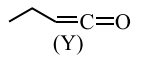
\(1.4 dm ^3\) (or 1.4 mL ) occupied by 1 gm
\(\therefore \) Molecular weight of \(Q =\frac{22.4}{1.4}=16\)
\(\therefore Q\) is \(CH _4\) gas and Grignard reagent is \(CH _3 MgBr\)
\(CH_3 MgBr \xrightarrow[\text { (ii) } H_3 O^{+}]{\text {(i) } CO_2 \text { (dryice) }} CH_3 COOH\)
(Molecular weight 60 )
\(\therefore \) Weight of 0.1 mole of \(CH _3 COOH =6\) -
- (A) Violet
- (B) Green
- (C) Red
- (D) Colourless
Show answer and solution
Correct Answer: (D)
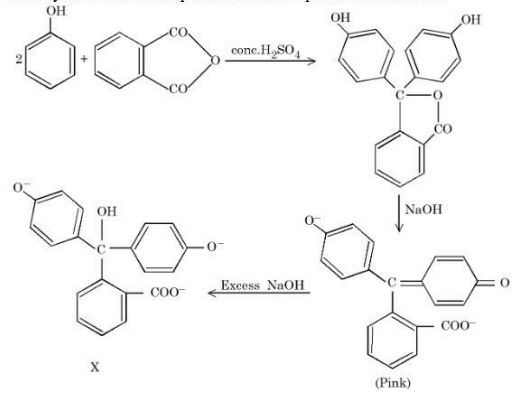
The given reaction sequence represents the synthesis and acid-base behaviour of phenolphthalein.
When phenol reacts with phthalic anhydride in the presence of concentrated \(H_2SO_4\), phenolphthalein is formed. In acidic or neutral medium, phenolphthalein exists in a lactone form which is colourless.
Upon addition of a moderate amount of alkali (NaOH), the lactone ring opens and a proton is removed, forming a dianion with an extended conjugated quinonoid structure. This extended conjugation is responsible for the characteristic pink colour of phenolphthalein in basic medium.
When excess NaOH is added (strongly alkaline medium), a hydroxide ion attacks the central \(sp^2\) hybridized carbon atom of the quinonoid structure. This converts the central carbon to an \(sp^3\) hybridized state, forming a carbinol structure (compound X).
Because the central carbon is now \(sp^3\) hybridized, the extended conjugation is broken. As a result, the compound loses its colour and becomes colourless.
Therefore, compound X is colourless.
Answer: Colourless -
- (A) \(B>D>E>A>C\)
- (B) \(D>B>E>A>C\)
- (C) \(C>A>B>D>E\)
- (D) \(D>E>B>A>C\)
Show answer and solution
Correct Answer: (D)
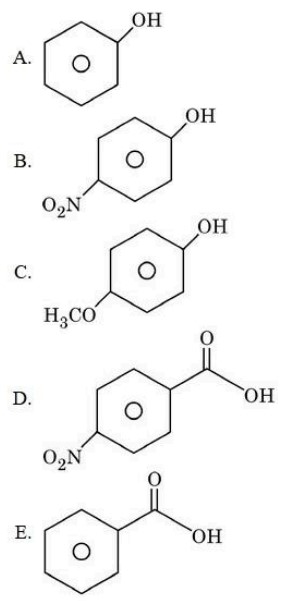
Carboxylic acids are stronger acids than phenols because the carboxylate anion is stabilized by equivalent resonance structures. Thus, D and E are more acidic than A, B, and C.
For the carboxylic acids, the \(-NO_2\) group in D is an electron-withdrawing group (\(-I, -R\)), which stabilizes the conjugate base, making D more acidic than E.
For the phenols, electron-withdrawing groups increase acidity while electron-donating groups decrease it. The \(-NO_2\) group in B is electron-withdrawing, making it more acidic than A. The \(-OCH_3\) group in C is electron-donating (\(+R > -I\)), making it less acidic than A. Thus, the order for phenols is B \(>\) A \(>\) C.
Combining these, the overall descending order of acidity is D \(>\) E \(>\) B \(>\) A \(>\) C.
Answer: \(D>E>B>A>C\) -
- (A) A, C & E only
- (B) A, B & C only
- (C) A & C only
- (D) B, D & E only
Show answer and solution
Correct Answer: (C)
(A) \( NaOCl + KI \rightarrow NaCl + KOI \)
(B) Incorrect statement
(C)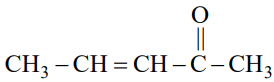 gives iodoform reaction.
(D) Incorrect statement
(E) Incorrect statement
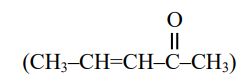 will give iodoform reaction.
No questions on this page match these filters.