


All JEE Mains 2026 Chemistry questions
26 chaptersShowing 401–432 of 432 questions
-
- (A) Among the isotopes of carbon, \({}^{13}C\) is a radioactive isotope.
- (B) Carbon exhibits negative oxidation states along with +4 and +2.
- (C) Carbon cannot exceed its covalency more than four.
- (D) \(CO_{2}\) is the most acidic oxide among the dioxides of group of 14 elements.
Show answer and solution
Correct Answer: (A)
\(C^{13}\) is not radioactive
\(C^{14}\) is radioactive -
- (A) Both Statement I and Statement II are true.
- (B) Both Statement I and Statement II are false.
- (C) Statement I is true but Statement II is false.
- (D) Statement I is false Statement II is true.
Show answer and solution
Correct Answer: (A)
\( SiO_{2}, CO_{2}, GeO, GeO_{2} \) are acidic in nature.
SnO, \( SnO_{2}, PbO, PbO_{2} \) are amphoteric in nature.
→ \( BF_{3} \) is lewis acid according to Lewis octet theory and has \( sp^{2} \) hybridization with trigonal planar geometry and it can accept lone pair from ammonia to form adduct. -
- (A) A and C only
- (B) A and D only
- (C) C and D only
- (D) B and D only
Show answer and solution
Correct Answer: (C)
(A) \(B ^{+3}< Al ^{+3}< Ga ^{+3}< In ^{+3}< Tl ^{+3}\) : ionic size
(B) \(B > Tl > In > Ga > Al : EN\)
(C) \(B > Tl > Ga > Al > In :\) IE
(D) Trichlorides and triiodides of group \(13^{\text {th }}\) elements are covalent in nature -
- (A) A and C Only
- (B) B and C Only
- (C) B and D Only
- (D) A and D Only
Show answer and solution
Correct Answer: (C)
The electronegativity of Ge on the Pauling scale is \(1.8\). In Group 13, the electronegativity values are B (\(2.0\)), Al (\(1.5\)), Ga (\(1.6\)), In (\(1.7\)), and Tl (\(1.8\)). Thus, the element 'E' is Thallium (Tl).
Due to the inert pair effect, the \(+1\) oxidation state is much more stable than the \(+3\) oxidation state for the heavier elements of Group 13, especially Thallium. Therefore, \(Tl^+\) is more stable than \(Tl^{3+}\). This makes statement C incorrect.
Since \(Tl^{3+}\) is relatively unstable, it readily accepts two electrons to form the more stable \(Tl^+\) ion (\(Tl^{3+} + 2e^- \rightarrow Tl^+\)). Because it undergoes reduction easily, \(Tl^{3+}\) acts as a strong oxidizing agent. This makes statement A incorrect and statement B correct.
The standard electrode potential for the reduction of \(Tl^{3+}\) to Tl (\(E^{\circ}_{Tl^{3+}/Tl}\)) is \(+1.26\text{ V}\), which is a positive value. This makes statement D correct.
Therefore, only statements B and D are correct. -
- (A) Both \(sp^{3}\)
- (B) \(sp^{2}\) and \(sp^{3}\)
- (C) \(sp^{3}\) and \(sp^{2}\)
- (D) Both \(sp^{2}\)
Show answer and solution
Correct Answer: (B)
\(XF_{3}=BF_{3}; \ sp^{2}\)
\(YF_{3}=NF_{3};\ sp^{3}\) -
- (A) \(80, 17\), liquid
- (B) \(81, 16\), solid
- (C) \(80, 16\), gas
- (D) \(81, 15\), gas
Show answer and solution
Correct Answer: (A)
Number of electrons in \(A^{-}\) is \(36\).
Number of electrons in neutral atom \(A = 36 - 1 = 35\).
Atomic number of \(A = 35\).
Number of protons in \(A = 35\).
Atomic mass of \(A = \text{Number of protons} + \text{Number of neutrons} = 35 + 45 = 80\).
The element with atomic number \(35\) is Bromine (\(\text{Br}\)).
Bromine belongs to Group \(17\) of the periodic table.
The physical state of Bromine at room temperature is liquid.
Answer: \(80, 17\), liquid -
- (A) \(C < D < B < A < E\)
- (B) \(B < A < E < C < D\)
- (C) \(E < C < D < B < A\)
- (D) \(E < B < A < D < C\)
Show answer and solution
Correct Answer: (D)
The energy of an atomic orbital in a multi-electron atom is determined by the \((n + l)\) rule. Orbitals with a lower value of \((n + l)\) have lower energy. If two orbitals have the same \((n + l)\) value, the one with the lower \(n\) value has lower energy.
Calculating the \((n + l)\) value for each given orbital:
A. \(n = 3, l = 2 \Rightarrow n + l = 5\)
B. \(n = 4, l = 0 \Rightarrow n + l = 4\)
C. \(n = 6, l = 1 \Rightarrow n + l = 7\)
D. \(n = 5, l = 1 \Rightarrow n + l = 6\)
E. \(n = 2, l = 1 \Rightarrow n + l = 3\)
Arranging the orbitals in increasing order of their \((n + l)\) values, we get:
\(3 < 4 < 5 < 6 < 7\)
This corresponds to the order:
\(E < B < A < D < C\)
Answer: \(E < B < A < D < C\) -
- (A) D < C < A < B
- (B) A < B < C < D
- (C) C < D < B < A
- (D) D < A < C < B
Show answer and solution
Correct Answer: (D)
Series \(n _1\) \(n _2\) (A) Paschen ( \(1^{\text {st }}\) line) 3 4 (B) Balmer ( \(2^{\text {nd }}\) line) 2 4 (C) Paschen ( \(3^{\text {rd }}\) line) 3 6 (D) Bracket \(\left(4^{\text {th }}\right.\) line) 4 8
So correct ascending order of energy of above lines is :
D < A < C < B -
- (A) 2
- (B) 3
- (C) 4
- (D) 5
Show answer and solution
Correct Answer: (B)
The energy of a photon is given by the relation:
\(E = \dfrac{hc}{\lambda}\)
For the two radiations, the energies are \(E_1 = \dfrac{hc}{\lambda_1}\) and \(E_2 = \dfrac{hc}{\lambda_2}\).
The ratio of their energies is:
\(\dfrac{E_1}{E_2} = \dfrac{\lambda_2}{\lambda_1}\)
Substituting the given values \(\lambda_1 = 2000\) and \(\lambda_2 = 6000\):
\(\dfrac{E_1}{E_2} = \dfrac{6000}{2000} = 3\)
Answer: \(3\) -
- (A) B
- (B) D
- (C) C
- (D) A
Show answer and solution
Correct Answer: (A)
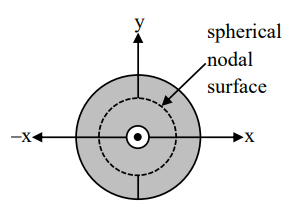
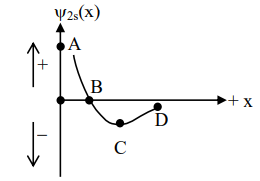
At spherical node
\(\psi_r=0\) -
- (A) 26 and 1
- (B) 4 and 1
- (C) 2 and 4
- (D) 8 and 1
Show answer and solution
Correct Answer: (D)
Explanation:
Let us determine the maximum number of electrons for each set of quantum numbers step-by-step based on the rules governing quantum numbers from the Structure of Atom chapter in the NCERT Class 11 Chemistry textbook:
1. Analyzing Set (A): \(n = 5, m_l = -1\)
For a principal quantum number \(n = 5\), the possible values of the azimuthal quantum number (\(l\)) range from \(0\) to \((n-1)\), i.e., \(l = 0, 1, 2, 3, 4\).
Now let's find which subshells can host a magnetic quantum number value of \(m_l = -1\):
- For \(l = 0\) (\(s\)-subshell): \(m_l = 0\) (No \(m_l = -1\) orbital exists)
- For \(l = 1\) (\(p\)-subshell): \(m_l = -1, 0, +1\) → Contains 1 orbital with \(m_l = -1\)
- For \(l = 2\) (\(d\)-subshell): \(m_l = -2, -1, 0, +1, +2\) → Contains 1 orbital with \(m_l = -1\)
- For \(l = 3\) (\(f\)-subshell): \(m_l = -3, -2, -1, 0, +1, +2, +3\) → Contains 1 orbital with \(m_l = -1\)
- For \(l = 4\) (\(g\)-subshell): \(m_l = -4, -3, -2, -1, 0, +1, +2, +3, +4\) → Contains 1 orbital with \(m_l = -1\)
Thus, there are a total of \(1 + 1 + 1 + 1 = 4\) distinct orbitals in the \(n = 5\) shell that have \(m_l = -1\).
According to Pauli's Exclusion Principle, each orbital can hold a maximum of 2 electrons with opposite spins.
\(\text{Maximum electrons} = 4 \text{ orbitals} \times 2 \text{ electrons/orbital} = 8 \text{ electrons}\).
2. Analyzing Set (B): \(n = 3, l = 2, m_l = -1, m_s = +\frac{1}{2}\)
Here, all four quantum numbers are explicitly specified:
- \(n = 3, l = 2\) defines a unique subshell (\(3d\)).
- \(m_l = -1\) uniquely defines one specific orbital inside that subshell.
- \(m_s = +\frac{1}{2}\) defines a single, specific clockwise electron spin state inside that orbital.
According to Pauli's exclusion principle, no two electrons in an atom can have the exact same set of all 4 quantum numbers. Therefore, this fully specified combination can correspond to exactly 1 electron.
Combining the findings gives 8 and 1.
Hence, Option D is the correct choice. -
- (A) Both Statement I and Statement II are true
- (B) Both Statement I and Statement II are false
- (C) Statement I is false but Statement II is true
- (D) Statement I is true but Statement II is false
Show answer and solution
Correct Answer: (A)
\( \frac{1}{\lambda}=RZ^{2}(\frac{1}{n_{1}^{2}}-\frac{1}{n_{2}^{2}}) \)
For 1st line of Lyman series in H-atom:
\( \frac{1}{\lambda}=R(1)^{2}(\frac{1}{1^{2}}-\frac{1}{2^{2}}) = \frac{3R}{4} \)
For 2nd line of Balmer series of \(He ^{+}\)
\( \frac{1}{\lambda'}=R(2)^{2}(\frac{1}{2^{2}}-\frac{1}{4^{2}}) = \frac{3R}{4} \)
As \(\lambda\) and \(\lambda'\) is equal so frequency of these lines will be also equal. -
- (A) A, B and C Only
- (B) A, B and D Only
- (C) B, C and D Only
- (D) A, C and D Only
Show answer and solution
Correct Answer: (B)
Statement A is correct. Heisenberg's uncertainty principle is applicable to microscopic particles such as electrons.
Statement B is correct. The size of an orbital increases with an increase in the principal quantum number \(n\). Thus, the size of the \(3p_x\) orbital is greater than that of the \(2p_x\) orbital.
Statement C is incorrect. The energy of an orbital depends on the effective nuclear charge. Since the nuclear charge of Li (\(Z=3\)) is greater than that of H (\(Z=1\)), the energy of the \(2s\) orbital of Li is lower than that of the \(2s\) orbital of H.
Statement D is correct. Chromium (\(Z=24\)) has an anomalous electronic configuration of \([\text{Ar}] 3d^5 4s^1\) due to the extra stability of the half-filled \(d\)-subshell.
Therefore, statements A, B, and D are correct.
Answer: A, B and D Only -
- (A) A and D only
- (B) A and C only
- (C) A and B only
- (D) B and C only
Show answer and solution
Correct Answer: (B)
(A) \( {}_{12}Mg^{24} \) represents 12 protons and 12 neutrons.
(B) \( \lambda = \frac{C}{\nu} = \frac{3 \times 10^{8}}{4.5 \times 10^{15}} = 6.67 \times 10^{-8} m \).
(C) \(\begin{array}{l}\frac{ E _1}{ E _2}=\frac{ hC / \lambda_1}{ hC / \lambda_2}=\frac{\lambda_2}{\lambda_1} \\ \frac{ E _1}{ E _2}=\frac{300}{900}=\frac{1}{3} \text { (false) }\end{array}\)
(D) No. of photons \( = \frac{\text{Energy}}{hC/\lambda} = 10^{16} \). (True) - 415. If shortest wavelength of hydrogen atom in Lyman series is \(x\), then longest wavelength in Balmer series of \(\text{He}^+\) is: 2026 Medium
- (A) \(\dfrac{9x}{5}\)
- (B) \(\dfrac{36x}{5}\)
- (C) \(\dfrac{x}{4}\)
- (D) \(\dfrac{5x}{9}\)
Show answer and solution
Correct Answer: (A)
For the shortest wavelength in the Lyman series of the hydrogen atom (\(Z=1\)), the transition is from \(n_2 = \infty\) to \(n_1 = 1\).
\(\dfrac{1}{x} = R(1)^2 \left(\dfrac{1}{1^2} - \dfrac{1}{\infty^2}\right) = R\)
This gives \(R = \dfrac{1}{x}\).
For the longest wavelength in the Balmer series of \(\text{He}^+\) (\(Z=2\)), the transition is from \(n_2 = 3\) to \(n_1 = 2\).
\(\dfrac{1}{\lambda} = R(2)^2 \left(\dfrac{1}{2^2} - \dfrac{1}{3^2}\right)\)
\(\dfrac{1}{\lambda} = 4R \left(\dfrac{1}{4} - \dfrac{1}{9}\right)\)
\(\dfrac{1}{\lambda} = 4R \left(\dfrac{5}{36}\right) = \dfrac{5R}{9}\)
Substituting \(R = \dfrac{1}{x}\):
\(\dfrac{1}{\lambda} = \dfrac{5}{9x}\)
\(\lambda = \dfrac{9x}{5}\)
Answer: \(\dfrac{9x}{5}\) -
- (A) A-IV, B-I, C-III, D-II
- (B) A-IV, B-II, C-III, D-I
- (C) A-III, B-I, C-IV, D-II
- (D) A-IV, B-III, C-II, D-I
Show answer and solution
Correct Answer: (D)
The number of radial nodes is given by the formula \(n - l - 1\).
The number of nodal planes (angular nodes) is given by \(l\).
For \(2s\) orbital: \(n = 2\), \(l = 0\).
Radial nodes = \(2 - 0 - 1 = 1\).
Nodal planes = \(0\).
This matches A with IV.
For \(3s\) orbital: \(n = 3\), \(l = 0\).
Radial nodes = \(3 - 0 - 1 = 2\).
Nodal planes = \(0\).
This matches B with III.
For \(3p\) orbital: \(n = 3\), \(l = 1\).
Radial nodes = \(3 - 1 - 1 = 1\).
Nodal planes = \(1\).
This matches C with II.
For \(4d\) orbital: \(n = 4\), \(l = 2\).
Radial nodes = \(4 - 2 - 1 = 1\).
Nodal planes = \(2\).
This matches D with I.
The correct matching is A-IV, B-III, C-II, D-I.
Answer: A-IV, B-III, C-II, D-I -
- (A) \(\text{Li}^{2+}, 3\)
- (B) \(\text{He}^+, 3\)
- (C) \(\text{He}^+, 2\)
- (D) \(\text{Li}^{2+}, 2\)
Show answer and solution
Correct Answer: (D)
The radius of the \(n\)-th Bohr orbit for a hydrogen-like species is given by the formula:
\(r_n = a_0 \dfrac{n^2}{Z}\)
where \(a_0\) is the Bohr radius of the hydrogen atom (\(52.9\) pm), \(n\) is the principal quantum number, and \(Z\) is the atomic number.
Given \(r_n = 70.53\) pm, we can write:
\(70.53 = 52.9 \times \dfrac{n^2}{Z}\)
\(\dfrac{n^2}{Z} = \dfrac{70.53}{52.9} = 1.333 = \dfrac{4}{3}\)
Checking the given options:
For \(\text{Li}^{2+}\) and \(n = 3\), \(Z = 3 \Rightarrow \dfrac{n^2}{Z} = \dfrac{9}{3} = 3\)
For \(\text{He}^+\) and \(n = 3\), \(Z = 2 \Rightarrow \dfrac{n^2}{Z} = \dfrac{9}{2} = 4.5\)
For \(\text{He}^+\) and \(n = 2\), \(Z = 2 \Rightarrow \dfrac{n^2}{Z} = \dfrac{4}{2} = 2\)
For \(\text{Li}^{2+}\) and \(n = 2\), \(Z = 3 \Rightarrow \dfrac{n^2}{Z} = \dfrac{4}{3}\)
The ratio matches for \(\text{Li}^{2+}\) and \(n = 2\).
Answer: \(\text{Li}^{2+}, 2\) - 418. The energy of first (lowest) Balmer line of H atom is x J. The energy (in J) of second Balmer line of H atom is: 2026 Medium
- (A) \(x^{2}\)
- (B) \(\frac{x}{1.35}\)
- (C) 2x
- (D) 1.35x
Show answer and solution
Correct Answer: (D)
Transition of first Balmer line
\(n_1=2 ; n_2=3\)
\(\Delta E=x=13.6(1)^2\left[\frac{1}{2^2}-\frac{1}{3^2}\right] \quad\ldots(i)\)
Transition of \(2^{\text {nd }}\) Balmer line
\(n_1=2 ; n_2=4\)
\(\Delta E=13.6(1)^2\left[\frac{1}{2^2}-\frac{1}{4^2}\right]\quad\ldots(ii)\)
Divide Eq. (ii) by eq. (i)
\(\frac{\Delta E }{ x }=\frac{\frac{1}{4}-\frac{1}{16}}{\frac{1}{4}-\frac{1}{9}}\)
\(\frac{\Delta E }{ x }=\frac{\frac{3}{16}}{\frac{5}{36}}\)
\(\frac{\Delta E }{ x }=\frac{27}{20}\)
\(\Delta E =1.35 x\). -
- (A) \(1.635\times10^{-18}\)
- (B) \(9.835\times10^{5}\)
- (C) \(9.835\times10^{12}\)
- (D) \(1.635\times10^{-11}\)
Show answer and solution
Correct Answer: (B)
\(E_{n}=-R_{H}\times\frac{Z^{2}}{n^{2}}\)
\(\Delta E=2.18\times10^{-11}\times10^{-7}\times1^{2}[\frac{1}{1^{2}}-\frac{1}{2^{2}}]\)
\(=1.635\times10^{-18} Joule/atom\)
\(=1.635\times10^{-18}\times6.02\times10^{23} Joule/mole\)
\(=9.835\times10^{5} Joule/mole\) -
- (A) 27
- (B) 54
- (C) 108
- (D) 36
Show answer and solution
Correct Answer: (B)
\( \Delta E(L_1) = 13.6 \times Z^2 (\frac{1}{1^2} - \frac{1}{2^2}) = 13.6Z^2 \times \frac{3}{4} \)
\( \Delta E(B_1) = 13.6 \times Z^2 (\frac{1}{2^2} - \frac{1}{3^2}) = 13.6Z^2 \times {\frac{5}{4 \times 9}} \)
\(\frac{\Delta E \left( L _1\right)}{\Delta E \left( B _1\right)}=\frac{3}{5} \times 9=\frac{27}{5}= x\)
\(x=\left(\frac{27}{5} \times 10\right) \times 10^{-1}=54 \times 10^{-1}\) -
- (A) A and C Only
- (B) A and E Only
- (C) B and E Only
- (D) C and D Only
Show answer and solution
Correct Answer: (B)
According to Bohr's theory, the radius of the \(n\)-th orbit of a hydrogen-like species is given by \(r_n = 0.529 \times \dfrac{n^2}{Z} \text{ \AA}\).
For \(H\) (first orbit), \(n = 1\), \(Z = 1 \Rightarrow r = 0.529 \times \dfrac{1^2}{1} = 0.529 \text{ \AA}\).
For \(He^+\) (first orbit), \(n = 1\), \(Z = 2 \Rightarrow r = 0.529 \times \dfrac{1^2}{2} = 0.2645 \text{ \AA}\).
For \(He^+\) (second orbit), \(n = 2\), \(Z = 2 \Rightarrow r = 0.529 \times \dfrac{2^2}{2} = 1.058 \text{ \AA}\).
For \(Li^{2+}\) (first orbit), \(n = 1\), \(Z = 3 \Rightarrow r = 0.529 \times \dfrac{1^2}{3} = 0.176 \text{ \AA}\).
For \(Be^{3+}\) (second orbit), \(n = 2\), \(Z = 4 \Rightarrow r = 0.529 \times \dfrac{2^2}{4} = 0.529 \text{ \AA}\).
The radii of \(H\) (first orbit) and \(Be^{3+}\) (second orbit) are identical. Therefore, species A and E have identical radii.
Answer: A and E Only -
- (A) 5
- (B) 10
- (C) 15
- (D) 20
Show answer and solution
Correct Answer: (A)
The work function of sodium in Joules is:
\(\Phi = 2.3 \times 1.6 \times 10^{-19} = 3.68 \times 10^{-19}\) J
The kinetic energy of the ejected electrons is:
\(K = 2.8 \times 10^{-20} = 0.28 \times 10^{-19}\) J
Using the photoelectric equation, the energy of the incident photon is:
\(E = \Phi + K\)
\(E = 3.68 \times 10^{-19} + 0.28 \times 10^{-19} = 3.96 \times 10^{-19}\) J
The wavelength of the incident radiation is calculated using \(E = \dfrac{hc}{\lambda}\):
\(\lambda = \dfrac{hc}{E} = \dfrac{6.6 \times 10^{-34} \times 3.0 \times 10^8}{3.96 \times 10^{-19}}\)
\(\lambda = \dfrac{19.8 \times 10^{-26}}{3.96 \times 10^{-19}} = 5 \times 10^{-7}\) m
Converting the wavelength to nanometers:
\(\lambda = 500 \times 10^{-9}\) m \(= 500\) nm
Given that the wavelength is \(x\) nm, we get \(x = 500\).
Expressing \(x\) in the required format:
\(x = 5 \times 10^2\)
The value to be filled in the blank is \(5\).
Answer: \(5\) - 423. The wave numbers of three spectral lines of H atom are considered. Identify the set of spectral lines belonging to Balmer series. (R = Rydberg constant) 2026 Medium
- (A) \( \frac{5R}{36}, \frac{3R}{16}, \frac{21R}{100} \)
- (B) \( \frac{5R}{36}, \frac{8R}{9}, \frac{15R}{16} \)
- (C) \( \frac{7R}{144}, \frac{3R}{16}, \frac{16R}{255} \)
- (D) \( \frac{3R}{4}, \frac{3R}{16}, \frac{7R}{144} \)
Show answer and solution
Correct Answer: (A)
Balmer series line \(\Rightarrow \bar{v}= R _{ H } z ^2\left[\frac{1}{2^2}-\frac{1}{ n ^2}\right]\)
if \(n=3 \Rightarrow \bar{v}=R(1)^2\left[\frac{1}{2^2}-\frac{1}{3^2}\right]=\frac{5 R}{36}\)
if \(n=4 \Rightarrow \bar{v}=\frac{3 R}{16}\)
if \(n=5 \Rightarrow \bar{v}=\frac{21 R}{100}\) -
- (A) \(C > B > A\)
- (B) \(B > A > C\)
- (C) \(A > B > C\)
- (D) \(A > C > B\)
Show answer and solution
Correct Answer: (B)
(1) Wavelength of \(A = 400 nm.\)
(2) Wavelength of B \((\lambda) = \frac{C}{\nu} = \frac{3 \times 10^{8}}{10^{16}}\)
\(=3 \times 10^{-8}=30 \times 10^{-9}=30 nm\).
(3) Wavelength of C \((\lambda) = \frac{1}{\bar{\nu}} = \frac{1}{10^{4}} = 10^{-4} cm\)
\(=10^{-6} m=1000 nm\)
Here \(\lambda_{C} > \lambda_{A} > \lambda_{B}\)
\(Energy (E) \propto \frac{1}{\lambda}\)
So \(E_{B} > E_{A} > E_{C}\) -
- (A) \(2.28 \times 10^{-7} cm\)
- (B) \(2.28 \times 10^{-6} cm\)
- (C) \(1.14 \times 10^{-7} cm\)
- (D) \(1.14 \times 10^{-6} cm\)
Show answer and solution
Correct Answer: (D)
\(n _1 \rightarrow\) lower energy level
\(n _2 \rightarrow\) higher energy level
\(n _1+ n _2=4, \quad n _2=3\)
\(n _2- n _1=2, n _1=1\)
Rydberg's formula :
\(\frac{1}{\lambda}= R _{ H } Z ^2\left[\frac{1}{ n _1^2}-\frac{1}{ n _2^2}\right]\)
\(\frac{1}{\lambda}= R _{ H }(3)^2\left[\frac{1}{1^2}-\frac{1}{3^2}\right]\)
\(\frac{1}{\lambda}=8 R _{ H }\)
\(\lambda=\frac{1}{8 R _{ H }}\)
\(\lambda=\frac{1}{8 \times 1.1 \times 10^5}\)
\(\lambda=\frac{1000}{8.8} \times 10^{-8} cm\)
\(\lambda=113.63 \times 10^{-8} cm\)
\(\lambda \simeq 1.14 \times 10^{-6} cm\) -
- (A) 3.1, 6.2
- (B) 2.3, 4.6
- (C) 1.4, 2.8
- (D) 1.5, 3.0
Show answer and solution
Correct Answer: (B)
\( KE_{max} = E - \phi \)
\( (KE_{max})_{1} = 6 - \phi_{1} \)\(\quad\) ... (1)
\( (KE_{max})_{2} = 6 - \phi_{2} \) \(\quad\)... (2)
By eq. (1) divide eq. (2)
\(\frac{\left( KE _{\max }\right)_1}{\left( KE _{\max }\right)_2}=\frac{2.642}{1}=\frac{6-\phi_1}{6-\phi_2}\)
\(\frac{2.642}{1}=\frac{6-\phi_1}{6-2 \phi_1}\)
\( \phi_{1} = 2.3 \text{ eV} \)
\( \phi_{2} = 4.6 \text{ eV} \). -
- (A) 1
- (B) 2
- (C) 4
- (D) 0.5
Show answer and solution
Correct Answer: (B)
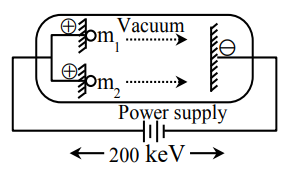
\(\lambda_{ d }=\frac{ h }{\sqrt{2 mK.E.}}\)
Here KE is same i.e. 200 k eV
So \(\lambda_{ d } \propto \frac{1}{\sqrt{m}}\)
\(\frac{\left(\lambda_{ d }\right)_{ m _1}}{\left(\lambda_{ d }\right)_{ m _2}}=\sqrt{\frac{ m _2}{m_1}}=\sqrt{4}=2\)
\(\left(\lambda_{ d }\right)_{ m _1}=2\left(\lambda_{ d }\right)_{ m _2}\)
So \(x =2\). -
- (A) \(8.72 \times 10^{-18}\)
- (B) \(1.962 \times 10^{-18}\)
- (C) \(1.962 \times 10^{-17}\)
- (D) \(6.54 \times 10^{-17}\)
Show answer and solution
Correct Answer: (C)
The given process \(Li^{2+}(g) \rightarrow Li^{3+}(g) + e^-\) represents the ionization of the hydrogen-like ion \(Li^{2+}\) from its ground state.
The ionization energy for a hydrogen-like species is given by the formula:
\(IE = IE_{H} \times Z^2\)
For \(Li^{2+}\), the atomic number \(Z = 3\).
Given the ionization energy of the hydrogen atom \(IE_{H} = 2.18 \times 10^{-18}\) J atom\(^{-1}\).
Substituting the values:
\(IE = 2.18 \times 10^{-18} \times (3)^2\)
\(IE = 2.18 \times 10^{-18} \times 9\)
\(IE = 19.62 \times 10^{-18}\) J atom\(^{-1}\)
\(IE = 1.962 \times 10^{-17}\) J atom\(^{-1}\)
Answer: \(1.962 \times 10^{-17}\) - 429. What is the ratio of wave number of first line (lowest energy line) of Balmer series of H atomic spectrum to first line of its Brackett series? 2026 Medium
- (A) \(5:1\)
- (B) \(5:0.81\)
- (C) \(5:1.75\)
- (D) \(5:27\)
Show answer and solution
Correct Answer: (B)
The wave number \(\bar{\nu}\) of a spectral line in the hydrogen emission spectrum is given by the Rydberg formula:
\(\bar{\nu} = R_H \left( \dfrac{1}{n_1^2} - \dfrac{1}{n_2^2} \right)\)
For the first line (lowest energy) of the Balmer series, the transition is from \(n_2 = 3\) to \(n_1 = 2\):
\(\bar{\nu}_{Balmer} = R_H \left( \dfrac{1}{2^2} - \dfrac{1}{3^2} \right) = R_H \left( \dfrac{1}{4} - \dfrac{1}{9} \right) = \dfrac{5R_H}{36}\)
For the first line of the Brackett series, the transition is from \(n_2 = 5\) to \(n_1 = 4\):
\(\bar{\nu}_{Brackett} = R_H \left( \dfrac{1}{4^2} - \dfrac{1}{5^2} \right) = R_H \left( \dfrac{1}{16} - \dfrac{1}{25} \right) = \dfrac{9R_H}{400}\)
Taking the ratio of the two wave numbers:
\(\dfrac{\bar{\nu}_{Balmer}}{\bar{\nu}_{Brackett}} = \dfrac{\dfrac{5R_H}{36}}{\dfrac{9R_H}{400}} = \dfrac{5}{36} \times \dfrac{400}{9} = \dfrac{500}{81}\)
To express this ratio in the form \(5 : x\), we divide the numerator and the denominator by \(100\):
\(\dfrac{500}{81} = \dfrac{5}{0.81}\)
The ratio is \(5 : 0.81\).
Answer: \(5:0.81\) -
- (A) \(n = 3, l = 2, m = +2, s = +\dfrac{1}{2}\)
- (B) \(n = 3, l = 2, m = -2, s = +\dfrac{1}{2}\)
- (C) \(n = 4, l = 1, m = 0, s = +\dfrac{1}{2}\)
- (D) \(n = 4, l = 0, m = 0, s = +\dfrac{1}{2}\)
Show answer and solution
Correct Answer: (D)
The atomic number of Chromium is \(24\).
According to the Aufbau principle, the order of filling of electrons is \(1s, 2s, 2p, 3s, 3p, 4s, 3d\).
The electronic configuration of the first \(18\) electrons is \(1s^2 2s^2 2p^6 3s^2 3p^6\).
The \(19^{th}\) electron enters the \(4s\) orbital.
For the \(4s\) orbital, the quantum numbers are:
Principal quantum number, \(n = 4\)
Azimuthal quantum number, \(l = 0\)
Magnetic quantum number, \(m = 0\)
Spin quantum number, \(s = +\dfrac{1}{2}\) or \(-\dfrac{1}{2}\)
This matches the set given in the fourth option.
Answer: \(n = 4, l = 0, m = 0, s = +\dfrac{1}{2}\) -
- (A) A, B and C only
- (B) A and C only
- (C) C and D only
- (D) A only
Show answer and solution
Correct Answer: (B)
Statement A: According to the \((n+l)\) rule, if two orbitals have the same \((n+l)\) value, the orbital with the lower value of \(n\) has lower energy. This statement is true.
Statement B: As the atomic number increases, the effective nuclear charge (\(Z_{eff}\)) increases. The energy of an orbital is proportional to \(-\dfrac{Z_{eff}^2}{n^2}\). Thus, the energy becomes more negative, meaning the energy of the orbitals in the same subshell decreases with an increase in atomic number. This statement is false.
Statement C: The size of an orbital increases with an increase in the principal quantum number \(n\). Therefore, the size of the \(2p_x\) orbital is less than the size of the \(3p_x\) orbital. This statement is true.
Statement D: The number of radial nodes is given by the formula \(n - l - 1\).
For \(5f\): \(5 - 3 - 1 = 1\)
For \(6s\): \(6 - 0 - 1 = 5\)
For \(4d\): \(4 - 2 - 1 = 1\)
For \(5p\): \(5 - 1 - 1 = 3\)
For \(5d\): \(5 - 2 - 1 = 2\)
Since the \(5d\) orbital has exactly \(2\) radial nodes, the statement that none of the orbitals have \(2\) radial nodes is false.
Therefore, only statements A and C are true.
Answer: A and C only - 432. Which of the following statements regarding the energy of the stationary state is true in the following one-electron system ? 2026 Easy
- (A) \(-1.09\times10^{-18}J\) for second orbit of H atom.
- (B) \(+2.18 \times 10^{-18} J\) for second orbit of \(He ^{+}\)ion
- (C) \(+8.72 \times 10^{-18} J\) for first orbit of \(He ^{+}\)ion
- (D) \(-2.18 \times 10^{-18} J\) for third orbit of \(Li ^{2+}\) ion
Show answer and solution
Correct Answer: (D)
\(E_{n}=-2.18\times10^{-18}\frac{Z^{2}}{n^{2}}J/atom.\)
For \(3^{rd}\) orbit of \(Li^{-2}\) ion
\(=-2.18\times10^{-18}\times\frac{3^{2}}{3^{2}}=-2.18\times10^{-18}J.\)
No questions on this page match these filters.