


JEE Mains · Chemistry · STD 12 - 4. d and f- block elements
Consider the transition metal ions \(Mn^{3+}\) \(Cr^{3+}\) \(Fe^{3+}\) and \(Co^{3+}\) and all form low spin octahedral complexes. The correct decreasing order of unpaired electrons in their respective d-orbitals of the complexes is
- A \(Cr^{3+}>Fe^{3+}>Co^{3+}>Mn^{3+}\)
- B \(Mn^{3+}>Fe^{3+}>Co^{3+}>Cr^{3+}\)
- C \(Fe^{3+}>Co^{3+}>Mn^{3+}>Cr^{3+}\)
- D \(Cr^{3+}>Mn^{3+}>Fe^{3+}>Co^{3+}\)
Answer & Solution
Correct Answer
(D) \(Cr^{3+}>Mn^{3+}>Fe^{3+}>Co^{3+}\)
Step-by-step Solution
Detailed explanation
\(Co^{3+}\rightarrow3d^{6}\Rightarrow t_{2g}^{2,2,2}e_{g}^{0,0}\), unpaired electron \(=0\) \(Fe^{3+}\rightarrow3d^{5}\Rightarrow t_{2g}^{2,2,1}e_{g}^{0,0}\) unpaired electron \(=1\) \(Cr^{3+}\rightarrow3d^{3}\Rightarrow t_{2g}^{1,1,1}e_{g}^{0,0}\) unpaired electron \(=3\)…
See the Complete Solution
Get step-by-step explanations for this and 2.5 Lakh+ more JEE, NEET & CET questions.
- Unlock all solutions
- Practice the full chapter
- Track accuracy across PYQs
4.8 rated on Google Play · 14,000+ reviews
More questions from Chemistry
- A flask contains a mixture of compounds \(A\) and \(B.\) Both compounds decompose by first-order kinetics. The half-lives for \(A\) and \(B\) are \(300\) \(s\) and \(180\, s ,\) respectively. If the concentrations of \(A\) and \(B\) are equal initially, the time required for the concentration of \(A\) to be four times that of \(B (\) in \(s ):\) (Use \(\ln 2=0.693)\)JEE Mains 2020 Medium
- Assuming ideal behaviour, the magnitude of \(log \, K\) for the following reaction at \(25^{\circ} C\) is \(x \times 10^{-1} .\) The value of \(x\) is \(...... .\) (Integer answer) \(3 HC \equiv CH _{( g )} \rightleftharpoons C _{6} H _{6(\ell)}\) [Given: \(\Delta_{f} G ^{\circ}( HC \equiv CH )=-2.04 \times 10^{5}\, J mol ^{-1}\) \(\Delta_{f} G ^{\circ}\left( C _{6} H _{6}\right)=-1.24 \times 10^{5}\, J mol ^{-1} ; R =8.314\,\left. J K ^{-1} mol ^{-1}\right]\)JEE Mains 2021 Hard
- For the reaction at \(298 \mathrm{~K}, 2 \mathrm{~A}+\mathrm{B} \rightarrow \mathrm{C} . \Delta \mathrm{H}\) \(=400 \mathrm{~kJ} \mathrm{~mol}^{-1}\) and \(\Delta \mathrm{S}=0.2 \mathrm{~kJ} \mathrm{~mol}^{-1} \mathrm{~K}^{-1}\). The reaction will become spontaneous above _______ \(\mathrm{K}\).JEE Mains 2024 Medium
- The coordination numbers of \(Co\) and \(Al\) in \([Co(Cl)(en)_2]Cl\) and \(K_3[Al(C_2O_4)_3]\), respectively, are (en \(=\) ethane \(-1,2-\) diamine)JEE Mains 2019 Hard
- Consider the following reactions is correct
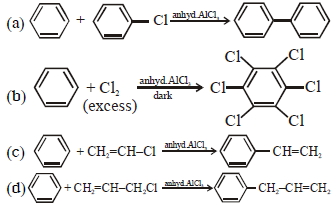 JEE Mains 2020 Hard
 - The value of \(K _{ C }\) is \(64\) at \(800\, K\) for the reaction \(N _{2}( g )+3 H _{2}( g ) \rightleftharpoons 2 NH _{3}( g )\) The value of \(K _{ C }\) for the following reaction is : \(NH_{3}(g) \rightleftharpoons \frac{1}{2} N _{2}(g)+\frac{3}{2} H_{2}(g)\)JEE Mains 2020 Medium
More PYQs from JEE Mains
- The results given in the below table were obtained during kinetic studies of the following reaction: \(2 A + B \longrightarrow C + D\)
\(X\) and \(Y\) in the given table are respectively :Experiment \([ A ] / molL ^{-1}\) \([ B ] / molL ^{-1}\) Initial \(rate/molL\) \(^{-1}\) \(\min ^{-1}\) \(I\) \(0.1\) \(0.1\) \(6.00 \times 10^{-3}\) \(II\) \(0.1\) \(0.2\) \(2.40 \times 10^{-2}\) \(III\) \(0.2\) \(0.1\) \(1.20 \times 10^{-2}\) \(IV\) \(X\) \(0.2\) \(7.20 \times 10^{-2}\) \(V\) \(0.3\) \(Y\) \(2.88 \times 10^{-1}\) JEE Mains 2020 Hard - The number of ways in which an examiner can assign \(30\) marks to \(8\) questions, giving not less than \(2\) marks to any question, isJEE Mains 2013 Hard
- Let the area of the region \(\left\{(x, y):|2 x-1| \leq y \leq\left|x^2-x\right|, 0 \leq x \leq 1\right\}\) be \(A\). Then \((6 A +11)^2\) is equal to \(.......\).JEE Mains 2023 Hard
- A group \(13\) element \('X'\) reacts with chlorine gas to produce a compound \(XCl_3. XCl_3\) is electron deficient and easily reacts with \(NH_3\) to form \(Cl_3X \leftarrow NH_3\) adduct, however, \(XCl_3\) does not dimerize. \(X\) isJEE Mains 2018 Hard
- 1.24 g of \(\mathrm{AX}_2\) (molar mass \(124 \mathrm{~g} \mathrm{~mol}^{-1}\) ) is dissolved in 1 kg of water to form a solution with boiling point of \(100.0156^{\circ} \mathrm{C}\), while \(25.4 \mathrm{~g}^{\circ}\) of \(\mathrm{AY}_2\) (molar mass \(250 \mathrm{~g} \mathrm{~mol}^{-1}\) ) in 2 kg of water constitutes a solution with a boiling point of \(100.0260^{\circ} \mathrm{C}\).
\(\mathrm{K}_{\mathrm{b}}\left(\mathrm{H}_2 \mathrm{O}\right)=0.52 \mathrm{~K} \mathrm{~kg} \mathrm{~mol}^{-1}\) Which of the following is correct ?JEE Mains 2025 Medium - Let \(a_{n}\) be the \(n^{\text {th }}\) term of a G.P. of positive terms. If \(\sum\limits_{n=1}^{100} a_{2 n+1}=200\) and \(\sum\limits_{n=1}^{100} a_{2 n}=100,\) then \(\sum\limits_{n=1}^{200} a_{n}\) is equal toJEE Mains 2020 Hard