


Questions
12 questionsShowing 1–12 of 12 questions
-
- (A) A, B and C Only
- (B) B and C Only
- (C) C and D Only
- (D) A and D Only
Show answer and solution
Correct Answer: (D)
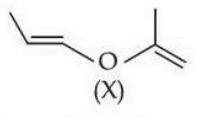
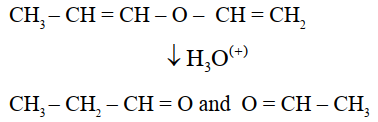
Molecule \((X)\) is an ether with two enol ether functional groups attached to the central oxygen atom. On mild acidic hydrolysis, an enol ether cleaves to give a carbonyl compound and an alcohol.
The \(1\)-propenyl side \((CH_3-CH=CH-O-)\) hydrolyses to propanal, \(CH_3CH_2CHO\).
The isopropenyl side \((-O-C(CH_3)=CH_2)\) hydrolyses to the enol of acetone, which tautomerises to acetone, \(CH_3COCH_3\).
Therefore, \((Y)\) and \((Z)\) are propanal and acetone.
Statement A: Both \((Y)\) and \((Z)\) have the same molar mass.
Propanal and acetone are functional isomers with the same molecular formula \(C_3H_6O\) and hence the same molar mass \((58\text{ g mol}^{-1})\).
Statement A is true.
Statement B: \((Y)\) and \((Z)\) can be distinguished by \(NaHCO_3\).
\(NaHCO_3\) reacts only with carboxylic acids (releasing \(CO_2\)). Neither an aldehyde nor a ketone reacts with \(NaHCO_3\), so it cannot distinguish between them.
Statement B is false.
Statement C: \((Y)\) and \((Z)\) react with HCN at the same rate.
In nucleophilic addition to carbonyls, aldehydes react faster than ketones due to lower steric hindrance and a more electrophilic carbonyl carbon (fewer \(+I\) alkyl groups). So propanal reacts faster than acetone.
Statement C is false.
Statement D: \((Y)\) and \((Z)\) undergo addition reaction with \(2,4\)-DNP.
Both aldehydes and ketones react with \(2,4\)-DNP (Brady's reagent) by nucleophilic addition followed by loss of water to give coloured \(2,4\)-dinitrophenylhydrazone precipitates.
Statement D is true.
Hence, the correct statements are A and D only, which corresponds to option \((4)\). -
- (A) \(CH_2 = CH - \overset{O}{\underset{\|}{C}} - OH\)
- (B) \(CH_3 - CH = CH - CH = O\)
- (C) \(O = C - OH, \, CH_2 - OH\) (with C-C bond)
- (D) \(CH_3 - \overset{O}{\underset{\|}{C}} - OH\)
Show answer and solution
Correct Answer: (C)
Given the molar ratio of C, O, and H in compound \(x\) is equal, the empirical formula is \(CHO\).
Empirical mass \(= 12 + 1 + 16 = 29\) g mol\(^{-1}\).
Since the molar mass of \(x\) is \(58\) g mol\(^{-1}\), the molecular formula is \((CHO)_2\) or \(C_2H_2O_2\).
The structure of \(x\) is glyoxal, \(OHC-CHO\).
Treatment of glyoxal with \(50\%\) KOH under reflux results in an intramolecular Cannizzaro reaction. One aldehyde group is oxidized to a carboxylate ion, and the other is reduced to a primary alcohol.
\(OHC-CHO \xrightarrow{50\% \text{ KOH}} HOCH_2-COO^{-}K^{+}\)
Subsequent acidification yields glycolic acid (\(y\)).
\(HOCH_2-COO^{-}K^{+} \xrightarrow{H^{+}} HOCH_2-COOH\)
The structure of \(y\) is \(HO-CH_2-COOH\).
Answer: \(O = C - OH, \, CH_2 - OH\) (with C-C bond) -
- (A) Both Statement I and Statement II are false
- (B) Statement I is false but Statement II is true
- (C) Both Statement I and Statement II are true
- (D) Statement I is true but Statement II is false
Show answer and solution
Correct Answer: (A)
Statement I: False
Cross aldol can give 2 or 4 products
Statement II: False
Benzaldehyde & Acetone both react with semi carbazide -
- (A) Both Statement I and Statement II are true
- (B) Both Statement I and Statement II are false
- (C) Statement I is true but Statement II is false
- (D) Statement I is false but Statement II is true
Show answer and solution
Correct Answer: (A)
Statement I is true because the \(-OCH_3\) group is an electron-donating group. It donates electron density through resonance (\(+R\) effect), which delocalizes the positive charge of the carbocation and stabilizes it.
Statement II is true because the \(-NO_2\) group is a strong electron-withdrawing group. It withdraws electron density through resonance (\(-R\) effect), which delocalizes the negative charge of the carbanion and stabilizes it.
Therefore, both Statement I and Statement II are true.
Answer: Both Statement I and Statement II are true -
- (A) Both Statement I and Statement II are true
- (B) Both Statement I and Statement II are false
- (C) Statement I is true but Statement II is false
- (D) Statement I is false but Statement II is true
Show answer and solution
Correct Answer: (A)
Statement I: Semicarbazide is \(H_2N-NH-C(=O)-NH_2\). The lone pair on the \(-NH_2\) group attached to the carbonyl carbon is involved in resonance with the \(C=O\) group, making it less nucleophilic. Therefore, the \(-NH_2\) group attached to the \(-NH-\) group acts as the nucleophile. The condensation of acetaldehyde (\(CH_3-CH=O\)) with semicarbazide under optimum pH (around 3.5) yields acetaldehyde semicarbazone, \(CH_3-CH=N-NH-C(=O)-NH_2\). Thus, Statement I is true.
Statement II: The molecule \(Ph-CH(OH)(OCH_3)\) is a hemiacetal. Hemiacetals are unstable and readily undergo hydrolysis in the presence of dilute acid to yield the corresponding aldehyde and alcohol. Hydrolysis of \(Ph-CH(OH)(OCH_3)\) gives benzaldehyde (\(Ph-CH=O\)) and methanol (\(CH_3OH\)). Thus, Statement II is also true.
Both Statement I and Statement II are true.
Answer: Both Statement I and Statement II are true -
- (A) 8
- (B) 10
- (C) 12
- (D) 14
Show answer and solution
Correct Answer: (B)
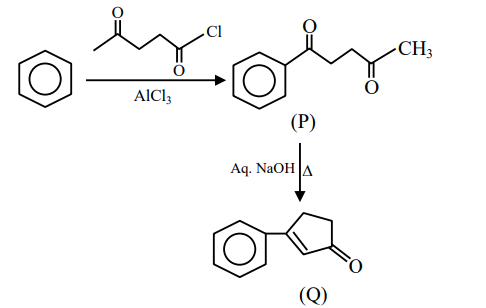
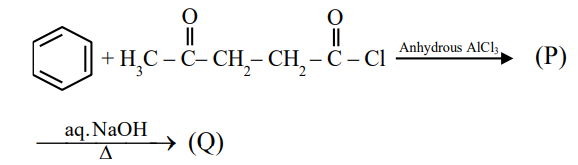
Molecular mass of Q is \(=157\)
\(\%\) of oxygen in product ' \(Q\) ' is \(=\frac{16}{157} \times 100=10.19 \%\) -
- (A) A-II, B-III, C-IV, D-I
- (B) A-IV, B-III, C-I, D-II
- (C) A-IV, B-I, C-II, D-III
- (D) A-II, B-IV, C-I, D-III
Show answer and solution
Correct Answer: (D)
A-II, B-IV, C-I, D-III -
- (A) A-III, B-I, C-IV, D-II
- (B) A-II, B-I, C-IV, D-III
- (C) A-IV, B-III, C-II, D-I
- (D) A-III, B-IV, C-I, D-II
Show answer and solution
Correct Answer: (A)
Theoretical (NCERT Based) -
- (A) 2-hydroxy acetophenone
- (B) 4-methoxy benzaldehyde
- (C) 4-hydroxy benzaldehyde
- (D) 4-methyl benzoic acid
Show answer and solution
Correct Answer: (B)
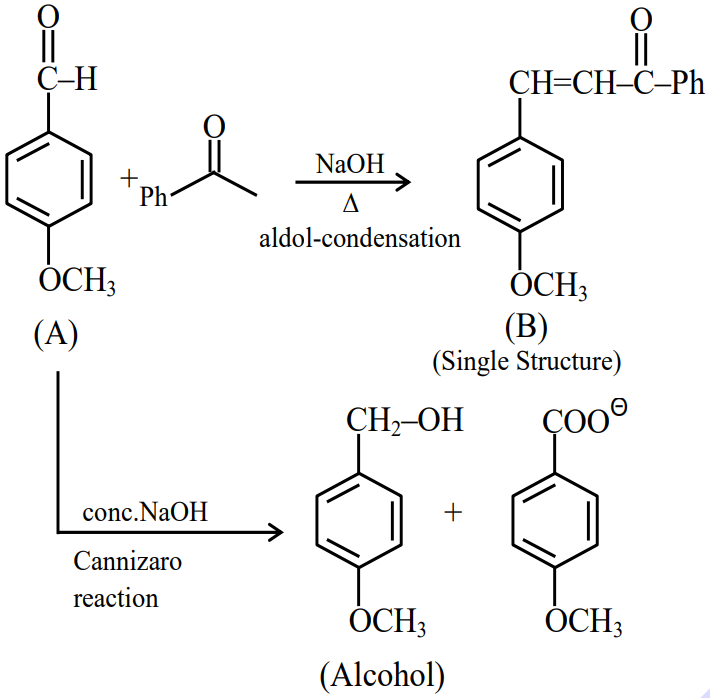
(On cross aldol reaction, a single structure is obtained but it can show geometrical isomerism). -
- (A) Lucas reagent
- (B) 2,4 - DNP reagent
- (C) Saturated \(NaHSO_{3}\) solution
- (D) Fehling solution
Show answer and solution
Correct Answer: (D)

'P' and 'Q' can be differentiated by Fehling's test.
P gives positive Fehling test
Q gives negative Fehling test -
- (A) 2-Methylpent-4-en-3-one
- (B) 4-Methylpent-3-en-2-one
- (C) 4-Methylpent-1-ene
- (D) 2-Methylpent-3-one
Show answer and solution
Correct Answer: (B)
Hydrolysis of prop-1-yne in the presence of \(HgSO_4\) and dilute \(H_2SO_4\) yields acetone.
\(CH_3-C \equiv CH + H_2O \xrightarrow{Hg^{2+}, H^+} CH_3-CO-CH_3\)
Thus, \(x\) is acetone.
Reaction of ethane nitrile (\(CH_3CN\)) with methyl magnesium bromide (\(CH_3MgBr\)) followed by hydrolysis also yields acetone.
\(CH_3-C \equiv N + CH_3MgBr \rightarrow CH_3-C(CH_3)=NMgBr \xrightarrow{H_3O^+} CH_3-CO-CH_3\)
Thus, \(y\) is acetone.
Reaction of \(x\) and \(y\) (both acetone) in the presence of \(Ba(OH)_2\) followed by heating results in an aldol condensation.
\(2 CH_3-CO-CH_3 \xrightarrow{Ba(OH)_2} CH_3-C(OH)(CH_3)-CH_2-CO-CH_3\)
Heating causes dehydration to form an unsaturated ketone.
\(CH_3-C(OH)(CH_3)-CH_2-CO-CH_3 \xrightarrow{\Delta} CH_3-C(CH_3)=CH-CO-CH_3\)
Numbering the principal carbon chain to give the lowest locant to the ketone group, the IUPAC name of the product is 4-methylpent-3-en-2-one.
Answer: 4-Methylpent-3-en-2-one -
- (A) 4
- (B) 8
- (C) 16
- (D) 32
Show answer and solution
Correct Answer: (C)
Benzene reacts with \(CO\) and \(HCl\) in the presence of \(CuCl\) to give benzaldehyde (\(x\)) via the Gattermann-Koch reaction.
Benzene reacts with ethanoyl chloride (\(CH_3COCl\)) in the presence of anhydrous \(AlCl_3\) to give acetophenone (\(y\)) via Friedel-Crafts acylation.
Heating benzaldehyde (\(x\)) and acetophenone (\(y\)) in the presence of alkali results in a crossed aldol condensation to form benzalacetophenone (\(z\)).
\(C_6H_5CHO + CH_3COC_6H_5 \xrightarrow{OH^-, \Delta} C_6H_5-CH=CH-CO-C_6H_5 + H_2O\)
The structure of \(z\) (\(C_6H_5-CH=CH-CO-C_6H_5\)) contains two phenyl rings (\(6\) \(\pi\) bonds), one \(C=C\) double bond (\(1\) \(\pi\) bond), and one \(C=O\) double bond (\(1\) \(\pi\) bond).
Total number of \(\pi\) bonds = \(6 + 1 + 1 = 8\)
Total number of \(\pi\) electrons = \(8 \times 2 = 16\)
Answer: \(16\)

No questions on this page match these filters.