


All JEE Mains 2026 Chemistry questions
26 chaptersShowing 251–300 of 432 questions
-
- (A) 70
- (B) 75
- (C) 78
- (D) 80
Show answer and solution
Correct Answer: (C)
We have considered
\(E _{\left[ Sn ( OH )_6\right]^{2-} / HSnO _2^{-}}^{ o }=-0.9 V\)
\(Pt \left| HSnO _2^{-}(aq ),\left[ Sn ( OH )_6\right]^{2-}( aq ), OH ^{-}( aq )\right| Bi _2 O _3(s) \\ | Bi ( s )|\)
\(\quad \quad\quad0.5 M \quad\quad\quad 0.05 M\)
\(E _{\text {cell }}^{\circ}=+0.9-0.44=0.46 V\)
Oxidation Half :
\(HSnO _2^{-}+ H _2 O +3 OH ^{-} \rightarrow\left[ Sn ( OH )_6\right]^{2-}+2 e ^{-}\)
Reduction Half :
\(\frac{ Bi _2 O _3+3 H _2 O +6 e ^{-} \rightarrow 2 Bi +6 OH ^{-}}{3 HSnO _2^{-}( aq )+ Bi _2 O _3(s)+6 H _2 O +3 OH ^{-}( aq )}\)
\(\rightarrow 3\left[ Sn ( OH )_6\right]^{-}( aq )+2 Bi ( s )\)
\(E _{\text {cell }}= E _{\text {cell }}^{ o }-\frac{0.059}{6} \log \frac{(0.5)^3}{(0.05)^3 \times\left[ OH ^{-}\right]^3}\)
\(0.2353=0.46-\frac{0.059}{6} \times 3 \log \left[\frac{10}{\left[ OH ^{-}\right]}\right]\)
\(\log \left[\frac{10}{ OH ^{-}}\right]=\frac{2 \times 0.2247}{0.059}=7.6\)
\(I + pOH =7.6\)
\(pOH =6.6\)
\(pH =14-6.6=7.4\)
\(pH = pK _{ a _1}+\log \frac{\left[ HCO _3^{-}\right]}{\left[ H _2 CO _3\right]}\)
\(7.4=6.11+\log \frac{5 x}{20}\)
\(1.29=\log \frac{x}{4}\)
\(\frac{x}{4}=19.5\)
\(x=78\) -
- (A) 0
- (B) 1
- (C) 2
- (D) 4
Show answer and solution
Correct Answer: (C)
Given standard reduction potentials:
\(E^{\ominus}_{M^{x+}/M} = +0.15\) V
\(E^{\ominus}_{Fe^{3+}/Fe} = -0.036\) V
Since \(E^{\ominus}_{M^{x+}/M} > E^{\ominus}_{Fe^{3+}/Fe}\), reduction occurs at the \(M^{x+}/M\) electrode (cathode) and oxidation occurs at the \(Fe^{3+}/Fe\) electrode (anode).
Cathode reaction: \((M^{x+} + x e^{-} \rightarrow M) \times 3\)
Anode reaction: \((Fe \rightarrow Fe^{3+} + 3 e^{-}) \times x\)
Overall balanced cell reaction:
\(3 M^{x+} + x Fe \rightarrow 3 M + x Fe^{3+}\)
The number of electrons transferred in the balanced reaction is \(n = 3x\).
Standard cell potential \(E^{\ominus}_{cell}\) is:
\(E^{\ominus}_{cell} = E^{\ominus}_{cathode} - E^{\ominus}_{anode}\)
\(E^{\ominus}_{cell} = 0.15 - (-0.036) = 0.186\) V
Using the Nernst equation:
\(E_{cell} = E^{\ominus}_{cell} - \dfrac{2.303RT}{nF} \log Q\)
Substitute the given values (\(E_{cell} = 0.2057\) V, \(Q = 10^{-2}\), and \(\dfrac{2.303RT}{F} = 0.059\) V):
\(0.2057 = 0.186 - \dfrac{0.059}{3x} \log(10^{-2})\)
\(0.2057 - 0.186 = -\dfrac{0.059}{3x} \times (-2)\)
\(0.0197 = \dfrac{0.118}{3x}\)
\(3x = \dfrac{0.118}{0.0197}\)
\(3x \approx 6\)
\(x = 2\)
Answer: \(2\) -
- (A) Overall reaction \(Fe(s) + 2OH^-(aq) + 2AgBr(s) \rightleftharpoons Fe(OH)_2(s) + 2Ag(s) + 2Br^-(aq)\)
- (B) \(E^\theta_{cell} = -0.95\) V
- (C) Fe is reduced in the electrochemical cell
- (D) \(E^\theta_{cell}\) is an extensive property
Show answer and solution
Correct Answer: (A)
For a spontaneous reaction, the cell potential \(E^{\theta}_{cell}\) must be positive. The half-cell with the higher standard reduction potential acts as the cathode (reduction), and the one with the lower standard reduction potential acts as the anode (oxidation).
Given standard reduction potentials:
\(E^{\theta}_{AgBr/Ag} = +0.07\) V
\(E^{\theta}_{Fe(OH)_2/Fe} = -0.88\) V
Since \(+0.07\) V \(> -0.88\) V, \(AgBr\) undergoes reduction at the cathode and \(Fe\) undergoes oxidation at the anode.
Cathode reaction: \(2AgBr(s) + 2e^{-} \rightarrow 2Ag(s) + 2Br^{-}(aq)\)
Anode reaction: \(Fe(s) + 2OH^{-}(aq) \rightarrow Fe(OH)_2(s) + 2e^{-}\)
Overall cell reaction:
\(Fe(s) + 2OH^{-}(aq) + 2AgBr(s) \rightleftharpoons Fe(OH)_2(s) + 2Ag(s) + 2Br^{-}(aq)\)
Standard cell potential:
\(E^{\theta}_{cell} = E^{\theta}_{cathode} - E^{\theta}_{anode} = 0.07 - (-0.88) = +0.95\) V
\(E^{\theta}_{cell}\) is an intensive property, and \(Fe\) is oxidized in the cell. Thus, only the overall reaction given in the first option is correct.
Answer: Overall reaction \(Fe(s) + 2OH^-(aq) + 2AgBr(s) \rightleftharpoons Fe(OH)_2(s) + 2Ag(s) + 2Br^-(aq)\) -
- (A) 10
- (B) 15
- (C) 20
- (D) 25
Show answer and solution
Correct Answer: (B)
The conductivity (specific conductance), \(\kappa\), is given by the product of conductance and cell constant:
\(\kappa = G \times G^*\)
\(\kappa = 1.9 \times 10^{-3} \text{ S} \times 1.3 \text{ cm}^{-1} = 2.47 \times 10^{-3} \text{ S cm}^{-1}\)
The molar conductivity, \(\Lambda_m\), is related to the conductivity and molarity \(C\) by the formula:
\(\Lambda_m = \dfrac{\kappa \times 1000}{C}\)
Substituting the given values:
\(123.5 = \dfrac{2.47 \times 10^{-3} \times 1000}{C}\)
\(123.5 = \dfrac{2.47}{C}\)
\(C = \dfrac{2.47}{123.5} = 0.02 \text{ mol L}^{-1}\)
Molarity \(C\) can also be expressed in terms of mass percentage \(x\) (w/w), density \(d\), and molar mass \(M\):
\(C = \dfrac{x \times d \times 10}{M}\)
Substituting the known values (\(d = 1.0 \text{ g mL}^{-1}\), \(M = 75 \text{ g mol}^{-1}\)):
\(0.02 = \dfrac{x \times 1.0 \times 10}{75}\)
\(1.5 = 10x\)
\(x = 0.15\)
Expressing \(x\) in the required format:
\(x = 15 \times 10^{-2}\)
The value is \(15\).
Answer: \(15\) -
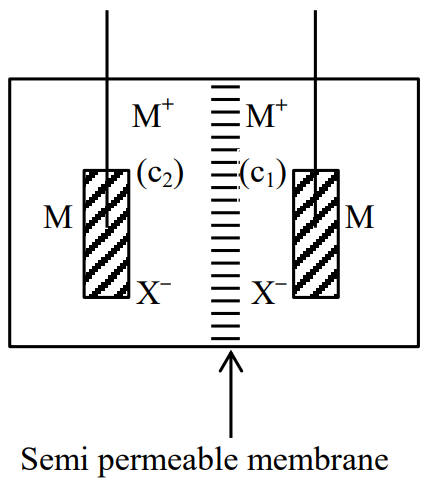
- (A) If \( c_{1} \) is present at anode, then \( c_{1} = c_{2} \)
- (B) If \( c_{1} \) is present at cathode, then \( c_{1} < c_{2} \)
- (C) If \( c_{1} \) is present at cathode, then \( c_{1} > c_{2} \)
- (D) If \( c_{1} \) is present at anode, then \( c_{1} > c_{2} \)
Show answer and solution
Correct Answer: (C)
(1) If \(C _1\) is at anode ⇒ cell reaction
\( M^{+}(C_{2}) \rightarrow M^{+}(C_{1}) \)
\( E_{cell} = -0.059 \log \frac{C_{1}}{C_{2}} \)
\(\therefore E_{cell} > 0 \Rightarrow C_{1} < C_{2} \)
(2) If \( C_{1} \) is at cathode
\( M^{+}(C_{1}) \rightarrow M^{+}(C_{2}) \)
\( E_{cell} = -0.059 \log \frac{C_{2}}{C_{1}} > 0 \)
\( C_{2} < C_{1} \) -
- (A) 2
- (B) 4
- (C) 6
- (D) 8
Show answer and solution
Correct Answer: (B)
For spontaneity \(E_{cell} > 0\).
At limiting condition:
\(E_{oxi}(anode) = -E_{red}(cathode)\)
\(H_{2}O \rightarrow 2H^{+} + \frac{1}{2}O_{2} + 2e^{-}\)
\(E = E ^{\circ}-\frac{0.059}{2} \log \left[\frac{\left[ H ^{+}\right]^2 \times P _{ O _2}^{1 / 2}}{1}\right]\)
\(-0.997 = -1.23 + 0.059 \times pH\)
\(pH = 3.94\)
\(pH \simeq 4\) -
- (A) \(\dfrac{10^6 x^2}{\alpha^2(x_1 + x_2 - 2x_3)^2}\)
- (B) \(\dfrac{x^2}{(x_1 + x_2 - 2x_3)^2}\)
- (C) \(\dfrac{\alpha^2(x_1 + x_2 - 2x_3)^2}{10^6 x^2}\)
- (D) \(\dfrac{x^2}{(x_1 + x_2 + 2x_3)^2}\)
Show answer and solution
Correct Answer: (A)
Using Kohlrausch's law of independent migration of ions, the limiting molar conductivity of \(\text{BaSO}_4\) is given by:
\(\Lambda^{\circ}_m(\text{BaSO}_4) = \Lambda^{\circ}_m(\text{BaCl}_2) + \Lambda^{\circ}_m(\text{H}_2\text{SO}_4) - 2\Lambda^{\circ}_m(\text{HCl})\)
Substituting the given values:
\(\Lambda^{\circ}_m(\text{BaSO}_4) = x_1 + x_2 - 2x_3\)
For a sparingly soluble salt, the solubility \(S\) (in mol L\(^{-1}\)) is related to its conductivity \(\kappa\) (in S cm\(^{-1}\)) and molar conductivity \(\Lambda_m\) (in S cm\(^2\) mol\(^{-1}\)) by the relation:
\(\Lambda_m = \dfrac{\kappa \times 1000}{S}\)
Given that \(\kappa = x\) and \(\Lambda_m = \Lambda^{\circ}_m\) (which implies complete dissociation, meaning the degree of dissociation \(\alpha = 1\)), we get:
\(S = \dfrac{1000 x}{x_1 + x_2 - 2x_3}\)
The solubility product \(K_{sp}\) for \(\text{BaSO}_4\) (which dissociates into \(\text{Ba}^{2+}\) and \(\text{SO}_4^{2-}\)) is:
\(K_{sp} = S^2 = \left( \dfrac{1000 x}{x_1 + x_2 - 2x_3} \right)^2 = \dfrac{10^6 x^2}{(x_1 + x_2 - 2x_3)^2}\)
Since \(\alpha = 1\), this expression is equivalent to \(\dfrac{10^6 x^2}{\alpha^2(x_1 + x_2 - 2x_3)^2}\).
Answer: \(\dfrac{10^6 x^2}{\alpha^2(x_1 + x_2 - 2x_3)^2}\) -
- (A) 2
- (B) 3
- (C) 4
- (D) 5
Show answer and solution
Correct Answer: (C)
\(E_{cell}^{\circ} = -0.44 - (-0.90)\)
\(= +0.46 V\)
Applying Nernst equation :-
\(E_{\text {cell }}=E_{\text {cell }}^{\circ}-\frac{0.06}{n} \log Q\)
\(E _{\text {cell }}=0.46-\frac{0.06}{6} \log 10^6\)
\(E _{\text {cell }}=4 \times 10^{-1}\)
\(x = 4\) -
- (A) 6
- (B) 12
- (C) 24
- (D) 8
Show answer and solution
Correct Answer: (C)
\( 3BH_{4}^{-}+4ClO_{3}^{-} \rightarrow 4Cl^{-}+3H_{2}BO_{3}^{-}+3H_{2}O \)
n -factor \(=8\)
moles \(=3\)
\(\therefore n =3 \times 8=24\) -
- (A) \(Al > Cr > Fe^{2+} > Co^{2+}\)
- (B) \(Al > Fe^{2+} > Cr > Co^{2+}\)
- (C) \(Al > Cr > Co^{2+} > Fe^{2+}\)
- (D) \(Cr > Fe^{2+} > Al > Co^{2+}\)
Show answer and solution
Correct Answer: (A)
Reducing power \(\propto \frac{1}{\text { Reduction potential }}\) -
- (A) -560
- (B) -565
- (C) -570
- (D) -575
Show answer and solution
Correct Answer: (A)
Explanation:
Let us compute the change in volume step-by-step based on the Electrochemistry and Chemical Thermodynamics principles in the NCERT Class 12 Chemistry textbook:
Step 1: Determine the standard cell potential (\(E^\circ_{cell}\))
Both given equations are written as reduction half-reactions. The half-reaction with the larger reduction potential occurs at the cathode, while the other is reversed to serve as the oxidation reaction at the anode:
- Cathode (Reduction): \(\frac{3}{2}O_2 + 6H^+ + 6e^- \rightarrow 3H_2O \quad E^\circ_{red} = 1.23\text{ V}\)
- Anode (Oxidation): \(CH_3OH + H_2O \rightarrow CO_2 + 6H^+ + 6e^- \quad E^\circ_{ox} = -0.02\text{ V}\)
- Net Cell Reaction: \(CH_3OH + \frac{3}{2}O_2 \rightarrow CO_2 + 2H_2O\)
The standard cell potential is calculated as:
\(E^\circ_{cell} = E^\circ_{cathode} - E^\circ_{anode} = 1.23\text{ V} - 0.02\text{ V} = 1.21\text{ V}\)
Step 2: Calculate the maximum electrical work (\(W_{max}\))
The number of moles of electrons transferred (\(n\)) per mole of \(CH_3OH\) reacted is 6. Using Faraday's constant (\(F = 96500\text{ C mol}^{-1}\)):
\(W_{max} = nFE^\circ_{cell} = 6 \times 96500 \times 1.21 = 700590\text{ J}\)
Step 3: Find the actual work derived (\(W_{actual}\))
Because the cell operates at 80% efficiency, the actual energy available to perform external work is:
\(W_{actual} = 0.80 \times 700590\text{ J} = 560472\text{ J}\)
Step 4: Calculate the volume change (\(\Delta V\)) during compression
The electrical energy delivered by the cell is utilized to perform work on the ideal gas during isothermal compression against a constant external pressure (\(P_{ext} = 1\text{ kPa} = 1000\text{ Pa}\)):
\(W = -P_{ext} \cdot \Delta V\)
Since work is done on the gas, \(W\) is positive:
\(560472 = -1000 \times \Delta V\)
\(\Delta V = -\frac{560472}{1000} = -560.472\text{ m}^3\)
Rounding to the nearest integer yields \(-560\text{ m}^3\).
Hence, Option A is the correct choice. -
- (A) 55
- (B) 222
- (C) 111
- (D) 148
Show answer and solution
Correct Answer: (C)
Eq of \( Cu = Eq \) of \( O_{2} \)
\(\frac{300 \times 10^{-3} \times 2}{63.54}= n _{ O _2} \times 4\)
\(2.36 \times 10^{-3}= n _{ O _2}\)
When current is further passed
\(n _{ O _2} \times 4=\frac{600 \times 28 \times 60}{96500 \times 1000}\)
\(n _{ O _2}=2.611 \times 10^{-3}\)
Total \( O_{2} \) released
\(=\left[10^{-3} \times(2.36+2.611)\right] \times 22400 ml\)
\(=111.35 ml\) -
- (A) The overall reaction can be written as \(n_2\text{Red}_1 + n_1\text{Ox}_2 \rightleftharpoons n_2\text{Ox}_1^{n_1^+} + n_1\text{Red}_2^{n_2^-}\)
- (B) The electrons do not appear in the overall reaction because electrons produced at the anode are consumed at the cathode.
- (C) Here \(n\) is the number of electrons transferred in redox reaction.
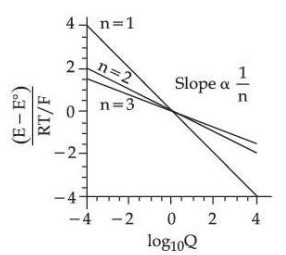
- (D) If the reaction is carried out reversibly, the electrical work done is equal to the ratio of charge and potential difference through which charge is moved.
Show answer and solution
Correct Answer: (D)
For the given redox reaction, the half-cell reactions are:
Anode: \(\text{Red}_1 \rightarrow \text{Ox}_1^{n_1^+} + n_1 e^-\)
Cathode: \(\text{Ox}_2 + n_2 e^- \rightarrow \text{Red}_2^{n_2^-}\)
To obtain the overall balanced chemical equation, we multiply the anode reaction by \(n_2\) and the cathode reaction by \(n_1\) so that the number of electrons lost equals the number of electrons gained:
\(n_2\text{Red}_1 \rightarrow n_2\text{Ox}_1^{n_1^+} + n_1 n_2 e^-\)
\(n_1\text{Ox}_2 + n_1 n_2 e^- \rightarrow n_1\text{Red}_2^{n_2^-}\)
Adding these gives the overall reaction:
\(n_2\text{Red}_1 + n_1\text{Ox}_2 \rightleftharpoons n_2\text{Ox}_1^{n_1^+} + n_1\text{Red}_2^{n_2^-}\)
Thus, statement (A) is correct.
In the overall reaction, electrons do not appear because the electrons produced at the anode are exactly consumed at the cathode. Thus, statement (B) is correct.
From the Nernst equation:
\(E = E^\circ - \dfrac{RT}{nF} \ln Q = E^\circ - \dfrac{2.303 RT}{nF} \log_{10} Q\)
\(\dfrac{E - E^\circ}{RT/F} = -\dfrac{2.303}{n} \log_{10} Q\)
The graph of \(\dfrac{E - E^\circ}{RT/F}\) versus \(\log_{10} Q\) is a straight line with a slope of \(-\dfrac{2.303}{n}\), where \(n\) is the number of electrons transferred in the balanced redox reaction. Thus, statement (C) is correct.
The electrical work done by a galvanic cell is given by the product of the total charge transferred and the cell potential (potential difference), not their ratio.
\(W_{\text{electrical}} = \text{Charge} \times \text{Potential difference} = nF E_{\text{cell}}\)
Thus, statement (D) is incorrect.
Answer: If the reaction is carried out reversibly, the electrical work done is equal to the ratio of charge and potential difference through which charge is moved. -
- (A) 2
- (B) 4
- (C) 6
- (D) 8
Show answer and solution
Correct Answer: (B)
Using equation : \(\Lambda_{ m }=\Lambda^0{ }_{ m }- A \sqrt{ c }\)
\(96.1=\Lambda_{ m }^0- A \sqrt{0.04}\)
\(96.1=\Lambda_{ m }^0- A \times 0.2 \quad\ldots(1)\)
\(95.7=\Lambda_{ m }^0- A \times \sqrt{0.09}\)
\(95.7=\Lambda_m^0- A \times 0.3 \quad\ldots(2)\)
From eq. (1) and eq. (2)
\(A =4\) -
- (A) \(2X-3Y\)
- (B) \(3Y-2X\)
- (C) \(3Y+2X\)
- (D) \(Y+X\)
Show answer and solution
Correct Answer: (B)
The half-reactions and their standard Gibbs free energy changes are given by:
\(Fe^{2+} + 2e^{-} \rightarrow Fe\)
\(\Delta G^{\ominus}_{1} = -2FX\)
\(Fe^{3+} + 3e^{-} \rightarrow Fe\)
\(\Delta G^{\ominus}_{2} = -3FY\)
The required half-reaction is:
\(Fe^{3+} + e^{-} \rightarrow Fe^{2+}\)
\(\Delta G^{\ominus}_{3} = -1FE^{\ominus}_{Fe^{3+}/Fe^{2+}}\)
This reaction is obtained by subtracting the first reaction from the second reaction:
\(\Delta G^{\ominus}_{3} = \Delta G^{\ominus}_{2} - \Delta G^{\ominus}_{1}\)
\(-FE^{\ominus}_{Fe^{3+}/Fe^{2+}} = -3FY - (-2FX)\)
\(-FE^{\ominus}_{Fe^{3+}/Fe^{2+}} = -3FY + 2FX\)
\(E^{\ominus}_{Fe^{3+}/Fe^{2+}} = 3Y - 2X\)
Answer: \(3Y-2X\) -
- (A) A and B only
- (B) A and E only
- (C) B only
- (D) C, D and E only
Show answer and solution
Correct Answer: (D)
\(Cl_{aq}^{-}+Ag_{(S)}+Fe_{aq}^{+3}\rightarrow Fe_{aq}^{+2}+AgCl_{(S)}\)
\(E_{cell}=E_{cell}^{o}-\frac{0.059}{1}log\frac{[Fe^{2+}]}{[Cl^{-}][Fe^{3+}]}\) -
- (A) 2
- (B) 1
- (C) 3
- (D) 4
Show answer and solution
Correct Answer: (A)
\(K _{ a }( HQ )= C _1 \alpha_1^2 \quad\alpha_1=\frac{\lambda_{ m }( HQ )}{\lambda_{ m }^{\infty}( HQ )}\)
\(K _{ a }( HZ )= C _2 \alpha_2^2 \quad \alpha_2=\frac{\lambda_{ m }( HZ )}{\lambda_{ m }^{\infty}( HZ )}\)
\(\frac{ K _{ a }( HQ )}{ K _{ a }( HZ )}=\frac{ C _1}{ C _2} \cdot\left(\frac{\alpha_1}{\alpha_2}\right)^2=\frac{0.18}{0.02} \cdot\left[\frac{\lambda_{ m }( HQ )}{\lambda_{ m }( HZ )}\right]^2\)
\(\frac{K_a( HQ )}{K_a( HQ )}=9 \times\left(\frac{1}{30}\right)^2=\frac{1}{100}\)
\(pK _3( HQ )- pK _3( HZ )=2\) -
- (A) 200
- (B) 790
- (C) 590
- (D) 1380
Show answer and solution
Correct Answer: (A)
\(E _{ X ^{-} / MX ( s ) / M }^{ o }= E _{ M ^{+} / M }^{ o }+\frac{0.0591}{ n } \log K _{ sp }\)
\(=0.79+\frac{0.059}{1} \log 10^{-10}\)
\(=0.79-0.59\)
\(=0.20 V=200 mV\) -
- (A) \(\dfrac{2}{3.9}\)
- (B) \(\dfrac{4}{5.9}\)
- (C) \(\dfrac{2.9}{2}\)
- (D) \(\dfrac{5.9}{4}\)
Show answer and solution
Correct Answer: (B)
The cell reaction is \(Zn(s) + 2Ag^+(aq) \rightarrow Zn^{2+}(aq) + 2Ag(s)\)
The standard cell potential is given by:
\(E^\circ_{cell} = E^\circ_{cathode} - E^\circ_{anode} = 0.80 - (-0.76) = 1.56\text{ V}\)
Using the Nernst equation:
\(E_{cell} = E^\circ_{cell} - \dfrac{0.059}{n} \log \dfrac{[Zn^{2+}]}{[Ag^+]^2}\)
Substituting the given values (\(n = 2\), \([Zn^{2+}] = 1\text{ M}\), \(E_{cell} = 1.60\text{ V}\)):
\(1.60 = 1.56 - \dfrac{0.059}{2} \log \dfrac{1}{x^2}\)
\(0.04 = - \dfrac{0.059}{2} (-2 \log x)\)
\(0.04 = 0.059 \log x\)
\(\log x = \dfrac{0.04}{0.059} = \dfrac{4}{5.9}\)
Answer: \(\dfrac{4}{5.9}\) -
- (A) 2
- (B) 4
- (C) 6
- (D) 8
Show answer and solution
Correct Answer: (C)
\(pH =5\)
\(\left[ H ^{+}\right]=10^{-5}=[ HX ] \cdot \alpha\)
\(=[ HX ] \cdot \frac{\Lambda_{ m }}{\Lambda_{ m }^{\infty}}\)
\(\Lambda_{ m }=\frac{ k \times 1000}{[ HX ]}\)
\(K = G . G ^*=4 \times 10^{-5} \times \frac{15}{1}=6 \times 10^{-4} S . cm ^{-1}\)
\(\left[ H ^{+}\right]=10^{-5}=[ HX ] \times \frac{6 \times 10^{-4} \times 1000}{\Lambda_{ m }^{\infty} \times[ HX ]}\)
\(\Lambda_{ m }^{\infty}=60000 S.cm^2 mol^{-1}\)
\(\Lambda_{ m }^{\infty}=6 S . m^2 mol^{-1}\) -
- (A) \(10^{-6}\)
- (B) \(4 \times 10^{-4}\)
- (C) \(3 \times 10^{-5}\)
- (D) \(3 \times 10^{-3}\)
Show answer and solution
Correct Answer: (D)
The molality of the solution is given by:
\(m = \dfrac{\text{Mass of solute}}{\text{Molar mass of solute} \times \text{Mass of solvent in kg}}\)
\(m = \dfrac{19.5}{78 \times 0.5} = 0.5 \text{ mol kg}^{-1}\)
The depression in freezing point is given by:
\(\Delta T_f = i \times K_f \times m\)
Substituting the given values:
\(1 = i \times 1.86 \times 0.5\)
\(1 = i \times 0.93\)
\(i = \dfrac{1}{0.93} = \dfrac{100}{93}\)
For the dissociation of a weak acid \(HA \rightleftharpoons H^+ + A^-\), the van 't Hoff factor is \(i = 1 + \alpha\), where \(\alpha\) is the degree of dissociation.
\(1 + \alpha = \dfrac{100}{93}\)
\(\alpha = \dfrac{100}{93} - 1 = \dfrac{7}{93}\)
The acid dissociation constant \(K_a\) is given by:
\(K_a = \dfrac{C \alpha^2}{1 - \alpha}\)
Since molarity and molality have the same values, \(C = 0.5 \text{ M}\).
\(K_a = \dfrac{0.5 \times \left(\dfrac{7}{93}\right)^2}{1 - \dfrac{7}{93}}\)
\(K_a = \dfrac{0.5 \times \dfrac{49}{93^2}}{\dfrac{86}{93}} = \dfrac{0.5 \times 49}{93 \times 86}\)
\(K_a = \dfrac{24.5}{7998} \approx 3.06 \times 10^{-3}\)
The closest value is \(3 \times 10^{-3}\).
Answer: \(3 \times 10^{-3}\) -
- (A) 60
- (B) 61
- (C) 62
- (D) 63
Show answer and solution
Correct Answer: (C)
The osmotic pressure \(\pi\) of the solution is balanced by the hydrostatic pressure of the liquid column.
\(\pi = \rho g h\)
Given:
Density of solution, \(\rho = 1000 \text{ kg m}^{-3}\)
Acceleration due to gravity, \(g = 10 \text{ m s}^{-2}\)
Height difference, \(h = 80.0 \text{ mm} = 0.08 \text{ m}\)
\(\pi = 1000 \times 10 \times 0.08 = 800 \text{ Pa} = 0.8 \text{ kPa}\)
From the van 't Hoff equation for osmotic pressure:
\(\pi = C R T = \dfrac{n}{V} R T\)
Given:
Volume of solution, \(V = 1 \text{ L} = 1 \text{ dm}^3\)
Gas constant, \(R = 8.3 \text{ kPa dm}^3 \text{ K}^{-1} \text{mol}^{-1}\)
Temperature, \(T = 300 \text{ K}\)
Substituting the values:
\(0.8 = \dfrac{n}{1} \times 8.3 \times 300\)
\(n = \dfrac{0.8}{2490} \text{ mol}\)
The mass of hemoglobin is \(w = 20 \text{ g} = 0.02 \text{ kg}\).
The molar mass \(M\) in \(\text{kg mol}^{-1}\) is:
\(M = \dfrac{w}{n} = \dfrac{0.02}{\dfrac{0.8}{2490}}\)
\(M = \dfrac{0.02 \times 2490}{0.8} = \dfrac{49.8}{0.8} = 62.25 \text{ kg mol}^{-1}\)
Rounding to the nearest integer, we get \(62\).
Answer: \(62\) -
- (A) 5
- (B) 10
- (C) 15
- (D) 20
Show answer and solution
Correct Answer: (A)
From the relative lowering of vapour pressure, we have:
\(\dfrac{P^0 - P_s}{P_s} = \dfrac{n_B}{n_A}\)
where \(n_B\) is the number of moles of solute and \(n_A\) is the number of moles of solvent.
Substituting the given values:
\(\dfrac{760 - 750}{750} = \dfrac{n_B}{n_A}\)
\(\dfrac{10}{750} = \dfrac{n_B}{n_A} \Rightarrow n_A = 75 n_B\)
The elevation in boiling point is given by:
\(\Delta T_b = T_b - T_b^0 = 320 - 319.5 = 0.5\) K
We also know that \(\Delta T_b = K_b \times m\), where \(m\) is the molality of the solution.
\(m = \dfrac{n_B}{\text{Mass of solvent in kg}} = \dfrac{n_B}{0.04}\)
Substituting the values into the elevation in boiling point equation:
\(0.5 = 0.3 \times \dfrac{n_B}{0.04}\)
\(n_B = \dfrac{0.5 \times 0.04}{0.3} = \dfrac{0.02}{0.3} = \dfrac{1}{15}\) mol
Now, substituting \(n_B\) back to find the number of moles of the solvent \(n_A\):
\(n_A = 75 \times \dfrac{1}{15} = 5\) mol
Answer: \(5\) -
- (A) 1.23 atm
- (B) 2.46 atm
- (C) 0.82 atm
- (D) 1.47 atm
Show answer and solution
Correct Answer: (B)
Mass of solute 'A' = 0.3 g
Moles of solute 'A' = \( \frac{0.3g}{60g/mol} = \frac{1}{200} \) mol
Mass of solute 'B' = 0.9 g
Moles of solute 'B' = \( \frac{0.9g}{180g/mol} = \frac{1}{200} \) mol
Total molarity of all solutes
= \( \frac{2/200}{100} \times 1000 = \frac{1}{10}M \)
\( \therefore\pi = \frac{1}{10} \times 0.082 \times 300 \)
\( \pi = 2.46 \) atm. -
- (A) 3
- (B) 1
- (C) 5
- (D) 2
Show answer and solution
Correct Answer: (A)
\(\Delta T _{ b }= i \times K _{ b } \times m\)
\(0.5= i \times m \times 5\)
\(i \times m =\frac{0.5}{5}=0.1\)
\(i \times a =\frac{15}{1000}\)
(where \(a=\) moles of solute)
Now,
\(\frac{P_o-P_S}{P^o}=i X_{\text {solute }}=i \times \frac{a}{a+\frac{150}{300}}\)
\(= i \times \frac{ a }{1 / 2}=\frac{15 / 1000}{1 / 2}=\frac{30}{1000}=3 \times 10^{-2}=3\) -
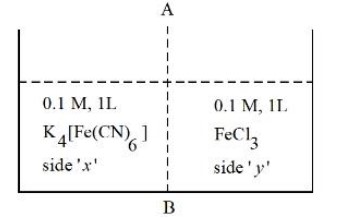
- (A) Blue color is formed on both sides.
- (B) Ionic solutes in aqueous solution can pass through semi-permeable membrane.
- (C) Solution on side '\(y\)' is hypotonic.
- (D) To cause the reverse flow of solvent during osmosis, external pressure (any value) should be applied to side '\(x\)'.
Show answer and solution
Correct Answer: (C)
For complete dissociation, the van 't Hoff factor \(i\) is equal to the number of ions produced per formula unit.
For side 'x' containing \(K_4[Fe(CN)_6]\):
\(K_4[Fe(CN)_6] \rightarrow 4K^+ + [Fe(CN)_6]^{4-}\)
Number of ions, \(i_x = 5\)
Effective concentration (osmolarity) \(= i_x \times C = 5 \times 0.1 = 0.5\) M
For side 'y' containing \(FeCl_3\):
\(FeCl_3 \rightarrow Fe^{3+} + 3Cl^-\)
Number of ions, \(i_y = 4\)
Effective concentration (osmolarity) \(= i_y \times C = 4 \times 0.1 = 0.4\) M
Since the effective concentration of side 'y' (\(0.4\) M) is less than that of side 'x' (\(0.5\) M), the solution on side 'y' has a lower osmotic pressure and is therefore hypotonic with respect to side 'x'.
Evaluating the other options:
A semi-permeable membrane (SPM) only allows solvent molecules to pass, not solute ions. Thus, \(Fe^{3+}\) and \([Fe(CN)_6]^{4-}\) cannot mix, and no blue color is formed.
To cause reverse osmosis, the external pressure applied to the hypertonic side (side 'x') must be strictly greater than the osmotic pressure difference (\(\Delta \pi = \pi_x - \pi_y\)), not just any value.
Answer: Solution on side '\(y\)' is hypotonic. -
- (A) \(1.23 \times 10^{-7}\)
- (B) \(1.17 \times 10^{-4}\)
- (C) \(9.35 \times 10^{5}\)
- (D) \(9.35 \times 10^{-5}\)
Show answer and solution
Correct Answer: (D)
\(P _{ N _2}= K _{ H } \cdot X _{ N _2}\)
\(P_{N_{2}} = 0.8 \times 10 = 8\) atm
\(8 \times 760 = 6.5 \times 10^{7} \times X_{N_{2}}\)
\(X _{ N _2}=\frac{8 \times 760}{6.5 \times 10^7}\)
\(X _{ N _2}=9.35 \times 10^{-5}\) -
- (A) 300, 200
- (B) 600, 400
- (C) 400, 300
- (D) 500, 200
Show answer and solution
Correct Answer: (D)
\(P_S=X_A P_A^{\circ}+X_B P_B^{\circ}\)
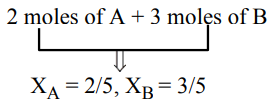
\(320= P _{ A }^{\circ}\left(\frac{2}{5}\right)+ P _{ B }^{\circ}\left(\frac{3}{5}\right)\)
\(2 P_{A}^{\circ}+3 P_{B}^{\circ}=1600\) ...(I)
Now 1 mole of A & 1 mole of B is added
\(X _{ A }^{\prime}=\frac{3}{7}, X _{ B }^{\prime}=\frac{4}{7}\)
\(P _{ S }^{\prime}=328.6= P _{ A }^{\circ}\left(\frac{3}{7}\right)+ P _{ B }^{\circ}\left(\frac{4}{7}\right)\)
\(3 P _{ A }^{\circ}+4 P _{ B }^{\circ}=2300.2\) ....(II)
Now eq \(( I ) \times 3-\) eq \(( II ) \times 2\)
\(6 P _{ A }^{\circ}+9 P _{ B }^{\circ}=4800\)
\(6 P _{ A }^{\circ}+8 P _{ B }^{\circ}=4600.4\)
\(P _{ B }^{\circ} \simeq 200 mm\) of Hg
\(P _{ A }^{\circ} \simeq 500 mm\) of Hg -
- (A) I < II < III < IV
- (B) III < II < I < IV
- (C) II < III < IV < I
- (D) II < III < I < IV
Show answer and solution
Correct Answer: (A)
\(\Delta T_{b} = i \cdot k_{b} \cdot m\)
For dilute solution ( \(M=m\) )Molarity \(i \times m\) (I) \(M _{\text {glucose }}=\frac{2.2}{180} \times \frac{1000}{125}=0.098\) \(0.098 \times 1\) (II) \(M _{ CaCl _2}=\frac{1.9}{111} \times \frac{1000}{250}=0.068\) \(0.068 \times 3\) (III) \(M _{\text {urea }}=\frac{9}{60} \times \frac{1000}{500}=0.3\) \(0.3 \times 1\) (IV) \(M _{ Al _2\left( SO _4\right)_2}=\frac{20.5}{342} \times \frac{1000}{750} \simeq 0.08\) \(0.08 \times 5\)
Order of \(\Delta T _{ b }= Al _2\left( SO _4\right)_3>\) Urea \(> CaCl _2>\) Glucose
So order of \(BP = Al _2\left( SO _4\right)_3>\) Urea \(> CaCl _2>\) Glucose
So Answer will be I \(<\) II \(<\) III \(<\) IV -
- (A) 70, 110
- (B) 65, 145
- (C) 60, 25
- (D) 25, 60
Show answer and solution
Correct Answer: (D)
\( (\Delta T_{b})_{PQ} = K_{b}m \)
\( 1.176 = 5 \times \frac{1}{M_{1}} \times \frac{1000}{50} \)
\( M_{1} = 85.03 \)
\( (\Delta T_{b})_{PQ_{2}} = 5 \times \frac{1}{M_{2}} \times \frac{1000}{50} = 0.689 \)
\( M_{2} = 145.13 \)
Let molar mass of \(P \& Q\) are \(M_P\) and \(M_Q\) respectively
\( M_{P} + M_{Q} = 85.03 \)
\( M_{P} + 2M_{Q} = 145.13 \)
\( M_{P} = 24.93 \approx 25 \)
\( M_{Q} = 60.1 \approx 60 \), -
- (A) Both Statement I and Statement II are true
- (B) Both Statement I and Statement II are false
- (C) Statement I is true but Statement II is false
- (D) Statement I is false but Statement II is true
Show answer and solution
Correct Answer: (A)
Statement I:
\(30\%\) (w/w) solution of methanol in CCl\(_4\) means \(30\) g of methanol is present in \(70\) g of CCl\(_4\).
Molar mass of methanol (CH\(_3\)OH) \(= 12 + 4 \times 1 + 16 = 32\) g mol\(^{-1}\)
Molar mass of CCl\(_4 = 12 + 4 \times 35.5 = 154\) g mol\(^{-1}\)
Moles of methanol \(= \dfrac{30}{32} = 0.9375\) mol
Moles of CCl\(_4 = \dfrac{70}{154} = 0.4545\) mol
Mole fraction of CCl\(_4 = \dfrac{0.4545}{0.9375 + 0.4545} = \dfrac{0.4545}{1.392} \approx 0.326 \approx 0.33\)
Thus, Statement I is true.
Statement II:
In pure methanol, molecules are held together by strong intermolecular hydrogen bonding. On adding CCl\(_4\), its molecules come between methanol molecules and break the hydrogen bonds. This decreases the intermolecular attractive forces, leading to an increase in vapour pressure. Hence, the mixture shows a positive deviation from Raoult's law.
Thus, Statement II is true.
Both Statement I and Statement II are true.
Answer: Both Statement I and Statement II are true -
- (A) Both Statement I and Statement II are true
- (B) Both Statement I and Statement II are false
- (C) Statement I is true but Statement II is false
- (D) Statement I is false but Statement II is true
Show answer and solution
Correct Answer: (D)
For Statement I:
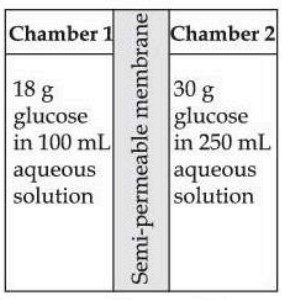
Molarity of the solution in Chamber 1 (\(M_1\)) = \(\dfrac{18 / 180}{100 / 1000} = 1\) M
Molarity of the solution in Chamber 2 (\(M_2\)) = \(\dfrac{30 / 180}{250 / 1000} = \dfrac{1/6}{1/4} = 0.667\) M
Since \(M_1 > M_2\), the solution in Chamber 1 has a higher solute concentration. During osmosis, the solvent (water) moves from the region of lower solute concentration to the region of higher solute concentration across a semi-permeable membrane. Thus, water will move from Chamber 2 to Chamber 1. Statement I is false.
For Statement II:
The osmotic pressure is given by \(\pi = iCRT\)
For \(K_2SO_4\), assuming complete dissociation (\(K_2SO_4 \rightarrow 2K^+ + SO_4^{2-}\)), the van't Hoff factor \(i = 3\).
Concentration \(C = \dfrac{50 \times 10^{-3}}{174 \times 2}\) mol/L
\(\pi = 3 \times \left( \dfrac{50 \times 10^{-3}}{174 \times 2} \right) \times 0.083 \times 300\)
\(\pi = \dfrac{3 \times 0.05 \times 24.9}{348} = \dfrac{3.735}{348} \approx 0.0107\) bar
Statement II is true.
Therefore, Statement I is false but Statement II is true.
Answer: Statement I is false but Statement II is true -
- (A) Statement I is false but Statement II is true.
- (B) Statement I is true but Statement II is false.
- (C) Both Statement I and Statement II are true.
- (D) Both Statement I and Statement II are false.
Show answer and solution
Correct Answer: (B)
\(K_{H}\) depends on the nature of gas and the solvent. -
- (A) \(9.96 \times 10^{-4}; 9.96 \times 10^{-4}; 9.96 \times 10^{-4}\)
- (B) \(9.96 \times 10^{-4}; 9.96 \times 10^{-4}; 19.92 \times 10^{-4}\)
- (C) \(4.98 \times 10^{-4}; 4.98 \times 10^{-4}; 9.96 \times 10^{-4}\)
- (D) \(4.98 \times 10^{-4}; 4.98 \times 10^{-4}; 4.98 \times 10^{-4}\)
Show answer and solution
Correct Answer: (A)
Osmotic pressure is given by \(\pi = CRT = \dfrac{w}{MV}RT\)
For solution A:
\(x = \dfrac{1}{50000 \times 0.5} \times 0.083 \times 300\)
\(x = \dfrac{1}{25000} \times 24.9 = 9.96 \times 10^{-4}\) bar
For solution B:
\(y = \dfrac{2}{50000 \times 1} \times 0.083 \times 300\)
\(y = \dfrac{2}{50000} \times 24.9 = 9.96 \times 10^{-4}\) bar
For the resultant solution (mixture of A and B):
Total mass of protein \(= 1 + 2 = 3\) g
Total volume of solution \(= 0.5 + 1 = 1.5\) L
\(z = \dfrac{3}{50000 \times 1.5} \times 0.083 \times 300\)
\(z = \dfrac{3}{75000} \times 24.9 = 9.96 \times 10^{-4}\) bar
Therefore, \(x = y = z = 9.96 \times 10^{-4}\) bar.
Answer: \(9.96 \times 10^{-4}; 9.96 \times 10^{-4}; 9.96 \times 10^{-4}\) -
- (A) 15
- (B) 30
- (C) 7.5
- (D) 58.5
Show answer and solution
Correct Answer: (A)
\(\pi= iCRT\)
\(12=2 \times C \times 0.08 \times 300\)
\(12=2 \times C \times 24\)
\(C =\frac{1}{4} mole / L\)
then strength of NaCl solution
\(=\frac{1}{4} \times 58.5 g / L\)
\(=14.625 g / L\)
\(=15 g / L\) -
- (A) 0.5217
- (B) 0.480
- (C) 0.663
- (D) 0.340
Show answer and solution
Correct Answer: (A)
\(\frac{Y_{A}}{Y_{B}}=\frac{P_{A}^{0}}{P_{B}^{0}}.\frac{X_{A}}{X_{B}}\)
\(\frac{0.8}{0.2}=\frac{55}{15}\times\frac{X_{A}}{X_{B}}\)
\(\frac{X_{A}}{X_{B}}=\frac{60}{55}=\frac{12}{11}\)
\(X_{A}=\frac{12}{23}=0.5217\) -
- (A) 100
- (B) 200
- (C) 300
- (D) 400
Show answer and solution
Correct Answer: (B)
\(X _{ A }=\frac{3}{4}, X _{ B }=\frac{1}{4}\)
\(P_S=P_A^o X_A+P_B^o X_B\)
\(500= P _{ A }^{ o } \times \frac{3}{4}+ P _{ B }^{ o } \times \frac{1}{4}\)
\(3 P _{ A }^{ o }+ P _{ B }^{ o }=2000\)\(\quad\)....(1)
Now 1 moles of A is further added so \(n _{ A }=4\) mole,
\(n _{ B }=1\) mole
\(X _{ A }^{\prime}=\frac{4}{5}, X _{ B }^{\prime}=\frac{1}{5}\)
\(P _{ s }=520= P _{ A }^{ o } \times \frac{4}{5}+ P _{ B }^{ o } \times \frac{1}{5}\)
\(4 P _{ A }^{ o }+ P _{ B }^{ o }=2600\)\(\quad\)...(2)
By equation (2) - equation (1)
\(P _{ A }^{ o }=600 mm Hg\)
\(P _{ B }^{ o }=200 mm Hg\) -
- (A) \( \frac{1.3}{8} \times \frac{W}{M} \)
- (B) \( \frac{16}{2.6} \times \frac{W}{M} \)
- (C) \( \frac{2.6}{16} \times \frac{M}{W} \)
- (D) \( \frac{1.3}{8} \times \frac{M}{W} \)
Show answer and solution
Correct Answer: (A)
P° = 640 mm Hg
\(P_S = 600 mm Hg\)
\( \Delta p = 40 \) mm Hg
moles of solute = \( \frac{W}{M} \)
\( \frac{\Delta P}{P^{\circ}}=i.X_{solute} \)
Again:
\( \Delta T_{b}=i \times k_{b} \times m \)
\( 2=i \times 0.52 \times \frac{W/M}{100} \times 1000 \)
\( i=\frac{2}{5.2} \times \frac{M}{W} \)
\(\begin{array}{l}X_{\text {solute }}=\frac{40}{640} \times \frac{1}{i}=\frac{1}{16} \times \frac{5.2}{2} \times \frac{W}{M} \\ X_{\text {solute }}=\frac{1.3}{8} \times \frac{W}{M}\end{array}\) -
- (A) \(50\%\)
- (B) \(60\%\)
- (C) \(70\%\)
- (D) \(80\%\)
Show answer and solution
Correct Answer: (D)
Moles of solute, \(n_B = 0.25\)
Moles of solvent, \(n_A = 1\)
Mole fraction of solvent, \(X_A = \dfrac{n_A}{n_A + n_B} = \dfrac{1}{1 + 0.25} = \dfrac{1}{1.25} = 0.8\)
According to Raoult's law, the vapor pressure of the solution is given by \(P_s = P^0 X_A\)
\(P_s = 0.8 P^0 = 80\% \text{ of } P^0\)
Thus, the vapor pressure of the solution is \(80\%\) of the vapor pressure of the pure solvent.
Answer: \(80\%\) -
- (A) A and B only
- (B) A and D only
- (C) A, B and D only
- (D) A, C and D only
Show answer and solution
Correct Answer: (C)
For water, the molal elevation constant \(K_b = 0.52 \text{ K kg mol}^{-1}\) and the molal depression constant \(K_f = 1.86 \text{ K kg mol}^{-1}\). Thus, \(K_b < K_f\). Statement A is incorrect.
For a solution with a given molality \(m\) of a non-volatile solute, the elevation in boiling point is \(\Delta T_b = K_b m\) and the depression in freezing point is \(\Delta T_f = K_f m\). Since \(K_b < K_f\), it follows that \(\Delta T_b < \Delta T_f\). Statement B is incorrect.
Osmotic pressure measurement is preferred for determining the molar mass of macromolecules such as proteins and polymers because the measurement is done at room temperature and the magnitude of osmotic pressure is significant even for very dilute solutions. Statement C is correct.
In benzene, benzoic acid undergoes dimerization through intermolecular hydrogen bonding, forming a cyclic dimer with two hydrogen bonds. The structure given in statement D represents a linear association with only one hydrogen bond. Statement D is incorrect.
Therefore, statements A, B, and D are incorrect.
Answer: A, B and D only -
- (A) 0.35 mol of \( H_{2} \) gas is evolved.
- (B) 7.84 L of \( H_{2} \) gas is evolved.
- (C) 33.3 g of \( CaCl_{2} \) is produced.
- (D) The limiting reagent is calcium metal.
Show answer and solution
Correct Answer: (C)
\(\underset{\frac{14}{40}}{ Ca _{( s )}}+\underset{\text { excess }}{2 HCl _{( g )}} \longrightarrow \underset{-}{ CaCl _{2(s)}}+\underset{-}{ H _{2(g)}}\)
\(=0.35 mole \quad 0.35 mole \quad 0.35 mole\)
Volume of \(H _{2(g)}\) evolved \(=0.35 \times 22.4=7.84 L\)
(3) is wrong because weight of \( CaCl_{2} = .35 \times 111 = 38.85 \) gm. -
- (A) \( C_{2}H_{4} \)
- (B) \( C_{4}H_{10} \)
- (C) \( C_{2}H_{2} \)
- (D) \( C_{2}H_{6} \)
Show answer and solution
Correct Answer: (C)
\(C _{ x } H _{ y ( g )}+\left( x +\frac{ y }{4}\right) O _{2(g)} \longrightarrow xCO _{2(g)}+\frac{ y }{2} H _2 O _{(\ell)}\)
\(\begin{array}{lllll} t =0 & 80 & 264 & 0\end{array}-\)
\(t = t _{\text {final }} \quad-\quad 264-80\left( x +\frac{ y }{4}\right) \quad 80 x\)
\(264-80\left(x+\frac{y}{4}\right)+80 x=224\)
\(264-\frac{80 y}{4}=224\)
\(40=\frac{80 y}{4} \Rightarrow y=2\)
\(264-80\left(x+\frac{y}{4}\right)=64\)
\(264-80\left(x+\frac{1}{2}\right)=64\)
\(264-80 x-40=64\)
\(x=2\) -
- (A) C and D only
- (B) A and C only
- (C) B and D only
- (D) A and B only
Show answer and solution
Correct Answer: (C)
(A) Molecular wt. of \(AB_{2}\) is
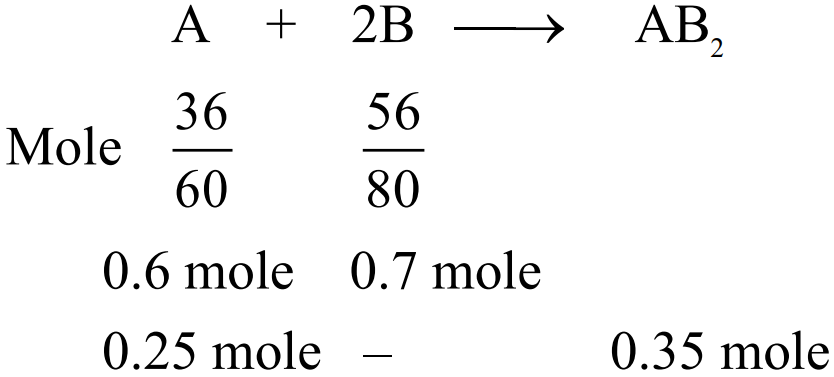
\(60 + 2 \times 80 = 220~g/mol\)
(B) LR is AB.
(C) Wt. of A remaining = \(0.25 \times 60 = 15~g\)
(D) wt. of \(AB_{2}\) formed = \(0.35 \times 220 = 77~gm\). -
- (A) \(\text{FeO}\)
- (B) \(\text{Fe}_2\text{O}_3\)
- (C) \(\text{Fe}_3\text{O}_4\)
- (D) \(\text{FeO}_3\)
Show answer and solution
Correct Answer: (B)
Mass percentage of \(\text{Fe} = 69.9\%\)
Mass percentage of \(\text{O} = 100\% - 69.9\% = 30.1\%\)
Number of moles of \(\text{Fe} = \dfrac{69.9}{56} = 1.248\)
Number of moles of \(\text{O} = \dfrac{30.1}{16} = 1.881\)
Molar ratio of \(\text{Fe} : \text{O} = 1.248 : 1.881\)
Dividing by the smallest value, the ratio is \(\dfrac{1.248}{1.248} : \dfrac{1.881}{1.248} = 1 : 1.5\)
Multiplying by \(2\) to get the simplest whole number ratio, we get \(2 : 3\).
The empirical formula is \(\text{Fe}_2\text{O}_3\).
Answer: \(\text{Fe}_2\text{O}_3\) -
- (A) 0.9
- (B) 0.1
- (C) 0.337
- (D) 0.663
Show answer and solution
Correct Answer: (C)
Explanation:
Step 1: Find the total mass of \( \text{H}_2\text{SO}_4 \) in the resultant mixture:
- Mass of \( \text{H}_2\text{SO}_4 \) from the first solution = \( 98\% \text{ of } 100\text{ g} = 98\text{ g} \)
- Mass of \( \text{H}_2\text{SO}_4 \) from the second solution = \( 49\% \text{ of } 100\text{ g} = 49\text{ g} \)
- Total mass of \( \text{H}_2\text{SO}_4 = 98\text{ g} + 49\text{ g} = 147\text{ g} \)
Step 2: Find the total mass of water (\( \text{H}_2\text{O} \)) in the resultant mixture:
- Total mass of the combined solution = \( 100\text{ g} + 100\text{ g} = 200\text{ g} \)
- Total mass of \( \text{H}_2\text{O} = \text{Total mass of solution} - \text{Total mass of } \text{H}_2\text{SO}_4 \)
- Total mass of \( \text{H}_2\text{O} = 200\text{ g} - 147\text{ g} = 53\text{ g} \)
Step 3: Calculate the number of moles of each component:
- Molar mass of \( \text{H}_2\text{SO}_4 = 2(1) + 32 + 4(16) = 98\text{ g mol}^{-1} \)
- Moles of \( \text{H}_2\text{SO}_4 \text{ } (n_{\text{H}_2\text{SO}_4}) = \frac{147\text{ g}}{98\text{ g mol}^{-1}} = 1.5\text{ mol} \)
- Molar mass of \( \text{H}_2\text{O} = 2(1) + 16 = 18\text{ g mol}^{-1} \)
- Moles of \( \text{H}_2\text{O} \text{ } (n_{\text{H}_2\text{O}}) = \frac{53\text{ g}}{18\text{ g mol}^{-1}} = 2.944\text{ mol} \)
Step 4: Calculate the mole fraction of \( \text{H}_2\text{SO}_4 \):
\( \text{Mole fraction } (\chi_{\text{H}_2\text{SO}_4}) = \frac{n_{\text{H}_2\text{SO}_4}}{n_{\text{H}_2\text{SO}_4} + n_{\text{H}_2\text{O}}} \)
\( \chi_{\text{H}_2\text{SO}_4} = \frac{1.5}{1.5 + 2.944} = \frac{1.5}{4.444} \approx 0.3375 \)
Rounding off to three decimal places, we get \( 0.337 \).
Hence, Option C is the correct choice. -
- (A) 64.97 g of HCl remains unreacted
- (B) 32.85 g of \(CaCO_{3}\) remains unreacted
- (C) 97.30 g of HCl reacted
- (D) 60.32 g of HCl remains unreacted
Show answer and solution
Correct Answer: (A)
Density of HCl solution \(( d )=1.13 g / ml\)
\(V =300 ml\)
Wt. of HCl solution \(=339 g\)
Wt. of \(HCl =339 \times \frac{38.55}{100}=130.68 g\)
(LR)
\(CaCO_3+2 HCl \rightarrow CaCl_2+H_2 O+CO_2\)
\(\frac{90}{100} \quad \frac{130.68}{36.5}\)
\(=0.90 mole \quad=3.58 mole\)
Moles of HCl remained \(=1.78\) mole.
Mass of HCl remained \(=64.97 g\). -
- (A) \(1.08\) g
- (B) \(2.16\) g
- (C) \(3.24\) g
- (D) \(4.32\) g
Show answer and solution
Correct Answer: (B)
Molar mass of \(Ag_2CO_3\) = \(2 \times 108 + 12 + 3 \times 16 = 276\) g mol\(^{-1}\)
Number of moles of \(Ag_2CO_3\) = \(\dfrac{2.76}{276} = 0.01\) mol
The decomposition reaction of silver carbonate on heating is:
\(Ag_2CO_3(s) \rightarrow 2Ag(s) + CO_2(g) + \dfrac{1}{2}O_2(g)\)
From the stoichiometry of the reaction, \(1\) mole of \(Ag_2CO_3\) gives \(2\) moles of Ag as residue.
Number of moles of Ag formed = \(2 \times 0.01 = 0.02\) mol
Mass of Ag residue = \(0.02 \times 108 = 2.16\) g
Answer: \(2.16\) g -
- (A) A, B, C and E only
- (B) A, B, and C only
- (C) A, B and E only
- (D) D and E only
Show answer and solution
Correct Answer: (B)
Primary standards must be soluble for standard solution information. -
- (A) 11.2 L \(H_{2}(g)\) at STP is produced for every mole of HCl consumed.
- (B) 67.2 L \(H_{2}(g)\) at STP is produced for every mole of Al that reacts.
- (C) 12 L \(HCl(aq)\) is consumed for every 6L \(H_{2}(g)\) produced.
- (D) 33.6 L \(H_{2}(g)\) is produced regardless of temperature and pressure for every mole of Al that reacts.
Show answer and solution
Correct Answer: (A)
\(2Al (s) + 6HCl (aq) \rightarrow 2Al^{3+} (aq) + 6Cl^{-} (aq) + 3H_{2}(g)\)
Mole of \(H_{2}\) produced
\(=2 \times\) mole of HCl used
\(=\frac{2}{3} \times\) mole of Al used -
- (A) A-IV, B-III, C-I, D-II
- (B) A-III, B-II, C-IV, D-I
- (C) A-III, B-IV, C-II, D-I
- (D) A-III, B-IV, C-I, D-II
Show answer and solution
Correct Answer: (C)
For A: Molar mass of \(H_2O = 18\) g/mol. Moles of \(H_2O = \dfrac{1.8 \times 10^{-3}}{18} = 10^{-4}\). Since each \(H_2O\) molecule has \(3\) atoms, the number of atoms = \(3 \times 10^{-4} \times N_A\).
For B: Molar mass of \(H_2SO_4 = 98\) g/mol. Moles of \(H_2SO_4 = \dfrac{9.8 \times 10^{-3}}{98} = 10^{-4}\). Since each \(H_2SO_4\) molecule has \(7\) atoms, the number of atoms = \(7 \times 10^{-4} \times N_A\).
For C: Molar mass of \(C = 12\) g/mol. Moles of \(C = \dfrac{1.8 \times 10^{-3}}{12} = 1.5 \times 10^{-4}\). The number of atoms = \(1.5 \times 10^{-4} \times N_A\).
For D: Molar mass of \(NaCl = 58.5\) g/mol. Moles of \(NaCl = \dfrac{5.85 \times 10^{-3}}{58.5} = 10^{-4}\). Since each \(NaCl\) formula unit has \(2\) atoms, the number of atoms = \(2 \times 10^{-4} \times N_A\).
Thus, the correct matching is A-III, B-IV, C-II, D-I.
Answer: A-III, B-IV, C-II, D-I
No questions on this page match these filters.