


Questions
10 questionsShowing 1–10 of 10 questions
-
- (A) 2
- (B) 3
- (C) 4
- (D) 5
Show answer and solution
Correct Answer: (B)
The chemical reaction of phenol with zinc dust is given by:
\(C_6H_5OH + Zn \xrightarrow{\Delta} C_6H_6 + ZnO\)
Product X is benzene (\(C_6H_6\)).
Molar mass of phenol (\(C_6H_5OH\)) = \(6 \times 12 + 6 \times 1 + 16 = 94\) g mol\(^{-1}\)
Number of moles of phenol taken = \(\dfrac{4.7}{94} = 0.05\) mol
From the stoichiometry of the reaction, 1 mole of phenol produces 1 mole of benzene.
Theoretical moles of X formed = \(0.05\) mol
Since the reaction goes to \(60\%\) completion, the actual moles of X formed is:
\(0.05 \times \dfrac{60}{100} = 0.03\) mol
This can be written as \(3 \times 10^{-2}\) mol.
Answer: \(3\) -
- (A) 3
- (B) 5
- (C) 2
- (D) 4
Show answer and solution
Correct Answer: (D)
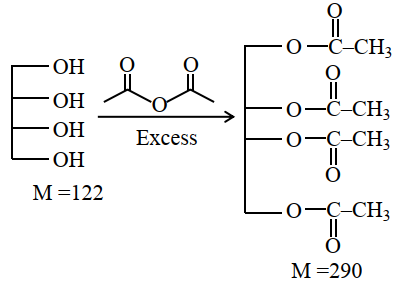
No. of OH groups \(=\frac{290-122}{42}=4\) -
- (A)
D E Conc. H\(_2\)SO\(_4\) CH\(_2 =\) CH \(-\) CH(OH)CH\(_3\) - (B)
D E PCC HO \(-\) CH\(_2\) \(-\) CH\(_2\) \(-\) CH \(=\) CH\(_2\) - (C)
D E PCC CH\(_2 =\) CH \(-\) CH \(=\) CH\(_2\) - (D)
D E Conc. H\(_2\)SO\(_4\) or H\(_3\)PO\(_4\) CH\(_2 =\) CH \(-\) CH \(=\) CH\(_2\)
Show answer and solution
Correct Answer: (D)
Compound A is pentan-1-ol (\(CH_3-CH_2-CH_2-CH_2-CH_2-OH\)) and Compound B is pent-1-ene (\(CH_2=CH-CH_2-CH_2-CH_3\)).
The conversion of an alcohol to an alkene is a dehydration reaction, which requires an acidic dehydrating agent such as concentrated \(H_2SO_4\) or \(H_3PO_4\). Thus, reagent D is concentrated \(H_2SO_4\) or \(H_3PO_4\).
Compound C is butane-1,3-diol (\(HO-CH_2-CH_2-CH(OH)-CH_3\)).
When C is treated with excess dehydrating agent (reagent D), both hydroxyl groups undergo elimination (dehydration). The elimination of two water molecules yields a conjugated diene, which is highly stable due to resonance.
The product E formed is 1,3-butadiene (\(CH_2=CH-CH=CH_2\)).
Answer:D E Conc. H\(_2\)SO\(_4\) or H\(_3\)PO\(_4\) CH\(_2 =\) CH \(-\) CH \(=\) CH\(_2\) - (A)
-
- (A) Both compounds x and y will dissolve in NaOH.
- (B) Compound y will dissolve in \(NaHCO _3\) and evolve a gas.
- (C) Compound x is more acidic than compound y.
- (D) Both compounds x and y will burn with sooty flame.
Show answer and solution
Correct Answer: (C)
\(( X ) \xrightarrow[(2)_3 H _3 O ^{\oplus}]{\text { (1) } CO _2 / NaOH } Y _{\text {Major }}\)
\(76.6 \% C\)
\(6.38 \% H\)
Vapour Density 47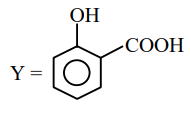
Salicylic acid
Gives colour with \(FeCl _3\)
Soluble in \(NaHCO _3\)
Soluble in NaOH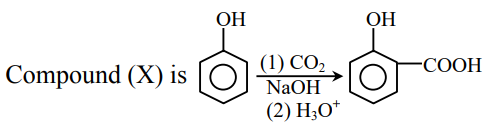
-
- (A) Both Statement I and Statement II are true
- (B) Both Statement I and Statement II are false
- (C) Statement I is true but Statement II is false
- (D) Statement I is false but Statement II is true
Show answer and solution
Correct Answer: (D)
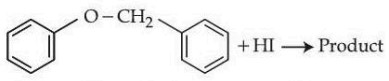
The given reactant is phenyl benzyl ether (\(C_6H_5-O-CH_2-C_6H_5\)).
When it reacts with \(HI\), the ether oxygen is first protonated to form an oxonium ion. The cleavage of the ether linkage then takes place.
The \(C_6H_5-O\) bond has partial double bond character due to the resonance of the oxygen's lone pair with the benzene ring, making it strong and difficult to break. On the other hand, the \(O-CH_2\) bond is a weaker single bond. Moreover, cleavage of the \(O-CH_2\) bond can proceed via a highly stable benzyl carbocation (in an \(S_N1\) mechanism) or undergo facile \(S_N2\) attack by the iodide ion (\(I^-\)) at the less sterically hindered and activated benzylic carbon.
Therefore, the \(I^-\) ion attacks the \(CH_2\) group, cleaving the \(O-CH_2\) bond. The products formed are phenol (\(C_6H_5OH\)) and benzyl iodide (\(C_6H_5CH_2I\)).
Statement I claims the products are benzyl alcohol and iodobenzene, which is incorrect. Thus, Statement I is false.
Statement II claims that the \(-O-CH_2-\) bond is cleaved to give the product, which is correct. Thus, Statement II is true.
Answer: Statement I is false but Statement II is true -
- (A) Five
- (B) Three
- (C) Four
- (D) Two
Show answer and solution
Correct Answer: (B)
Classification of Alcohols:
Primary \( (1^\circ) \) alcohol: The \( -\text{OH} \) group is attached to a carbon atom that is bonded to only one other carbon atom.
Secondary \( (2^\circ) \) alcohol: The \( -\text{OH} \) group is attached to a carbon atom that is bonded to two other carbon atoms.
Tertiary \( (3^\circ) \) alcohol: The \( -\text{OH} \) group is attached to a carbon atom that is bonded to three other carbon atoms.
Structural Analysis:
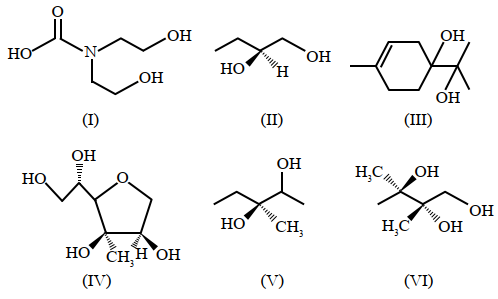
- Compound (I): The \( -\text{OH} \) groups are part of terminal \( -\text{CH}_2\text{CH}_2\text{OH} \) chains, making them primary \( (1^\circ) \) alcohols.
- Compound (II): Contains a \( -\text{CH(OH)}- \) group where the hydroxyl-bearing carbon is bonded directly to two neighboring carbon atoms. This is a secondary \( (2^\circ) \) alcohol.
- Compound (III): The alcohol groups are attached to carbons that are bonded to three other carbons, which classifies them as tertiary \( (3^\circ) \) alcohols.
- Compound (IV): Contains secondary \( (2^\circ) \) alcohol groups on both the side chain (\( -\text{CH(OH)}- \)) and the cyclic ring structure.
- Compound (V): Contains a \( -\text{CH(OH)}- \) group attached to two adjacent carbon positions, classifying it as a secondary \( (2^\circ) \) alcohol.
- Compound (VI): Contains only primary \( (1^\circ) \) and tertiary \( (3^\circ) \) alcohol functional groups.
Thus, compounds (II), (IV), and (V) contain at least one secondary alcohol group.
Total number of such compounds = \( 3 \)
Correct Option: B (Three) -
- (A) Both Statement I and Statement II are false
- (B) Statement I is true but Statement II is false
- (C) Both Statement I and Statement II are true
- (D) Statement I is false but Statement II is true
Show answer and solution
Correct Answer: (D)
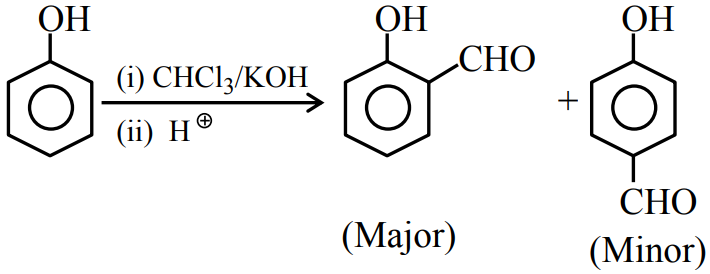
(can be separated by steam distillation) -
- (A) A-III, B-I, C-IV, D-II
- (B) A-III, B-IV, C-I, D-II
- (C) A-I, B-III, C-II, D-IV
- (D) A-I, B-II, C-III, D-IV
Show answer and solution
Correct Answer: (A)
Cyclohexanol is a secondary alcohol, which gives a positive Lucas test.
Cyclohexylamine is a primary aliphatic amine, which reacts with Hinsberg's reagent (benzenesulfonyl chloride) to form a product soluble in alkali.
Cyclohexanecarbaldehyde is an aliphatic aldehyde, which gives a positive Tollen's test (silver mirror test).
Phenol undergoes the phthalein dye test by reacting with phthalic anhydride in the presence of concentrated sulfuric acid to form phenolphthalein, which gives a pink colour in an alkaline medium.
Thus, the correct matching is A-III, B-I, C-IV, D-II.
Answer: A-III, B-I, C-IV, D-II -
- (A) 165
- (B) 170
- (C) 175
- (D) 180
Show answer and solution
Correct Answer: (C)
When phenol is treated with dilute \(\text{HNO}_3\) at \(298\text{ K}\), it undergoes electrophilic aromatic substitution to give a mixture of ortho-nitrophenol and para-nitrophenol.
The mixture is separated by steam distillation. Ortho-nitrophenol is steam volatile due to intramolecular hydrogen bonding, whereas para-nitrophenol is not steam volatile due to intermolecular hydrogen bonding. Thus, the steam volatile compound (X) is ortho-nitrophenol.
Molecular formula of phenol: \(\text{C}_6\text{H}_6\text{O}\)
Molar mass of phenol \(= (6 \times 12) + (6 \times 1) + 16 = 94\text{ g mol}^{-1}\)
Percentage of oxygen in phenol \(= \dfrac{16}{94} \times 100 \approx 17.02\%\)
Molecular formula of ortho-nitrophenol (X): \(\text{C}_6\text{H}_5\text{NO}_3\)
Molar mass of ortho-nitrophenol \(= (6 \times 12) + (5 \times 1) + 14 + (3 \times 16) = 139\text{ g mol}^{-1}\)
Percentage of oxygen in ortho-nitrophenol \(= \dfrac{48}{139} \times 100 \approx 34.53\%\)
Increase in percentage of oxygen \(= 34.53\% - 17.02\% = 17.51\%\)
We need to express this as \(y \times 10^{-1} \%\).
\(17.51\% = 175.1 \times 10^{-1} \%\)
Rounding to the nearest integer, we get \(175\).
Answer: \(175\) -
- (A) A and D Only
- (B) A, C and E Only
- (C) C and D Only
- (D) B, D and E Only
Show answer and solution
Correct Answer: (C)
Reaction given Alcohol
(A) \(CH_{4} + O_{2} \xrightarrow{Mo_{2}O_{3}} HCHO\)
(B) \(2 CH _3 CH _3+3 O _2 \xrightarrow[\Delta]{\left( CH _3 COO \right)_2 Mn } CH _3 COOH\)
(C)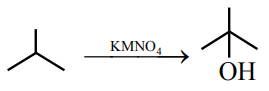
(D) \(2 CH _4+ O _2 \xrightarrow[523 K, 100 atm .]{ Cu } CH _3- OH\)
(E)
No questions on this page match these filters.