


All JEE Mains 2026 Chemistry questions
26 chaptersShowing 351–400 of 432 questions
-
- (A) Both Statement I and Statement II are false
- (B) Statement I is false but Statement II is true
- (C) Statement I is true but Statement II is false
- (D) Both Statement I and Statement II are true
Show answer and solution
Correct Answer: (B)
Correct order of size is \(Mg > Al > Mg ^{2+}> Al ^{3+}\)
Atomic size depends mainly upon \(Z _{\text {effective }}\) and shell number.
Generally on moving down the group electron affinity decreases and on moving across the period electron affinity increase.
In the periodic table Cl has maximum electron affinity. Halogen has higher electron affinity than Chalcogen.
\(Cl > Br > S > O\) -
- (A) Both Statement I and Statement II are true
- (B) Both Statement I and Statement II are false
- (C) Statement I is true but Statement II is false
- (D) Statement I is false but Statement II is true
Show answer and solution
Correct Answer: (A)
Electronegativity increases across a period from left to right. Nitrogen, oxygen, and fluorine belong to group 15, 16, and 17 respectively in the second period. Thus, the correct order of electronegativity is \(F > O > N\). Statement I is true.
In \(OF_2\), fluorine is more electronegative than oxygen and always exhibits an oxidation state of \(-1\). Let the oxidation state of oxygen be \(x\). Then \(x + 2(-1) = 0 \Rightarrow x = +2\).
In \(Na_2O\), sodium is an alkali metal and exhibits an oxidation state of \(+1\). Let the oxidation state of oxygen be \(y\). Then \(2(+1) + y = 0 \Rightarrow y = -2\).
Statement II is also true.
Both Statement I and Statement II are true.
Answer: Both Statement I and Statement II are true -
- (A) Both Statement I and Statement II are true
- (B) Both Statement I and Statement II are false
- (C) Statement I is true but Statement II is false
- (D) Statement I is false but Statement II is true
Show answer and solution
Correct Answer: (A)
Statement I:
\(Al_2O_3\) and \(Cr_2O_3\) are both amphoteric oxides.
\(Cl_2O_7\) and \(Mn_2O_7\) are both acidic oxides.
\(Na_2O\) and \(V_2O_3\) are both basic oxides.
\(CO\) and \(N_2O\) are both neutral oxides.
All \(4\) pairs contain oxides of the same nature. Hence, Statement I is true.
Statement II:
\(Na_2O\) is a strongly basic oxide.
\(Al_2O_3\) is an amphoteric oxide.
\(CO\) is a neutral oxide.
\(Cl_2O_7\) is a strongly acidic oxide.
Thus, the most basic oxide is \(Na_2O\) and the most acidic oxide is \(Cl_2O_7\). Hence, Statement II is true.
Both Statement I and Statement II are true.
Answer: Both Statement I and Statement II are true -
- (A) Both statement I and statement II are true
- (B) Both statement I and statement II are false
- (C) Statement I is false but statement II is true
- (D) Statement I is true but statement II is false
Show answer and solution
Correct Answer: (A)
\( Na^{+}:-1s^{2} 2s^{2} 2p^{6} \) (fully filled electronic configuration)
\( Mg^{+}:-1s^{2} 2s^{2} 2p^{6} 3s^{1} \)
\( IE_{2} \) of \( Na > IE_{2} \) of Mg
Size of \( O^{2-} > F^{-} \) -
- (A) Both Statement I and Statement II are true
- (B) Both Statement I and Statement II are false
- (C) Statement I is true but Statement II is false
- (D) Statement I is false but Statement II is true
Show answer and solution
Correct Answer: (B)
Statement I: The second ionization enthalpy of Ga is higher than that of Al. This is due to the poor shielding effect of the ten \(3d\) electrons in Ga, which increases the effective nuclear charge and holds the valence electrons more tightly. The correct order of second ionization enthalpy is \(B > Ga > Al\). Thus, Statement I is false.
Statement II: The first ionization enthalpy generally decreases down the group. However, Pb has a slightly higher ionization enthalpy than Sn due to the poor shielding of \(4f\) and \(5d\) electrons (lanthanoid contraction). The correct order of first ionization enthalpy for Group 14 elements is \(Sn < Pb < Ge < Si < C\). Thus, Statement II is false.
Both Statement I and Statement II are false.
Answer: Both Statement I and Statement II are false -
- (A) lowest and lowest
- (B) highest and lowest
- (C) lowest and highest
- (D) highest and highest
Show answer and solution
Correct Answer: (C)
In a period, as we move from left to right, the atomic size decreases and the effective nuclear charge increases.
Due to the large atomic size and low effective nuclear charge, the element at the extreme left (alkali metal) has the lowest first ionisation enthalpy in the period.
As we move to the extreme right (excluding noble gases), the elements (halogens) have the smallest atomic size and highest effective nuclear charge in the period. They require only one electron to complete their octet. Thus, they have the highest negative electron gain enthalpy.
Therefore, the first ionisation enthalpy of the extreme left element is the lowest, and the negative electron gain enthalpy of the extreme right element is the highest.
Answer: lowest and highest - 357. In period 4 of the periodic table, the elements with highest and lowest atomic radii are respectively: 2026 Medium
- (A) Na & Cl
- (B) K & Se
- (C) K & Br
- (D) Rb & Br
Show answer and solution
Correct Answer: (C)
In a period moving from left to right atomic size decreases. -
- (A) A-II, B-III, C-IV, D-I
- (B) A-IV, B-III, C-II, D-I
- (C) A-III, B-II, C-IV, D-I
- (D) A-III, B-II, C-I, D-IV
Show answer and solution
Correct Answer: (A)
Given \(n=2\), the electronic configurations correspond to elements of the second period.
A. \(ns^2 \Rightarrow 2s^2\) is Beryllium (Be).
B. \(ns^2np^1 \Rightarrow 2s^2 2p^1\) is Boron (B).
C. \(ns^2np^3 \Rightarrow 2s^2 2p^3\) is Nitrogen (N).
D. \(ns^2np^6 \Rightarrow 2s^2 2p^6\) is Neon (Ne).
The first ionization energy generally increases across a period from left to right. However, Beryllium has a higher ionization energy than Boron due to the stable fully-filled \(2s\) subshell. Nitrogen has a high ionization energy due to its stable half-filled \(2p\) subshell. Neon, being a noble gas, has the highest ionization energy.
The order of first ionization energy is B \(<\) Be \(<\) N \(<\) Ne.
Arranging the given values in increasing order: \(800 < 899 < 1402 < 2080\) kJ mol\(^{-1}\).
Thus, the matching is:
A. Be \(\rightarrow 899\) (II)
B. B \(\rightarrow 800\) (III)
C. N \(\rightarrow 1402\) (IV)
D. Ne \(\rightarrow 2080\) (I)
This corresponds to A-II, B-III, C-IV, D-I.
Answer: A-II, B-III, C-IV, D-I - 359. The \(1^{st}\) ionization enthalpy for Mg is \(+737\) kJ/mol. The most probable estimated value of the \(2^{nd}\) ionization enthalpy of Mg is ______. 2026 Medium
- (A) \(-906\) kJ/mol
- (B) \(-856\) kJ/mol
- (C) \(+1450\) kJ/mol
- (D) \(+590\) kJ/mol
Show answer and solution
Correct Answer: (C)
Ionization enthalpy is the energy required to remove an electron from an isolated gaseous atom or ion. It is always an endothermic process, so its value is always positive.
The second ionization enthalpy is the energy required to remove an electron from a unipositive ion. Since the effective nuclear charge increases after the removal of the first electron, the remaining electrons are held more tightly by the nucleus. Thus, the second ionization enthalpy is always greater than the first ionization enthalpy (\(IE_{2} > IE_{1}\)).
Given the first ionization enthalpy of Mg is \(+737\) kJ/mol, the second ionization enthalpy must be positive and greater than \(+737\) kJ/mol.
Among the given options, only \(+1450\) kJ/mol satisfies these conditions.
Answer: \(+1450\) kJ/mol -
- (A) \(F < N < C < O\)
- (B) \(C < O < N < F\)
- (C) \(C < N < F < O\)
- (D) \(C < F < N < O\)
Show answer and solution
Correct Answer: (C)
To compare second ionization potential configuration of mono-cation is observed.\(C ^{+}\) \(N ^{+}\) \(O ^{+}\) \(F ^{+}\) [He]\(2 s^2 sp ^1\) [He]\(2 s^2 sp ^2\) [He]\(2 s^2 sp ^3\)Half - filled stable. [He]\(2 s^2 sp ^4\)
\(2^{nd}\) IE order:
\(O > F > N > C\) - 361. The correct set that contains all kinds (basic, acidic, amphoteric and neutral) of oxides is: 2026 Medium
- (A) \(Na_2 O, K_2 O, Al_2 O_3\) and \(As_2 O_3\)
- (B) \(Al_2 O_3, As_2 O_3, CO\) and \(NO\)
- (C) \(K_2 O, Cl_2 O_7, As_2 O_3\) and \(NO\)
- (D) \(Na_2 O, N_2 O, Al_2 O_3\) and \(CO\)
Show answer and solution
Correct Answer: (C)
\(K_2O\) is a metallic oxide and is basic in nature.
\(Cl_2O_7\) is a non-metallic oxide with a high oxidation state and is acidic in nature.
\(As_2O_3\) is a metalloid oxide and is amphoteric in nature.
\(NO\) is a neutral oxide.
Thus, the set \(K_2O, Cl_2O_7, As_2O_3\) and \(NO\) contains all kinds of oxides.
Answer: \(K_2 O, Cl_2 O_7, As_2 O_3\) and \(NO\) - 362. The correct trend in the first ionization enthalpies of the elements in the \(3^{rd}\) period of periodic table is: 2026 Hard
- (A) \(Al < Si < S < P < Cl\)
- (B) \(Al < S < P < Si < Cl\)
- (C) \(Si < S < Al < P < Cl\)
- (D) \(S < Si < Al < P < Cl\)
Show answer and solution
Correct Answer: (A)
In general on moving from left to right in a period ionization energy increases as \(Z_{eff}\) increases.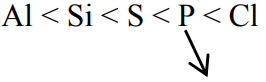
(Ionisation energy of phosphorus is more because of half filled stable configuration) -
- (A) \((r_A + r_B), 2(r_A + r_B)\)
- (B) \(\dfrac{1}{2}(r_A + r_B), (r_A + r_B)\)
- (C) \((r_A + r_B), (r_A + r_B)\)
- (D) \(2(r_A + r_B), \dfrac{1}{2}(r_A + r_B)\)
Show answer and solution
Correct Answer: (A)
The covalent bond length of the AB molecule is the internuclear distance between atom A and atom B.
Bond length = \(r_A + r_B\)
The total length of the AB molecule is the distance between the outermost boundaries of the two atoms along the internuclear axis.
Total length = Radius of A + Bond length + Radius of B
Total length = \(r_A + (r_A + r_B) + r_B = 2(r_A + r_B)\)
Answer: \((r_A + r_B), 2(r_A + r_B)\) -
- (A) A, B and D only
- (B) A, B, C and D
- (C) A and B only
- (D) B and C only
Show answer and solution
Correct Answer: (A)
→ On moving left to right in a period IE increases and from top to bottom in a group IE decreases.
\( F>P>S>B \) (IE order)
→ On moving left to right in a period metallic and basic character decreases.
\( K>Mg>Al>B \) (Metallic character order)
On moving top to bottom in a group metallic and basic character increases.
\( K_{2}O>Na_{2}O>MgO>Al_{2}O_{3} \)
→ EA: Group 17 > Group 16 > Group 15
\( Cl>F>S>P \) -
- (A) \((2.7 \times 10^{-5})^3\)
- (B) \(6 \times 10^{-2}\)
- (C) \(\sqrt{2.7 \times 10^{-5}}\)
- (D) \(3 \times 10^{-2}\)
Show answer and solution
Correct Answer: (D)
For the reaction \(A_2(g) + B_2(g) \rightleftharpoons C(g)\), the equilibrium constant is \(K_1 = 2.7 \times 10^{-5}\).
When a reaction is multiplied by a factor \(n\), the new equilibrium constant becomes \(K^n\).
The given reaction is multiplied by \(\dfrac{1}{3}\) to obtain the reaction \(\dfrac{1}{3}A_2(g) + \dfrac{1}{3}B_2(g) \rightleftharpoons \dfrac{1}{3}C(g)\).
The new equilibrium constant \(K_2\) is given by:
\(K_2 = (K_1)^{1/3}\)
\(K_2 = (2.7 \times 10^{-5})^{1/3}\)
\(K_2 = (27 \times 10^{-6})^{1/3}\)
\(K_2 = 3 \times 10^{-2}\)
Answer: \(3 \times 10^{-2}\) -
- (A) 2.67, 2.67, 2.67
- (B) 1.21, 2.24, 1.56
- (C) 1.66, 1.66, 1.66
- (D) 2.56, 1.62, 2.24
Show answer and solution
Correct Answer: (A)
\(\underset {t = t_{eq}}{} ~\underset {2 ~mole}{P_2(g)} +~\underset {2 ~mole}{Q_2(g)} \rightleftharpoons ~\underset {2 ~mole}{2PQ(g)}\)
\(K _{ eq }=\frac{2^2}{2.2}=1\)
Now 1 mole of each \(P_2\) and \(Q_2\) is added
So reaction will move in forward direction
\(\underset {t = t'_{eq}}{} ~\underset {3 ~-~x}{P_2(g)} +~\underset {3 ~-~x}{Q_2(g)} \rightleftharpoons ~\underset {2 ~+~2x}{2PQ(g)}\)
\(K_{c}=1=\frac{(2+2x)^{2}}{(3-x)(3-x)}\)
\(\frac{2+2x}{3-x}=1\)
\(2+2x=3-x\)
\(x=\frac{1}{3}\)
At new equilibrium
Moles of \(P_{2}=\frac{8}{3}=2.67\)
Moles of \(Q_{2}=\frac{8}{3}=2.67\)
Moles of \(PQ=\frac{8}{3}=2.67\) -
- (A) \(2.5\times 10^{-3}\)
- (B) \(2.5\times 10^{3}\)
- (C) \(1.0\times 10^{-5}\)
- (D) \(5\times 10^{-3}\)
Show answer and solution
Correct Answer: (C)
The given reactions are:
\(2xy \rightleftharpoons x_2 + y_2 \quad K_1 = 2.5 \times 10^5\)
\(xy + \dfrac{1}{2}z_2 \rightleftharpoons xyz \quad K_2 = 5 \times 10^{-3}\)
We need to find the equilibrium constant \(K_3\) for the reaction:
\(\dfrac{1}{2}x_2 + \dfrac{1}{2}y_2 + \dfrac{1}{2}z_2 \rightleftharpoons xyz\)
Reversing the first reaction and multiplying it by \(\dfrac{1}{2}\), we get:
\(\dfrac{1}{2}x_2 + \dfrac{1}{2}y_2 \rightleftharpoons xy\)
The equilibrium constant for this modified reaction is:
\(K' = \left(\dfrac{1}{K_1}\right)^{\dfrac{1}{2}} = \dfrac{1}{\sqrt{K_1}}\)
Adding this modified reaction to the second reaction:
\(\dfrac{1}{2}x_2 + \dfrac{1}{2}y_2 \rightleftharpoons xy \quad (K')\)
\(xy + \dfrac{1}{2}z_2 \rightleftharpoons xyz \quad (K_2)\)
---------------------------------------------------
\(\dfrac{1}{2}x_2 + \dfrac{1}{2}y_2 + \dfrac{1}{2}z_2 \rightleftharpoons xyz\)
The equilibrium constant \(K_3\) for the overall reaction is the product of the equilibrium constants of the added reactions:
\(K_3 = K' \times K_2 = \dfrac{K_2}{\sqrt{K_1}}\)
Substituting the given values:
\(K_3 = \dfrac{5 \times 10^{-3}}{\sqrt{2.5 \times 10^5}}\)
\(K_3 = \dfrac{5 \times 10^{-3}}{\sqrt{25 \times 10^4}}\)
\(K_3 = \dfrac{5 \times 10^{-3}}{5 \times 10^2}\)
\(K_3 = 1.0 \times 10^{-5}\)
Answer: \(1.0\times 10^{-5}\) -
- (A) (i) 3, 1; (ii) 3, 1
- (B) (i) 4, 1; (ii) 4, 1
- (C) (i) 1, 3; (ii) 2, 1
- (D) (i) 1, 2; (ii) 2, 1
Show answer and solution
Correct Answer: (D)
For reaction (i): \(K _{ p }> K _{ c }\)
\(\Delta n _{ g }>0\)
\(y-x>0\)
\(85.87=2.586(0.0821 \times 400)^{y \times}\)
Solving \(y-x \simeq 1\)
For reaction (ii) : \(K _{ p }< K _{ c }\)
\( y-x<0\). -
- (A) 100
- (B) 125
- (C) 150
- (D) 200
Show answer and solution
Correct Answer: (B)
\(NH _{3(g)} \rightleftharpoons \frac{1}{2} N_{2(g)}+\frac{3}{2} H _{2(g)}\)
\(t=0\)\(\quad\)1mole\(\quad\quad\)—\(\quad\quad\)—
\(t = t _{ eq }\)\(\quad\)\(1-\alpha\)\(\quad\)\(\alpha / 2\)\(\quad\)\(3 \alpha / 2\)
\(k _{ p }=\frac{\left(\frac{\alpha}{2}\right)^{1 / 2}\left(\frac{3 \alpha}{2}\right)^{3 / 2}}{(1-\alpha)}\left[\frac{ P _{ T }}{1+\alpha}\right]^1\)\(\quad\)\(\left[\because P _{ T }=\sqrt{3} atm\right]\)
\(9=\frac{\left(\frac{\alpha}{2}\right)^{1 / 2}\left(\frac{3 \alpha}{2}\right)^{3 / 2}}{(1-\alpha)} \times \frac{(3)^{1 / 2}}{1+\alpha}\)
\(9=\frac{9\left(\frac{\alpha}{2}\right)^2}{1-\alpha^2}\)
\(1-\alpha^2=\frac{\alpha^2}{4}\)
\(\frac{5 \alpha^2}{4}=1\)
\(\alpha^2=0.8\)
\(\alpha=(0.8)^{1 / 2}\)
\(\alpha=\left[\frac{1}{0.8}\right]^{-1 / 2}\)
\(\begin{array}{l}\alpha=\left[125 \times 10^{-2}\right]^{-1 / 2} \\ x=125\end{array}\) -
- (A) 2472
- (B) 2473
- (C) 2474
- (D) 2475
Show answer and solution
Correct Answer: (C)
Let the initial moles of \(N_2O_5\) be \(2\).
The given reaction is:
\(2N_2O_5(g) \rightleftharpoons 2N_2O_4(g) + O_2(g)\)
Since \(N_2O_5\) is \(50\%\) dissociated (degree of dissociation \(\alpha = 0.5\)), the moles at equilibrium are:
Moles of \(N_2O_5 = 2(1 - 0.5) = 1\)
Moles of \(N_2O_4 = 2(0.5) = 1\)
Moles of \(O_2 = 0.5\)
Total moles at equilibrium \(= 1 + 1 + 0.5 = 2.5\)
Given the total pressure \(P = 2\) atm, the partial pressures of the gases are:
\(P_{N_2O_5} = \dfrac{1}{2.5} \times 2 = 0.8\) atm
\(P_{N_2O_4} = \dfrac{1}{2.5} \times 2 = 0.8\) atm
\(P_{O_2} = \dfrac{0.5}{2.5} \times 2 = 0.4\) atm
The equilibrium constant \(K_p\) is:
\(K_p = \dfrac{(P_{N_2O_4})^2 \cdot P_{O_2}}{(P_{N_2O_5})^2} = \dfrac{(0.8)^2 \times 0.4}{(0.8)^2} = 0.4\)
The standard free energy change \(\Delta G^\circ\) is given by:
\(\Delta G^\circ = -RT \ln K_p\)
Using the given values:
\(\ln(0.4) = 2.303 \log(0.4) = 2.303 (\log 4 - \log 10)\)
\(\ln(0.4) = 2.303 (2 \log 2 - 1) = 2.303 (2 \times 0.30 - 1) = 2.303 (-0.4) = -0.9212\)
Now, substituting the values into the \(\Delta G^\circ\) equation (\(T = 50^\circ C + 273 = 323\) K):
\(\Delta G^\circ = -8.314 \times 323 \times (-0.9212)\)
\(\Delta G^\circ = 2473.81\) J mol\(^{-1}\)
The magnitude of the standard free energy change to the nearest integer is \(2474\) J mol\(^{-1}\).
Answer: \(2474\) -
- (A) D and E only
- (B) C and E only
- (C) A and D only
- (D) B and C only
Show answer and solution
Correct Answer: (A)

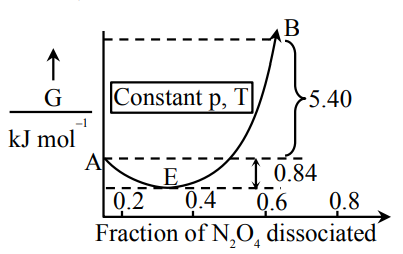
(A) \( \Delta_{r}G^{\circ} = G^{\circ}_{B} - G^{\circ}_{A} = +ve \)
(B) \( \Delta_{r}G^{\circ} = +ve \). \( N_{2}O_{4} \) will partially dissociate into \( NO_{2} \).
(C) For reverse reaction, It is partially completed as there is equilibrium at E.
(D) For 1 mole \( N_{2}O_{4} \) ; \( \Delta_{r}G^{\circ} = -0.84 \, kJ \, mol^{-1} \).
(E) For 2 mole \( NO_{2} \) ; \( \Delta G^{\circ} = -5.4 - 0.84 = -6.24 \, kJ \, mol^{-1} \). -
- (A) 8
- (B) 10
- (C) 12
- (D) 14
Show answer and solution
Correct Answer: (A)
The given equilibrium reaction is:
\(\text{X}_2\text{Y}_4(g) \rightleftharpoons 2\text{XY}_2(g)\)
Initial moles: \(1\)
Degree of dissociation, \(\alpha = 0.75\)
Moles of \(\text{X}_2\text{Y}_4\) at equilibrium \(= 1 - \alpha = 1 - 0.75 = 0.25\)
Moles of \(\text{XY}_2\) at equilibrium \(= 2\alpha = 2 \times 0.75 = 1.5\)
Total moles at equilibrium \(= 0.25 + 1.5 = 1.75\)
Given total pressure, \(P = 1\) atm.
Partial pressure of \(\text{X}_2\text{Y}_4\), \(P_{\text{X}_2\text{Y}_4} = \dfrac{0.25}{1.75} \times 1 = \dfrac{1}{7}\) atm
Partial pressure of \(\text{XY}_2\), \(P_{\text{XY}_2} = \dfrac{1.5}{1.75} \times 1 = \dfrac{6}{7}\) atm
The equilibrium constant \(K_p\) is given by:
\(K_p = \dfrac{(P_{\text{XY}_2})^2}{P_{\text{X}_2\text{Y}_4}} = \dfrac{(\dfrac{6}{7})^2}{\dfrac{1}{7}} = \dfrac{36}{7}\)
The standard Gibbs free energy change is:
\(\Delta_r G^{\ominus} = -RT \ln K_p = -2.3 RT \log K_p\)
Calculating \(\log K_p\):
\(\log \left(\dfrac{36}{7}\right) = \log 36 - \log 7 = \log (2^2 \times 3^2) - \log 7\)
\(\log \left(\dfrac{36}{7}\right) = 2 \log 2 + 2 \log 3 - \log 7\)
\(\log \left(\dfrac{36}{7}\right) = 2(0.3) + 2(0.48) - 0.84 = 0.6 + 0.96 - 0.84 = 0.72\)
Substituting the values into the \(\Delta_r G^{\ominus}\) equation:
\(\Delta_r G^{\ominus} = -2.3 \times 8.3 \times 600 \times 0.72\)
\(\Delta_r G^{\ominus} = -8246.88 \text{ J mol}^{-1} = -8.24688 \text{ kJ mol}^{-1}\)
The magnitude of \(\Delta_r G^{\ominus}\) is \(8.24688 \text{ kJ mol}^{-1}\).
Rounding to the nearest integer, we get \(8\).
Answer: \(8\) -
- (A) 0.367, 0.275
- (B) 0.53, 0.4
- (C) 0.742, 0.557
- (D) 0.557, 0.418
Show answer and solution
Correct Answer: (D)
\(\begin{array}{ccc} A & \rightleftharpoons & B \\ 0.5 M & & 0.375 M \end{array} \quad\) (At equilibrium)
\(K_{eq} = \frac{[B]_{eq}}{[A]_{eq}} = \frac{0.375}{0.5} = 0.75\)
Now 0.1 mole of A is added so reaction will move in forward direction.
\(A \rightleftharpoons B\)
\(0.6 - x\) \(0.375 + x\)
\(K_{eq} = 0.75 = \frac{0.375 + x}{0.6 - x}\)
\(0.45 - 0.75x = 0.375 + x\)
\(1.75x = 0.075\)
\(x = \frac{0.075}{1.75} = \frac{3}{70} = 0.043\)
Moles of \(A =0.043=0.557\)
Moles of \(B =0.418\) -
- (A) \(3.28, 2.624\)
- (B) \(2.624, 3.28\)
- (C) \(3.28, 0.656\)
- (D) \(0.656, 6.56\)
Show answer and solution
Correct Answer: (A)
The given reaction is \(A(g) \rightleftharpoons B(g)\).
Let the initial moles of \(A\) be \(1\) and at equilibrium, let \(x\) moles of \(A\) dissociate.
Moles at equilibrium:
\(n_A = 1 - x\)
\(n_B = x\)
Since \(\Delta n_g = 0\), the equilibrium constant \(K_c\) can be written in terms of moles:
\(K_c = \dfrac{n_B}{n_A} = \dfrac{x}{1 - x} = 4.0\)
\(x = 4 - 4x \Rightarrow 5x = 4 \Rightarrow x = 0.8\)
At equilibrium, the moles of the gases are:
\(n_{He} = 1\)
\(n_B = 0.8\)
Using the ideal gas equation \(P = \dfrac{nRT}{V}\), the partial pressures are calculated as follows:
Partial pressure of He:
\(P_{He} = \dfrac{1 \times 0.082 \times 400}{10} = 3.28\) atm
Partial pressure of \(B(g)\):
\(P_B = \dfrac{0.8 \times 0.082 \times 400}{10} = 2.624\) atm
Answer: \(3.28, 2.624\) -
- (A) 2
- (B) 4
- (C) 6
- (D) 8
Show answer and solution
Correct Answer: (B)
For the first equilibrium:
\(\text{CaCO}_3(s) \rightleftharpoons \text{CaO}(s) + \text{CO}_2(g)\)
\(K_{p_1} = P_{\text{CO}_2} = 0.08 \text{ atm}\)
For the second equilibrium:
\(\text{C}(s) + \text{CO}_2(g) \rightleftharpoons 2\text{CO}(g)\)
\(K_{p_2} = \dfrac{(P_{\text{CO}})^2}{P_{\text{CO}_2}} = 2 \text{ atm}\)
Substituting the value of \(P_{\text{CO}_2}\):
\(\dfrac{(P_{\text{CO}})^2}{0.08} = 2\)
\((P_{\text{CO}})^2 = 0.16\)
\(P_{\text{CO}} = 0.4 \text{ atm} = 4 \times 10^{-1} \text{ atm}\)
Answer: \(4\) -
- (A) 100
- (B) 10
- (C) 1
- (D) 0.1
Show answer and solution
Correct Answer: (A)
\(H _2 X \rightleftharpoons H ^{+}+ HX ^{-}\),
\(0.1-x \quad x+y \quad x-y\)
\(2.5 \times 10^{-8}=\frac{(x+y)(x-y)}{0.1-x}\)
\(HX ^{-} \rightleftharpoons H ^{+}+ X ^{2-}\)
\(x-y \quad x+y \quad y\)
\(1 \times 10^{-13}=\frac{( x + y )( y )}{ x - y }\)
Approximate : \(K _{ a _1} \gg K_{ a _2} \Rightarrow\) So \(x \gg y\).
\(x + y \approx x , x - y \approx x\)
\(10^{-13}=\frac{x \cdot y}{x}\)
\(y=10^{-13}\)
\(\left[ X ^{2-}\right]=10^{-13}\)
\(\left[ X ^{2-}\right]=100 \times 10^{-15}\) -
- (A) \(\dfrac{x^2}{a^2 + x^2} \times p\)
- (B) \(\dfrac{x^2}{a^2 - x^2} \times p\)
- (C) \(\dfrac{a + x^2}{x^2} \times p\)
- (D) \(\dfrac{a^2 - x^2}{x^2} \times p\)
Show answer and solution
Correct Answer: (B)
The reaction is \(A(g) \rightleftharpoons B(g) + C(g)\)
Initial moles: \(a\) for \(A\), \(0\) for \(B\), \(0\) for \(C\)
Moles at equilibrium: \((a - x)\) for \(A\), \(x\) for \(B\), \(x\) for \(C\)
Total moles at equilibrium \(= (a - x) + x + x = a + x\)
Partial pressures at equilibrium:
\(p_A = \dfrac{a - x}{a + x} p\)
\(p_B = \dfrac{x}{a + x} p\)
\(p_C = \dfrac{x}{a + x} p\)
The equilibrium constant \(K_p\) is given by:
\(K_p = \dfrac{p_B \cdot p_C}{p_A}\)
\(K_p = \dfrac{\left(\dfrac{x}{a + x} p\right) \left(\dfrac{x}{a + x} p\right)}{\dfrac{a - x}{a + x} p}\)
\(K_p = \dfrac{x^2}{(a + x)(a - x)} p\)
\(K_p = \dfrac{x^2}{a^2 - x^2} p\)
Answer: \(\dfrac{x^2}{a^2 - x^2} \times p\) -
- (A) 215
- (B) 220
- (C) 225
- (D) 230
Show answer and solution
Correct Answer: (D)
According to the van 't Hoff equation:
\(\log_{10} K_p = -\dfrac{\Delta H^\circ}{2.303 R} \left(\dfrac{1}{T}\right) + \dfrac{\Delta S^\circ}{2.303 R}\)
This represents a linear equation \(y = mx + c\), where \(y = \log_{10} K_p\) and \(x = \dfrac{1}{T}\). The slope \(m\) of the line is given by:
\(m = -\dfrac{\Delta H^\circ}{2.303 R}\)
From the given data table, we can calculate the slope \(m\) using any two points, for example \((0.05, 3.5)\) and \((0.06, 2.5)\):
\(m = \dfrac{y_2 - y_1}{x_2 - x_1} = \dfrac{2.5 - 3.5}{0.06 - 0.05} = \dfrac{-1.0}{0.01} = -100\)
Equating the calculated slope to the theoretical slope:
\(-\dfrac{\Delta H^\circ}{2.303 R} = -100\)
\(\dfrac{\Delta H^\circ}{R} = 100 \times 2.303 = 230.3\)
The magnitude of \(\dfrac{\Delta H^\circ}{R}\) is \(230.3\). Rounding to the nearest integer, we get \(230\).
Answer: \(230\) -
- (A) 60
- (B) 70
- (C) 80
- (D) 90
Show answer and solution
Correct Answer: (B)
\(A _2+ B _2 \xrightarrow{500 K} 2 AB \log K =2.2\)
\(\Delta H ^{\circ}=(2 \times 32)-(6+ x )=(58- x ) kJ\)
\(\Delta S ^{\circ}=(2 \times 222)-(146+280)=18\) Joule
\(\Delta G ^{\circ}=- RT \ln K\)
\(\Delta G ^{\circ}=-\frac{8.314 \times 500 \times 2.2 \times 2.303}{1000}\)
\(\Delta G ^{\circ}=-21.06\)
\(58-x-500\left(\frac{18}{1000}\right)=-21.06\)
\(x =70.06 KJ / mol\) -
- (A) 12
- (B) 15
- (C) 18
- (D) 20
Show answer and solution
Correct Answer: (B)
\(X _2(g)+ Y _2(g) \rightleftharpoons 2 Z ( g )\)
\(K_C=\frac{(9)^2}{3 \times 3}=9\)
Now 10 moles of \(Z\) are added then reaction will move in backward direction.
\(X _2(g)+ Y _2(g) \rightleftharpoons 2 Z ( g )\)
\(3+X \quad 3+X \quad 19-2 X\)
\(K_c=\frac{(19-2 X)^2}{(3+X)(3+X)}=9\)
\(\frac{19-2 X}{3+X}=3\)
\(19-2 X=9+3 X\)
\(\begin{array}{l}10=5 X \\ X=2\end{array}\)
At equilibrium ⇒ moles of \(Z=19-2 \times 2\)
\(=15\) moles -
- (A) \( w=-9.1~kJ, \Delta U=0, \Delta H=0, q=9.1~kJ \)
- (B) \( w=9.1~J, \Delta U=9.1~J, \Delta H=0; q=0 \)
- (C) \( w=+4.1~kJ, \Delta U=0, \Delta H=0; q=-4.1~kJ \)
- (D) \( w=-3.9~kJ, \Delta U=0, \Delta H=0; q=3.9~kJ \)
Show answer and solution
Correct Answer: (A)
For isothermal reversible process \( \Delta U=\Delta H=0 \)
\( w_{iso}=-p_{1}v_{1} \ln \frac{p_1}{p_2} \)
\( W_{iso}=-0.5 \times 10^{6} \times 20 \times 10^{-3} \ln \frac{0.5}{0.2} \)
\( W_{iso}=-0.5 \times 10^{6} \times 20 \times 10^{-3} \times 2.303 \times (0.6989-0.3010) \)
\( w=-9.1~kJ \)
\( q=-w=9.1~kJ \) -
- (A) \(q=+ve, w=0, \Delta U=-ve\)
- (B) \(q=+ve, w=-ve, \Delta U=+ve\)
- (C) \(q=-ve, w=-ve, \Delta U=-ve\)
- (D) \(q=+ve, w=-ve, \Delta U=-ve\)
Show answer and solution
Correct Answer: (B)
\(\underset{5^{\circ} C }{ H _2 O (\ell)} \longrightarrow \underset{100^{\circ} C }{ H _2 O (\ell) \rightleftarrows} \underset{100^{\circ} C }{ H _2 O ( g )}\)
due to expansion \(W=-ve\)
as heat is given to system so \(q = +ve\) and internal energy of gas will be more than internal energy of liquid so \(\Delta U=+ve\) -
- (A) \(|w_B| > |w_A| > |w_C| > |w_D|\)
- (B) \(|w_C| > |w_D| > |w_A| > |w_B|\)
- (C) \(|w_C| > |w_D| > |w_B| > |w_A|\)
- (D) \(|w_B| > |w_A| > |w_D| > |w_C|\)
Show answer and solution
Correct Answer: (C)
Let State \(1\) have pressure \(P_1\) and volume \(V_1\), and State \(2\) have pressure \(P_2\) and volume \(V_2\). For an isothermal expansion, \(V_2 > V_1\) and \(P_1 > P_2\).
For expansion from State \(1\) to State \(2\):
In a single-stage expansion, the external pressure is constant at the final pressure \(P_2\). The magnitude of work is \(|w_A| = P_2(V_2 - V_1)\).
In a multi-stage expansion, the external pressure is reduced in steps, keeping it closer to the internal pressure of the gas. The work done by the gas increases with the number of stages, reaching a maximum for a reversible process (\(|w_{rev}|\)). Thus, \(|w_{rev}| > |w_B| > |w_A|\).
For compression from State \(2\) to State \(1\):
In a single-stage compression, the external pressure is constant at the final pressure \(P_1\). The magnitude of work is \(|w_C| = P_1(V_2 - V_1)\).
In a multi-stage compression, the external pressure is increased in steps. The work done on the gas decreases with the number of stages, reaching a minimum for a reversible process (\(|w_{rev}|\)). Thus, \(|w_C| > |w_D| > |w_{rev}|\).
Since \(P_1 > P_2\), the single-stage compression work \(|w_C|\) is the largest, and the single-stage expansion work \(|w_A|\) is the smallest. The reversible work magnitude \(|w_{rev}|\) is the same for both expansion and compression between the same states.
Combining these inequalities, we get:
\(|w_C| > |w_D| > |w_{rev}| > |w_B| > |w_A|\)
Therefore, the correct order of the magnitude of work is \(|w_C| > |w_D| > |w_B| > |w_A|\).
Answer: \(|w_C| > |w_D| > |w_B| > |w_A|\) -
- (A) 725
- (B) 726
- (C) 727
- (D) 728
Show answer and solution
Correct Answer: (C)
At the transition temperature and \(1\) atm pressure, the two states \(A\) and \(B\) are in equilibrium.
For a phase transition of a pure substance at \(1\) atm, both states are in their standard states, so the reaction quotient \(Q = 1\).
Using the relation \(\Delta G = \Delta G^0 + RT \ln Q\), we get \(\Delta G = \Delta G^0\).
At equilibrium, \(\Delta G = 0\), which implies \(\Delta G^0 = 0\).
Given \(\Delta G^0 = 105 - 35\log T\), we can equate it to zero:
\(105 - 35\log T = 0\)
\(35\log T = 105\)
\(\log T = 3\)
\(T = 10^3 = 1000\) K
Converting the temperature to Celsius:
\(T(^{\circ}\text{C}) = 1000 - 273 = 727^{\circ}\text{C}\)
Answer: \(727\) -
- (A) \(\frac{X+Y+2Z}{4}\)
- (B) \(\frac{X+Y+4Z}{2}\)
- (C) \(X+Y+Z\)
- (D) \(\frac{-X+Y+Z}{4}\)
Show answer and solution
Correct Answer: (A)
\(C ( s )+2 H _2(g) \rightarrow CH _4(g)\)
\(-x=\left(\Delta H_{\text {sub }}\right.\) of carbon \()+2 \times(\) B.E. of \(H-H)\)
\(-4 \times(\) B.E. of \(C - H )\)
\(-x=y+2 z-4(\) B.E. of \(C-H)\)
B.E. of \(C - H =\frac{ y +2 z + x }{4}\). -
- (A) \(-21000\)
- (B) \(-10\)
- (C) \(-1000\)
- (D) \(-9.012\)
Show answer and solution
Correct Answer: (B)
The given reaction is \(X_2(g) + Y_2(g) \rightleftharpoons 2XY(g)\).
The standard enthalpy of reaction, \(\Delta_r H^\circ\), is calculated as:
\(\Delta_r H^\circ = \sum \Delta_f H^\circ(\text{products}) - \sum \Delta_f H^\circ(\text{reactants})\)
\(\Delta_r H^\circ = 2 \Delta_f H^\circ(XY) - [\Delta_f H^\circ(X_2) + \Delta_f H^\circ(Y_2)]\)
\(\Delta_r H^\circ = 2(42) - (8 + 80) = 84 - 88 = -4 \text{ kJ mol}^{-1}\)
The standard entropy of reaction, \(\Delta_r S^\circ\), is calculated as:
\(\Delta_r S^\circ = \sum S^\circ(\text{products}) - \sum S^\circ(\text{reactants})\)
\(\Delta_r S^\circ = 2 S^\circ(XY) - [S^\circ(X_2) + S^\circ(Y_2)]\)
\(\Delta_r S^\circ = 2(200) - (140 + 250) = 400 - 390 = 10 \text{ J K}^{-1} \text{ mol}^{-1}\)
Converting \(\Delta_r S^\circ\) to \(\text{kJ K}^{-1} \text{ mol}^{-1}\):
\(\Delta_r S^\circ = \dfrac{10}{1000} = 0.01 \text{ kJ K}^{-1} \text{ mol}^{-1}\)
Now, using the Gibbs free energy equation:
\(\Delta_r G^\circ = \Delta_r H^\circ - T \Delta_r S^\circ\)
\(\Delta_r G^\circ = -4 - 600 \times 0.01\)
\(\Delta_r G^\circ = -4 - 6 = -10 \text{ kJ mol}^{-1}\)
Answer: \(-10\) -
- (A) \(-648\) kJ mol\(^{-1}\)
- (B) \(-1350\) kJ mol\(^{-1}\)
- (C) \(-2002\) kJ mol\(^{-1}\)
- (D) \(-1527\) kJ mol\(^{-1}\)
Show answer and solution
Correct Answer: (D)
Explanation:
Let us calculate the enthalpy of formation of anhydrous solid \( Al_2Cl_6 \) using Hess's Law of Constant Heat Summation:
1. Identify the Target Reaction:
The standard reaction for the enthalpy of formation of anhydrous solid \( Al_2Cl_6 \) from its constituent elements is:
\( 2Al(s) + 3Cl_2(g) \rightarrow Al_2Cl_6(s) \) ; \( \Delta H_f = ? \)
2. Algebraic Manipulation of Given Equations:
To obtain the target equation, we perform the following mathematical operations on the given equations:
We need \( 2Al(s) \) on the reactant side: Keep Equation (i) as it is.
We need \( 3Cl_2(g) \) on the reactant side: Multiply Equation (ii) by 3.
To cancel out the \( 6HCl(g) \) produced, we need them in aqueous form: Multiply Equation (iii) by 6.
We need anhydrous \( Al_2Cl_6(s) \) on the product side: Reverse Equation (iv) (multiply by -1).
Therefore, the net operation is: Equation (i) + 3 \times Equation (ii) + 6 \times Equation (iii) - Equation (iv)
3. Verification by Adding the Modified Equations:
\( 2Al(s) + 6HCl(aq) \rightarrow Al_2Cl_6(aq) + 3H_2(g) \)
\( 3H_2(g) + 3Cl_2(g) \rightarrow 6HCl(g) \)
\( 6HCl(g) + aq \rightarrow 6HCl(aq) \)
\( Al_2Cl_6(aq) \rightarrow Al_2Cl_6(s) + aq \)
Summing these equations and canceling common species on both sides yields our target equation:
\( 2Al(s) + 3Cl_2(g) \rightarrow Al_2Cl_6(s) \)
4. Calculating the Final Enthalpy (\( \Delta H_f \)):
Applying the same algebraic operations to the respective enthalpy values:
\( \Delta H_f = \Delta H_1 + 3\Delta H_2 + 6\Delta H_3 - \Delta H_4 \)
\( \Delta H_f = -1200 + 3(-164) + 6(-83) - (-663) \)
\( \Delta H_f = -1200 - 492 - 498 + 663 \)
\( \Delta H_f = -2190 + 663 = -1527\text{ kJ/mol} \)
Hence, Option D is the correct choice. -
- (A) 1123
- (B) 1126
- (C) 1128
- (D) 1130
Show answer and solution
Correct Answer: (B)
The standard enthalpy of reaction is given by:
\(\Delta_r H^{\ominus} = \sum \Delta_f H^{\ominus}(\text{products}) - \sum \Delta_f H^{\ominus}(\text{reactants})\)
For the given reaction:
\(2\text{H}_2\text{S}(g) + 3\text{O}_2(g) \rightarrow 2\text{H}_2\text{O}(l) + 2\text{SO}_2(g)\)
\(\Delta_r H^{\ominus} = [2 \Delta_f H^{\ominus}(\text{H}_2\text{O}, l) + 2 \Delta_f H^{\ominus}(\text{SO}_2, g)] - [2 \Delta_f H^{\ominus}(\text{H}_2\text{S}, g) + 3 \Delta_f H^{\ominus}(\text{O}_2, g)]\)
Substituting the given values:
\(\Delta_r H^{\ominus} = [2(-286.0) + 2(-297.0)] - [2(-20.1) + 3(0)]\)
\(\Delta_r H^{\ominus} = [-572.0 - 594.0] - [-40.2]\)
\(\Delta_r H^{\ominus} = -1166.0 + 40.2 = -1125.8 \text{ kJ mol}^{-1}\)
The magnitude of the enthalpy change is \(1125.8 \text{ kJ mol}^{-1}\).
Rounding to the nearest integer, we get \(1126\).
Answer: \(1126\) -
- (A) 30
- (B) 32
- (C) 34
- (D) 36
Show answer and solution
Correct Answer: (C)
The standard Gibbs free energy change is given by:
\(\Delta G^{\theta} = -RT \ln K = -2.3 RT \log K\)
First, calculate \(\log K\):
\(\log K = \log(1.8 \times 10^{-7}) = \log(18 \times 10^{-8})\)
\(\log K = \log 18 - 8 = \log(2 \times 3^2) - 8\)
\(\log K = \log 2 + 2 \log 3 - 8\)
Substituting the given values:
\(\log K = 0.30 + 2(0.48) - 8 = 0.30 + 0.96 - 8 = 1.26 - 8 = -6.74\)
Now, calculate \(\Delta G^{\theta}\):
\(\Delta G^{\theta} = -2.3 \times 8.3 \times 300 \times (-6.74) = 38599.98 \text{ J mol}^{-1}\)
Using the relation \(\Delta G^{\theta} = \Delta H^{\theta} - T \Delta S^{\theta}\):
\(38599.98 = 28400 - 300 \Delta S^{\theta}\)
\(300 \Delta S^{\theta} = 28400 - 38599.98 = -10199.98\)
\(\Delta S^{\theta} = -\dfrac{10199.98}{300} \approx -34 \text{ J K}^{-1} \text{ mol}^{-1}\)
The magnitude of \(\Delta S^{\theta}\) is \(34\).
Answer: \(34\) -
- (A) 30
- (B) 33
- (C) 35
- (D) 38
Show answer and solution
Correct Answer: (B)
\(-1.664 \times 10^3=-8.3 \times 300 \ln K_{ p }\)
\(\ln K _{ p }=0.693\)
\(K_{ p }=2\)
\(2=\frac{4 \alpha^2 P _0}{1-\alpha^2}\)
\(\alpha=\frac{1}{\sqrt{3}}\)
\(\alpha=\left(\frac{100}{3} \times 10^{-2}\right)^{1 / 2}\)
\(=\left(33.33 \times 10^{-2}\right)^{1 / 2}\) -
- (A) \(18\) J of the work is done by the gas 'A'.
- (B) \(2\) J of the work is done by the gas 'A'.
- (C) \(12\) J of the work is done on the gas 'A' by the surrounding.
- (D) \(14\) J of the work is done on the gas 'A' by the surrounding.
Show answer and solution
Correct Answer: (D)
Using the first law of thermodynamics, \(\Delta U = q + w\).
For the process from state X to state Y:
Heat absorbed by the gas, \(q_{X \to Y} = +10\) J
Work done by the gas, \(w_{X \to Y} = -18\) J
Change in internal energy, \(\Delta U_{X \to Y} = q_{X \to Y} + w_{X \to Y} = 10 - 18 = -8\) J
For the reverse process from state Y to state X:
Change in internal energy, \(\Delta U_{Y \to X} = -\Delta U_{X \to Y} = +8\) J
Heat evolved by the gas, \(q_{Y \to X} = -6\) J
Let the work done on the gas be \(w_{Y \to X}\).
\(\Delta U_{Y \to X} = q_{Y \to X} + w_{Y \to X}\)
\(8 = -6 + w_{Y \to X}\)
\(w_{Y \to X} = +14\) J
Since the work done is positive, \(14\) J of work is done on the gas by the surrounding.
Answer: \(14\) J of the work is done on the gas 'A' by the surrounding. -
- (A) Both Statement I and Statement II are true
- (B) Both Statement I and Statement II are false
- (C) Statement I is true but Statement II is false
- (D) Statement I is false but Statement II is true
Show answer and solution
Correct Answer: (D)
For an ideal gas, the relationship between heat capacity at constant pressure (\(C_p\)) and heat capacity at constant volume (\(C_v\)) is given by Mayer's relation:
\(C_p - C_v = R\)
Since the universal gas constant \(R\) is a positive value, \(C_p > C_v\). Thus, Statement I is false.
In a constant volume (isochoric) process, the change in volume \(\Delta V = 0\).
Work done, \(W = P\Delta V = 0\).
According to the first law of thermodynamics:
\(\Delta U = q + W\)
Since \(W = 0\), we get \(\Delta U = q_v\).
This means that in a constant volume process, no work is produced and all the heat absorbed by the system (withdrawn from the surroundings) goes entirely into increasing the internal energy (chaotic motion of the molecules). This increase in internal energy is reflected by an increase in the temperature of the ideal gas. Thus, Statement II is true.
Therefore, Statement I is false but Statement II is true.
Answer: Statement I is false but Statement II is true -
- (A) 3
- (B) 4
- (C) 5
- (D) 6
Show answer and solution
Correct Answer: (A)
Molar mass of ethanol (\(C_2H_5OH\)) \(= 2(12) + 6(1) + 16 = 46\) g mol\(^{-1}\)
Number of moles of ethanol burnt, \(n = \dfrac{3.365}{46} = 0.07315\) mol
Since the combustion occurs in a bomb calorimeter (constant volume), the heat produced corresponds to the change in internal energy (\(\Delta U_c^\circ\)).
\(\Delta U_c^\circ = -\dfrac{99.472}{0.07315} = -1359.8\) kJ mol\(^{-1}\)
The balanced chemical equation for the combustion of ethanol is:
\(C_2H_5OH(l) + 3O_2(g) \rightarrow 2CO_2(g) + 3H_2O(l)\)
Change in the number of gaseous moles, \(\Delta n_g = 2 - 3 = -1\)
Now, calculating the standard enthalpy of combustion (\(\Delta H_c^\circ\)):
\(\Delta H_c^\circ = \Delta U_c^\circ + \Delta n_g RT\)
\(\Delta H_c^\circ = -1359.8 + (-1) \times (8.314 \times 10^{-3} \text{ kJ K}^{-1} \text{ mol}^{-1}) \times 298.15 \text{ K}\)
\(\Delta H_c^\circ = -1359.8 - 2.48 = -1362.28\) kJ mol\(^{-1}\)
The standard enthalpy of combustion can also be written in terms of enthalpies of formation:
\(\Delta H_c^\circ = \sum \Delta H_f^\circ(\text{products}) - \sum \Delta H_f^\circ(\text{reactants})\)
\(\Delta H_c^\circ = [2\Delta H_f^\circ(CO_2, g) + 3\Delta H_f^\circ(H_2O, l)] - [\Delta H_f^\circ(C_2H_5OH, l) + 3\Delta H_f^\circ(O_2, g)]\)
Substituting the given values (note that \(\Delta H_f^\circ\) of \(O_2(g)\) is \(0\)):
\(-1362.28 = [2(-393.5) + 3(-285.8)] - \Delta H_f^\circ(C_2H_5OH, l)\)
\(-1362.28 = [-787.0 - 857.4] - \Delta H_f^\circ(C_2H_5OH, l)\)
\(-1362.28 = -1644.4 - \Delta H_f^\circ(C_2H_5OH, l)\)
\(\Delta H_f^\circ(C_2H_5OH, l) = -1644.4 + 1362.28 = -282.12\) kJ mol\(^{-1}\)
The magnitude is \(|\Delta H_f^\circ| = 282.12\) kJ mol\(^{-1} = 2.8212 \times 10^2\) kJ mol\(^{-1}\)
Rounding to the nearest integer, we get \(3\).
Answer: \(3\) -
- (A) 1000
- (B) 1031
- (C) 1150
- (D) 950
Show answer and solution
Correct Answer: (B)
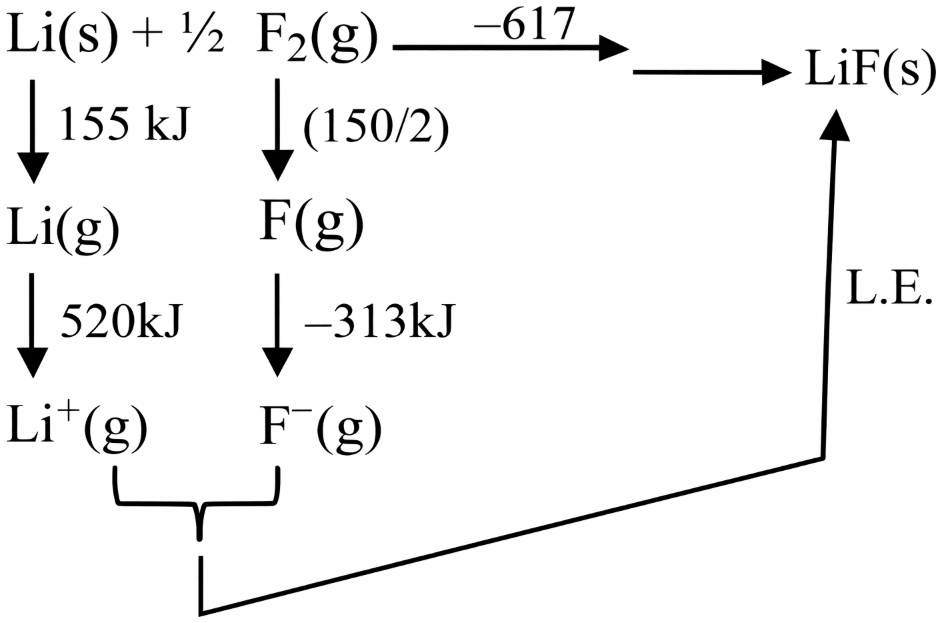
\(-594=155+520+\frac{150}{2}-313+(\) L.E. \()\)
L.E. \(=-1031 kJ / mol\) -
- (A) \( \Delta_{r}G^{\circ}(1) > 0; \Delta_{r}G^{\circ}(2) < 0 \)
- (B) \( \Delta_{r}G^{\circ}(1) < 0; \Delta_{r}G^{\circ}(2) < 0 \)
- (C) \( \Delta_{r}G^{\circ}(1) < 0; \Delta_{r}G^{\circ}(2) > 0 \)
- (D) \( \Delta_{r}G^{\circ}(1) > 0; \Delta_{r}G^{\circ}(2) > 0 \)
Show answer and solution
Correct Answer: (C)
\( PbO_{2} + Pb \rightarrow 2PbO \)
\( Pb^{2+} \) is more stable hence reaction will be spontaneous. So \( \Delta G^{\circ}_{r}(1) \) is negative.
\( SnO_{2} + Sn \rightarrow 2SnO \)
\( Sn^{2+} \) is less stable, so reaction will be non-spontaneous hence \( \Delta G^{\circ}_{r}(2) \) is positive. -
- (A) A-II, B-III, C-I, D-IV
- (B) A-II, B-I, C-IV, D-III
- (C) A-II, B-I, C-III, D-IV
- (D) A-I, B-II, C-III, D-IV
Show answer and solution
Correct Answer: (C)
For an isothermal reversible expansion, the change in internal energy \(\Delta U = 0\). From the first law of thermodynamics, \(q = -w\). The work done is \(w = -nRT \ln\left(\dfrac{V_2}{V_1}\right)\), which gives \(q = nRT \ln\left(\dfrac{V_2}{V_1}\right)\). Thus, A matches II.
For free expansion, the external pressure is zero (\(p_{ext} = 0\)), so the work done \(w = 0\). Since the process is isothermal, \(\Delta U = 0\). Therefore, the heat exchanged \(q = 0\). Thus, B matches I.
For an irreversible compression, the work done against a constant external pressure is given by \(w = -p_{ext}\Delta V\). This corresponds to the expression in III. Thus, C matches III.
For a cyclic reversible process, the initial and final states are the same, so the change in entropy \(\Delta S = 0\). Since \(\Delta S = \dfrac{q_{rev}}{T}\), we get \(\dfrac{q_{rev}}{T} = 0\). Thus, D matches IV.
The correct matching is A-II, B-I, C-III, D-IV.
Answer: A-II, B-I, C-III, D-IV -
- (A) A-IV, B-I, C-III, D-II
- (B) A-IV, B-II, C-III, D-I
- (C) A-I, B-III, C-II, D-IV
- (D) A-II, B-I, C-III, D-IV
Show answer and solution
Correct Answer: (D)
(A) \(W _{ Rev .}=-\int P _{ gas } dV\)
\(W _{\text {Rev. Isot. Exp. }}=- nRT \ln \left[\frac{ V _{ f }}{ V _{ i }}\right]\)
(A) → (II)
(B) Free expansion
\(W _{ irrev. }=- P _{ ext } \Delta V\)
\(P _{ ext }=0\)
\(W =0\)
\(( B ) \rightarrow( I )\)
(C) Irreversible expansion
\(W _{\text {irrev: }}=- P _{\text {ext }} \Delta V\)
\(W_{\text {irrev: }}=-P_{\text {ext }}\left(V_f-V_i\right)\)
(C) → (III)
(D) Irreversible compression
\(W _{\text {irrer: }}=- P _{\text {ext }} \Delta V\)
\(W _{\text {irrer: }}=- P _{\text {ext }}\left( V _{ i }- V _{ f }\right)\) -
- (A) A-III, B-II, C-IV, D-I
- (B) A-II, B-III, C-I, D-IV
- (C) A-I, B-II, C-III, D-IV
- (D) A-II, B-I, C-III, D-IV
Show answer and solution
Correct Answer: (B)
Option (A)
\(
\begin{array}{l}
W=-nRT \ln \frac{V_2}{V_1} \\
=\frac{-2 \times 8.314 \times 300}{1000} \times \ln \left(\frac{20}{2}\right) kJ \\
=-11.5 kJ
\end{array}
\)
Option (B)
\(
\begin{array}{l}
W=-P_{\text {ext }}\left[V_2-V_1\right] \\
=-3[3-1] \\
=-6 kJ
\end{array}
\)
Option (C)
\(
\begin{array}{l}
\Delta U=nC_{v} \Delta T \\
=1 \times \frac{3}{2} \times \frac{8.314 \times 320}{1000} 100 kJ \\
=3.99
\end{array}
\)
Option (D)
\(
\begin{aligned}
\Delta H & =nC_{p} \Delta T \\
& =1 \times \frac{5}{2} \times \frac{8.314 \times 337}{1000} kJ \\
& =7 kJ
\end{aligned}
\) - 399. The correct order of molar heat capacities measured at \(298\text{ K}\) and \(1\text{ bar}\) is : 2026 Medium
- (A) Copper(s) > Bromine(l) > Helium(g)
- (B) Bromine(l) > Copper(s) > Helium(g)
- (C) Helium(g) > Bromine(l) > Copper(s)
- (D) Helium(g) > Bromine(l) = Copper(s)
Show answer and solution
Correct Answer: (B)
The molar heat capacity of Helium (a monatomic gas) at constant pressure is \(C_p = \dfrac{5}{2}R \approx 20.8 \text{ J K}^{-1} \text{ mol}^{-1}\).
The molar heat capacity of Copper (a solid) follows the Dulong-Petit law, which gives \(C_p \approx 3R \approx 24.9 \text{ J K}^{-1} \text{ mol}^{-1}\).
The molar heat capacity of Bromine (a diatomic liquid) is significantly higher due to translational, rotational, and vibrational degrees of freedom along with intermolecular interactions in the liquid state, having \(C_p \approx 75.7 \text{ J K}^{-1} \text{ mol}^{-1}\).
Therefore, the correct order of molar heat capacities is Bromine(l) > Copper(s) > Helium(g).
Answer: Bromine(l) > Copper(s) > Helium(g) -
- (A) \(\frac{hc}{1000}(\frac{y-6x}{4})^{-1}\)
- (B) \(\frac{N_{A}hc}{250(4y-6x)}\)
- (C) \(\frac{N_{A}hc}{250(y-6x)}\)
- (D) \(N_{A}hc(y-\frac{6x}{4})^{-1}\)
Show answer and solution
Correct Answer: (B)
\(CH _4(g) \rightarrow C ( g )+4 H ( g ) ; \quad \Delta_{ r } H = x kJ / mole\)
\(C _2 H _6(g) \rightarrow 2 C ( g )+6 H ( g ) ; \Delta_{ r } H = y kJ / mole\)
\(1000 x =4 \times \varepsilon_{ C - H }\)
\(1000 y =1 \times \varepsilon_{ C - C }+6 \times \varepsilon_{ C - H }\)
\(\varepsilon_{ C - C }=\left[ y -\frac{3 x }{2}\right] \times 1000=\frac{ hc }{\lambda} \cdot N _{ A }\)
\(\left(' \lambda^{\prime}\right)\) wavelength of photon \(=\frac{ hc N _{ A }}{[4 y -6 x ] \times 250}\)
No questions on this page match these filters.