


All JEE Mains 2026 Chemistry questions
26 chaptersShowing 151–200 of 432 questions
-
- (A) A > B > C > D
- (B) C > D > B > A
- (C) A > C > D > B
- (D) C > A > D > B
Show answer and solution
Correct Answer: (C)
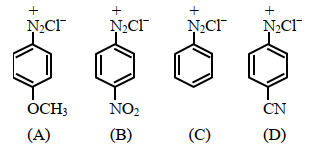
Correct order of stability
\(\underset {+M} {A} > C > \underset {-M} {D} > \underset {-M} {B} \)
EDG increases stability
EWG decreases stability -
- (A) 8
- (B) 10
- (C) 12
- (D) 15
Show answer and solution
Correct Answer: (B)
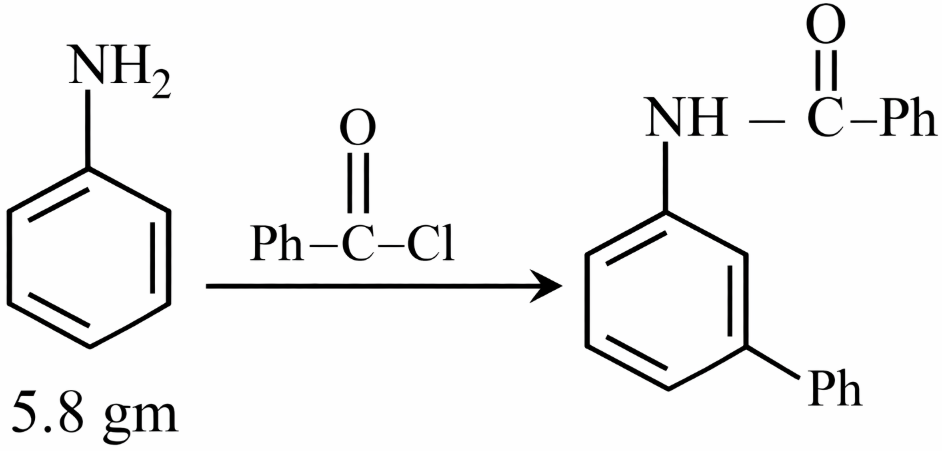
\(n=\frac{5.8}{93}\)
\(n=0.0623\)
\(n =0.0623 \times \frac{82}{100}\)
\(mass =0.051 \times 197\)
\(mass =10.047\) -
- (A) \(5\)
- (B) \(4\)
- (C) \(3\)
- (D) \(6\)
Show answer and solution
Correct Answer: (C)
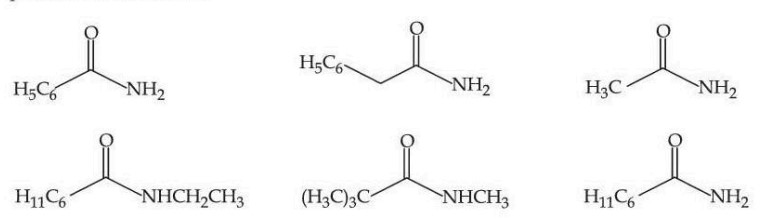
The reaction of an amide with \(\text{Br}_2/\text{KOH}\) (alcoholic) is the Hoffmann bromamide degradation reaction. This reaction is specific to primary amides (\(R-\text{CONH}_2\)) and produces primary amines (\(R-\text{NH}_2\)) with one less carbon atom.
Among the given compounds, the primary amides are:
1. Benzamide (\(\text{C}_6\text{H}_5\text{CONH}_2\))
2. 2-Phenylacetamide (\(\text{C}_6\text{H}_5\text{CH}_2\text{CONH}_2\))
3. Acetamide (\(\text{CH}_3\text{CONH}_2\))
4. Cyclohexanecarboxamide (\(\text{C}_6\text{H}_{11}\text{CONH}_2\))
The other two compounds (N-ethylcyclohexanecarboxamide and N-methylpivalamide) are secondary amides and do not undergo this reaction.
The primary amines formed from the degradation of the four primary amides are:
1. Aniline (\(\text{C}_6\text{H}_5\text{NH}_2\))
2. Benzylamine (\(\text{C}_6\text{H}_5\text{CH}_2\text{NH}_2\))
3. Methylamine (\(\text{CH}_3\text{NH}_2\))
4. Cyclohexylamine (\(\text{C}_6\text{H}_{11}\text{NH}_2\))
The Gabriel phthalimide synthesis is used for the preparation of aliphatic primary amines. It cannot be used to prepare aromatic primary amines (like aniline) because aryl halides do not undergo nucleophilic substitution with the phthalimide anion.
Therefore, aniline cannot be prepared by Gabriel phthalimide synthesis. The remaining three amines (benzylamine, methylamine, and cyclohexylamine) are aliphatic primary amines and can be prepared by this method.
Thus, there are \(3\) compounds that satisfy both conditions.
Answer: \(3\) -
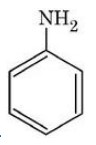
- (A) aniline
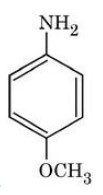
- (B) \(4\)-methoxyaniline
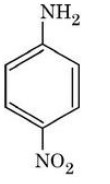
- (C) \(4\)-nitroaniline
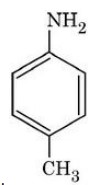
- (D) \(4\)-methylaniline (p-toluidine)
Show answer and solution
Correct Answer: (C)
The strength of a conjugate acid is inversely proportional to the basic strength of its corresponding base. Thus, the weakest base will form the strongest conjugate acid.
The basicity of anilines depends on the availability of the lone pair on the nitrogen atom. Electron-withdrawing groups decrease basicity by withdrawing electron density, while electron-donating groups increase basicity.
In \(4\)-nitroaniline, the \(-\text{NO}_2\) group is a strong electron-withdrawing group due to its \(-R\) and \(-I\) effects. This strongly delocalizes the lone pair of electrons on the nitrogen atom, making \(4\)-nitroaniline the weakest base among the given options.
In contrast, \(-\text{OCH}_3\) (\(+R\) effect) and \(-\text{CH}_3\) (\(+I\) and hyperconjugation) are electron-donating groups that increase basicity, making \(4\)-methoxyaniline and \(4\)-methylaniline stronger bases than aniline.
Since \(4\)-nitroaniline is the weakest base, its conjugate acid is the strongest.
Answer: \(4\)-nitroaniline - (A) aniline
-
- (A) 4
- (B) 2
- (C) 8
- (D) 5
Show answer and solution
Correct Answer: (A)
\(2^{\circ}\) Amines are insoluble with hinsberg reagent.
\(Ph - NH - CH _3, Me - NH - Me\),
\(Ph - NH - CH _2- CH _2- CH _3, Ph - NH - Ph\) -
- (A) A, C and E only
- (B) B, C and D only
- (C) C and E only
- (D) C, D and E only
Show answer and solution
Correct Answer: (C)
The balanced chemical equation for Hoffmann bromamide degradation is:
\(\text{R-CONH}_2 + \text{Br}_2 + 4\text{NaOH} \rightarrow \text{R-NH}_2 + \text{Na}_2\text{CO}_3 + 2\text{NaBr} + 2\text{H}_2\text{O}\)
Statement A is false because \(1\) mole of \(\text{Br}_2\) and \(4\) moles of \(\text{NaOH}\) are consumed per mole of amide.
Statement B is false because primary alkyl amides readily undergo this reaction.
Statement C is true as the primary product of this reaction is a primary amine.
Statement D is false because the reaction is strictly given by primary amides (\(\text{R-CONH}_2\)), not secondary amides.
Statement E is true as the by-products formed are \(\text{Na}_2\text{CO}_3\), \(\text{NaBr}\), and \(\text{H}_2\text{O}\).
Therefore, only statements C and E are true.
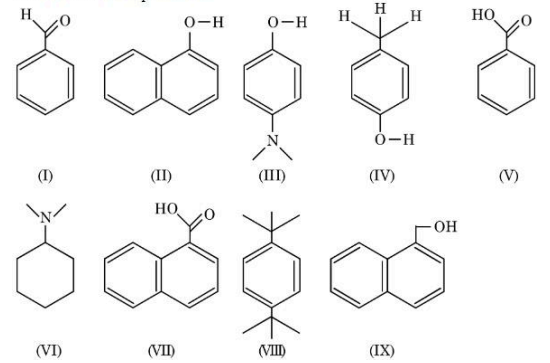
Answer: C and E only - 157. Amongst the following, the total number of compounds soluble in aqueous \(NaOH\) at room temperature is:
 2026 Hard
- (A) \(5\)
- (B) \(4\)
- (C) \(6\)
- (D) \(3\)
Show answer and solution
Correct Answer: (A)
To determine which compounds are soluble in aqueous \(NaOH\), we need to identify the compounds that are sufficiently acidic to react with \(NaOH\) (a strong base) to form water-soluble sodium salts. Generally, carboxylic acids and phenols are acidic enough to dissolve in aqueous \(NaOH\), whereas alcohols, aldehydes, amines, and hydrocarbons are not.
Let us analyze each compound:
(I) Benzaldehyde: It is an aldehyde. It does not have an acidic proton and is insoluble in aqueous \(NaOH\).
(II) 1-Naphthol: It is a phenol derivative. Phenols are acidic and react with \(NaOH\) to form soluble phenoxide salts. (Soluble)
(III) 4-(Dimethylamino)phenol: It contains a phenolic \(-OH\) group. Despite the basic amino group, the acidic phenol group will react with \(NaOH\) to form a soluble salt. (Soluble)
(IV) p-Cresol: It is a phenol derivative. It reacts with \(NaOH\) to form a soluble sodium salt. (Soluble)
(V) Benzoic acid: It is a carboxylic acid, which is highly acidic and readily dissolves in aqueous \(NaOH\). (Soluble)
(VI) N,N-Dimethylcyclohexanamine: It is an aliphatic amine. It is basic in nature and insoluble in aqueous \(NaOH\).
(VII) 1-Naphthoic acid: It is a carboxylic acid and will dissolve in aqueous \(NaOH\). (Soluble)
(VIII) 1,4-Di-tert-butylbenzene: It is a hydrocarbon. It is neutral and insoluble in aqueous \(NaOH\).
(IX) 1-Naphthalenemethanol: It is an alcohol (benzyl-type). Alcohols are generally not acidic enough to react with aqueous \(NaOH\). (Insoluble)
The compounds soluble in aqueous \(NaOH\) are (II), (III), (IV), (V), and (VII).
Total number of soluble compounds = \(5\).
Answer: \(5\) -
- (A) 2-Chloropropanoic acid
- (B) 3-Chloropropanoic acid
- (C) 1-Chloropropane
- (D) 2-Chloropropane
Show answer and solution
Correct Answer: (A)
Step 1: Hydrolysis of the nitrile.
Propanenitrile on basic hydrolysis followed by acidic workup gives propanoic acid:
\(CH_3-CH_2-C \equiv N \xrightarrow[(ii)\ H_3O^+]{(i)\ OH^-/H_2O/\Delta} CH_3-CH_2-COOH\)
Step 2: Hell\(-\)Volhard\(-\)Zelinsky (HVZ) reaction.
Propanoic acid has an \(sp^3\) \(\alpha\)-carbon bearing two \(\alpha\)-hydrogens. In the HVZ reaction, \(Cl_2\) in the presence of red phosphorus selectively replaces one \(\alpha\)-hydrogen by chlorine, giving the \(\alpha\)-chloro acid after aqueous workup:
\(CH_3-CH_2-COOH \xrightarrow[(iv)\ H_2O]{(iii)\ Cl_2/\text{Red P}} CH_3-CH(Cl)-COOH\)
Hence, the major product \(P\) is \(2\)-chloropropanoic acid, which corresponds to option \((1)\). -
- (A) 78.21
- (B) 78.23
- (C) 78.25
- (D) 78.26
Show answer and solution
Correct Answer: (C)
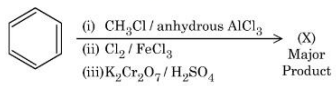
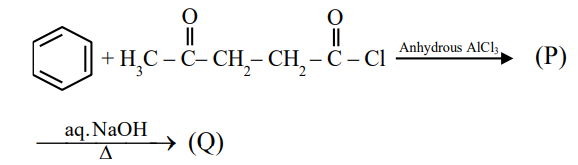
Step 1: The first reaction is a Friedel-Crafts alkylation. Benzene reacts with \(CH_3Cl\) in the presence of anhydrous \(AlCl_3\) to form toluene.
Step 2: The second reaction is electrophilic aromatic substitution. Toluene reacts with \(Cl_2\) in the presence of \(FeCl_3\) to form a mixture of o-chlorotoluene and p-chlorotoluene. Due to steric hindrance at the ortho position, the major product is p-chlorotoluene.
Step 3: The third reaction is the oxidation of the alkyl side chain. p-chlorotoluene is oxidized by \(K_2Cr_2O_7 / H_2SO_4\) to form p-chlorobenzoic acid, which is the major product \((X)\).
The molecular formula of p-chlorobenzoic acid is \(C_7H_5ClO_2\).
Molar mass of \((X) = (7 \times 12) + (5 \times 1) + 35.5 + (2 \times 16) = 84 + 5 + 35.5 + 32 = 156.5 \text{ g mol}^{-1}\).
Step 4: Reaction of p-chlorobenzoic acid with \(NaHCO_3\) liberates \(CO_2\) gas:
\(C_6H_4ClCOOH + NaHCO_3 \rightarrow C_6H_4ClCOONa + H_2O + CO_2 \uparrow\)
From the stoichiometry, \(1\) mole of p-chlorobenzoic acid produces \(1\) mole of \(CO_2\) gas.
Volume of \(CO_2\) liberated at STP = \(11.2 \text{ dm}^3\).
Moles of \(CO_2\) liberated = \(\dfrac{11.2}{22.4} = 0.5 \text{ mol}\).
Therefore, moles of p-chlorobenzoic acid reacted = \(0.5 \text{ mol}\).
Mass of \((X)\) reacted, \(P = 0.5 \text{ mol} \times 156.5 \text{ g mol}^{-1} = 78.25 \text{ g}\).
Answer: \(78.25\) - 160. Consider the following two reactions A and B.
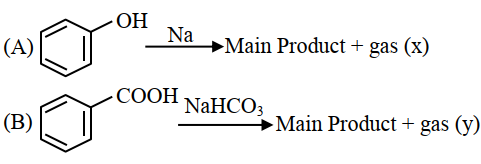
Numerical value of [molar mass of x + molar mass of y] is _____. 2026 Hard- (A) 4
- (B) 88
- (C) 46
- (D) 160
Show answer and solution
Correct Answer: (C)
\( x = H_{2} \) (gas), \( y = CO_{2} \) (gas)
Sum of molar mass = 2 + 44 = 46 -
- (A) A, C and E only
- (B) A and E only
- (C) C and E only
- (D) A, B, D and E only
Show answer and solution
Correct Answer: (A)
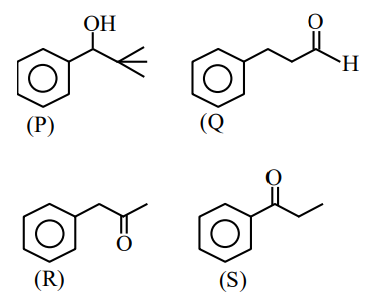
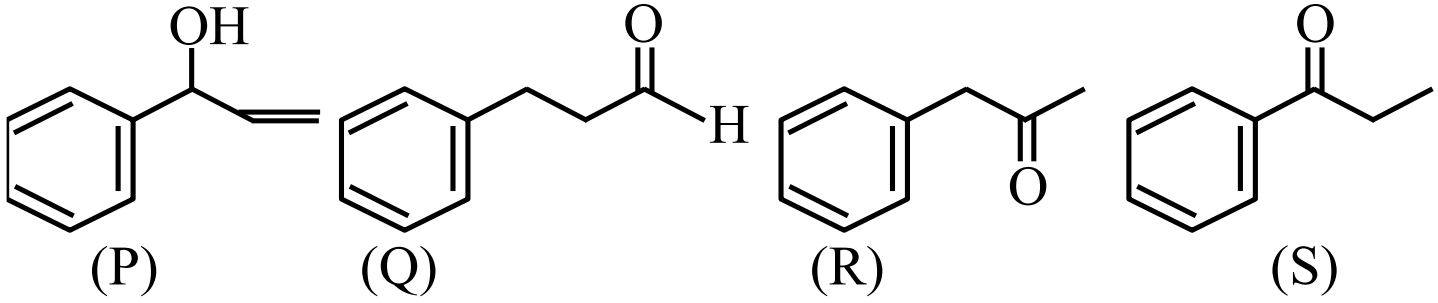
(A) Q, R, S all three give 2, 4 DNP test as they have Aldehyde/ketone group
(C) Q & R gives sooty flame
(E) Q gives Tollens reagent test -
- (A) Statement I is true but Statement II is false
- (B) Statement I is false but Statement II is true
- (C) Both Statement I and Statement II are true
- (D) Both Statement I and Statement II are false
Show answer and solution
Correct Answer: (C)
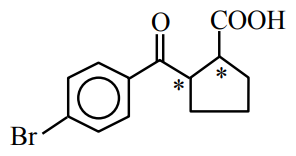
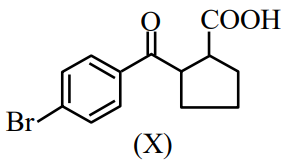
Two chiral centre and due to presence of - COOH compound dissolves in \(NaHCO _3\).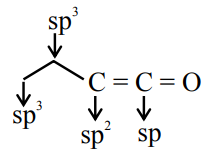
-
- (A) 6
- (B) 16
- (C) 4
- (D) 60
Show answer and solution
Correct Answer: (A)
\(1.4 dm ^3\) (or 1.4 mL ) occupied by 1 gm
\(\therefore \) Molecular weight of \(Q =\frac{22.4}{1.4}=16\)
\(\therefore Q\) is \(CH _4\) gas and Grignard reagent is \(CH _3 MgBr\)
\(CH_3 MgBr \xrightarrow[\text { (ii) } H_3 O^{+}]{\text {(i) } CO_2 \text { (dryice) }} CH_3 COOH\)
(Molecular weight 60 )
\(\therefore \) Weight of 0.1 mole of \(CH _3 COOH =6\) -
- (A) Violet
- (B) Green
- (C) Red
- (D) Colourless
Show answer and solution
Correct Answer: (D)
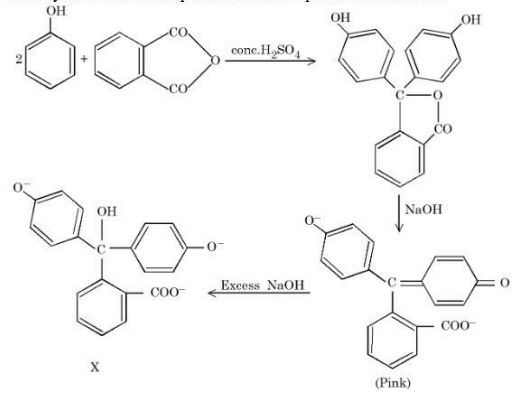
The given reaction sequence represents the synthesis and acid-base behaviour of phenolphthalein.
When phenol reacts with phthalic anhydride in the presence of concentrated \(H_2SO_4\), phenolphthalein is formed. In acidic or neutral medium, phenolphthalein exists in a lactone form which is colourless.
Upon addition of a moderate amount of alkali (NaOH), the lactone ring opens and a proton is removed, forming a dianion with an extended conjugated quinonoid structure. This extended conjugation is responsible for the characteristic pink colour of phenolphthalein in basic medium.
When excess NaOH is added (strongly alkaline medium), a hydroxide ion attacks the central \(sp^2\) hybridized carbon atom of the quinonoid structure. This converts the central carbon to an \(sp^3\) hybridized state, forming a carbinol structure (compound X).
Because the central carbon is now \(sp^3\) hybridized, the extended conjugation is broken. As a result, the compound loses its colour and becomes colourless.
Therefore, compound X is colourless.
Answer: Colourless -
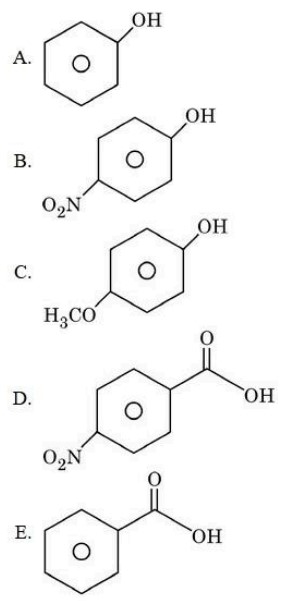
- (A) \(B>D>E>A>C\)
- (B) \(D>B>E>A>C\)
- (C) \(C>A>B>D>E\)
- (D) \(D>E>B>A>C\)
Show answer and solution
Correct Answer: (D)
Carboxylic acids are stronger acids than phenols because the carboxylate anion is stabilized by equivalent resonance structures. Thus, D and E are more acidic than A, B, and C.
For the carboxylic acids, the \(-NO_2\) group in D is an electron-withdrawing group (\(-I, -R\)), which stabilizes the conjugate base, making D more acidic than E.
For the phenols, electron-withdrawing groups increase acidity while electron-donating groups decrease it. The \(-NO_2\) group in B is electron-withdrawing, making it more acidic than A. The \(-OCH_3\) group in C is electron-donating (\(+R > -I\)), making it less acidic than A. Thus, the order for phenols is B \(>\) A \(>\) C.
Combining these, the overall descending order of acidity is D \(>\) E \(>\) B \(>\) A \(>\) C.
Answer: \(D>E>B>A>C\) -
- (A) A, C & E only
- (B) A, B & C only
- (C) A & C only
- (D) B, D & E only
Show answer and solution
Correct Answer: (C)
(A) \( NaOCl + KI \rightarrow NaCl + KOI \)
(B) Incorrect statement
(C)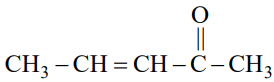 gives iodoform reaction.
(D) Incorrect statement
(E) Incorrect statement -
- (A) A, B and C Only
- (B) B and C Only
- (C) C and D Only
- (D) A and D Only
Show answer and solution
Correct Answer: (D)
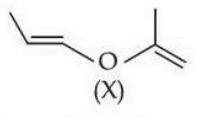
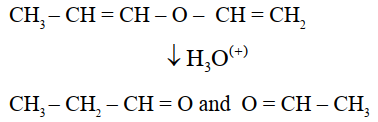
Molecule \((X)\) is an ether with two enol ether functional groups attached to the central oxygen atom. On mild acidic hydrolysis, an enol ether cleaves to give a carbonyl compound and an alcohol.
The \(1\)-propenyl side \((CH_3-CH=CH-O-)\) hydrolyses to propanal, \(CH_3CH_2CHO\).
The isopropenyl side \((-O-C(CH_3)=CH_2)\) hydrolyses to the enol of acetone, which tautomerises to acetone, \(CH_3COCH_3\).
Therefore, \((Y)\) and \((Z)\) are propanal and acetone.
Statement A: Both \((Y)\) and \((Z)\) have the same molar mass.
Propanal and acetone are functional isomers with the same molecular formula \(C_3H_6O\) and hence the same molar mass \((58\text{ g mol}^{-1})\).
Statement A is true.
Statement B: \((Y)\) and \((Z)\) can be distinguished by \(NaHCO_3\).
\(NaHCO_3\) reacts only with carboxylic acids (releasing \(CO_2\)). Neither an aldehyde nor a ketone reacts with \(NaHCO_3\), so it cannot distinguish between them.
Statement B is false.
Statement C: \((Y)\) and \((Z)\) react with HCN at the same rate.
In nucleophilic addition to carbonyls, aldehydes react faster than ketones due to lower steric hindrance and a more electrophilic carbonyl carbon (fewer \(+I\) alkyl groups). So propanal reacts faster than acetone.
Statement C is false.
Statement D: \((Y)\) and \((Z)\) undergo addition reaction with \(2,4\)-DNP.
Both aldehydes and ketones react with \(2,4\)-DNP (Brady's reagent) by nucleophilic addition followed by loss of water to give coloured \(2,4\)-dinitrophenylhydrazone precipitates.
Statement D is true.
Hence, the correct statements are A and D only, which corresponds to option \((4)\). -
- (A) \(CH_2 = CH - \overset{O}{\underset{\|}{C}} - OH\)
- (B) \(CH_3 - CH = CH - CH = O\)
- (C) \(O = C - OH, \, CH_2 - OH\) (with C-C bond)
- (D) \(CH_3 - \overset{O}{\underset{\|}{C}} - OH\)
Show answer and solution
Correct Answer: (C)
Given the molar ratio of C, O, and H in compound \(x\) is equal, the empirical formula is \(CHO\).
Empirical mass \(= 12 + 1 + 16 = 29\) g mol\(^{-1}\).
Since the molar mass of \(x\) is \(58\) g mol\(^{-1}\), the molecular formula is \((CHO)_2\) or \(C_2H_2O_2\).
The structure of \(x\) is glyoxal, \(OHC-CHO\).
Treatment of glyoxal with \(50\%\) KOH under reflux results in an intramolecular Cannizzaro reaction. One aldehyde group is oxidized to a carboxylate ion, and the other is reduced to a primary alcohol.
\(OHC-CHO \xrightarrow{50\% \text{ KOH}} HOCH_2-COO^{-}K^{+}\)
Subsequent acidification yields glycolic acid (\(y\)).
\(HOCH_2-COO^{-}K^{+} \xrightarrow{H^{+}} HOCH_2-COOH\)
The structure of \(y\) is \(HO-CH_2-COOH\).
Answer: \(O = C - OH, \, CH_2 - OH\) (with C-C bond) -
- (A) Both Statement I and Statement II are false
- (B) Statement I is false but Statement II is true
- (C) Both Statement I and Statement II are true
- (D) Statement I is true but Statement II is false
Show answer and solution
Correct Answer: (A)
Statement I: False
Cross aldol can give 2 or 4 products
Statement II: False
Benzaldehyde & Acetone both react with semi carbazide -
- (A) Both Statement I and Statement II are true
- (B) Both Statement I and Statement II are false
- (C) Statement I is true but Statement II is false
- (D) Statement I is false but Statement II is true
Show answer and solution
Correct Answer: (A)
Statement I is true because the \(-OCH_3\) group is an electron-donating group. It donates electron density through resonance (\(+R\) effect), which delocalizes the positive charge of the carbocation and stabilizes it.
Statement II is true because the \(-NO_2\) group is a strong electron-withdrawing group. It withdraws electron density through resonance (\(-R\) effect), which delocalizes the negative charge of the carbanion and stabilizes it.
Therefore, both Statement I and Statement II are true.
Answer: Both Statement I and Statement II are true -
- (A) Both Statement I and Statement II are true
- (B) Both Statement I and Statement II are false
- (C) Statement I is true but Statement II is false
- (D) Statement I is false but Statement II is true
Show answer and solution
Correct Answer: (A)
Statement I: Semicarbazide is \(H_2N-NH-C(=O)-NH_2\). The lone pair on the \(-NH_2\) group attached to the carbonyl carbon is involved in resonance with the \(C=O\) group, making it less nucleophilic. Therefore, the \(-NH_2\) group attached to the \(-NH-\) group acts as the nucleophile. The condensation of acetaldehyde (\(CH_3-CH=O\)) with semicarbazide under optimum pH (around 3.5) yields acetaldehyde semicarbazone, \(CH_3-CH=N-NH-C(=O)-NH_2\). Thus, Statement I is true.
Statement II: The molecule \(Ph-CH(OH)(OCH_3)\) is a hemiacetal. Hemiacetals are unstable and readily undergo hydrolysis in the presence of dilute acid to yield the corresponding aldehyde and alcohol. Hydrolysis of \(Ph-CH(OH)(OCH_3)\) gives benzaldehyde (\(Ph-CH=O\)) and methanol (\(CH_3OH\)). Thus, Statement II is also true.
Both Statement I and Statement II are true.
Answer: Both Statement I and Statement II are true -
- (A) 8
- (B) 10
- (C) 12
- (D) 14
Show answer and solution
Correct Answer: (B)
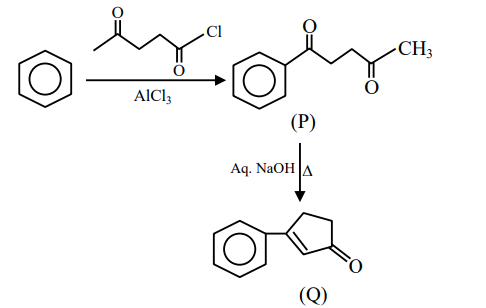
Molecular mass of Q is \(=157\)
\(\%\) of oxygen in product ' \(Q\) ' is \(=\frac{16}{157} \times 100=10.19 \%\) -
- (A) A-II, B-III, C-IV, D-I
- (B) A-IV, B-III, C-I, D-II
- (C) A-IV, B-I, C-II, D-III
- (D) A-II, B-IV, C-I, D-III
Show answer and solution
Correct Answer: (D)
A-II, B-IV, C-I, D-III -
- (A) A-III, B-I, C-IV, D-II
- (B) A-II, B-I, C-IV, D-III
- (C) A-IV, B-III, C-II, D-I
- (D) A-III, B-IV, C-I, D-II
Show answer and solution
Correct Answer: (A)
Theoretical (NCERT Based) -
- (A) 2-hydroxy acetophenone
- (B) 4-methoxy benzaldehyde
- (C) 4-hydroxy benzaldehyde
- (D) 4-methyl benzoic acid
Show answer and solution
Correct Answer: (B)
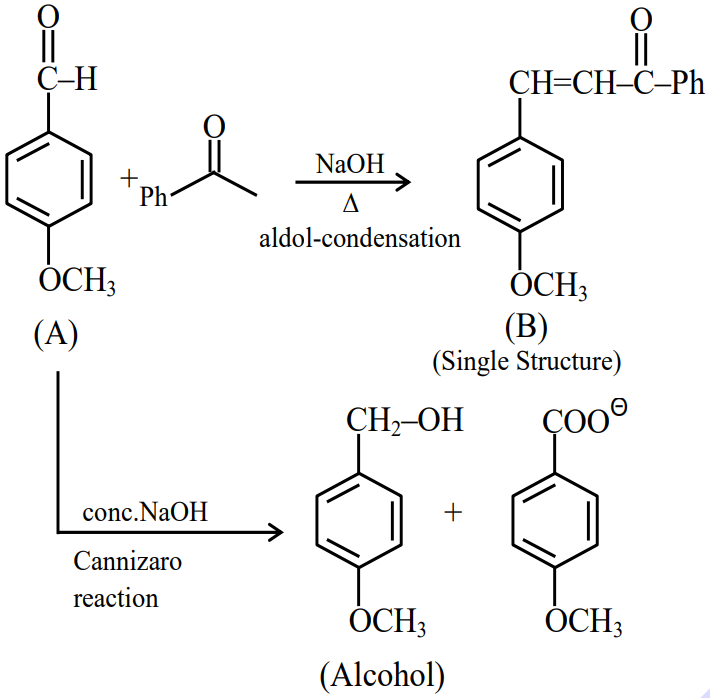
(On cross aldol reaction, a single structure is obtained but it can show geometrical isomerism). -
- (A) Lucas reagent
- (B) 2,4 - DNP reagent
- (C) Saturated \(NaHSO_{3}\) solution
- (D) Fehling solution
Show answer and solution
Correct Answer: (D)

'P' and 'Q' can be differentiated by Fehling's test.
P gives positive Fehling test
Q gives negative Fehling test -
- (A) 2-Methylpent-4-en-3-one
- (B) 4-Methylpent-3-en-2-one
- (C) 4-Methylpent-1-ene
- (D) 2-Methylpent-3-one
Show answer and solution
Correct Answer: (B)
Hydrolysis of prop-1-yne in the presence of \(HgSO_4\) and dilute \(H_2SO_4\) yields acetone.
\(CH_3-C \equiv CH + H_2O \xrightarrow{Hg^{2+}, H^+} CH_3-CO-CH_3\)
Thus, \(x\) is acetone.
Reaction of ethane nitrile (\(CH_3CN\)) with methyl magnesium bromide (\(CH_3MgBr\)) followed by hydrolysis also yields acetone.
\(CH_3-C \equiv N + CH_3MgBr \rightarrow CH_3-C(CH_3)=NMgBr \xrightarrow{H_3O^+} CH_3-CO-CH_3\)
Thus, \(y\) is acetone.
Reaction of \(x\) and \(y\) (both acetone) in the presence of \(Ba(OH)_2\) followed by heating results in an aldol condensation.
\(2 CH_3-CO-CH_3 \xrightarrow{Ba(OH)_2} CH_3-C(OH)(CH_3)-CH_2-CO-CH_3\)
Heating causes dehydration to form an unsaturated ketone.
\(CH_3-C(OH)(CH_3)-CH_2-CO-CH_3 \xrightarrow{\Delta} CH_3-C(CH_3)=CH-CO-CH_3\)
Numbering the principal carbon chain to give the lowest locant to the ketone group, the IUPAC name of the product is 4-methylpent-3-en-2-one.
Answer: 4-Methylpent-3-en-2-one -
- (A) 4
- (B) 8
- (C) 16
- (D) 32
Show answer and solution
Correct Answer: (C)
Benzene reacts with \(CO\) and \(HCl\) in the presence of \(CuCl\) to give benzaldehyde (\(x\)) via the Gattermann-Koch reaction.
Benzene reacts with ethanoyl chloride (\(CH_3COCl\)) in the presence of anhydrous \(AlCl_3\) to give acetophenone (\(y\)) via Friedel-Crafts acylation.
Heating benzaldehyde (\(x\)) and acetophenone (\(y\)) in the presence of alkali results in a crossed aldol condensation to form benzalacetophenone (\(z\)).
\(C_6H_5CHO + CH_3COC_6H_5 \xrightarrow{OH^-, \Delta} C_6H_5-CH=CH-CO-C_6H_5 + H_2O\)
The structure of \(z\) (\(C_6H_5-CH=CH-CO-C_6H_5\)) contains two phenyl rings (\(6\) \(\pi\) bonds), one \(C=C\) double bond (\(1\) \(\pi\) bond), and one \(C=O\) double bond (\(1\) \(\pi\) bond).
Total number of \(\pi\) bonds = \(6 + 1 + 1 = 8\)
Total number of \(\pi\) electrons = \(8 \times 2 = 16\)
Answer: \(16\) -
- (A) 2
- (B) 3
- (C) 4
- (D) 5
Show answer and solution
Correct Answer: (B)
The chemical reaction of phenol with zinc dust is given by:
\(C_6H_5OH + Zn \xrightarrow{\Delta} C_6H_6 + ZnO\)
Product X is benzene (\(C_6H_6\)).
Molar mass of phenol (\(C_6H_5OH\)) = \(6 \times 12 + 6 \times 1 + 16 = 94\) g mol\(^{-1}\)
Number of moles of phenol taken = \(\dfrac{4.7}{94} = 0.05\) mol
From the stoichiometry of the reaction, 1 mole of phenol produces 1 mole of benzene.
Theoretical moles of X formed = \(0.05\) mol
Since the reaction goes to \(60\%\) completion, the actual moles of X formed is:
\(0.05 \times \dfrac{60}{100} = 0.03\) mol
This can be written as \(3 \times 10^{-2}\) mol.
Answer: \(3\) -
- (A) 3
- (B) 5
- (C) 2
- (D) 4
Show answer and solution
Correct Answer: (D)
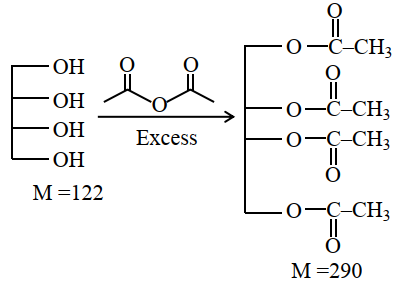
No. of OH groups \(=\frac{290-122}{42}=4\) -
- (A)
D E Conc. H\(_2\)SO\(_4\) CH\(_2 =\) CH \(-\) CH(OH)CH\(_3\) - (B)
D E PCC HO \(-\) CH\(_2\) \(-\) CH\(_2\) \(-\) CH \(=\) CH\(_2\) - (C)
D E PCC CH\(_2 =\) CH \(-\) CH \(=\) CH\(_2\) - (D)
D E Conc. H\(_2\)SO\(_4\) or H\(_3\)PO\(_4\) CH\(_2 =\) CH \(-\) CH \(=\) CH\(_2\)
Show answer and solution
Correct Answer: (D)
Compound A is pentan-1-ol (\(CH_3-CH_2-CH_2-CH_2-CH_2-OH\)) and Compound B is pent-1-ene (\(CH_2=CH-CH_2-CH_2-CH_3\)).
The conversion of an alcohol to an alkene is a dehydration reaction, which requires an acidic dehydrating agent such as concentrated \(H_2SO_4\) or \(H_3PO_4\). Thus, reagent D is concentrated \(H_2SO_4\) or \(H_3PO_4\).
Compound C is butane-1,3-diol (\(HO-CH_2-CH_2-CH(OH)-CH_3\)).
When C is treated with excess dehydrating agent (reagent D), both hydroxyl groups undergo elimination (dehydration). The elimination of two water molecules yields a conjugated diene, which is highly stable due to resonance.
The product E formed is 1,3-butadiene (\(CH_2=CH-CH=CH_2\)).
Answer:D E Conc. H\(_2\)SO\(_4\) or H\(_3\)PO\(_4\) CH\(_2 =\) CH \(-\) CH \(=\) CH\(_2\) - (A)
-
- (A) Both compounds x and y will dissolve in NaOH.
- (B) Compound y will dissolve in \(NaHCO _3\) and evolve a gas.
- (C) Compound x is more acidic than compound y.
- (D) Both compounds x and y will burn with sooty flame.
Show answer and solution
Correct Answer: (C)
\(( X ) \xrightarrow[(2)_3 H _3 O ^{\oplus}]{\text { (1) } CO _2 / NaOH } Y _{\text {Major }}\)
\(76.6 \% C\)
\(6.38 \% H\)
Vapour Density 47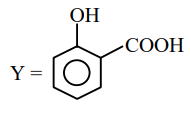
Salicylic acid
Gives colour with \(FeCl _3\)
Soluble in \(NaHCO _3\)
Soluble in NaOH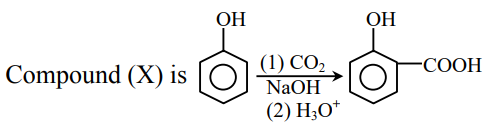
-
- (A) Both Statement I and Statement II are true
- (B) Both Statement I and Statement II are false
- (C) Statement I is true but Statement II is false
- (D) Statement I is false but Statement II is true
Show answer and solution
Correct Answer: (D)
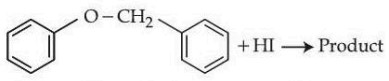
The given reactant is phenyl benzyl ether (\(C_6H_5-O-CH_2-C_6H_5\)).
When it reacts with \(HI\), the ether oxygen is first protonated to form an oxonium ion. The cleavage of the ether linkage then takes place.
The \(C_6H_5-O\) bond has partial double bond character due to the resonance of the oxygen's lone pair with the benzene ring, making it strong and difficult to break. On the other hand, the \(O-CH_2\) bond is a weaker single bond. Moreover, cleavage of the \(O-CH_2\) bond can proceed via a highly stable benzyl carbocation (in an \(S_N1\) mechanism) or undergo facile \(S_N2\) attack by the iodide ion (\(I^-\)) at the less sterically hindered and activated benzylic carbon.
Therefore, the \(I^-\) ion attacks the \(CH_2\) group, cleaving the \(O-CH_2\) bond. The products formed are phenol (\(C_6H_5OH\)) and benzyl iodide (\(C_6H_5CH_2I\)).
Statement I claims the products are benzyl alcohol and iodobenzene, which is incorrect. Thus, Statement I is false.
Statement II claims that the \(-O-CH_2-\) bond is cleaved to give the product, which is correct. Thus, Statement II is true.
Answer: Statement I is false but Statement II is true - 184. From the following, how many compounds contain at least one secondary alcohol ?
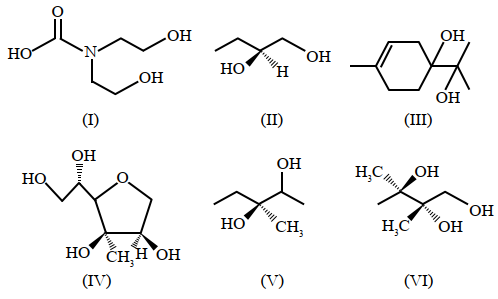
Choose the correct answer from the options given below : 2026 Easy- (A) Five
- (B) Three
- (C) Four
- (D) Two
Show answer and solution
Correct Answer: (B)
Classification of Alcohols:
Primary \( (1^\circ) \) alcohol: The \( -\text{OH} \) group is attached to a carbon atom that is bonded to only one other carbon atom.
Secondary \( (2^\circ) \) alcohol: The \( -\text{OH} \) group is attached to a carbon atom that is bonded to two other carbon atoms.
Tertiary \( (3^\circ) \) alcohol: The \( -\text{OH} \) group is attached to a carbon atom that is bonded to three other carbon atoms.
Structural Analysis:
- Compound (I): The \( -\text{OH} \) groups are part of terminal \( -\text{CH}_2\text{CH}_2\text{OH} \) chains, making them primary \( (1^\circ) \) alcohols.
- Compound (II): Contains a \( -\text{CH(OH)}- \) group where the hydroxyl-bearing carbon is bonded directly to two neighboring carbon atoms. This is a secondary \( (2^\circ) \) alcohol.
- Compound (III): The alcohol groups are attached to carbons that are bonded to three other carbons, which classifies them as tertiary \( (3^\circ) \) alcohols.
- Compound (IV): Contains secondary \( (2^\circ) \) alcohol groups on both the side chain (\( -\text{CH(OH)}- \)) and the cyclic ring structure.
- Compound (V): Contains a \( -\text{CH(OH)}- \) group attached to two adjacent carbon positions, classifying it as a secondary \( (2^\circ) \) alcohol.
- Compound (VI): Contains only primary \( (1^\circ) \) and tertiary \( (3^\circ) \) alcohol functional groups.
Thus, compounds (II), (IV), and (V) contain at least one secondary alcohol group.
Total number of such compounds = \( 3 \)
Correct Option: B (Three) -
- (A) Both Statement I and Statement II are false
- (B) Statement I is true but Statement II is false
- (C) Both Statement I and Statement II are true
- (D) Statement I is false but Statement II is true
Show answer and solution
Correct Answer: (D)
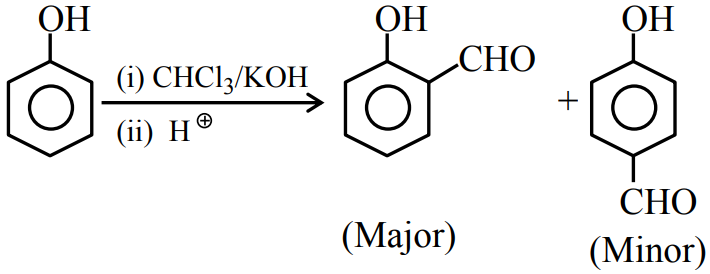
(can be separated by steam distillation) -
- (A) A-III, B-I, C-IV, D-II
- (B) A-III, B-IV, C-I, D-II
- (C) A-I, B-III, C-II, D-IV
- (D) A-I, B-II, C-III, D-IV
Show answer and solution
Correct Answer: (A)
Cyclohexanol is a secondary alcohol, which gives a positive Lucas test.
Cyclohexylamine is a primary aliphatic amine, which reacts with Hinsberg's reagent (benzenesulfonyl chloride) to form a product soluble in alkali.
Cyclohexanecarbaldehyde is an aliphatic aldehyde, which gives a positive Tollen's test (silver mirror test).
Phenol undergoes the phthalein dye test by reacting with phthalic anhydride in the presence of concentrated sulfuric acid to form phenolphthalein, which gives a pink colour in an alkaline medium.
Thus, the correct matching is A-III, B-I, C-IV, D-II.
Answer: A-III, B-I, C-IV, D-II -
- (A) 165
- (B) 170
- (C) 175
- (D) 180
Show answer and solution
Correct Answer: (C)
When phenol is treated with dilute \(\text{HNO}_3\) at \(298\text{ K}\), it undergoes electrophilic aromatic substitution to give a mixture of ortho-nitrophenol and para-nitrophenol.
The mixture is separated by steam distillation. Ortho-nitrophenol is steam volatile due to intramolecular hydrogen bonding, whereas para-nitrophenol is not steam volatile due to intermolecular hydrogen bonding. Thus, the steam volatile compound (X) is ortho-nitrophenol.
Molecular formula of phenol: \(\text{C}_6\text{H}_6\text{O}\)
Molar mass of phenol \(= (6 \times 12) + (6 \times 1) + 16 = 94\text{ g mol}^{-1}\)
Percentage of oxygen in phenol \(= \dfrac{16}{94} \times 100 \approx 17.02\%\)
Molecular formula of ortho-nitrophenol (X): \(\text{C}_6\text{H}_5\text{NO}_3\)
Molar mass of ortho-nitrophenol \(= (6 \times 12) + (5 \times 1) + 14 + (3 \times 16) = 139\text{ g mol}^{-1}\)
Percentage of oxygen in ortho-nitrophenol \(= \dfrac{48}{139} \times 100 \approx 34.53\%\)
Increase in percentage of oxygen \(= 34.53\% - 17.02\% = 17.51\%\)
We need to express this as \(y \times 10^{-1} \%\).
\(17.51\% = 175.1 \times 10^{-1} \%\)
Rounding to the nearest integer, we get \(175\).
Answer: \(175\) -
- (A) A and D Only
- (B) A, C and E Only
- (C) C and D Only
- (D) B, D and E Only
Show answer and solution
Correct Answer: (C)
Reaction given Alcohol
(A) \(CH_{4} + O_{2} \xrightarrow{Mo_{2}O_{3}} HCHO\)
(B) \(2 CH _3 CH _3+3 O _2 \xrightarrow[\Delta]{\left( CH _3 COO \right)_2 Mn } CH _3 COOH\)
(C)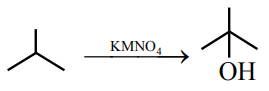
(D) \(2 CH _4+ O _2 \xrightarrow[523 K, 100 atm .]{ Cu } CH _3- OH\)
(E)
-
- (A) Haloform test
- (B) Lucas test
- (C) Silver mirror test
- (D) Benedict test
Show answer and solution
Correct Answer: (A)
The optically active alkyl bromide \(\text{C}_4\text{H}_9\text{Br}\) is \(2\)-bromobutane, \(\text{CH}_3\text{CH}(\text{Br})\text{CH}_2\text{CH}_3\).
Reaction with ethanolic \(\text{KOH}\) undergoes dehydrohalogenation to form but-\(2\)-ene as the major product [A] (Zaitsev's rule).
But-\(2\)-ene [A] reacts with \(\text{Br}_2\) to form \(2,3\)-dibromobutane [B], \(\text{CH}_3\text{CH}(\text{Br})\text{CH}(\text{Br})\text{CH}_3\).
Compound [B] undergoes double dehydrohalogenation with ethanolic \(\text{KOH}\) and \(\text{NaNH}_2\) to give but-\(2\)-yne [C], \(\text{CH}_3\text{C}\equiv\text{CCH}_3\).
Hydration of but-\(2\)-yne [C] with \(\text{HgSO}_4\) and dilute \(\text{H}_2\text{SO}_4\) yields butan-\(2\)-one [D], \(\text{CH}_3\text{COCH}_2\text{CH}_3\).
Since compound [D] is a methyl ketone, its functional group is confirmed by the haloform test.
Answer: Haloform test -
- (A) A, C and E only
- (B) B, C and D only
- (C) A, D and E only
- (D) B, C and E only
Show answer and solution
Correct Answer: (D)
Chlorocylohexane is more polar due to - I effect of - Cl,
Whereas chlorobenzene has \(- I >+ M\), so it is less polar & also has partial double bond character. -
- (A) 2
- (B) 3
- (C) 4
- (D) 5
Show answer and solution
Correct Answer: (B)
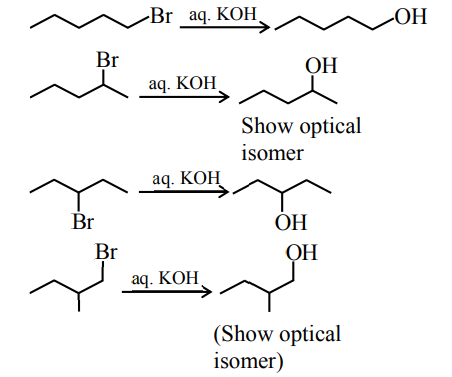
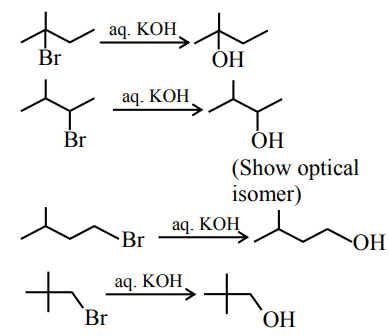
Explanation:
Let us analyze all the structural isomers and their respective substitution products step-by-step to find the ones that exhibit optical isomerism:
1. Understanding the Reaction:
Reaction of alkyl halides with aqueous KOH is a nucleophilic substitution reaction where the bromine atom \((-\text{Br})\) is replaced by a hydroxyl group \((-\text{OH})\) to form an alcohol without any skeletal rearrangement.
2. Identifying all 8 Structural Isomers and their Products:
There are a total of 8 structural isomers for the molecular formula \(C_5H_{11}Br\). Let us check the alcohol products formed by each:
- 1-Bromopentane \(\rightarrow\) Pentan-1-ol (Achiral)
- 2-Bromopentane \(\rightarrow\) Pentan-2-ol (Chiral, contains a stereocenter at C-2) → Product 1
- 3-Bromopentane \(\rightarrow\) Pentan-3-ol (Achiral)
- 1-Bromo-2-methylbutane \(\rightarrow\) 2-Methylbutan-1-ol (Chiral, contains a stereocenter at C-2) → Product 2
- 2-Bromo-2-methylbutane \(\rightarrow\) 2-Methylbutan-2-ol (Achiral)
- 2-Bromo-3-methylbutane \(\rightarrow\) 3-Methylbutan-2-ol (Chiral, contains a stereocenter at C-2) → Product 3
- 1-Bromo-3-methylbutane \(\rightarrow\) 3-Methylbutan-1-ol (Achiral)
- 1-Bromo-2,2-dimethylpropane \(\rightarrow\) 2,2-Dimethylpropan-1-ol (Achiral)
3. Conclusion:
Out of the 8 distinct structural products formed, exactly 3 products contain an asymmetric chiral carbon atom bonded to four different groups, meaning only 3 products can exhibit optical isomerism. Therefore, Option B is absolutely correct.
Hence, Option B is the correct choice. -
- (A) A, B and C Only
- (B) B and D Only
- (C) A and E Only
- (D) D and E Only
Show answer and solution
Correct Answer: (C)
Statement A is correct. Alcoholic KOH provides alkoxide ions which are stronger bases than hydroxide ions. Furthermore, alcohol is a less polar solvent than water, which decreases the solvation of the base, making it more effective for elimination reactions over substitution.
Statement B is incorrect. The reactivity towards the \(S_N^1\) mechanism depends on the stability of the intermediate carbocation. The carbocation \(C_6H_5-\overset{+}{C}H-C_6H_5\) is more stable than \(C_6H_5-\overset{+}{C}H_2\) due to extended resonance stabilization from two phenyl rings. Thus, \(C_6H_5-CHCl-C_6H_5\) is more reactive than \(C_6H_5-CH_2-Cl\).
Statement C is incorrect. Aryl halides are much less reactive towards nucleophilic substitution than alkyl halides due to the partial double bond character of the C-X bond arising from resonance, as well as the \(sp^2\) hybridization of the carbon atom.
Statement D is incorrect. Allyl chloride (\(CH_2=CH-CH_2-Cl\)) contains a carbon-carbon double bond, making it a haloalkene, not a haloalkyne.
Statement E is correct. Alkyl chlorides (\(R-Cl\)) can be easily prepared from alcohols (\(R-OH\)) using \(SOCl_2\). However, phenols (\(Ar-OH\)) do not react with \(SOCl_2\) to give aryl chlorides because the C-O bond in phenol has a partial double bond character due to resonance, making it difficult to cleave.
Therefore, only statements A and E are correct.
Answer: A and E Only -
- (A) Both Statement I and Statement II are true
- (B) Both Statement I and Statement II are false
- (C) Statement I is true but Statement II is false
- (D) Statement I is false but Statement II is true
Show answer and solution
Correct Answer: (C)
Statement I:
When \(3\)-phenylpropene reacts with \(HBr\), protonation of the alkene occurs to form a secondary carbocation.
\(C_6H_5-CH_2-CH=CH_2 + H^+ \rightarrow C_6H_5-CH_2-CH^+-CH_3\)
This secondary carbocation undergoes a \(1,2\)-hydride shift to form a more stable, resonance-stabilized benzylic carbocation.
\(C_6H_5-CH_2-CH^+-CH_3 \rightarrow C_6H_5-CH^+-CH_2-CH_3\)
The bromide ion then attacks this benzylic carbocation to form the major product, \(1\)-bromo-\(1\)-phenylpropane.
\(C_6H_5-CH^+-CH_2-CH_3 + Br^- \rightarrow C_6H_5-CH(Br)-CH_2-CH_3\)
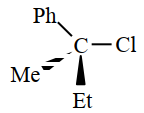
The carbon atom bonded to the bromine is attached to four different groups: a phenyl group (\(-C_6H_5\)), an ethyl group (\(-CH_2CH_3\)), a hydrogen atom (\(-H\)), and a bromine atom (\(-Br\)). Thus, it is a chiral carbon. The product is a secondary alkyl bromide. Therefore, Statement I is true.
Statement II:
The Sandmeyer reaction involves treating a diazonium salt with \(Cu(I)\) salts (\(CuCl\), \(CuBr\), \(CuCN\)) to prepare aryl chlorides, aryl bromides, and aryl cyanides, respectively.
The Gattermann reaction involves treating a diazonium salt with copper powder (\(Cu\)) and halogen acids (\(HCl\), \(HBr\)) to prepare aryl chlorides and aryl bromides. Aryl cyanides are not prepared using the Gattermann reaction. Therefore, Statement II is false.
Conclusion: Statement I is true but Statement II is false.
Answer: Statement I is true but Statement II is false -
- (A) Statement I is false but Statement II is true
- (B) Both Statement I and Statement II are true
- (C) Both Statement I and Statement II are false
- (D) Statement I is true but Statement II is false
Show answer and solution
Correct Answer: (D)
Statement - I :
C - Cl bond is strong in vinyl chloride because of double bond character.
Statement - II :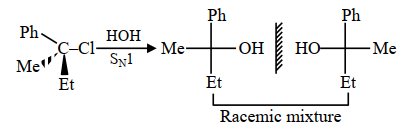
Racemic mixture is optically inactive, which can not rotate PPL. -
- (A) Both Statement I and Statement II are true
- (B) Both Statement I and Statement II are false
- (C) Statement I is true but Statement II is false
- (D) Statement I is false but Statement II is true
Show answer and solution
Correct Answer: (A)
The rate of \(S_N1\) reaction depends on the stability of the carbocation intermediate formed during the rate-determining step.
Benzyl chloride undergoes ionization to form a benzyl carbocation (\(C_6H_5CH_2^+\)), whereas ethyl chloride forms an ethyl carbocation (\(CH_3CH_2^+\)). The benzyl carbocation is highly stabilized by the delocalization of the positive charge over the benzene ring through resonance. On the other hand, the ethyl carbocation is stabilized only by hyperconjugation involving three \(\alpha\)-hydrogens.
Since resonance provides significantly greater stabilization than hyperconjugation, the benzyl carbocation is much more stable than the ethyl carbocation. Consequently, benzyl chloride reacts faster in the \(S_N1\) mechanism than ethyl chloride. Thus, Statement I is true.
Statement II correctly explains that the ethyl carbocation intermediate is less stabilized by hyperconjugation compared to the resonance stabilization of the benzyl carbocation. Thus, Statement II is also true.
Both Statement I and Statement II are true.
Answer: Both Statement I and Statement II are true -
- (A) Both Statement I and Statement II are true
- (B) Both Statement I and Statement II are false
- (C) Statement I is true but Statement II is false
- (D) Statement I is false but Statement II is true
Show answer and solution
Correct Answer: (A)
Statement I is true because as the size of the alkyl group increases, the molecular mass and surface area increase. This leads to an increase in the magnitude of van der Waals forces, which in turn increases the boiling point. Thus, the correct order of boiling points is \(\text{CH}_3\text{CH}_2\text{CH}_2\text{I} > \text{CH}_3\text{CH}_2\text{I} > \text{CH}_3\text{I}\).
Statement II is true because para-dichlorobenzene is more symmetrical than ortho-dichlorobenzene, allowing it to pack more efficiently in the crystal lattice, which results in a higher melting point. However, ortho-dichlorobenzene has a higher dipole moment than para-dichlorobenzene (which has a dipole moment of zero). The stronger dipole-dipole interactions in ortho-dichlorobenzene lead to a higher boiling point compared to para-dichlorobenzene.
Both Statement I and Statement II are true.
Answer: Both Statement I and Statement II are true -
- (A) A-IV, B-I, C-III, D-II
- (B) A-III, B-IV, C-I, D-II
- (C) A-III, B-IV, C-II, D-I
- (D) A-I, B-II, C-IV, D-III
Show answer and solution
Correct Answer: (C)
Explanation:
Let us match the given chloro derivatives with their respective structural formulas:
1. Vinyl Chloride: In vinylic halides, the halogen atom is directly bonded to the \( sp^2 \) hybridized carbon atom of a carbon-carbon double bond. Therefore, Vinyl chloride corresponds to \( \text{CH}_2 = \text{CHCl} \) (A-III).
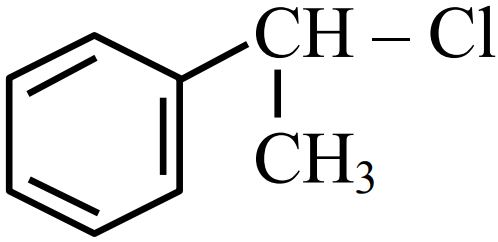
2. Benzylic chloride: In benzylic halides, the halogen atom is bonded to an \( sp^3 \) hybridized carbon atom attached next to an aromatic ring. Therefore, structure IV \( \text{C}_6\text{H}_5 - \text{CH(Cl)} - \text{CH}_3 \) represents a benzylic chloride derivative (B-IV).
3. Alkyl chloride: In alkyl halides, the halogen atom is bonded to a saturated alkyl chain. Isopropyl chloride \( \text{CH}_3 - \text{CH(Cl)} - \text{CH}_3 \) is a standard alkyl chloride (C-II).
4. Allyl chloride: In allylic halides, the halogen atom is bonded to an \( sp^3 \) hybridized carbon atom next to a carbon-carbon double bond. Therefore, Allyl chloride corresponds to \( \text{CH}_2 = \text{CH} - \text{CH}_2\text{Cl} \) (D-I).
Hence, the correct matching is A-III, B-IV, C-II, D-I, which corresponds to Option C. -
- (A) A-I, B-IV, C-III, D-II
- (B) A-III, B-I, C-IV, D-II
- (C) A-IV, B-II, C-I, D-III
- (D) A-I, B-III, C-II, D-IV
Show answer and solution
Correct Answer: (B)
Finkelstein reaction involves the conversion of alkyl chlorides or bromides to alkyl iodides using \(NaI\) in dry acetone. Thus, A matches with III.
Swarts reaction is used for the synthesis of alkyl fluorides by heating an alkyl chloride or bromide in the presence of a metallic fluoride such as \(SbF_3\), \(AgF\), \(Hg_2F_2\), or \(CoF_2\). Thus, B matches with I.
Sandmeyer's reaction involves the conversion of aryl diazonium salts to aryl halides using cuprous halides like \(Cu_2Cl_2\) or \(Cu_2Br_2\). Thus, C matches with IV.
Fittig reaction involves the coupling of two aryl halide molecules in the presence of sodium (\(Na\)) and dry ether to form a diaryl compound. Thus, D matches with II.
The correct matching is A-III, B-I, C-IV, D-II.
Answer: A-III, B-I, C-IV, D-II -
- (A) 20
- (B) 30
- (C) 40
- (D) 50
Show answer and solution
Correct Answer: (B)
The reaction of Grignard reagent with water yields an alkane:
\(RMgI + H_2O \rightarrow RH + Mg(OH)I\)
Given that \(1 \text{ g}\) of the gas \(RH\) occupies \(1.4 \text{ dm}^3\) at STP, we can find its molar mass. Using the standard molar volume at STP (\(22.4 \text{ dm}^3\)):
\(\text{Molar mass of } RH = \dfrac{22.4 \text{ dm}^3 \text{ mol}^{-1}}{1.4 \text{ dm}^3 \text{ g}^{-1}} = 16 \text{ g mol}^{-1}\)
The alkane with a molar mass of \(16 \text{ g mol}^{-1}\) is methane (\(CH_4\)).
Methane reacts with iodine in the presence of an oxidizing agent like \(HIO_3\) (which prevents the backward reaction by consuming the formed \(HI\)) to give methyl iodide:
\(CH_4 + I_2 \xrightarrow{HIO_3} CH_3I + HI\)
Thus, compound (X) is methyl iodide (\(CH_3I\)).
Compound (X) undergoes the Wurtz reaction when treated with sodium and dry ether to form a higher alkane:
\(2CH_3I + 2Na \xrightarrow{\text{dry ether}} CH_3-CH_3 + 2NaI\)
Compound (Y) is ethane (\(C_2H_6\)).
The molar mass of ethane (\(C_2H_6\)) is:
\(2 \times 12 + 6 \times 1 = 30 \text{ g mol}^{-1}\)
Answer: \(30\) -
- (A) \(I^{-}>C_{6}H_{5}O^{-}>F^{-}>C_{2}H_{5}O^{-}\)
- (B) \(I^{-}>C_{2}H_{5}O^{-}>C_{6}H_{5}O^{-}>F^{-}\)
- (C) \(I^{-}>C_{2}H_{5}O^{-}>F^{-}>C_{6}H_{5}O^{-}\)
- (D) \(I^{-}>F^{-}>C_{6}H_{5}O^{-}>C_{2}H_{5}O^{-}\)
Show answer and solution
Correct Answer: (B)
Order of nucleophilicity:
\(I ^{\ominus}> C _2 H _5 O ^{\ominus}> PhO ^{\ominus}> F ^{\ominus}\)
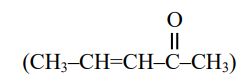 will give iodoform reaction.

No questions on this page match these filters.