


Questions
19 questionsShowing 1–19 of 19 questions
-
- (A) 0.35 mol of \( H_{2} \) gas is evolved.
- (B) 7.84 L of \( H_{2} \) gas is evolved.
- (C) 33.3 g of \( CaCl_{2} \) is produced.
- (D) The limiting reagent is calcium metal.
Show answer and solution
Correct Answer: (C)
\(\underset{\frac{14}{40}}{ Ca _{( s )}}+\underset{\text { excess }}{2 HCl _{( g )}} \longrightarrow \underset{-}{ CaCl _{2(s)}}+\underset{-}{ H _{2(g)}}\)
\(=0.35 mole \quad 0.35 mole \quad 0.35 mole\)
Volume of \(H _{2(g)}\) evolved \(=0.35 \times 22.4=7.84 L\)
(3) is wrong because weight of \( CaCl_{2} = .35 \times 111 = 38.85 \) gm. -
- (A) \( C_{2}H_{4} \)
- (B) \( C_{4}H_{10} \)
- (C) \( C_{2}H_{2} \)
- (D) \( C_{2}H_{6} \)
Show answer and solution
Correct Answer: (C)
\(C _{ x } H _{ y ( g )}+\left( x +\frac{ y }{4}\right) O _{2(g)} \longrightarrow xCO _{2(g)}+\frac{ y }{2} H _2 O _{(\ell)}\)
\(\begin{array}{lllll} t =0 & 80 & 264 & 0\end{array}-\)
\(t = t _{\text {final }} \quad-\quad 264-80\left( x +\frac{ y }{4}\right) \quad 80 x\)
\(264-80\left(x+\frac{y}{4}\right)+80 x=224\)
\(264-\frac{80 y}{4}=224\)
\(40=\frac{80 y}{4} \Rightarrow y=2\)
\(264-80\left(x+\frac{y}{4}\right)=64\)
\(264-80\left(x+\frac{1}{2}\right)=64\)
\(264-80 x-40=64\)
\(x=2\) -
- (A) C and D only
- (B) A and C only
- (C) B and D only
- (D) A and B only
Show answer and solution
Correct Answer: (C)
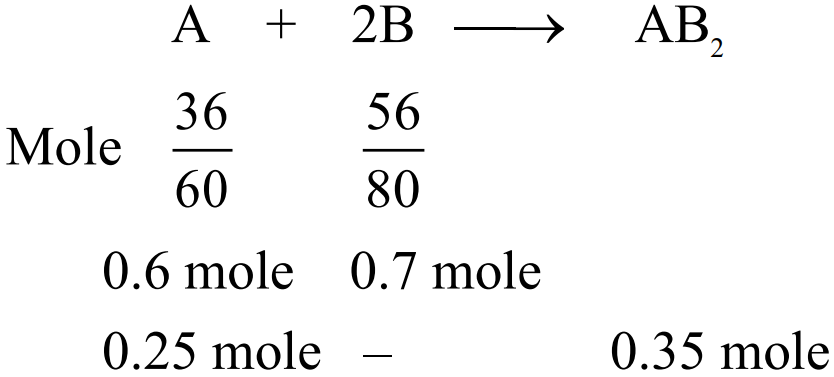
(A) Molecular wt. of \(AB_{2}\) is
\(60 + 2 \times 80 = 220~g/mol\)
(B) LR is AB.
(C) Wt. of A remaining = \(0.25 \times 60 = 15~g\)
(D) wt. of \(AB_{2}\) formed = \(0.35 \times 220 = 77~gm\). -
- (A) \(\text{FeO}\)
- (B) \(\text{Fe}_2\text{O}_3\)
- (C) \(\text{Fe}_3\text{O}_4\)
- (D) \(\text{FeO}_3\)
Show answer and solution
Correct Answer: (B)
Mass percentage of \(\text{Fe} = 69.9\%\)
Mass percentage of \(\text{O} = 100\% - 69.9\% = 30.1\%\)
Number of moles of \(\text{Fe} = \dfrac{69.9}{56} = 1.248\)
Number of moles of \(\text{O} = \dfrac{30.1}{16} = 1.881\)
Molar ratio of \(\text{Fe} : \text{O} = 1.248 : 1.881\)
Dividing by the smallest value, the ratio is \(\dfrac{1.248}{1.248} : \dfrac{1.881}{1.248} = 1 : 1.5\)
Multiplying by \(2\) to get the simplest whole number ratio, we get \(2 : 3\).
The empirical formula is \(\text{Fe}_2\text{O}_3\).
Answer: \(\text{Fe}_2\text{O}_3\) -
- (A) 0.9
- (B) 0.1
- (C) 0.337
- (D) 0.663
Show answer and solution
Correct Answer: (C)
Explanation:
Step 1: Find the total mass of \( \text{H}_2\text{SO}_4 \) in the resultant mixture:
- Mass of \( \text{H}_2\text{SO}_4 \) from the first solution = \( 98\% \text{ of } 100\text{ g} = 98\text{ g} \)
- Mass of \( \text{H}_2\text{SO}_4 \) from the second solution = \( 49\% \text{ of } 100\text{ g} = 49\text{ g} \)
- Total mass of \( \text{H}_2\text{SO}_4 = 98\text{ g} + 49\text{ g} = 147\text{ g} \)
Step 2: Find the total mass of water (\( \text{H}_2\text{O} \)) in the resultant mixture:
- Total mass of the combined solution = \( 100\text{ g} + 100\text{ g} = 200\text{ g} \)
- Total mass of \( \text{H}_2\text{O} = \text{Total mass of solution} - \text{Total mass of } \text{H}_2\text{SO}_4 \)
- Total mass of \( \text{H}_2\text{O} = 200\text{ g} - 147\text{ g} = 53\text{ g} \)
Step 3: Calculate the number of moles of each component:
- Molar mass of \( \text{H}_2\text{SO}_4 = 2(1) + 32 + 4(16) = 98\text{ g mol}^{-1} \)
- Moles of \( \text{H}_2\text{SO}_4 \text{ } (n_{\text{H}_2\text{SO}_4}) = \frac{147\text{ g}}{98\text{ g mol}^{-1}} = 1.5\text{ mol} \)
- Molar mass of \( \text{H}_2\text{O} = 2(1) + 16 = 18\text{ g mol}^{-1} \)
- Moles of \( \text{H}_2\text{O} \text{ } (n_{\text{H}_2\text{O}}) = \frac{53\text{ g}}{18\text{ g mol}^{-1}} = 2.944\text{ mol} \)
Step 4: Calculate the mole fraction of \( \text{H}_2\text{SO}_4 \):
\( \text{Mole fraction } (\chi_{\text{H}_2\text{SO}_4}) = \frac{n_{\text{H}_2\text{SO}_4}}{n_{\text{H}_2\text{SO}_4} + n_{\text{H}_2\text{O}}} \)
\( \chi_{\text{H}_2\text{SO}_4} = \frac{1.5}{1.5 + 2.944} = \frac{1.5}{4.444} \approx 0.3375 \)
Rounding off to three decimal places, we get \( 0.337 \).
Hence, Option C is the correct choice. -
- (A) 64.97 g of HCl remains unreacted
- (B) 32.85 g of \(CaCO_{3}\) remains unreacted
- (C) 97.30 g of HCl reacted
- (D) 60.32 g of HCl remains unreacted
Show answer and solution
Correct Answer: (A)
Density of HCl solution \(( d )=1.13 g / ml\)
\(V =300 ml\)
Wt. of HCl solution \(=339 g\)
Wt. of \(HCl =339 \times \frac{38.55}{100}=130.68 g\)
(LR)
\(CaCO_3+2 HCl \rightarrow CaCl_2+H_2 O+CO_2\)
\(\frac{90}{100} \quad \frac{130.68}{36.5}\)
\(=0.90 mole \quad=3.58 mole\)
Moles of HCl remained \(=1.78\) mole.
Mass of HCl remained \(=64.97 g\). -
- (A) \(1.08\) g
- (B) \(2.16\) g
- (C) \(3.24\) g
- (D) \(4.32\) g
Show answer and solution
Correct Answer: (B)
Molar mass of \(Ag_2CO_3\) = \(2 \times 108 + 12 + 3 \times 16 = 276\) g mol\(^{-1}\)
Number of moles of \(Ag_2CO_3\) = \(\dfrac{2.76}{276} = 0.01\) mol
The decomposition reaction of silver carbonate on heating is:
\(Ag_2CO_3(s) \rightarrow 2Ag(s) + CO_2(g) + \dfrac{1}{2}O_2(g)\)
From the stoichiometry of the reaction, \(1\) mole of \(Ag_2CO_3\) gives \(2\) moles of Ag as residue.
Number of moles of Ag formed = \(2 \times 0.01 = 0.02\) mol
Mass of Ag residue = \(0.02 \times 108 = 2.16\) g
Answer: \(2.16\) g -
- (A) A, B, C and E only
- (B) A, B, and C only
- (C) A, B and E only
- (D) D and E only
Show answer and solution
Correct Answer: (B)
Primary standards must be soluble for standard solution information. -
- (A) 11.2 L \(H_{2}(g)\) at STP is produced for every mole of HCl consumed.
- (B) 67.2 L \(H_{2}(g)\) at STP is produced for every mole of Al that reacts.
- (C) 12 L \(HCl(aq)\) is consumed for every 6L \(H_{2}(g)\) produced.
- (D) 33.6 L \(H_{2}(g)\) is produced regardless of temperature and pressure for every mole of Al that reacts.
Show answer and solution
Correct Answer: (A)
\(2Al (s) + 6HCl (aq) \rightarrow 2Al^{3+} (aq) + 6Cl^{-} (aq) + 3H_{2}(g)\)
Mole of \(H_{2}\) produced
\(=2 \times\) mole of HCl used
\(=\frac{2}{3} \times\) mole of Al used -
- (A) A-IV, B-III, C-I, D-II
- (B) A-III, B-II, C-IV, D-I
- (C) A-III, B-IV, C-II, D-I
- (D) A-III, B-IV, C-I, D-II
Show answer and solution
Correct Answer: (C)
For A: Molar mass of \(H_2O = 18\) g/mol. Moles of \(H_2O = \dfrac{1.8 \times 10^{-3}}{18} = 10^{-4}\). Since each \(H_2O\) molecule has \(3\) atoms, the number of atoms = \(3 \times 10^{-4} \times N_A\).
For B: Molar mass of \(H_2SO_4 = 98\) g/mol. Moles of \(H_2SO_4 = \dfrac{9.8 \times 10^{-3}}{98} = 10^{-4}\). Since each \(H_2SO_4\) molecule has \(7\) atoms, the number of atoms = \(7 \times 10^{-4} \times N_A\).
For C: Molar mass of \(C = 12\) g/mol. Moles of \(C = \dfrac{1.8 \times 10^{-3}}{12} = 1.5 \times 10^{-4}\). The number of atoms = \(1.5 \times 10^{-4} \times N_A\).
For D: Molar mass of \(NaCl = 58.5\) g/mol. Moles of \(NaCl = \dfrac{5.85 \times 10^{-3}}{58.5} = 10^{-4}\). Since each \(NaCl\) formula unit has \(2\) atoms, the number of atoms = \(2 \times 10^{-4} \times N_A\).
Thus, the correct matching is A-III, B-IV, C-II, D-I.
Answer: A-III, B-IV, C-II, D-I - 11. Number of moles and number of molecules in \(1.4187\) L of \(SO_2\) at STP respectively are: 2026 Medium
- (A) \(0.1266; 3.812 \times 10^{22}\)
- (B) \(0.0633; 3.812 \times 10^{22}\)
- (C) \(0.1266; 7.6238 \times 10^{22}\)
- (D) \(0.0633; 7.6238 \times 10^{22}\)
Show answer and solution
Correct Answer: (B)
Volume of \(SO_2\) at STP \(= 1.4187\) L
Molar volume of an ideal gas at STP is approximately \(22.414\) L.
Number of moles \(n = \dfrac{\text{Volume}}{\text{Molar Volume}} = \dfrac{1.4187}{22.414} = 0.0633\)
Number of molecules \(= n \times N_A\)
Number of molecules \(= 0.0633 \times 6.022 \times 10^{23} = 3.812 \times 10^{22}\)
Answer: \(0.0633; 3.812 \times 10^{22}\) -
- (A) 15
- (B) 17
- (C) 19
- (D) 21
Show answer and solution
Correct Answer: (B)
The general formula of an alkane is \(C_n H_{2n+2}\).
The balanced chemical equation for the complete combustion of an alkane is:
\(C_n H_{2n+2} + \left(\dfrac{3n+1}{2}\right) O_2 \rightarrow n CO_2 + (n+1) H_2O\)
Given that \(1\) mole of the alkane requires \(8\) moles of oxygen for complete combustion, we equate the stoichiometric coefficient of \(O_2\) to \(8\):
\(\dfrac{3n+1}{2} = 8\)
\(3n + 1 = 16\)
\(3n = 15\)
\(n = 5\)
The molecular formula of the alkane is \(C_5H_{12}\).
The number of carbon atoms is \(5\) and the number of hydrogen atoms is \(12\).
Sum of the number of carbon and hydrogen atoms \(= 5 + 12 = 17\).
Answer: \(17\) -
- (A) \(C>A>B\)
- (B) \(C>B>A\)
- (C) \(B>C>A\)
- (D) \(B>A>C\)
Show answer and solution
Correct Answer: (D)
For (A):
Formula of cyclohexane is \(C_6H_{12}\).
Number of atoms per molecule = \(6 + 12 = 18\).
Total number of atoms in \(2\) moles = \(2 \times 18 \times N_A = 36 N_A\).
For (B):
Formula of sucrose is \(C_{12}H_{22}O_{11}\).
Molar mass of sucrose = \(342\) g/mol.
Number of moles = \(\dfrac{684}{342} = 2\) moles.
Number of atoms per molecule = \(12 + 22 + 11 = 45\).
Total number of atoms = \(2 \times 45 \times N_A = 90 N_A\).
For (C):
Formula of dihydrogen is \(H_2\).
Number of moles at STP = \(\dfrac{90.8}{22.7} = 4\) moles.
Number of atoms per molecule = \(2\).
Total number of atoms = \(4 \times 2 \times N_A = 8 N_A\).
Comparing the total number of atoms:
\(90 N_A > 36 N_A > 8 N_A\)
Therefore, the correct order is \(B > A > C\).
Answer: \(B>A>C\) -
- (A) \(2.1\) g
- (B) \(4.2\) g
- (C) \(21\) g
- (D) \(42\) g
Show answer and solution
Correct Answer: (D)
The balanced chemical equation for the reaction of iron with steam is:
\(3Fe + 4H_2O \rightarrow Fe_3O_4 + 4H_2\)
Molar mass of \(H_2O = 2 \times 1 + 16 = 18 \text{ g mol}^{-1}\)
Number of moles of steam (\(H_2O\)) given = \(\dfrac{18}{18} = 1 \text{ mol}\)
From the balanced equation, \(4 \text{ moles}\) of \(H_2O\) react with \(3 \text{ moles}\) of \(Fe\).
Therefore, \(1 \text{ mole}\) of \(H_2O\) will react with \(\dfrac{3}{4} \text{ moles}\) of \(Fe\).
Mass of iron reacted = Moles of \(Fe \times\) Molar mass of \(Fe\)
Mass of iron = \(\dfrac{3}{4} \times 56 = 3 \times 14 = 42 \text{ g}\)
Answer: \(42\) g -
- (A) \(5.68\)
- (B) \(11.44\)
- (C) \(22.74\)
- (D) \(17.05\)
Show answer and solution
Correct Answer: (B)
Ratio of mass percentage of C : H = \(12 : 1\)
Ratio of moles of C : H = \(\dfrac{12}{12} : \dfrac{1}{1} = 1 : 1\)
The empirical formula is \(CH\). Since the hydrocarbon has two carbon atoms, its molecular formula is \(C_2H_2\).
Molar mass of \(C_2H_2 = 2 \times 12 + 2 \times 1 = 26\) g mol\(^{-1}\)
Moles of \(C_2H_2\) in \(3.38\) g = \(\dfrac{3.38}{26} = 0.13\) mol
The combustion reaction is:
\(C_2H_2 + \dfrac{5}{2}O_2 \rightarrow 2CO_2 + H_2O\)
From the stoichiometry, \(1\) mole of \(C_2H_2\) produces \(2\) moles of \(CO_2\).
Moles of \(CO_2\) produced = \(2 \times 0.13 = 0.26\) mol
Molar mass of \(CO_2 = 12 + 2 \times 16 = 44\) g mol\(^{-1}\)
Weight of \(CO_2\) formed = \(0.26 \times 44 = 11.44\) g
Answer: \(11.44\) -
- (A) \(0.825\)
- (B) \(0.032\)
- (C) \(0.867\)
- (D) \(0.967\)
Show answer and solution
Correct Answer: (D)
\(10\%\) w/w aqueous urea solution means \(10\) g of urea is present in \(100\) g of solution.
Mass of urea \(= 10\) g
Mass of water \(= 100 - 10 = 90\) g
Molar mass of urea (\(\text{NH}_2\text{CONH}_2\)) \(= 14 + 2 + 12 + 16 + 14 + 2 = 60\) g mol\(^{-1}\)
Molar mass of water (\(\text{H}_2\text{O}\)) \(= 18\) g mol\(^{-1}\)
Moles of urea, \(n_{\text{urea}} = \dfrac{10}{60} = \dfrac{1}{6}\) mol
Moles of water, \(n_{\text{water}} = \dfrac{90}{18} = 5\) mol
Total moles \(= 5 + \dfrac{1}{6} = \dfrac{31}{6}\) mol
Mole fraction of water, \(x_{\text{water}} = \dfrac{n_{\text{water}}}{n_{\text{water}} + n_{\text{urea}}} = \dfrac{5}{\dfrac{31}{6}} = \dfrac{30}{31} \approx 0.967\)
Answer: \(0.967\) -
- (A) \(5.824\text{ L}\)
- (B) \(7.428\text{ L}\)
- (C) \(6.892\text{ L}\)
- (D) \(8.375\text{ L}\)
Show answer and solution
Correct Answer: (C)
Mass of \(H_2SO_4\) solution \(= 50 \times 1.3 = 65\text{ g}\)
Mass of pure \(H_2SO_4 = 65 \times \dfrac{50}{100} = 32.5\text{ g}\)
Moles of \(H_2SO_4 = \dfrac{32.5}{98} \approx 0.3316\text{ mol}\)
Moles of \(Zn = \dfrac{20}{65} \approx 0.3077\text{ mol}\)
The balanced chemical equation is:
\(Zn + H_2SO_4 \rightarrow ZnSO_4 + H_2\)
Since the moles of \(Zn\) are less than the moles of \(H_2SO_4\), \(Zn\) is the limiting reagent.
Moles of \(H_2\) produced \(=\) Moles of \(Zn = \dfrac{20}{65}\text{ mol}\)
Volume of \(H_2\) gas at STP \(= \dfrac{20}{65} \times 22.4\text{ L} = 6.892\text{ L}\)
Answer: \(6.892\text{ L}\) -
- (A) A and B only
- (B) B and C only
- (C) C and D only
- (D) A, C and E only
Show answer and solution
Correct Answer: (D)
Number of atoms is calculated as the product of the number of moles, atomicity, and Avogadro's number (\(N_A\)).
For A: Moles of O\(_2\) = \(\dfrac{2}{32} = \dfrac{1}{16}\) mol. Atomicity of O\(_2\) is \(2\).
Number of atoms = \(\dfrac{1}{16} \times 2 \times N_A = \dfrac{1}{8} N_A\)
For B: Moles of SO\(_2\) = \(\dfrac{4}{64} = \dfrac{1}{16}\) mol. Atomicity of SO\(_2\) is \(3\).
Number of atoms = \(\dfrac{1}{16} \times 3 \times N_A = \dfrac{3}{16} N_A\)
For C: Moles of O\(_2\) at STP = \(\dfrac{1400}{22400} = \dfrac{1}{16}\) mol. Atomicity of O\(_2\) is \(2\).
Number of atoms = \(\dfrac{1}{16} \times 2 \times N_A = \dfrac{1}{8} N_A\)
For D: Moles of He at STP = \(\dfrac{0.05}{22.4} = \dfrac{1}{448}\) mol. Atomicity of He is \(1\).
Number of atoms = \(\dfrac{1}{448} \times 1 \times N_A = \dfrac{1}{448} N_A\)
For E: Moles of H\(_2\) = \(0.0625 = \dfrac{1}{16}\) mol. Atomicity of H\(_2\) is \(2\).
Number of atoms = \(\dfrac{1}{16} \times 2 \times N_A = \dfrac{1}{8} N_A\)
Comparing the number of atoms, A, C, and E contain the same number of atoms.
Answer: A, C and E only -
- (A) 182.5
- (B) 1825
- (C) 365
- (D) 91.25
Show answer and solution
Correct Answer: (B)
\(Ba ( OH )_{2( aq )}+2 HCl _{( aq )} \rightarrow BaCl _{2( aq )}+2 H _2 O _{(\ell)}\)
2.5 mmole \(\quad\)5mmole
wt of \(HCl =5 \times 36.5\) (milligram)
= 182.5 (milligram)
Hence \(x =1825\).
No questions on this page match these filters.