


Questions
17 questionsShowing 1–17 of 17 questions
- 1. Both human DNA and RNA are chiral molecules. The chirality in DNA and RNA arises due to the presence of 2026 Easy
- (A) Base unit
- (B) Chiral phosphate unit
- (C) D-sugar component
- (D) L-sugar component
Show answer and solution
Correct Answer: (C)
DNA & RNA are chiral molecules due to presence of chiral 2-deoxy-Ribose & Ribose sugar unit respectively. -
- (A) \(12\)
- (B) \(16\)
- (C) \(14\)
- (D) \(18\)
Show answer and solution
Correct Answer: (D)
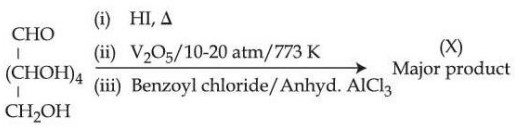
Step 1: The starting material is an aldohexose (like D-glucose). On prolonged heating with \(HI\), it undergoes reduction to form n-hexane. This indicates that all six carbon atoms are linked in a straight chain.
\(\text{CHO}-(\text{CHOH})_4-\text{CH}_2\text{OH} \xrightarrow{\text{HI, } \Delta} \text{CH}_3-\text{CH}_2-\text{CH}_2-\text{CH}_2-\text{CH}_2-\text{CH}_3\) (n-hexane)
Step 2: n-Hexane, when passed over heated \(V_2O_5\) at \(773 \text{ K}\) and \(10-20 \text{ atm}\) pressure, undergoes aromatization (dehydrogenation and cyclization) to form benzene.
\(\text{n-hexane} \xrightarrow{V_2O_5, \text{ 773 K, 10-20 atm}} \text{C}_6\text{H}_6\) (Benzene)
Step 3: Benzene reacts with benzoyl chloride (\(\text{C}_6\text{H}_5\text{COCl}\)) in the presence of anhydrous \(\text{AlCl}_3\) to form benzophenone. This is a Friedel-Crafts acylation reaction.
\(\text{C}_6\text{H}_6 + \text{C}_6\text{H}_5\text{COCl} \xrightarrow{\text{Anhyd. AlCl}_3} \text{C}_6\text{H}_5-\text{CO}-\text{C}_6\text{H}_5\) (Benzophenone)
Step 4: Analyze the product (X), which is benzophenone.
The structure of benzophenone consists of two phenyl rings attached to a carbonyl group.
- Each phenyl ring contains \(3\) \(\pi\) bonds, so two rings have \(6\) \(\pi\) bonds.
- The carbonyl group (\(\text{C=O}\)) contains \(1\) \(\pi\) bond.
- Total number of \(\pi\) bonds = \(6 + 1 = 7\).
- Total number of \(\pi\) electrons = \(7 \times 2 = 14\).
- The oxygen atom in the carbonyl group has \(2\) lone pairs of electrons.
- Total number of lone pair electrons = \(2 \times 2 = 4\).
Total number of electrons in the \(\pi\) bonds and lone pairs = \(14 + 4 = 18\).
Answer: \(18\) - 3. From the given following \(( A\) to D \()\) cyclac structures, those which will not react with Tollen's reagent are :
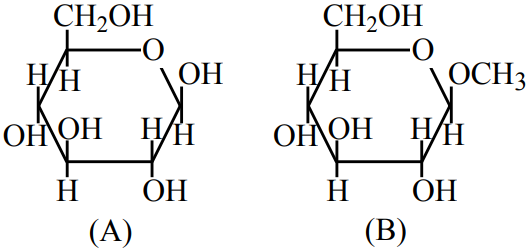
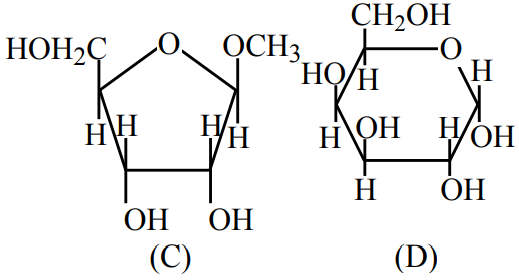 2026 Medium
- (A) B and D
- (B) A and D
- (C) A and B
- (D) B and C
Show answer and solution
Correct Answer: (D)
Compounds in option (B) and (C) are acetals (i.e. not having anomeric -OH). Hence they do not give Tollen's test. -
- (A) Statement I is false but Statement II is true.
- (B) Both Statement I and Statement II are false.
- (C) Both Statement I and Statement II are true.
- (D) Statement I is true but Statement II is false.
Show answer and solution
Correct Answer: (D)
\(\begin{array}{r} C _{12} H _{22} O _{11}+ H _2 O \xrightarrow{ HCl } C _6 H _{12} O _6+ C _6 H _{12} O _6 \\ \text { D- Glucose + D fructose }\end{array}\)
\([\alpha]_{D \text {-sucrose }}=+66.5^{\circ}, \quad[\alpha]_{D \text {-Glucose }}=+52.5^{\circ}\),
\([\alpha]_{\text {D-Fructose }}=-92.4^{\circ}\)
⇒ Sucrose is dextrorotatory and hydrolysed product is laevorotatory. -
- (A) Both Statement I and Statement II are true
- (B) Both Statement I and Statement II are false
- (C) Statement I is true but Statement II is false
- (D) Statement I is false but Statement II is true
Show answer and solution
Correct Answer: (D)
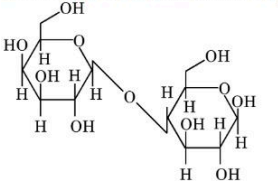
Maltose is a disaccharide composed of two \(\alpha\)-D-glucose units linked by an \(\alpha(1 \rightarrow 4)\) glycosidic bond. The anomeric carbon (C1) of the second glucose unit has a free hemiacetal group, which can open to form an aldehyde. Therefore, maltose can reduce Tollens' and Fehling's reagents, making it a reducing sugar. Statement I claims that maltose is a non-reducing sugar, so it is false.
Lactose is a disaccharide composed of \(\beta\)-D-galactose and D-glucose linked by a \(\beta(1 \rightarrow 4)\) glycosidic bond. Similar to maltose, the anomeric carbon (C1) of the glucose unit in lactose has a free hemiacetal group. This allows it to act as a reducing agent. Statement II correctly identifies lactose as a reducing sugar, so it is true.
Therefore, Statement I is false but Statement II is true.
Answer: Statement I is false but Statement II is true -
- (A) Both Statement I and Statement II are true
- (B) Both Statement I and Statement II are false
- (C) Statement I is true but Statement II is false
- (D) Statement I is false but Statement II is true
Show answer and solution
Correct Answer: (A)
Statement I is true because the \(\alpha\) and \(\beta\) forms of D-(+)-glucose are cyclic hemiacetals that differ only in the configuration of the hydroxyl group at C1, which is the anomeric carbon. Such isomers are called anomers.
Statement II is true because the open chain structures of D-glucose and D-fructose have identical configurations at C3, C4, and C5. D-glucose is an aldohexose with chiral centers at C2, C3, C4, and C5, while D-fructose is a ketohexose with chiral centers at C3, C4, and C5. The stereochemistry at C3 (hydroxyl group on the left), C4 (hydroxyl group on the right), and C5 (hydroxyl group on the right) is exactly the same in both sugars.
Therefore, both Statement I and Statement II are true.
Answer: Both Statement I and Statement II are true -
- (A) C and E Only
- (B) B and E Only
- (C) C and D Only
- (D) A and D Only
Show answer and solution
Correct Answer: (D)
- Histidine does contain heterocyclic ring.
- Proline is a five membered cyclic ring amino acid.
- Cysteine side chain is \(CH _2- SMe\).
A and D are correct. -
- (A) A and B Only
- (B) B and C Only
- (C) A, B and D Only
- (D) A, B and E Only
Show answer and solution
Correct Answer: (D)
Statement A is correct because glucose exists in two anomeric forms, \(\alpha\)-D-glucose and \(\beta\)-D-glucose.
Statement B is correct because the two anomers differ only in the configuration of the hydroxyl group at C\(-1\), which is the anomeric carbon in the cyclic hemiacetal structure.
Statement C is incorrect because the melting point of the \(\alpha\)-anomer is \(419\) K, which is less than the melting point of the \(\beta\)-anomer (\(423\) K).
Statement D is incorrect because the specific rotation of the \(\alpha\)-anomer is \(+112^{\circ}\) and that of the \(\beta\)-anomer is \(+19^{\circ}\).
Statement E is correct because the \(\alpha\)-form is obtained by crystallization from a concentrated solution of glucose at \(303\) K, while the \(\beta\)-form is obtained by crystallization from a hot and saturated aqueous solution at \(371\) K.
Thus, statements A, B, and E are correct.
Answer: A, B and E Only -
- (A) They can be fibrous or globular in structure.
- (B) The main forces that stabilize the structure are hydrogen bonding, disulphide links, van der Waals and electrostatic forces of attraction.
- (C) The structure remains intact when exposed to pH changes.
- (D) A linear polypeptide chain will convert to a secondary structure and then further folding of the secondary structure will convert to tertiary structure.
Show answer and solution
Correct Answer: (C)
The tertiary structure of proteins represents the overall folding of the polypeptide chains, which is the further folding of the secondary structure. This folding gives rise to two major molecular shapes: fibrous and globular.
The main forces that stabilize the secondary and tertiary structures of proteins are hydrogen bonds, disulphide linkages, van der Waals forces, and electrostatic forces of attraction.
When a protein in its native form is subjected to physical changes like temperature or chemical changes like pH, the hydrogen bonds and other stabilizing forces are disturbed. Due to this, globules unfold and the helix gets uncoiled, causing the protein to lose its biological activity. This process is called denaturation of the protein. Thus, the tertiary structure does not remain intact when exposed to pH changes.
Answer: The structure remains intact when exposed to pH changes. -
- (A) A-II, B-I, C-III, D-IV
- (B) A-IV, B-III, C-II, D-I
- (C) A-III, B-IV, C-I, D-II
- (D) A-I, B-III, C-II, D-IV
Show answer and solution
Correct Answer: (C)
Vitamin \(B_1\) is chemically known as Thiamine.
Vitamin \(B_2\) is chemically known as Riboflavin.
Vitamin \(B_6\) is chemically known as Pyridoxine.
Vitamin C is chemically known as Ascorbic acid.
Therefore, the correct matching is A-III, B-IV, C-I, D-II.
Answer: A-III, B-IV, C-I, D-II -
- (A) A-IV, B-II, C-I, D-III
- (B) A-IV, B-I, C-II, D-III
- (C) A-III, B-II, C-I, D-IV
- (D) A-IV, B-I, C-III, D-II
Show answer and solution
Correct Answer: (B)
Glutamine contains an amide group in its side chain, which gives a positive Hoffmann bromamide degradation test. Thus, A matches IV.
Lysine contains a primary amine group in its side chain, which gives a positive Hinsberg's test. Thus, B matches I.
Tyrosine contains a phenolic hydroxyl group in its side chain, which gives a positive neutral \(\text{FeCl}_3\) test. Thus, C matches II.
Serine contains an alcoholic hydroxyl group in its side chain, which gives a positive ceric ammonium nitrate test. Thus, D matches III.
The correct match is A-IV, B-I, C-II, D-III.
Answer: A-IV, B-I, C-II, D-III -
- (A) A-I, B-III, C-II, D-IV
- (B) A-I, B-III, C-IV, D-II
- (C) A-III, B-I, C-IV, D-II
- (D) A-III, B-I, C-II, D-IV
Show answer and solution
Correct Answer: (C)
Scurvy is caused by the deficiency of Vitamin C, which is chemically known as Ascorbic acid. Thus, A matches with III.
Convulsions are caused by the deficiency of Vitamin B6, which is chemically known as Pyridoxine. Thus, B matches with I.
Cheilosis (fissuring at corners of mouth and lips) is caused by the deficiency of Vitamin B2, which is chemically known as Riboflavin. Thus, C matches with IV.
Xerophthalmia (hardening of cornea of eye) is caused by the deficiency of Vitamin A. Thus, D matches with II.
The correct matching is A-III, B-I, C-IV, D-II.
Answer: A-III, B-I, C-IV, D-II -
- (A) A-II, B-I, C-IV, D-III
- (B) A-IV, B-III, C-II, D-I
- (C) A-III, B-IV, C-I, D-II
- (D) A-II, B-IV, C-I, D-III
Show answer and solution
Correct Answer: (A)
Arginine is an essential amino acid and its one-letter symbol is R. Thus, A matches with II.
Aspartic acid is a non-essential amino acid and its one-letter symbol is D. Thus, B matches with I.
Lysine is an essential amino acid and its one-letter symbol is K. Thus, C matches with IV.
Glutamic acid is a non-essential amino acid and its one-letter symbol is E. Thus, D matches with III.
The correct matching is A-II, B-I, C-IV, D-III.
Answer: A-II, B-I, C-IV, D-III -
- (A) A, C and D Only
- (B) A, B and D Only
- (C) A and B Only
- (D) B and C Only
Show answer and solution
Correct Answer: (C)
Explanation:
Let us analyze each statement meticulously according to the core text of the Class 12 NCERT textbook:
1. Statement A is correct: Enzymes are exceptional biological catalysts that lower the activation energy (\( E_{\text{a}} \)) of metabolic pathways with extreme efficiency. The activation energy for the enzyme-catalyzed (sucrase) hydrolysis of sucrose is significantly lower than that of ordinary acid-catalyzed hydrolysis.
2. Statement B is correct: Upon changing temperature or altering pH, a protein undergoes denaturation. During this process, weak stabilizing interactions and hydrogen bonds break down, disrupting the higher-order structural configurations. Thus, the secondary and tertiary structures are completely destroyed, while the covalent peptide bonds of the primary structure remain fully intact.
3. Statement C is incorrect: Successive nucleotides in nucleic acid strands are covalently linked together linearly by phosphodiester linkages connecting the \( C_5' \) carbon of one pentose ring to the \( C_3' \) carbon of the next. Glycosidic linkages are instead responsible for anchoring the nitrogenous bases to the \( C_1' \) carbon of the sugar unit.
4. Statement D is incorrect: According to the precise terminology used in the NCERT textbook, the tertiary structure of a protein represents the overall folding of the polypeptide chains (reflecting the further coiling of secondary structures). Conversely, the quaternary structure details the specific spatial arrangement of multiple distinct polypeptide subunits with respect to one another. Hence, statement D defines the tertiary structure, not the quaternary configuration.
Since only statements A and B are scientifically accurate, Option C is verified as the correct answer choice. -
- (A) All monosaccharides are reducing sugars.
- (B) The monosaccharide units obtained from hydrolysis of oligosaccharides are always the same.
- (C) Starch and cellulose are typical examples of polysaccharides, which are very high molecular weight compounds of more than ten monosaccharide units.
- (D) Open chain and cyclic structures co-exist at equilibrium that are responsible for certain properties as in the case of \(D-(+)\)-glucose.
Show answer and solution
Correct Answer: (B)
Statement (A) is correct because all monosaccharides contain a free aldehyde or ketonic group (or exist in equilibrium with it) and act as reducing sugars.
Statement (B) is incorrect because the hydrolysis of oligosaccharides can yield either the same or different monosaccharide units. For example, sucrose is an oligosaccharide (disaccharide) that yields one molecule of glucose and one molecule of fructose upon hydrolysis, whereas maltose yields two molecules of glucose.
Statement (C) is correct as polysaccharides like starch and cellulose are high molecular weight polymers containing more than ten monosaccharide units.
Statement (D) is correct because in an aqueous solution, \(D-(+)\)-glucose exists in an equilibrium between its open-chain form and its cyclic hemiacetal forms (\(\alpha\) and \(\beta\) anomers), which explains its mutarotation and other properties.
Answer: The monosaccharide units obtained from hydrolysis of oligosaccharides are always the same. -
- (A) 6
- (B) 3
- (C) 4
- (D) 8
Show answer and solution
Correct Answer: (A)
Gly ala val
Gly val ala
Val gly ala
Val ala gly
Ala val gly
Ala gly val
Total tri peptides = 6 - 17. Which of the following amino acid will give violet coloured complex with neutral ferric chloride solution? 2026 Medium
- (A) Threonine
- (B) Serine
- (C) Tyrosine
- (D) Cysteine
Show answer and solution
Correct Answer: (C)
Neutral ferric chloride (\(\text{FeCl}_3\)) solution gives a characteristic violet coloured complex with compounds containing a phenolic hydroxyl group.
Among the given amino acids, Tyrosine contains a phenolic \(-\text{OH}\) group in its side chain.
Threonine and Serine contain aliphatic \(-\text{OH}\) groups, and Cysteine contains a thiol (\(-\text{SH}\)) group, none of which give a positive neutral \(\text{FeCl}_3\) test.
Therefore, Tyrosine will give a violet coloured complex with neutral ferric chloride solution.
Answer: Tyrosine
No questions on this page match these filters.