


Questions
19 questionsShowing 1–19 of 19 questions
-
- (A) \(0.50\)
- (B) \(0.125\)
- (C) \(0.072\)
- (D) \(0.10\)
Show answer and solution
Correct Answer: (D)
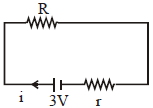
\(P_{R}=0.5 W\)\(\Rightarrow i ^{2} R =0.5 W\)
\(Also , V = E - ir\)
\(2.5=3-\) ir
\(\Rightarrow\) ir \(=0.5\)
Power dissipated across 'r' : \(P_{r}=i 2 r\)
\(Now\) iR \(=2.5\)
ir \(=0.5\)
On dividing : \(\frac{ R }{ r }=5\)
\(\operatorname{Now} \frac{ P _{ R }}{ P _{ r }}=\frac{ i ^{2} R }{ i ^{2} r } \Rightarrow \frac{ P _{ R }}{ P _{ r }}=\frac{ R }{ r } \Rightarrow \frac{ P _{ R }}{ P _{ r }}=5\)
\(\Rightarrow P _{ r }=\frac{ P _{ R }}{5}\)
\(\Rightarrow P _{ r }=\frac{0.50}{5} \Rightarrow P _{ r }=0.10 W\)
-
- (A) \(0.02\)
- (B) \(0.04\)
- (C) \(0.01\)
- (D) \(.0.03\)
Show answer and solution
Correct Answer: (A)
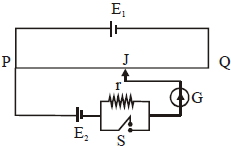
Sol. Balancing length is measured from \(P.\)So \(100-49=51 cm\)
\(E _{2}=\phi \times 51\)
Where \(\phi=\) Potential gradient
\(1.02=\phi \times 51\)
\(\phi=0.02 V / cm\)
-
- (A) \(72\)
- (B) \(96\)
- (C) \(91\)
- (D) \(85\)
Show answer and solution
Correct Answer: (B)
\(vi =10^{3}\)\(i =\frac{1000}{220}\)
loss \(= i ^{2} R =\left(\frac{50}{11}\right)^{2} \times 2\)
efficiency \(=\frac{1000}{1000+ i ^{2} R } \times 100=96 \%\)
-
- (A) \(8\)
- (B) \(10\)
- (C) \(15\)
- (D) \(25\)
Show answer and solution
Correct Answer: (A)
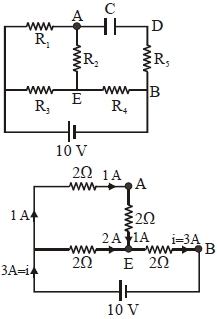
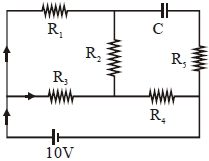
\(R _{1}\) to \(R _{5} \rightarrow\) each \(2 \Omega\)Cap. is fully charged
So no current is there in branch \(ADB\)
Effective circuit of current flow
\(R_{e q}=\left(\frac{4 \times 2}{4+2}\right)+2\)
\(R _{ eq }=\frac{4}{3}+2=\frac{10}{3} \Omega\)
\(i=\frac{10}{10 / 3}=3 A\)
So potential different across \(AEB\)
\(\Rightarrow 2 \times 1+2 \times 3=8 V\)
Hence potential difference across
Capacitor \(=\Delta V = V _{ AEB }=8 V\)
-
- (A) \(\rho_{ A }>\rho_{ T }>\rho_{ C }\)
- (B) \(\rho_{ C }>\rho_{ A }>\rho_{ T }\)
- (C) \(\rho_{A}>\rho_{M}>\rho_{C}\)
- (D) \(\rho_{ M }>\rho_{ A }>\rho_{ C }\)
Show answer and solution
Correct Answer: (D)
\(\rho_{ M }>\rho_{ A }>\rho_{ C }\) -
- (A) \(4\)
- (B) \(1\)
- (C) \(2\)
- (D) \(5\)
Show answer and solution
Correct Answer: (C)
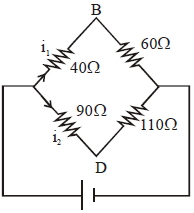
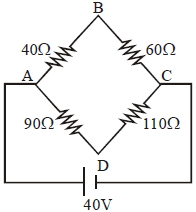
\(i _{1}=\frac{40}{40+60}=0.4\)\(i _{2}=\frac{40}{90+110}=\frac{1}{5}\)
\(v _{ B }+ i _{1}(40)- i _{2}(90)= v _{ D }\)
\(v _{ B }- v _{ D }=\frac{1}{5}(90)-\frac{4}{10} \times 40\)
\(v _{ B }- v _{ D }=18-16=2\)
-
- (A) \(13\)
- (B) \(10\)
- (C) \(7\)
- (D) \(17\)
Show answer and solution
Correct Answer: (B)
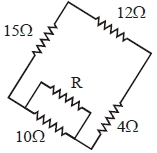
Let the resistance to be connected is \(\mathrm{R}\). For balanced wheatstone bridge.\(15 \times 4=12 \times \frac{10 \mathrm{R}}{10+\mathrm{R}}\)
\(\Rightarrow \mathrm{R}=10 \Omega\)
-
- (A) \(10\)
- (B) \(25\)
- (C) \(15\)
- (D) \(20\)
Show answer and solution
Correct Answer: (D)
\(220 \mathrm{I}=\mathrm{P}=15 \times 45+15 \times 100+15 \times 10+2 \times 10^{3}\)\(I=\frac{4325}{220}=19.66\)
\(\mathrm{I} \simeq 20 \mathrm{A}\)
-
- (A) \(36\)
- (B) \(37\)
- (C) \(33\)
- (D) \(40\)
Show answer and solution
Correct Answer: (D)
In balancing\(\frac{R}{S}=\frac{25}{75}\)
New resistance \(\mathrm{R}^{\prime}=\frac{\rho \ell}{\mathrm{A}}\)
\(=\frac{\rho \times \frac{\ell}{2}}{\frac{\mathrm{A}}{4}}=\frac{\rho \ell}{2} \times 4 \mathrm{A}\)
\(\mathrm{R}^{\prime}=2 \mathrm{R}\)
\(\frac{2 \mathrm{R}}{\mathrm{S}}=\frac{\ell}{100-\ell^{\prime}}\)
\(2 \times \frac{1}{3}=\frac{\ell^{\prime}}{100-\ell^{\prime}}=3 \ell^{\prime}=200-2 \ell^{\prime}\)
\(5 \ell '=200\)
\(\ell^{\prime}=40\)
-
- (A) \(+1\)
- (B) \(-1\)
- (C) \(-2\)
- (D) \(+2\)
Show answer and solution
Correct Answer: (A)
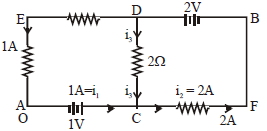
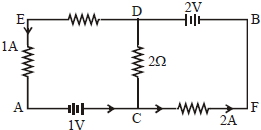
Let us asssume the potential at \(A=V_{A}=0\)Now at junction \(C,\) According to \(KCL\)
\(i_{1}+i_{3}=i_{2}\)
\(1 A + i _{3}=2 A\)
\(i _{3}=2 A\)
Now Analyse potential along \(ACDB\)
\(v_{A}+1+i_{3}(2)-2=v_{B}\)
\(0+1+2(1)-2=v_{B}\)
\(v_{B}=3-2\)
\(v_{B}=1 Amp\)
-
- (A) \(0.36 \,A\) from negative to positive terminal.
- (B) \(0.71\, A\) from positive to negative terminal.
- (C) \(0.21\, A\) from positive to negative terminal.
- (D) \(0.42\, A\) from positive to negative terminal.
Show answer and solution
Correct Answer: (C)
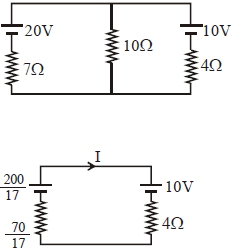
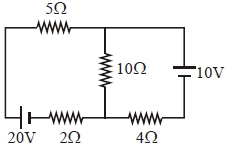
\(E _{ eq }=\frac{20 \times 10}{17}=\frac{200}{17}\)and \(R _{ eq }=\frac{7 \times 10}{17}=\frac{70}{17}\)
\(\therefore \quad I=\frac{\frac{20}{17}-10}{4+\frac{70}{17}}=0.21 A\)
from \(+ve\) to \(-ve\) terminal
-
- (A) \(R =\frac{2 \rho}{\pi l} l n \left(\frac{ b }{ a }\right)\)
- (B) \(R =\frac{\rho}{\pi l} \ln \left(\frac{ b }{ a }\right)\)
- (C) \(R =\frac{\rho}{2 \pi l}\left(\frac{ b }{ a }\right)\)
- (D) \(R =\frac{\rho}{2 \pi l} \ln \left(\frac{ b }{ a }\right)\)
Show answer and solution
Correct Answer: (D)
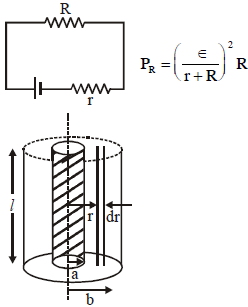
Maximum power in external resistance is generated when it is equal to internal resistance of battery.\(P_{R}\) is max. when \(r=R\)
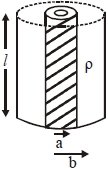
\(\int dr =\int_{2}^{b} \frac{\rho dr }{2 \pi r l} \Rightarrow r =\frac{\rho}{2 \pi l} l n \frac{ b }{ a }\)
-
- (A) \(12\)
- (B) \(10\)
- (C) \(8\)
- (D) \(14\)
Show answer and solution
Correct Answer: (A)
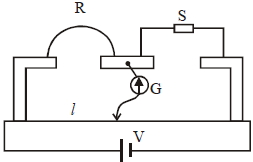
\(\mathrm{r}=\mathrm{R}\left(\frac{\mathrm{x}-\mathrm{x}^{\prime}}{\mathrm{x}^{\prime}}\right)\)\(=10 \times \frac{60}{500}\)
\(=12\)
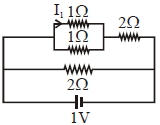
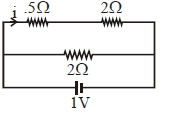
- 14. The current \(I_{1}\) (in \(A\)) flowing through \(1\; \Omega\) resistor in the following circuit is:
 2020 Medium
- (A) \(0.5\)
- (B) \(0.2\)
- (C) \(0.25\)
- (D) \(0.4\)
Show answer and solution
Correct Answer: (B)
Equivalent resistance of upper branch of circuit \(\mathrm{R}=2.5 \Omega\)Voltage across upper branch \(=1 \mathrm{V}\)
\(\Rightarrow \quad i=\frac{1}{2.5}=.4 \mathrm{A}\)
\(\Rightarrow \mathrm{I}_{1}=0.2 \mathrm{A}\)
-
- (A) \(120\)
- (B) \(60\)
- (C) \(80\)
- (D) \(100\)
Show answer and solution
Correct Answer: (D)
\(5=\lambda \ell\)where \(\lambda\) is potential gradient and \(L\) is total length of wire.
\(5=\frac{\Delta V}{L} \ell\)
\(\Delta \mathrm{V}=\frac{5 \times \mathrm{L}}{\ell}=5 \times \frac{12}{10}=6 \mathrm{V}=60 \;\mathrm{mA} \times \mathrm{R}\)
\(\mathrm{R}=100 \;\Omega\)
-
- (A) \(30\)
- (B) \(26\)
- (C) \(36\)
- (D) \(15\)
Show answer and solution
Correct Answer: (A)
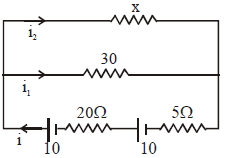
\(\mathrm{E}_{1} =\mathrm{E}-\mathrm{ir}\) \(=10-\mathrm{i} \times20=0\)\(\mathrm{i}=0.5 \mathrm{A}\)
\(\mathrm{E}_{2}=\mathrm{E}-\mathrm{ir}\)
\(=10-0.5 \times 5\) \(=7.5 \mathrm{V}\)
\(\mathrm{E}_{\mathrm{net}}=\mathrm{E}_{1}+\mathrm{E}_{2}=7.5 \mathrm{V}\)
\(\mathrm{i}=\mathrm{i}_{1}+\mathrm{i}_{2}\)
\(0.5=\frac{7.5}{x}+\frac{7.5}{30}\)
\(\mathrm{x}=30 \Omega\)
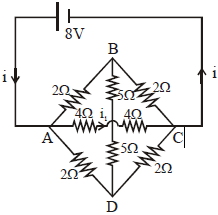
- 17. The value of current \(i_{1}\) flowing from \(A\) to \(C\) in the circuit diagram is\(.......A\)
 2020 Medium
- (A) \(5\)
- (B) \(2\)
- (C) \(4\)
- (D) \(1\)
Show answer and solution
Correct Answer: (D)
Voltage across \(AC =8 V\)\(R _{ AC }=4+4=8 \Omega\)
\(i_{1}=\frac{V}{R_{A C}}=\frac{8}{8}=1 A\)
-
- (A) \(2\)
- (B) \(1.95\)
- (C) \(2.05\)
- (D) \(1.8\)
Show answer and solution
Correct Answer: (B)
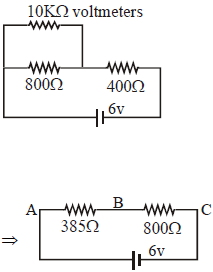
So the potential difference in voltmeter acrossthe points \(A\) and \(B\) is \(\frac{6}{1185} \times 385=1.949 V\)
-
- (A) Multimeter shows \(NO\) deflection in both cases i.e. before and after reversing the probes if the chosen component is capacitor.
- (B) Multimeter shows a deflection, accompanied by a splash of light out of connected component in one direction and \(NO\) deflection on reversing the probes if the chosen component is \(LED.\)
- (C) Multimeter shows \(NO\) deflection in both cases i.e. before and after reversing the probes if the chosen compoenent is metal wire.
- (D) Multimeter shows an equal deflection in both cases i.e. before and after reversing the probes if the chosen component is resistor.
Show answer and solution
Correct Answer: (A)
\((1)\) Multimeter shows deflection when it connects with capacitor\((2)\) If we assume that \(LED\) has negligiable resistance then multimeter shows no deflection for the forward blas but when it connects in reverse direction, it break down occurs so splash of light out.
\((3)\) The resistance of metal wire may be taken zero, so no deflection in multimeter
\((4)\) No matter, how we connect the resistance across multimeter It shows same deflection.
No questions on this page match these filters.