


All JEE Mains 2020 Physics questions
31 chaptersShowing 301–350 of 401 questions
-
- (A) \(45\)
- (B) \(41\)
- (C) \(38\)
- (D) \(49\)
Show answer and solution
Correct Answer: (B)
\(V _{ rms }=\sqrt{\frac{3 RT }{ M }}\)\(V _{ N _{2}}= V _{ H _{2}}\)
\(\sqrt{\frac{3 RT _{ N _{2}}}{ M _{ N _{2}}}}=\sqrt{\frac{3 RT _{ H _{2}}}{ M _{ H _{2}}}}\)
\(\frac{573}{28}=\frac{ T _{ H _{2}}}{2} \Rightarrow T _{ H _{2}}=40.928\)
-
- (A) \(5.8 \times 10^{18}\)
- (B) \(5.8 \times 10^{16}\)
- (C) \(4.0 \times 10^{18}\)
- (D) \(4.0 \times 10^{16}\)
Show answer and solution
Correct Answer: (C)
\(n =\frac{ PV }{ RT }, \frac{3}{2} kT =4 \times 10^{-14}\)\(N =\frac{ PV }{ RT } \times Na\)
\(=\frac{2 \times 13.6 \times 980 \times 4}{\frac{8}{3} \times 10^{-14}}=3.99 \times 10^{18}\)
-
- (A) \(150\)
- (B) \(176\)
- (C) \(145\)
- (D) \(135\)
Show answer and solution
Correct Answer: (A)
\(PV = nRT\)\(P \Delta V + V \Delta P =0 \quad(\) for constant temp. \()\)
\(P \Delta V = n R \Delta T \quad(\) for constant pressure)
\(\Delta T =\frac{ P \Delta V }{ nR }\)
\(\Delta P =-\frac{ P \Delta V }{ V } \quad(\Delta V\) is same in both cases \()\)
\(\frac{\Delta T }{\Delta P }=\frac{ P \Delta V }{ nR } \frac{ V }{- P \Delta V }=\frac{- V }{ nR }=-\frac{ T }{ P }\)
\(( PV = nRT )\)
\(\left(\frac{ V }{ nR }=\frac{ T }{ P }\right) \quad\left|\frac{\Delta T }{\Delta P }\right|=\left|\frac{-300}{2}\right|=150\)
-
- (A) \(5\)
- (B) \(3\)
- (C) \(6\)
- (D) \(7\)
Show answer and solution
Correct Answer: (C)
\(nC _{ P }(50)=160\)\(nC _{ v }(100)=240\)
\(\Rightarrow \frac{ C _{ p }}{2 C _{ v }}=\frac{160}{240}=\frac{\gamma}{2}\)
\(\therefore \gamma=\frac{4}{3}\) and \(f =\frac{2}{\gamma-1}=6\)
-
- (A) \(1.09\)
- (B) \(4.67\)
- (C) \(1.83\)
- (D) \(2.3\)
Show answer and solution
Correct Answer: (A)
\(\lambda=\frac{1}{\sqrt{2} \pi \mathrm{n}_{\mathrm{v}} \mathrm{d}^{2}}\)\(\tau=\frac{\lambda}{\mathrm{v}}=\frac{1}{\sqrt{2} \pi \mathrm{n}_{\mathrm{v}} \mathrm{d}^{2} \mathrm{v}}=\frac{1}{\sqrt{2} \pi \mathrm{n}_{\mathrm{v}} \mathrm{d}^{2}} \sqrt{\frac{\mathrm{M}}{3 \mathrm{RT}}}\)
\(\frac{\tau_{1}}{\tau_{2}}=\sqrt{\frac{M_{1}}{M_{2}}} \frac{d_{2}^{2}}{d_{1}^{2}}\)
\(=\sqrt{\frac{40}{140}} \frac{(0.1)^{2}}{(0.07)^{2}}\)
\(=1.09\)
-
- (A) \(1.50\)
- (B) \(1.42\)
- (C) \(1.45\)
- (D) \(1.47\)
Show answer and solution
Correct Answer: (B)
For \(1^{\text {st }}\) gas \(\frac{C_{P_{1}}}{C_{V_{1}}}=\frac{5}{3} \Rightarrow C_{P_{1}}=5 x\) and \(C_{V_{1}}=3 x\)For \(2^{\text {nd }}\) gas \(\frac{C_{P_{2}}}{C_{V_{2}}}=\frac{4}{3} \Rightarrow C_{P_{2}}=4 x\) and \(C_{V_{2}}=3 x\)
Now for mixture \(\mathrm{C}_{\mathrm{P}}=\frac{\mathrm{n}_{1} \mathrm{C}_{\mathrm{P}}+\mathrm{n}_{2} \mathrm{C}_{\mathrm{B}_{2}}}{\mathrm{n}_{1}+\mathrm{n}_{2}}=\frac{17 \mathrm{R}}{5}\)
\(C_{V}=\frac{n_{1} C_{V_{1}}+n_{2} C_{V_{3}}}{n_{1}+n_{2}}=\frac{12 R}{5}\)
\(\Rightarrow \frac{C_{p}}{C_{v}}=\frac{2(5 x)+3(4 x)}{2(3 x)+3(3 x)}=\frac{17}{12}\)
\(\Rightarrow \frac{C_{P}}{C_{V}} \approx 1.42\)
-
- (A) \(\left(\frac{1}{2}\right)^{\frac{\gamma+1}{2}}\)
- (B) \(2\)
- (C) \(\frac 12\)
- (D) \(\left(\frac{1}{2}\right)^{\gamma}\)
Show answer and solution
Correct Answer: (A)
\({\lambda \propto V}\)The average time between the collisions of the gas molecules is nothing but the mean free path divided by the root mean square speed of the gas molecules.
\(\mathrm{So}\)
\(\Longrightarrow\left[\text { Time }=t=\frac{\lambda}{v_{R M S}}\right]\)
Now we also know that :-
\(v_{R M S} \propto \sqrt{P V}\)
Using the above we get :-
\(\Longrightarrow t \propto V \times \sqrt{\frac{1}{P V}}\)
\(\Longrightarrow t \propto \sqrt{\frac{V^{2}}{P V}}\)
\(\Longrightarrow t \propto \sqrt{\frac{V}{P}}\)
adiabatic process then \(PV^{\gamma}=constant\)
then \(t \propto V^{\frac{\gamma+1}{2}}\)
-
- (A) Irreversible isothermal
- (B) Irreversible adiabatic
- (C) Reversible adiabatic
- (D) Reversible isothermal
Show answer and solution
Correct Answer: (B)
Bursting of helium balloon is irreversible \(\&\) adiabatic. -
- (A) \(450\)
- (B) \(500\)
- (C) \(600\)
- (D) \(650\)
Show answer and solution
Correct Answer: (C)
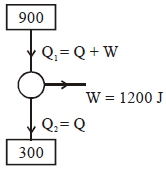
for carnot engine\(\frac{Q_{1}}{Q_{2}}=\frac{T_{1}}{T_{2}}\)
\(\frac{\mathrm{Q}+1200}{\mathrm{Q}}=\frac{900}{300}\)
\(\mathrm{Q}+1200=3 \mathrm{Q}\)
\(Q=600 \mathrm{J}\)
-
- (A) \(269.5\)
- (B) \(260.6\)
- (C) \(250.5\)
- (D) \(266.67\)
Show answer and solution
Correct Answer: (D)
As work done on gas and heat supplied to the gas are zero,total internal energy of gases remain same
\(u _{1}+ u _{2}= u _{1}^{\prime}+ u _{2}^{\prime}\)
\((0.1) C _{ v }(200)+(0.05) C _{ v }(400)=(0.15) C _{ v } T\)
\(T =\frac{800}{3} k =266.67 k\)
-
- (A) \(640\)
- (B) \(400\)
- (C) \(980\)
- (D) \(40\)
Show answer and solution
Correct Answer: (C)
\(\eta=\frac{\text { Work done }}{\text { Heat supplied }}\)\(\frac{1}{2}=\eta=\frac{1915-40+125- Q }{1915+125}\)
\(\frac{1}{2}=\frac{2000- Q }{2040}\)
\(2040=4000-2 Q\)
\(2 Q =1960\)
\(Q =980 J\)
-
- (A) \(90.5 \;J\)
- (B) \(48 \;J\)
- (C) \(60.7 \;J\)
- (D) \(100.8 \;J\)
Show answer and solution
Correct Answer: (A)
\(\mathrm{W}=\frac{\mathrm{nR}\left(\mathrm{T}_{1}-\mathrm{T}_{2}\right)}{\gamma-1}=\frac{\mathrm{P}_{1} \mathrm{V}_{1}-\mathrm{P}_{2} \mathrm{V}_{2}}{0.4}\)\(W=\frac{100-\frac{100}{4.6555} \times 3}{0.4}=88.90\;J\)
-
- (A) \(19\)
- (B) \(25\)
- (C) \(27\)
- (D) \(30\)
Show answer and solution
Correct Answer: (A)
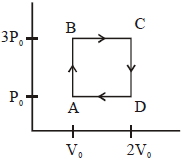
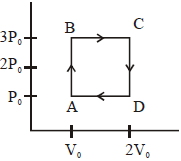
\(W _{ ABCDA }=2 P _{0} V _{0}\)\(Q_{\text {in }}=Q_{A B}+Q_{B C}\)
\(Q _{ AB }= nC \left( T _{ B }- T _{ A }\right)\)
\(=\frac{ n 3 R }{2}\left( T _{ B }- T _{ A }\right)\)
\(=\frac{3}{2}\left(P_{B} V_{B}-P_{A} V_{A}\right)\)
\(=\frac{3}{2}\left(3 P_{B} V_{0}=P_{0} V_{0}\right)=3 P_{0} V_{0}\)
\(Q _{ BC }= nC _{ P }\left( T _{ C }- T _{ B }\right)\)
\(=\frac{ n 5 R }{2}\left( T _{ C }- T _{ B }\right)\)
\(=\frac{5}{2}\left(P_{C} V_{C}-P_{B} V_{B}\right)\)
\(=\frac{5}{2}\left(6 P _{0} V _{0}-3 P _{0} V _{0}\right)=\frac{15}{2} P _{0} V _{0}\)
\(\eta=\frac{ W }{ Q _{ in }} \times 100=\frac{2 P _{0} V _{0}}{3 P _{0} V _{0}+\frac{15}{2} P _{0} V _{0}} \times 100\)
\(\eta=\frac{400}{21}=19.04 \approx 19\)
\(\eta=19\)
-
- (A) \(46.87\)
- (B) \(45.78\)
- (C) \(55.78\)
- (D) \(50.23\)
Show answer and solution
Correct Answer: (B)
Diatomic :\(f=5\)
\(\gamma=7 / 5\)
\(T _{ i }= T =273+2 0 =293 K\)
\(V_{i}=V\)
\(V _{ f }= V / 10\)
Adiabatic \(TV ^{\gamma-1}=\) constant
\(T _{1} V _{1}^{\gamma-1}= T _{2} V _{2}^{\gamma-1}\)
\(T \cdot V ^{7 / 5-1}= T _{2}\left(\frac{ V }{10}\right)^{7 / 5-1}\)
\(\Rightarrow T _{2}= T .10^{2 / 5}\)
\(\Delta U =\frac{ nfR \left( T _{2}- T _{1}\right)}{2}=\frac{5 \times 5 \times \frac{25}{3} \times\left( T \cdot 10^{2 / 5}- T \right)}{2}\)
\(=\frac{25 \times 25 \times}{6} T \left(10^{2 / 5}-1\right)\)
\(=\frac{625 \times 293 \times\left(10^{2 / 5}-1\right)}{6}\)
\(=4.033 \times 10^{3} \approx 4 kJ\)
-
- (A) \(8000\)
- (B) \(8502\)
- (C) \(8791\)
- (D) \(8561\)
Show answer and solution
Correct Answer: (C)
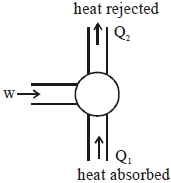
\(W + Q _{1}= Q _{2}\)\(W = Q _{2}- Q _{1}\)
\(C.O.P. =\frac{ Q _{1}}{ W }=\frac{ Q _{1}}{ Q _{2}- Q _{1}}=\frac{273}{300-273}=\frac{ Q _{1}}{ W }\)
\(W =\frac{27}{273} \times 80 \times 100 \times 4.2\)
\(Q _{2}= W+Q_{1}\)
\(Q _{2}=\frac{27}{273} \times 80 \times 100 \times 4.2+80 \times 100 \times 4.2\)
\(Q _{2}=\frac{300}{273} \times 80 \times 100=8791.2 cal\)
-
- (A) \(326\)
- (B) \(\frac{1}{32}\)
- (C) \(32\)
- (D) \(128\)
Show answer and solution
Correct Answer: (D)
In adiabatic process\(PV ^{\gamma}= constant\)
\(P \left(\frac{ m }{\rho}\right)^{\gamma}= constant\)
as mass is constant
\(P \propto \rho^{\gamma}\)
\(\frac{P_{f}}{P_{i}}=\left(\frac{\rho_{f}}{\rho_{i}}\right)^{\gamma}=(32)^{7 / 5}=2^{7}=128\)
-
- (A) \(I-B, II-D, III-A, IV-C\)
- (B) \(I-B, II-A, III-D, IV-C\)
- (C) \(I - A , II - A , III - B , IV - C\)
- (D) \(I - A , II - B , III - D , IV - D\)
Show answer and solution
Correct Answer: (A)
\((I)\) Adiabatic process \(\Rightarrow \Delta Q=0\) No exchange of heat takes place with surroundings\((II)\) Isothermal proess \(\Rightarrow\) Temperature remains constant \((\Delta T =0)\)
\(\Delta u =\frac{ F }{2} nR \Delta T \Rightarrow \Delta u =0\)
No change in internal energy \([\Delta u =0]\)
\((III)\) Isochoric process Volume remains constant
\(\Delta V =0\)
\(W =\int P \cdot d V =0\)
Hence work done is zero.
\((IV)\) Isobaric process \(\Rightarrow\) Pressure remains constant
\(W = P . \Delta V \neq 0\)
\(\Delta u =\frac{ F }{2} nR \Delta T =\frac{ F }{2}[ P \Delta V ] \neq 0\)
\(\Delta Q = n C _{ p } \Delta T \neq 0\)
-
- (A) \(1818\)
- (B) \(2020\)
- (C) \(1576\)
- (D) \(1734\)
Show answer and solution
Correct Answer: (A)
\(\mathrm{PV} ^\gamma=\) constant\(\mathrm{TV} ^{\gamma-1}=\mathrm{C}\)
\(300 \times \mathrm{V}^{\frac{7}{5}-1}=\mathrm{T}_{2}\left(\frac{\mathrm{V}}{16}\right)^{\frac{7}{5}-1}\)
\(300 \times 2^{4 \times \frac{2}{5}}=\mathrm{T}_{2}\)
Isobaric process
\(\mathrm{V}=\frac{\mathrm{nRT}}{\mathrm{P}}\)
\(\mathrm{V}_{2}=\mathrm{kT}_{2}\)
\(2 \mathrm{V}_{2}=\mathrm{KT}_{\mathrm{f}}\)
\(\frac{1}{2}=\frac{\mathrm{T}_{2}}{\mathrm{T}_{\mathrm{f}}} \Rightarrow \mathrm{T}_{\mathrm{f}}=2 \mathrm{T}_{2}\)
\(\mathrm{T}_{\mathrm{f}}=2 \times 300 \times 2^{\frac{8}{5}}=1818.85\)
-
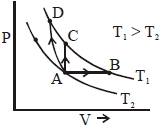
- (A) \(E _{ AB }= E _{ AC }= E _{ AD }, W _{ AB }>0, W _{ AC }=0,\) \(W _{ AD }>0\)
- (B) \(E _{ AB }< E _{ AC }< E _{ AD }, W _{ AB }>0, W _{ AC }> W _{ AD }\)
- (C) \(E _{ AB }= E _{ AC }< E _{ AD }, W _{ AB }>0, W _{ AC }=0\) \(W _{ AD }<0\)
- (D) \(E _{ AB }> E _{ AC }> E _{ AD }, W _{ AB }< W _{ AC }< W _{ AD }\)
Show answer and solution
Correct Answer: (A)
\(\Delta U = nC _{ v } \Delta T =\) same\(AB \rightarrow\) volume is increasing \(\Rightarrow W >0\)
\(AD \rightarrow\) volume is decreasing \(\Rightarrow W <0\)
\(AC \rightarrow\) volume is constant \(\Rightarrow W =0\)
-
- (A) \(\mathrm{T}=\frac{2 \mathrm{T}_{1} \mathrm{T}_{2}}{\mathrm{T}_{1}+\mathrm{T}_{2}}\)
- (B) \(\mathrm{T}=\sqrt{\mathrm{T}_{1} \mathrm{T}_{2}}\)
- (C) \(\mathrm{T}=\frac{\mathrm{T}_{1}+\mathrm{T}_{2}}{2}\)
- (D) \(T=0\)
Show answer and solution
Correct Answer: (C)
\(\frac{\mathrm{Q}_{\mathrm{H}}}{\mathrm{Q}_{\mathrm{L}}}=\frac{\mathrm{T}_{1}}{\mathrm{T}}\) and \(\mathrm{W}=\mathrm{Q}_{\mathrm{H}}-\mathrm{Q}_{\mathrm{L}}\)\(\frac{\mathrm{Q}_{\mathrm{L}}}{\mathrm{Q}_{\mathrm{L}}^{\prime}}=\frac{\mathrm{T}}{\mathrm{T}_{2}}\) and \(\mathrm{W}=\mathrm{Q}_{\mathrm{L}}-\mathrm{Q}_{\mathrm{L}}\)
From \((1)\) and \((2)\)
we get \(\mathrm{T}=\frac{\mathrm{T}_{1}+\mathrm{T}_{2}}{2}\)
-
- (A) \(20\)
- (B) \(25\)
- (C) \(35\)
- (D) \(27\)
Show answer and solution
Correct Answer: (A)
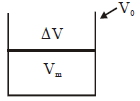
\(\Delta V =\left( V _{0}- V _{ m }\right)\)After increasing temperature
\(\Delta V ^{\prime}=\left( V _{0}^{\prime}- V _{ m }^{\prime}\right)\)
\(\Delta V ^{\prime}=\Delta V\)
\(V _{0}- V _{ m }= V _{0}\left(1+\gamma_{ b } \Delta T \right)- V _{ m }\left(1+\gamma_{ M } \Delta T \right)\)
\(V _{{0} \gamma_b} = V _{ m } \gamma_{ m }\)
\(V _{ m }=\frac{ V _{0} \gamma_{ b }}{\gamma_{ m }}=\frac{(500)\left(6 \times 10^{-6}\right)}{\left(1.5 \times 10^{-4}\right)}\)
\(20\,CC\)
-
- (A) \(83.3\)
- (B) \(87.5\)
- (C) \(119.2\)
- (D) \(38.4\)
Show answer and solution
Correct Answer: (B)
\(\frac{1}{2} m v^{2} \times \frac{1}{2}=m s \Delta T\)\(\Delta T=\frac{v^{2}}{4 \times 5}=\frac{210^{2}}{4 \times 30 \times 4.200}\)
\(=87.5^{\circ} C\)
-
- (A) \(2.6\)
- (B) \(2\)
- (C) \(4\)
- (D) \(3.2\)
Show answer and solution
Correct Answer: (B)
\(\frac{ Cal }{20 gm } \frac{ H _{2} O }{180 gm } \quad \frac{ Steam }{ m }\)\(200 \times 1 \times(31-25)\)\(= m \times 540+ m \times 1 \times(100-31)\)
\(m \approx 2 \;gm\)
-
- (A) \(35\)
- (B) \(37\)
- (C) \(40\)
- (D) \(42\)
Show answer and solution
Correct Answer: (C)
\(\mathrm{M} \times 540+\mathrm{M}+60=200 \times 80+200 \times 1 \times(40-0)\)\(\Rightarrow \mathrm{M}=40\)
-
- (A) \(61.7\)
- (B) \(63.8\)
- (C) \(69.3\)
- (D) \(64.6\)
Show answer and solution
Correct Answer: (A)
Here the water will provide heat for ice to melt therefore\(m_{w} s_{w} \Delta \theta=m_{i c e} L_{i c e}\)
\(m _{ ice }=\frac{0.2 \times 4200 \times 25}{3.4 \times 10^{5}}\)
\(=0.0617 \,kg\)
\(=61.7\, gm\)
Remaining ice will remain un-melted
-
- (A) \(45\)
- (B) \(48\)
- (C) \(55\)
- (D) \(50\)
Show answer and solution
Correct Answer: (D)
According to table and applying law of calorimetry\(1 \mathrm{T}_{1}+2 \mathrm{T}_{2}=(1+2) 60^{\circ}\)
\(=180\)
\(1 \mathrm{T}_{2}+2 \mathrm{T}_{3}=(1+2) 30^{\circ}\)
\(=90\)
\(2 \mathrm{T}_{1}+1 \mathrm{T}_{3}=(1+2) 60\)
\(=180\)
\(3\left(\mathrm{T}_{1}+\mathrm{T}_{2}+\mathrm{T}_{3}\right)=450\)
\(\mathrm{T}_{1}+\mathrm{T}_{2}+\mathrm{T}_{3}=150^{\circ}\)
Hence,
\(\mathrm{T}_{1}+\mathrm{T}_{2}+\mathrm{T}_{3}=(1+1+1) \theta\)
\(150=3 \theta\)
\(\theta=50^{\circ} \mathrm{C}\)
-
- (A) \(4 \frac{\alpha_{1} \alpha_{2}}{\alpha_{1}+\alpha_{2}} \frac{ L _{2} L _{1}}{\left( L _{2}+ L _{1}\right)^{2}}\)
- (B) \(2 \sqrt{\alpha_{1} \alpha_{2}}\)
- (C) \(\frac{\alpha_{1}+\alpha_{2}}{2}\)
- (D) \(\frac{\alpha_{1} L_{1}+\alpha_{2} L_{2}}{L_{1}+L_{2}}\)
Show answer and solution
Correct Answer: (D)
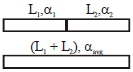
At \(T^{\circ} C \quad L = L _{1}+ L _{2}\)At \(T +\Delta T \quad L _{ eq }= L _{1}+ L _{2}\)
where \(L _{1}= L _{1}\left(1+\alpha_{1} \Delta T \right)\)
\(L _{2}^{\prime}= L _{2}\left(1+\alpha_{2} \Delta T \right)\)
\(L _{ eq }^{\prime}=\left( L _{1}+ L _{2}\right)\left(1+\alpha_{ avg } \Delta T \right)\)
\(\Rightarrow\left(L_{1}+L_{2}\right)\left(1+\alpha_{avg } \Delta T \right)= L _{1}+ L _{2}+ L _{1} \alpha_{1} \Delta T + L _{2} \alpha_{2} \Delta T\)
\(\Rightarrow\left( L _{1}+ L _{2}\right) \alpha_{ avg }= L _{1} \alpha_{1}+ L _{2} \alpha_{2}\)
\(\Rightarrow \alpha_{ avg }=\frac{ L _{1} \alpha_{1}+ L _{2} \alpha_{2}}{ L _{1}+ L _{2}}\)
-
- (A) \(0.008\)
- (B) \(0.06\)
- (C) \(0.8\)
- (D) \(2.3\)
Show answer and solution
Correct Answer: (B)
Given \(\frac{\Delta L }{ L }=0.02 \%\)\(\therefore \Delta L = L \alpha \Delta T \Rightarrow \frac{\Delta L }{ L }=\alpha \Delta T =0.02 \%\)
\(\therefore \beta=2 \alpha\) (Areal coefficient of expansion) \(\Rightarrow \beta \Delta T =2 \alpha \Delta T =0.04 \%\)
Volume \(=\) Area \(\times\) Length
Density \((\rho)=\frac{\text { Mass }}{\text { Volume }}=\frac{\text { Mass }}{\text { Area } \times \text { Length }}=\frac{ M }{ AL }\)
\(\Rightarrow \frac{\Delta \rho}{\rho}=\frac{\Delta M}{M}+\frac{\Delta A }{ A }+\frac{\Delta L }{ L }\) (Mass remains constant)
\(\Rightarrow\left(\frac{\Delta \rho}{\rho}\right)=\frac{\Delta A }{ A }+\frac{\Delta L }{ L }=\beta \Delta T +\alpha \Delta T\)
\(=0.04 \%+0.02 \%\)
\(=0.06 \%\)
-
- (A) \(8\)
- (B) \(7\)
- (C) \(11\)
- (D) \(4\)
Show answer and solution
Correct Answer: (D)
\(\mathrm{T}=\mathrm{m\omega}^{2} \ell\)Breaking stress \(=\frac{\mathrm{T}}{\mathrm{A}}=\frac{\mathrm{mo}^{2} \ell}{\mathrm{A}}\)
\(\Rightarrow \omega^{2}=\frac{4.8 \times 10^{7} \times\left(10^{-2} \times 10^{-4}\right)}{10 \times 0.3}=16\)
\(\Rightarrow \omega=4\)
-
- (A) \(0.6\)
- (B) \(1.67\)
- (C) \(5\)
- (D) \(20\)
Show answer and solution
Correct Answer: (B)
\(B =-\frac{\Delta P }{\frac{\Delta V }{ V }}\)\(\left|\frac{\Delta V }{ V }\right|=\frac{\Delta P }{ B }\)
\(=\frac{4 \times 10^{9}}{8 \times 10^{10}}=\frac{1}{20}\)
\(\frac{\Delta \ell}{\ell}=\frac{1}{3} \times \frac{\Delta V }{ V }=\frac{1}{60}\)
Percentage change \(=\frac{\Delta \ell}{\ell} \times 100 \%\)
\(=\frac{100}{60} \%=1.67 \%\)
-
- (A) \(1: \sqrt{2}\)
- (B) \(1: 2\)
- (C) \(2:1\)
- (D) \(\sqrt{2}: 1\)
Show answer and solution
Correct Answer: (D)
\(\frac{\text { Energystored }}{\text { Volume }}=\frac{1}{2} \frac{(\text { Stress })^{2}}{\mathrm{Y}}\)\(\frac{\mathrm{u}_{1}}{\mathrm{u}_{2}}=\frac{1}{4} \Rightarrow 4 \mathrm{u}_{1}=\mathrm{u}_{2}\)
\(4 \frac{1}{2 \mathrm{Y}}\left[\frac{\mathrm{W} \cdot 4}{\pi \mathrm{d}_{1}^{2}}\right]^{2}=\frac{1}{2 \mathrm{Y}}\left[\frac{\mathrm{W} \cdot 4}{\pi \mathrm{d}_{2}^{2}}\right]^{2}\)
\(4=\left(\frac{\mathrm{d}_{1}}{\mathrm{d}_{2}}\right)^{4}\)
\(\Rightarrow \frac{\mathrm{d}_{1}}{\mathrm{d}_{2}}=\sqrt{2}: 1\)
-
- (A) \(0.137\)
- (B) \(0.172\)
- (C) \(0.087\)
- (D) \(0.049\)
Show answer and solution
Correct Answer: (C)
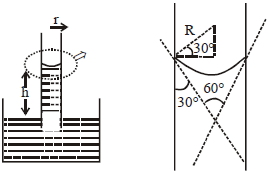
\(r \rightarrow\) radius of capillary\(R \rightarrow\) Radius of meniscus.
From figure, \(\frac{r}{R}=\cos 30^{\circ}\)
\(R =\frac{2 r }{\sqrt{3}}=\frac{2 \times 0.15 \times 10^{-3}}{\sqrt{3}}\)
\(=\frac{0.3}{\sqrt{3}} \times 10^{-3} m\)
Height of capillary
\(h =\frac{2 T }{\rho gR }=2 \sqrt{3} T\)
\(h =\frac{2 \times 0.05}{667 \times 10 \times\left(\frac{0.3 \times 10^{-3}}{\sqrt{3}}\right)}\)
\(h=0.087 m\)
-
- (A) \(r=\sqrt{\frac{2 T}{3(d+\rho) g}}\)
- (B) \(r=\sqrt{\frac{3 T}{(2 d-\rho) g}}\)
- (C) \(r=\sqrt{\frac{T}{(d-\rho) g}}\)
- (D) \(r=\sqrt{\frac{\mathrm{T}}{(\mathrm{d}+\rho) \mathrm{g}}}\)
Show answer and solution
Correct Answer: (B)
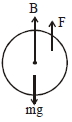
\(B + F = mg\)\(\mathrm{B}=\left(\frac{2}{3} \pi \mathrm{R}^{3}\right) \rho \mathrm{g}\)
\(\mathrm{F}=\mathrm{T}(2 \pi \mathrm{R})\)
\(\mathrm{m}=\mathrm{d}\left(\frac{4}{3} \pi \mathrm{R}^{3}\right)\)
\(\left(\frac{2}{3} \pi \mathrm{R}^{3}\right) \rho \mathrm{g}+\mathrm{T}(2 \pi \mathrm{R})=\mathrm{d}\left(\frac{4}{3} \pi \mathrm{R}^{3}\right) \mathrm{g}\)
\(\mathrm{T}(2 \pi \mathrm{R})=\left(\frac{2}{3} \pi \mathrm{R}^{3}\right) \mathrm{g}[2 \mathrm{d}-\rho]\)
\(\mathrm{R}=\sqrt{\frac{3 \mathrm{T}}{(2 \mathrm{d}-\rho) \mathrm{g}}}\)
- 334. Pressure inside two soap bubbles are \(1.01\) and \(1.02\) atmosphere, respectively. The ratio of their volumes is 2020 Medium
- (A) \(8:1\)
- (B) \(0.8:1\)
- (C) \(2:1\)
- (D) \(4:1\)
Show answer and solution
Correct Answer: (A)
\(\Delta P _{1}=0.01=4 T / R _{1} \quad \ldots . .(1)\)\(\Delta P _{2}=0.02=4 T / R _{2} \quad \ldots . .(2)\)
Equation \((1)+(2)\)
\(\frac{1}{2}=\frac{ R _{2}}{ R _{1}}\)
\(R _{1}=2 R _{2}\)
\(\frac{V_{1}}{V_{2}}=\frac{R_{1}^{3}}{R_{2}^{3}}=\frac{8 R_{2}^{3}}{R_{2}^{3}}=8\)
-
- (A) \(115\)
- (B) \(120\)
- (C) \(101\)
- (D) \(109\)
Show answer and solution
Correct Answer: (C)
Capillary rise\(h =\frac{2 S \cos \theta}{\rho gr }\)
\(S=\frac{\rho grh}{2 \cos \theta}\)
\(=\frac{(900)(10)\left(15 \times 10^{-5}\right)\left(15 \times 10^{-2}\right)}{2}\)
\(S=1012.5 \times 10^{-4}\)
\(S=101.25 \times 10^{-3}=101.25 mN / m\)
In question closest integer is asked
so closest integer \(=101.00\)
-
- (A) \(3.15\)
- (B) \(4.51\)
- (C) \(4.15\)
- (D) \(1.52\)
Show answer and solution
Correct Answer: (C)
Volume \(V =\frac{4 \pi}{3} r ^{3}=\frac{4 \pi}{3} \times(1)^{3}=4.19 cm ^{3}\)\(a =9.8 cm / s ^{2}\)
\(B - mg = ma\)
\(m =\frac{ B }{ g + a }\)
\(m =\frac{\left( V \rho_{ \omega} g \right)}{ g + a }=\frac{ V \rho_{ \omega }}{1+\frac{ a }{ g }}\)
\(=\frac{(4.19) \times 1}{1+\frac{9.8}{980}}=\frac{4.19}{1.01}=4.15 gm\)

-
- (A) \(\frac{25 \omega^{2}}{2 g}\)
- (B) \(\frac{2 \omega^{2}}{5 g}\)
- (C) \(\frac{5 \omega^{2}}{2 g}\)
- (D) \(\frac{2 \omega^{2}}{25 g}\)
Show answer and solution
Correct Answer: (A)
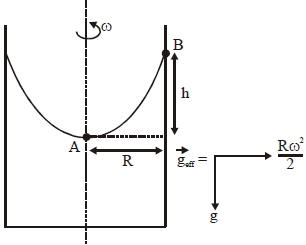
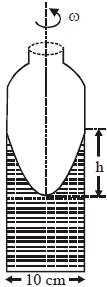
Applying pressure equation from \(A\) to \(B\)\(P_{0}+\rho \cdot \frac{R \omega^{2}}{2} \cdot R-\rho g h=P_{0}\)
\(\frac{\rho R ^{2} \omega^{2}}{2}=\rho gh\)
\(h =\frac{ R ^{2} \omega^{2}}{2 g }=(5)^{2} \frac{\omega^{2}}{2 g }=\frac{25}{2} \frac{\omega^{2}}{ g }\)
-
- (A) \(\sqrt{\frac{ P }{2 \rho}+ v ^{2}}\)
- (B) \(\sqrt{\frac{ P }{\rho}+ v ^{2}}\)
- (C) \(\sqrt{\frac{2 P }{\rho}+ v ^{2}}\)
- (D) \(\sqrt{\frac{ P }{\rho}+ v }\)
Show answer and solution
Correct Answer: (B)
Applying Bernoulli's Equation\(P _{1}+\frac{1}{2} \rho v _{1}^{2}+\rho gy _{1}= P _{2}+\frac{1}{2} \rho v _{2}^{2}+\rho gy _{2}\)
\(P +\frac{1}{2} \rho v ^{2}=\frac{ P }{2}+\frac{1}{2} \rho V ^{2}\)
\(\frac{2 P }{2 \rho}+\frac{1}{2} \frac{\rho v ^{2}}{\rho} \times 2= V ^{2}\)
\(\sqrt{\frac{P}{\rho}+v^{2}}=V\)
-
- (A) \(0.44\)
- (B) \(0.88\)
- (C) \(0.33\)
- (D) \(0.66\)
Show answer and solution
Correct Answer: (B)
\(\frac{4}{3} \pi\left( R ^{3}- r ^{3}\right) \rho_{ m } g =\frac{4}{3} \pi R ^{3} \rho_{ w } g\)\(1-\left(\frac{ r }{ R }\right)^{3}=\frac{8}{27}\)
\(\Rightarrow \frac{ r }{ R }=\left(\frac{19}{27}\right)^{1 / 3}=\frac{19^{1 / 3}}{3}\)
\(=0.88\simeq \frac{8}{ g }\)
-
- (A) \(1.01\)
- (B) \(1.04\)
- (C) \(1.03\)
- (D) \(1.26\)
Show answer and solution
Correct Answer: (A)
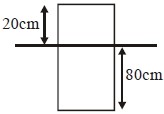
\(\mathrm{m}=\rho_{0} \mathrm{A}(80)\)\(\mathrm{m}=\rho \mathrm{A}(79)\)
-
- (A) \(\frac{\sqrt{3}}{2}\)
- (B) \(\frac{{3}}{4}\)
- (C) \(\frac{{81}}{256}\)
- (D) \(\frac{{9}}{16}\)
Show answer and solution
Correct Answer: (D)
\(\mathrm{A}_{1} \mathrm{v}_{1}=\mathrm{A}_{2} \mathrm{v}_{2}\)\(\frac{V_{\min }}{V_{\max }}=\frac{A_{\min }}{A_{\max }}\)
\(\frac{v_{\min }}{v_{\max }}=\left(\frac{4.8}{6.4}\right)^{2}\)
\(\frac{V_{\min }}{V_{\max }}=\frac{9}{16}\)
-
- (A) \(\frac{\rho_{0}}{5}\)
- (B) \(\frac{\rho_{0}}{3}\)
- (C) \(\frac{2\rho_{0}}{3}\)
- (D) \(\frac{2\rho_{0}}{5}\)
Show answer and solution
Correct Answer: (D)
In case of minimum density of liqued, sphere will be floating while completely submerged So \(\mathrm{mg}=\mathrm{B}\)\(\mathrm{m}=\int_{0}^{\mathrm{R}} \rho\left(4 \pi \mathrm{r}^{2} \mathrm{dr}\right)=\mathrm{B}\)
\(=\rho_{0} \int_{0}^{R}\left(1-\frac{r^{2}}{R^{2}}\right) 4 \pi r^{2} d r=\frac{4}{3} \pi R^{3} \rho_{\ell} g\)
On Solving
\(\rho_{\ell}=\frac{2 \rho_{0}}{5}\)
-
- (A) \(r\)
- (B) \(r^{4}\)
- (C) \(r^{3}\)
- (D) \(r^{2}\)
Show answer and solution
Correct Answer: (B)
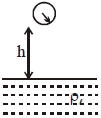
After falling through h, the velocity be equal to terminal velocity\(\sqrt{2 gh }=\frac{2}{9} \frac{ r ^{2} g }{\eta}\left(\rho_{\ell}-\rho\right)\)
\(\Rightarrow h =\frac{2}{81} \frac{ r ^{4} g \left(\rho_{\ell}-\rho\right)^{2}}{\eta^{2}}\)
\(\Rightarrow h \propto r ^{4}\)
-
- (A) \({gdS}\left(x_{2}+x_{1}\right)^{2}\)
- (B) \(\frac{3}{4} g d S\left(x_{2}-x_{1}\right)^{2}\)
- (C) \(\frac{1}{4} g d S\left(x_{2}-x_{1}\right)^{2}\)
- (D) \({gdS}\left(x_{2}^{2}+x_{1}^{2}\right)\)
Show answer and solution
Correct Answer: (C)
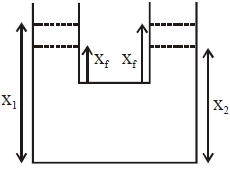
\(U _{ i }=\left(\rho Sx _{1}\right) g \cdot \frac{ x _{1}}{2}+\left(\rho Sx _{2}\right) g \cdot \frac{ x _{2}}{2}\)\(U _{ f }=\left(\rho Sx _{ f }\right) g \cdot \frac{ x _{ f }}{2} \times 2\)
By volume conservation
\(Sx _{1}+ Sx _{2}= S \left(2 x _{ f }\right)\)
\(x_{f}=\frac{x_{1}+x_{2}}{2}\)
\(\Delta U =\rho \operatorname{Sg}\left[\left(\frac{ x _{1}^{2}}{2}+\frac{ x _{2}^{2}}{2}\right)- x _{ f }^{2}\right]\)
\(=\rho \operatorname{Sg}\left[\frac{ x _{1}^{2}}{2}+\frac{ x _{2}^{2}}{2}-\left(\frac{ x _{1}+ x _{2}}{2}\right)^{2}\right]\)
\(=\frac{\rho Sg }{2}\left[\frac{ x _{1}^{2}}{2}+\frac{ x _{2}^{2}}{2}- x _{1} x _{2}\right]\)
\(=\frac{\rho Sg }{4}\left( x _{1}- x _{2}\right)^{2}\)
-
- (A) \(\frac 14\)
- (B) \(\frac 23\)
- (C) \(\frac 13\)
- (D) \(\frac 12\)
Show answer and solution
Correct Answer: (A)
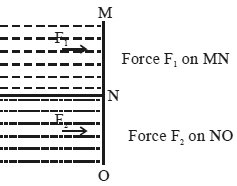
\(\mathrm{F}_{1}=\frac{\rho \mathrm{gh}}{2} \times \mathrm{A}\)\(\mathrm{F}_{2}=\left(\rho \mathrm{gh}+\frac{2 \rho \mathrm{gh}}{2}\right) \mathrm{A}\)
\(\frac{\mathrm{F}_{1}}{\mathrm{F}_{2}}=\frac{1}{4}\)
-
- (A) \(1810\)
- (B) \(3020 \)
- (C) \(2720 \)
- (D) \(2420\)
Show answer and solution
Correct Answer: (C)
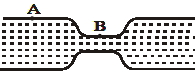
Rate of flow of water \(=\mathrm{A}_{\mathrm{A}} \mathrm{V}_{\mathrm{A}}=\mathrm{A}_{\mathrm{B}} \mathrm{V}_{\mathrm{B}}\)\((40) \mathrm{V}_{\mathrm{A}}=(20) \mathrm{V}_{\mathrm{B}}\)
\(\mathrm{V}_{\mathrm{B}}=2 \mathrm{V}_{\mathrm{A}}\)
Using Bernoulli's theorem
\(\mathrm{P}_{\mathrm{A}}+\frac{1}{2} \rho \mathrm{V}_{\mathrm{A}}^{2}=\mathrm{P}_{\mathrm{B}}+\frac{1}{2} \rho \mathrm{V}_{\mathrm{B}}^{2}\)
\(\mathrm{P}_{\mathrm{A}}-\mathrm{P}_{\mathrm{B}}=\frac{1}{2} \rho\left(\mathrm{V}_{\mathrm{B}}^{2}-\mathrm{V}_{\mathrm{A}}^{2}\right)\)
\(700=\frac{1}{2} \times 1000\left(4 \mathrm{V}_{\mathrm{A}}^{2}-\mathrm{V}_{\mathrm{A}}^{2}\right)\)
\(\mathrm{V}_{\mathrm{A}}=0.68 \mathrm{m} / \mathrm{s}=68 \mathrm{cm} / \mathrm{s}\)
Rate of flow \(=\mathrm{A}_{\mathrm{A}} \mathrm{V}_{\mathrm{A}}\)
\(=(40)(68)=2720\; \mathrm{cm}^{3} / \mathrm{s}\)
-
- (A) \(100\)
- (B) \(90\)
- (C) \(75\)
- (D) \(70\)
Show answer and solution
Correct Answer: (A)
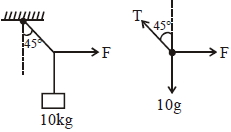
For equilibrium.\(\mathrm{T} \sin 45^{\circ}=\mathrm{F}\)
and \(\mathrm{T} \cos 45^{\circ}=10 \mathrm{g}\)
equation \((1) /(2)\)
we get \(\mathrm{F}=10 \mathrm{g}\)
\(=100 \mathrm{N}\)
-
- (A) \(\frac{\mathrm{m} \ell \omega^{2}}{\mathrm{k}+\mathrm{m} \omega^{2}}\)
- (B) \(\frac{\mathrm{m} \ell \omega^{2}}{\mathrm{k}-\mathrm{m} \omega^{2}}\)
- (C) \(\frac{\mathrm{m} \ell \omega^{2}}{\mathrm{k}-\mathrm{m} \omega}\)
- (D) \(\frac{\mathrm{m} \ell \omega^{2}}{\mathrm{k}+\mathrm{m} \omega}\)
Show answer and solution
Correct Answer: (B)
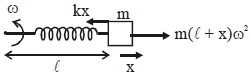
\(\mathrm{kx}=\mathrm{m}\ell \omega^{2}+\mathrm{m} \mathrm{x} \omega^{2}\)\(\mathrm{x}=\frac{\mathrm{m}\ell \omega^{2}}{\mathrm{k}-\mathrm{m} \omega^{2}}\)
-
- (A) \(\frac{1}{2 k } \tan ^{-1} \frac{ ku ^{2}}{ g }\)
- (B) \(\frac{1}{2 k } \ln \left(1+\frac{ ku ^{2}}{ g }\right)\)
- (C) \(\frac{1}{k} \tan ^{-1} \frac{k u^{2}}{2 g}\)
- (D) \(\frac{1}{ k } \ln \left(1+\frac{ k u ^{2}}{2 g }\right)\)
Show answer and solution
Correct Answer: (B)
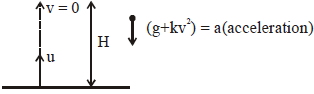
\(\overrightarrow{ F }= mkv ^{2}- mg\)\(\overrightarrow{ a }=\frac{\overrightarrow{ F }}{ m }=-\left[ kv ^{2}+ g \right]\)
\(\Rightarrow v \cdot \frac{ dv }{ dh }=-\left[ kv ^{2}+ g \right]\)
\(\Rightarrow \int_{ u }^{0} \frac{ v \cdot dv }{ kv ^{2}+ g }=-\int_{0}^{ H } dh\)
\(\frac{1}{2 K } \ln \left[ kv ^{2}+ g \right]_{ u }^{0}=- H\)
\(\Rightarrow \frac{1}{2 K } \ln \left[\frac{ ku ^{2}+ g }{ g }\right]= H\)
-
- (A) \(-\frac{2 b v^{3}}{M(t)}\)
- (B) \(-\frac{ bv ^{3}}{2 M ( t )}\)
- (C) \(-b v^{3}(t)\)
- (D) \(-\frac{b v^{3}}{M(t)}\)
Show answer and solution
Correct Answer: (D)
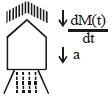
\(\frac{\operatorname{dm}( t )}{ dt }= bv ^{2}\)\(F _{\text {thast }}= v \frac{ dm }{ dt }\)
Force on statellile \(=-\overrightarrow{ v } \frac{ dm ( t )}{ dt }\)
\(M ( t ) a =- v \left( bv ^{2}\right)\)
\(a = - \frac{ bv ^{3}}{ M ( t )}\)
No questions on this page match these filters.