


Questions
2 questionsShowing 1–2 of 2 questions
-
- (A) \(33\)
- (B) \(35\)
- (C) \(31\)
- (D) \(28\)
Show answer and solution
Correct Answer: (A)
\(\frac{50-40}{300}=\beta\left(\frac{50+40}{2}-20\right)\)\(\frac{40-T}{300}=\beta\left(\frac{40+T}{2}-20\right)\)
\(\therefore \quad T=\frac{100}{3}\)
-
- (A) \(K _{1}: K _{3}=2: 3 ; K _{2}: K _{3}=2: 5\)
- (B) \(K _{1}< K _{2}< K _{3}\)
- (C) \(K _{1}: K _{2}=5: 2 ; K _{1}: K _{3}=3: 5\)
- (D) \(K _{1}> K _{2}> K _{3}\)
Show answer and solution
Correct Answer: (A)
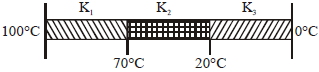
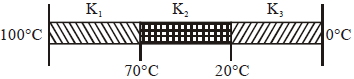
Rods are identical have same length ( \(\ell\) ) and area of cross-section \((A)\)Combination are in series, so heat current is same for all Rods
\(\left(\frac{\Delta Q }{\Delta t }\right)_{ AB }=\left(\frac{\Delta Q }{\Delta t }\right)_{ BC }=\left(\frac{\Delta Q }{\Delta t }\right)_{ CD }=\) Heat current
\(\frac{(100-70) K _{1} A }{\ell}=\frac{(70-20) K _{2} A }{\ell}=\frac{(20-0) K _{3} A }{\ell}\)
\(30 K _{1}=50 K _{2}=20 K _{3}\)
\(3 K _{1}=2 K _{3}\)
\(\frac{K_{1}}{K_{3}}=\frac{2}{3}=2: 3\)
\(5 K _{2}=2 K _{3}\)
\(\frac{ K _{2}}{ K _{3}}=\frac{2}{5}=2: 5\)
No questions on this page match these filters.