


Questions
17 questionsShowing 1–17 of 17 questions
-
- (A) \(5\)
- (B) \(8\)
- (C) \(11\)
- (D) \(13\)
Show answer and solution
Correct Answer: (C)
Power incident \(P=I \times A\)\(\mathrm{n}=\mathrm{no} .\) of photons incident/second
\(\mathrm{nE}_{\mathrm{ph}}=\mathrm{IA}\)
\(\mathrm{n}=\frac{\mathrm{IA}}{\mathrm{E}_{\mathrm{ph}}}\)
\(\mathrm{n}=\frac{\mathrm{IA}}{\left(\frac{\mathrm{hc}}{\lambda}\right)}=\frac{6.4 \times 10^{-5} \times 1}{\frac{1240}{310} \times 1.6 \times 10^{-19}}\)
\(\mathrm{n}=10^{+14}\) per second
since efficiency \(=10^{-3}\)
no. of electrons emitted \(=10^{+11}\) per second.
\(\mathrm{x}=11\)
-
- (A) \(57\)
- (B) \(65\)
- (C) \(50\)
- (D) \(51\)
Show answer and solution
Correct Answer: (C)
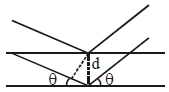
\(2 d \sin \theta=\lambda=\frac{ h }{\sqrt{2 mE }}\)\(2 \times 10^{-10} \times \frac{\sqrt{3}}{2}=\frac{6.6 \times 10^{-34}}{\sqrt{2 mE }}\)
\(E =\frac{1}{2} \times \frac{6.64^{2} \times 10^{-48}}{9.1 \times 10^{-31} \times 3 \times 1.6 \times 10^{-19}}=50.47\)
-
- (A) \(4.8 \times 10^{-27}\, kg\)
- (B) \(1.2 \times 10^{-28}\, kg\)
- (C) \(9.1 \times 10^{-31}\, kg\)
- (D) \(9.7 \times 10^{-28}\, kg\)
Show answer and solution
Correct Answer: (D)
Let mass of particle \(= m\)Let speed of \(e= V\)
\(\Rightarrow\) speed of particle \(=5 V\)
Debroglie wavelength \(\lambda_{ d }=\frac{ h }{ P }=\frac{ h }{ mv }\)
\(\Rightarrow\left(\lambda_{d}\right)_{P}=\frac{h}{m(5 V)}\) \(...(1)\)
\(\Rightarrow\left(\lambda_{d}\right)_{e}=\frac{ h }{ m _{ e } \cdot V }\)\(...(2)\)
According to question
\(\frac{(1)}{(2)}=\frac{m_{e}}{5 m}=1.878 \times 10^{-4}\)
\(\Rightarrow m =\frac{ m _{ e }}{5 \times 1.878 \times 10^{-4}}\)
\(\Rightarrow m =\frac{9.1 \times 10^{-31}}{5 \times 1.878 \times 10^{-4}}\)
\(\Rightarrow m =9.7 \times 10^{-28} kg\)
-
- (A) \(2E\)
- (B) \(E\)
- (C) \(3E\)
- (D) \(4E\)
Show answer and solution
Correct Answer: (C)
de-Broglie wavelength \(=\frac{\mathrm{h}}{\sqrt{2 \mathrm{mE}}}=\lambda\)Also, \(\frac{\mathrm{h}}{\sqrt{2 \mathrm{m}(\mathrm{E}+\Delta \mathrm{E})}}=\frac{\lambda}{2}\)
\(\therefore \quad \frac{\mathrm{E}+\Delta \mathrm{E}}{\mathrm{E}}=4 \Rightarrow \Delta \mathrm{E}=3 \mathrm{E}\)
-
- (A) \(\lambda_{ e }<\lambda_{ P }<\lambda_{ He ^{++}}\)
- (B) \(\lambda_{e}<\lambda_{H e^{++}}=\lambda_{P}\)
- (C) \(\lambda_{e}>\lambda_{H e^{++}}>\lambda_{P}\)
- (D) \(\lambda_{e}>\lambda_{P}>\lambda_{H e^{++}}\)
Show answer and solution
Correct Answer: (D)
\(\lambda=\frac{ h }{ P }=\frac{ h }{\sqrt{2 m ( KE )}}\)\(\lambda \propto \frac{1}{\sqrt{ m }} \Rightarrow \lambda=\frac{ C }{\sqrt{ m }}\)
\(m _{ He ^{++}}> m _{ P }> m _{ e }\)
\(\therefore \lambda_{ He ^{++}}<\lambda_{ P }<\lambda_{ e }\)
-
- (A) \(\frac{\lambda_{0} \sqrt{2}}{\sqrt{ {\Large{1}}+\cfrac{\mathrm{e}^{2} \mathrm{E}^{2} \mathrm{t}^{2}}{\mathrm{m}^{2} \mathrm{v}_{0}^{2}}}}\)
- (B) \(\frac{\lambda_{0}}{\sqrt{{\Large{2}}+\cfrac{\mathrm{e}^{2} \mathrm{E}^{2} \mathrm{t}^{2}}{\mathrm{m}^{2} \mathrm{v}_{0}^{2}}}}\)
- (C) \(\frac{\lambda_{0}}{\sqrt{{\Large{1}}+\cfrac{\mathrm{e}^{2} \mathrm{E}^{2} \mathrm{t}^{2}}{2 \mathrm{m}^{2} \mathrm{v}_{0}^{2}}}}\)
- (D) \(\frac{\lambda_{0}}{\sqrt{{\Large{1}}+\cfrac{\mathrm{e}^{2} \mathrm{E}_{0}^{2} \mathrm{t}^{2}}{\mathrm{m}^{2} \mathrm{v}_{0}^{2}}}}\)
Show answer and solution
Correct Answer: (C)
By de-Broglie hypothesis\(\lambda=\frac{\mathrm{h}}{\mathrm{mv}}\)
\(\lambda_{0}=\frac{\mathrm{h}}{\mathrm{m} \sqrt{2} \mathrm{v}_{0}}\dots(1)\)
\(\lambda^{\prime}=\frac{\mathrm{h}}{\sqrt{\mathrm{v}_{0}^{2}+\mathrm{v}_{0}^{2}+\left(\frac{\mathrm{eE}_{0} \mathrm{t}}{\mathrm{m}}\right)^{2}}}\)
\(=\frac{h}{m \sqrt{2 v_{0}^{2}+\frac{e^{2} E_{0}^{2} t^{2}}{m^{2}}}}\dots(2)\)
\(\mathrm{By}(1)\) and ( 2)
\(\lambda^{\prime}=\frac{\lambda_{0}}{\sqrt{1+\frac{\mathrm{e}^{2} \mathrm{E}_{0}^{2} \mathrm{t}^{2}}{2 \mathrm{m}^{2} \mathrm{v}_{0}^{2}}}}\)
-
- (A) \(\frac{-\mathrm{h}}{|\mathrm{e}| \mathrm{Et}^{2}}\)
- (B) \(\frac{|\mathrm{e}| \mathrm{Et}}{\mathrm{h}}\)
- (C) \(-\frac{\mathrm{h}}{|\mathrm{e}| \mathrm{E} \sqrt{\mathrm{t}}}\)
- (D) \(-\frac{\mathrm{h}}{|\mathrm{e}| \mathrm{Et}}\)
Show answer and solution
Correct Answer: (A)
\(\mathrm{a}=\frac{\mathrm{eE}}{\mathrm{m}}\)\(\mathrm{v}=\mathrm{u}+\mathrm{at}=\left(\frac{\mathrm{eE}}{\mathrm{m}}\right) \mathrm{t}\)
\(\lambda=\frac{\mathrm{h}}{\mathrm{mv}}\)
\(\frac{\mathrm{d} \lambda}{\mathrm{dt}}=\frac{-(\mathrm{hm}) \cdot \frac{\mathrm{dv}}{\mathrm{dt}}}{(\mathrm{mv})^{2}}\)\(=-\frac{\mathrm{ah}}{\mathrm{mv}^{2}}=-\frac{\mathrm{h}}{| \mathrm{et}^{2}}\)
-
- (A) \(0.34\)
- (B) \(0.24\)
- (C) \(0.20\)
- (D) \(0.44\)
Show answer and solution
Correct Answer: (B)
\(v_{ ms }=\sqrt{\frac{3 KT }{ m }}\)\(m \rightarrow\) mass of one molecule (in \(kg\) ) \(=\) \(\frac{\text { molar mass }}{ NA }\)
de-Broglie wavelenth,
\(\lambda=\frac{ h }{ mv }\)
given, \(v = v _{ rms }\)
\(\lambda=\frac{ h }{ m \sqrt{\frac{3 KT }{ m }}}\)
\(\lambda=\frac{ h }{\sqrt{3 K T m }}\)
\(=\frac{6.63\times 10^{-34}}{\sqrt{3 \times 1.38 \times 10^{-23} \times 400 \times\left(\frac{28 \times 10^{-3}}{6.023 \times 10^{-23}}\right)}}\)
\(\lambda=\frac{6.63 \times 10^{-11}}{2.77}=2.39 \times 10^{-11} m\)
\(\lambda=0.24\dot A\)
-
- (A) \(2.27\)
- (B) \(2.59\)
- (C) \(1.93\)
- (D) \(2.10\)
Show answer and solution
Correct Answer: (A)
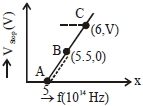
Graph of \(V_{s}\) and \(f\) given \((B\,5.5,0)\)\(hv =\phi+ eV _{ s }\)
at \(B \quad V _{ s }=0, \quad v=5.5\)
\(\Rightarrow \quad h \times 5.5 \times 10^{14}=\phi\)
\(\phi=\frac{6.62 \times 10^{-34} \times 5.5 \times 10^{14}}{1.6 \times 10^{-19}} eV =2.27 eV\)
-
- (A) Slope of the straight line get more steep
- (B) Straight line shifts to left
- (C) Graph does not change
- (D) Straight line shifts to right
Show answer and solution
Correct Answer: (C)
\(eV =\frac{ hc }{\lambda}-\phi\)\(V =\left(\frac{ hc }{ e }\right)\left(\frac{1}{\lambda}\right)-\phi\)
Slope of the line in above equation and all other terms are independent of intensity.
The graph does not change.
-
- (A) \(\Delta \lambda=4 \lambda_{0}\)
- (B) \(\Delta \lambda=\frac{5}{2} \lambda_{0}\)
- (C) \(\Delta \lambda=2 \lambda_{0}\)
- (D) \(\Delta \lambda=\frac{3}{2} \lambda_{0}\)
Show answer and solution
Correct Answer: (A)
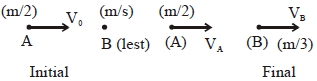
Applying momentum conservation\(\frac{m}{2} \times V_{0}+\frac{m}{3} \times(0)=\frac{m}{2} V_{A}+\frac{m}{3} V_{B}\)
\(=\frac{V_{0}}{2}=\frac{V_{A}}{2}+\frac{V_{B}}{3}\) \(....(1)\)
since, collision is elastic \(( e =1)\)
\(e =1=\frac{ V _{ B }- V _{ A }}{ V _{0}} \Rightarrow V _{0}= V _{ B }- V _{ A } \ldots(2)\)
On solving \((1) \&(2): V_{A}=\frac{V_{0}}{5}\)
Now, \(De-\)Broglie wavelength of \(A\) before collision :
\(\lambda_{0}=\frac{ h }{ m _{ A } V _{0}}=\frac{ h }{\left(\frac{ m }{2}\right) V _{0}}\)
\(\Rightarrow \lambda_{0}=\frac{2 h }{ mV _{0}}\)
Final \(De-\)Broglie wavelength :
\(\lambda_{ f }=\frac{ h }{ m _{ A } V _{0}}=\frac{ h }{\frac{ m }{2} \times \frac{ V _{ o }}{5}} \Rightarrow \lambda_{ f }=\frac{10 h }{ mV _{ o }}\)
Now \(\Delta \lambda=\lambda_{f}-\lambda_{0}\)
\(\Delta \lambda=\frac{10 h }{ mV _{0}}-\frac{2 h }{ mV _{0}}\)
\(\Rightarrow \Delta \lambda=\frac{8 h }{ mv _{0}} \Rightarrow \Delta \lambda=4 \times \frac{2 h }{ mv _{0}}\)
\(\Rightarrow \Delta \lambda=4 \lambda_{0}\)
-
- (A) \(1.8\)
- (B) \(0.8\)
- (C) \(1.1\)
- (D) \(1.6\)
Show answer and solution
Correct Answer: (C)
Let the work function be \(\phi\)\(\therefore \quad \mathrm{KE}_{\max }=\frac{\mathrm{hc}}{\lambda}-\phi\)
Again, \(\mathrm{R}_{\max }=\frac{\sqrt{2 \mathrm{mKE}_{\max }}}{\mathrm{qB}}=\frac{\sqrt{2 \mathrm{m}\left(\frac{\mathrm{hc}}{\lambda}-\phi\right)}}{\mathrm{qB}}\)
\(\therefore \quad \frac{\mathrm{R}_{\max }^{2} \mathrm{q}^{2} \mathrm{B}^{2}}{2 \mathrm{m}}=\frac{\mathrm{hc}}{\lambda}-\phi\)
\(\therefore \quad \phi=\frac{\mathrm{hc}}{\lambda}-\frac{\mathrm{R}_{\mathrm{max}}^{2} \mathrm{q}^{2} \mathrm{B}^{2}}{2 \mathrm{m}}=1.0899 \mathrm{eV} \approx 1.1 \mathrm{eV}\)
-
- (A) \(2\)
- (B) \(4\)
- (C) \(8\)
- (D) \(10\)
Show answer and solution
Correct Answer: (A)
\(E _{1}=\phi+ K _{1} \ldots(1)\)\(E _{2}=\phi+ K _{2}\) \(...(2)\)
\(E _{1}- E _{2}= K _{1}- K _{2}\)
Now \(\frac{ V _{1}}{ V _{2}}=2\)
\(\frac{ K _{1}}{ K _{2}}=4\)
\(K _{1}=4 K _{2}\)
Now from equation \((2)\)
\(\Rightarrow 4-2.5=4 K _{2}- K _{2}\)
\(1.5=3 K _{2}\)
\(K _{2}=0.5 eV\)
Now putting This
Value in equation \(( 2 )\)
\(2.5=\phi+0.5 eV\)
\(\phi=2 ev\)
-
- (A) \(\frac{1}{500}\)
- (B) \(500\)
- (C) \(250\)
- (D) \(\frac{1}{250}\)
Show answer and solution
Correct Answer: (A)
\(P=\frac{n h c}{\lambda t}\)\(\therefore \frac{n_{1}}{n_{2}}=\frac{\lambda_{1}}{\lambda_{2}}=\frac{1}{5}\)
-
- (A) \(3\)
- (B) \(2\)
- (C) \(4\)
- (D) \(1.5\)
Show answer and solution
Correct Answer: (C)
\(\lambda_{\mathrm{B}}=2 \lambda_{\mathrm{A}}\)\(\Rightarrow \frac{\mathrm{h}}{\sqrt{2 \mathrm{T}_{\mathrm{B}} \mathrm{m}}}=\frac{2 \mathrm{h}}{\sqrt{2 \mathrm{T}_{\mathrm{A}} \mathrm{m}}}\)
\(\mathrm{T}_{\mathrm{A}}=4 \mathrm{T}_{\mathrm{B}}\) and \(\mathrm{T}_{\mathrm{B}}=\left(\mathrm{T}_{\mathrm{A}}-1.5\right)\) eV
\(3 \mathrm{T}_{\mathrm{B}} 1.5 \mathrm{eV} \Rightarrow \mathrm{T}_{\mathrm{B}}=0.5 \mathrm{eV}\)
\(\mathrm{T}_{\mathrm{B}}=0.5 \mathrm{eV}=4.5 \mathrm{eV}-\phi_{\mathrm{B}}\)
\(\phi=4 \mathrm{eV}\)
-
- (A) \(9\)
- (B) \(3\)
- (C) \(11\)
- (D) \(16\)
Show answer and solution
Correct Answer: (A)
\(\frac{ hc }{\lambda}=\frac{ hc }{\lambda_{0}}+ eV\)\(...(i)\)\(\frac{ hc }{3 \lambda}=\frac{ hc }{\lambda_{0}}+\frac{ e \cdot V }{4}\)\(...(ii)\)
(multiply by \(4\))
\(\frac{4 hc }{3 \lambda}=\frac{4 hc }{\lambda_{0}}+ eV\)\(...(iii)\)
From \((i)\) \(\&\) \((iii)\)
\(\frac{h c}{\lambda}-\frac{h c}{\lambda_{0}}=\frac{4 h c}{3 \lambda}-\frac{4 h c}{\lambda_{0}}\)
\(-\frac{ hc }{3 \lambda}=-\frac{3 hc }{\lambda_{0}}\)
\(9 \lambda=\lambda_{0}\)
\(n=9\)
-
- (A) \(0.61\)
- (B) \(0.52\)
- (C) \(0.81\)
- (D) \(1.02\)
Show answer and solution
Correct Answer: (A)
\(\frac{3}{1}=\frac{\frac{ hc }{200 nm }-\phi}{\frac{ hc }{500 nm }-\phi}, hc =1240 eV - nm\)On solving \(\phi=0.61 eV\)

No questions on this page match these filters.