


Questions
16 questionsShowing 1–16 of 16 questions
-
- (A) \(50\)
- (B) \(55\)
- (C) \(60\)
- (D) \(62\)
Show answer and solution
Correct Answer: (A)
Final image at \(\infty\)\(\Rightarrow\) obj. for eye piece at \(5 cm\)
\(\Rightarrow\) image for objective at \(5 cm\)
\(\frac{1}{v}-\frac{1}{u}=\frac{1}{f}\)
\(\frac{1}{5}+\frac{1}{x}=1\)
\(\frac{1}{x}=1-\frac{1}{5}=\frac{4}{5} \Rightarrow x=\frac{5}{4}\)
-
- (A) \(0.5\)
- (B) \(2\)
- (C) \(1.5\)
- (D) \(0.33\)
Show answer and solution
Correct Answer: (D)
\(R _{1}= R _{2}= R\)Power \((P)\)
Refractive index is assume \(\left(\mu_{\ell}\right)\)
\(P =\frac{1}{ f }=\left(\mu_{\ell}-1\right)\left(\frac{2}{ R }\right)\) \(...(i)\)
\(P ^{\prime}=\frac{1}{ f ^{\prime}}=\left(\mu_{\ell}-1\right)\left(\frac{1}{ R ^{\prime}}\right)\)\(....(ii)\)
\(P ^{\prime}=\frac{3}{2} P\)
\(\left(\mu_{\ell}-1\right)\left(\frac{1}{ R ^{\prime}}\right)=\mu \frac{3}{2}\left(\mu_{\ell}-1\right)\left(\frac{2}{ R }\right)\)
\(\therefore \quad R ^{\prime}=\frac{ R }{3}\)

-
- (A) \(85\)
- (B) \(90\)
- (C) \(80\)
- (D) \(75\)
Show answer and solution
Correct Answer: (B)
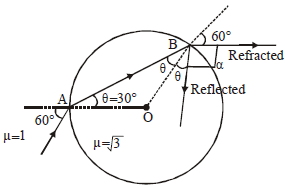
By Snell's law at \(A\)\(1 \times \sin 60^{\circ}=\sqrt{3} \times \sin \theta\)
\(\frac{\sqrt{3}}{2}=\sqrt{3} \sin \theta\)
\(\sin \theta=\frac{1}{2} \Rightarrow \theta=30^{\circ}\)
So at \(B:\)
\(\theta+60^{\circ}+\alpha=180^{\circ}\)
\(30^{\circ}+60^{\circ}+\alpha=180^{\circ}\)
\(\alpha=90^{\circ}\)
-
- (A) \(1\, m\) from the mirror, virtual
- (B) \(1\, m\) from the mirror, real
- (C) \(2.6\, m\) from the mirror, real
- (D) \(2.6\, m\) from the mirror, virtual
Show answer and solution
Correct Answer: (C)
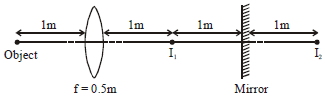
Object is at \(2 f\). So image will also be at \(2 f\).\(\left( I _{1}\right)\)
Image of \(I_{1}\) will be \(1\, m\) behind mirror.
i.e. \(\Rightarrow I _{2}\)
Now \(I \)\(_{2}\) will be object for lens.
\(\therefore u \Rightarrow-3 m\)
\(f \Rightarrow+0.5 m\)
\(\frac{1}{v} \Rightarrow \frac{1}{f}+\frac{1}{u}\)
\(\Rightarrow \frac{1}{+0.5}+\frac{1}{-3}\)
\(v \Rightarrow \frac{3}{5} \Rightarrow 0.6 m\)
So total distance from mirror \(\Rightarrow 2+0.6\)
\(\Rightarrow 2.6 m\) and real image
-
- (A) \(58\)
- (B) \(62\)
- (C) \(60\)
- (D) \(67\)
Show answer and solution
Correct Answer: (C)
Using Lens-Maker's formula\(\frac{1}{f}=(\mu-1)\left(\frac{1}{R_{1}}-\frac{1}{R_{2}}\right)\)
\(\Rightarrow \frac{1}{f}=(1.5-1)\left(\frac{1}{30}-0\right)\)
\(\mathrm{f}=60 \mathrm{cm}\)
-
- (A) \(5\)
- (B) \(8\)
- (C) \(10\)
- (D) \(15\)
Show answer and solution
Correct Answer: (A)
\(\delta_{\min }=(\mu-1) A\)\(=(1.5-1) 1\)
\(=0.5\)
\(\delta_{\min }=\frac{5}{10}\)
\(N=5\)
-
- (A) Inverted, real and magnified
- (B) Erect, virtual and magnified
- (C) Erect, virtual and unmagnified
- (D) Inverted, real and unmagnified
Show answer and solution
Correct Answer: (D)
\(f =\frac{-8}{2}=-4 cm\)\(u =-10 cm\)
\(v=?\)
as \(\frac{1}{v}+\frac{1}{u}=\frac{1}{f}\)
\(\frac{1}{v}+\left(\frac{1}{-10}\right)=\frac{1}{-4}\)
\(\frac{1}{v}=\frac{1}{10}-\frac{1}{4}\)
\(\frac{1}{v}=\frac{4-10}{40}\)
\(v=\frac{40}{-6}\)
\(V =\frac{-20}{3}\)
\(m =\frac{- V }{ u }\)
\(m=\frac{-\left(-\frac{20}{3}\right)}{-10} \Rightarrow m=\frac{-2}{3}\)
or image will be real, inverted and unmagnified.
-
- (A) \(1\)
- (B) \(5\)
- (C) \(9\)
- (D) \(17\)
Show answer and solution
Correct Answer: (C)
Using \(\frac{1}{f}=\left(\frac{\mu_{2}}{\mu_{1}}-1\right)\left(\frac{1}{R_{1}}-\frac{1}{R_{2}}\right)\)\(\frac{1}{f}=\left(\frac{1.5}{1}-1\right)\left(\frac{1}{R_{1}}-\frac{1}{R_{2}}\right)\dots ( 1)\)
and \(\frac{1}{f_{l}}=\left(\frac{1.5}{1.42}-1\right)\left(\frac{1}{R_{1}}-\frac{1}{R_{2}}\right)\dots (2)\)
equation \((1) /(2)\)
we get \(\frac{f_{ળ}}{f}=\frac{0.5}{0.056}\)
\(=8.93 \approx 9\)
-
- (A) \(\frac{\mathrm{h}}{\sqrt{2}}\)
- (B) \(\frac{3}{4} \mathrm{h} \sqrt{2}\)
- (C) \(\frac{\mathrm{h}}{2(\sqrt{2}+1)}\)
- (D) \(\frac{\mathrm{h}}{3 \sqrt{2}}\)
Show answer and solution
Correct Answer: (B)
For near normal incidence,\(\mathrm{h}_{\mathrm{app}}=\frac{\mathrm{h}_{\mathrm{actal}}}{\left(\frac{\mu_{\mathrm{in}}}{\mu_{\mathrm{rat}}}\right)}\)
\(\mathrm{h}_{\text {apparent }}=\frac{\frac{\mathrm{h}}{\left(\frac{2 \sqrt{2}}{\sqrt{2}}\right)}+\mathrm{h}}{\frac{\sqrt{2}}{1}}=\frac{3 \mathrm{h}}{2 \sqrt{2}}=\frac{3}{4} \mathrm{h} \sqrt{2}\)
-
- (A) \(22\)
- (B) \(12\)
- (C) \(33\)
- (D) \(2\)
Show answer and solution
Correct Answer: (A)
\(M =\frac{ v _{0}}{+ u _{0}}\left(1+\frac{ d }{ fe }\right)\)focal length of objective lens is small \(u_{0} \simeq f _{0}\). Alos as focal length of eye is small
\(v _{0} \simeq L\)
\( M =\frac{ L }{+ f _{0}}\left(1+\frac{ d }{ f _{ e }}\right) \)
\(\Rightarrow 375=\frac{150}{5}\left(1+\frac{250}{ f _{ e }}\right)\)
\(\Rightarrow \frac{375}{30}=\left(1+\frac{250}{f_{e}}\right)\)
\(\Rightarrow \frac{375}{30}-1=\frac{250}{f_{e}}\)
\(\Rightarrow \frac{345}{30}=\frac{250}{f_{e}}\)
\(\Rightarrow f _{e}=2.2 \;cm\)
\(F _{ e }=22\; mm\)
-
- (A) \(4.5\)
- (B) \(4\)
- (C) \(3.5\)
- (D) \(4.8\)
Show answer and solution
Correct Answer: (A)
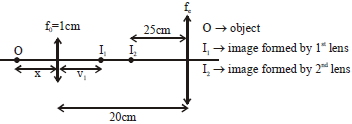
for first lens \(=\frac{1}{v_{1}}-\frac{1}{-x}=\frac{1}{1} \Rightarrow v_{1}=\frac{x}{x-1}\)also magnification \(\left| m _{1}\right|=\left|\frac{ v _{1}}{ u _{1}}\right|=\frac{1}{ x -1}\)
for \(2^{nd}\) lens this is acting as object
so \(u _{2}=-\left(20- v _{1}\right)=-\left(20-\frac{ x }{ x -1}\right)\)
and \(v _{2}=-25 cm\)
angular magnification \(\left| m _{ A }\right|=\left|\frac{ D }{ u _{2}}\right|=\frac{25}{\left| u _{2}\right|}\)
Total magnification \(m = m _{1} m _{ A }=100\)
\(\left(\frac{1}{x-1}\right)\left(\frac{25}{20-\frac{x}{x-1}}\right)=100\)
\(\frac{25}{20(x-1)-x}=100 \Rightarrow 1=80(x-1)-4 x\)
\(\Rightarrow 76 x=81 \Rightarrow x=\frac{81}{76}\)
\(\Rightarrow u _{2}=-\left(20-\frac{81 / 76}{81 / 76-1}\right)=\frac{-19}{5}\)
now by lens formula
\(\frac{1}{-25}-\frac{1}{-19 / 5}=\frac{1}{f_{e}} \Rightarrow f_{e}=\frac{25 \times 19}{106} \approx 4.48 cm\)
-
- (A) \(60\)
- (B) \(15\)
- (C) \(45\)
- (D) \(30\)
Show answer and solution
Correct Answer: (D)
\(\sin \theta_{\mathrm{C}}=\frac{1}{\mu}=\frac{1}{\sqrt{3 \times 4 / 3}}\)\(\theta_{\mathrm{C}}=30^{\circ}\)
-
- (A) \(445\)
- (B) \(495\)
- (C) \(486\)
- (D) \(476\)
Show answer and solution
Correct Answer: (D)
Using displacement method\(f =\frac{ D ^{2}- d ^{2}}{4 D }\)
Here, \(D=100 cm\)
\(d =40 cm\)
\(f =\frac{100^{2}-40^{2}}{4(100)}=21 cm\)
\(P =\frac{1}{ f }=\frac{100}{21} D \quad \frac{ N }{100}=\frac{100}{21} N =476\)
- 14. The magnifying power of a telescope with tube \(60\; \mathrm{cm}\) is \(5 .\) What is the focal length of its eye piece?......\(cm\) 2020 Medium
- (A) \(30\)
- (B) \(40\)
- (C) \(20\)
- (D) \(10\)
Show answer and solution
Correct Answer: (D)
\(\mathrm{L}=\mathrm{f}_{0}+\mathrm{f}_{\mathrm{e}}=60\; \mathrm{cm}\)\(\mathrm{M}=\frac{\mathrm{f}_{0}}{\mathrm{f}_{\mathrm{e}}}=5\)
\(\Rightarrow \mathrm{f}_{0}=5 \mathrm{f}_{\mathrm{e}}\)
\(\therefore \quad 6 \mathrm{f}_{\mathrm{e}}=60 \mathrm{cm}\)
\(\mathrm{f}_{\mathrm{e}}=10 \mathrm{cm}\)
-
- (A) \(17\)
- (B) \(21\)
- (C) \(34\)
- (D) \(50\)
Show answer and solution
Correct Answer: (A)
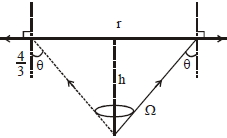
\(\frac{4}{3} \sin \theta=1 \sin 90^{\circ}\)\(\sin \theta=\frac{3}{4}\)
Area of sphere in which light spread \(=4 \pi \mathrm{R}^{2}\) \(\Omega=2 \pi(1-\cos \theta)\)
\(\Omega=2 \pi\left(1-\frac{\sqrt{7}}{4}\right)\)
\(\mathrm{P} \rightarrow 4 \pi\) steradians
\(\mathrm{P}^{\prime} \rightarrow \frac{\mathrm{P}}{4 \pi}(1-\cos \theta)\)
ratio \(=\frac{P'}{P}=\frac{2 \pi(1-\cos \theta)}{4 \pi}=\frac{(1-\cos \theta)}{2}=\frac{1-\frac{\sqrt{7}}{4}}{2}\)
\(=\frac{0.33}{2}=0.17\)
-
- (A) \(1\)
- (B) \(5\)
- (C) \(9\)
- (D) \(13\)
Show answer and solution
Correct Answer: (A)
\(\left(\frac{d v}{d t}\right)|=| \frac{v^{2}}{u^{2}}\left|\frac{d u}{d t}\right|\)\(=\left(\frac{10}{30}\right) 2 \times 9=1 m / s\)
No questions on this page match these filters.