


Questions
22 questionsShowing 1–22 of 22 questions
-
- (A) \(12\)
- (B) \(4\)
- (C) \(5\)
- (D) \(2\)
Show answer and solution
Correct Answer: (B)
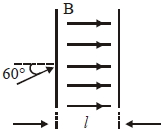
Pitch \(=\frac{2 \pi m }{ qB } v \cos \theta\)Pitch \(=\frac{2(3.14)\left(1.67 \times 10^{-27}\right) \times 4 \times 10^{5} \times \cos 60}{\left(1.69 \times 10^{-19}\right)(0.3)}\)
Pitch \(=0.04 m =4 cm\)
-
- (A) \(-0.30 \hat{ i }+0.32 \hat{ j }-0.09 \hat{ k }\)
- (B) \(-300 \hat{ i }+320 \hat{ j }-90 \hat{ k }\)
- (C) \(-30 \hat{ i }+32 \hat{ j }-9 \hat{ k }\)
- (D) \(-3.0 \hat{ i }+3.2 \hat{ j }-0.9 \hat{ k }\)
Show answer and solution
Correct Answer: (C)
\(\overrightarrow{ F }=q(\overrightarrow{ V } \times \overrightarrow{ B })\) (Force on charge particle moving in magnetic field)\(\overrightarrow{ V } \times \overrightarrow{ B }=(2 \hat{ i }+3 \hat{ j }+4 \hat{ k }) \times(5 \hat{ i }+3 \hat{ j }-6 \hat{ k }) \times 10^{-3}\)
\(=\left|\begin{array}{ccc}\hat{i} & \hat{j} & \hat{k} \\ 2 & 3 & 4 \\ 5 & 3 & -6\end{array}\right| \times 10^{-3}\)
\(=[\hat{i}[-18-12]-\hat{j}[-12-20]+\hat{k}[6-15]] \times 10^{-3}\)
\(=[\hat{i}[-30]+\hat{j}[32]+\hat{k}[-9]] \times 10^{-3}\)
Force \(=10^{-6}[-30 \hat{i}+32 \hat{j}-9 \hat{k}] \times 10^{-3}\)
\(=10^{-9}[-30 \hat{ i }+32 \hat{ j }-9 \hat{ k }]\)
-
- (A) \(-\frac{ mv ^{2} \overrightarrow{ B }}{ B ^{2}}\)
- (B) \(-\frac{m v^{2} \vec{B}}{2 \pi B^{2}}\)
- (C) \(\frac{m v^{2} \vec{B}}{2 B^{2}}\)
- (D) \(-\frac{m v^{2} \vec{B}}{2 B^{2}}\)
Show answer and solution
Correct Answer: (D)
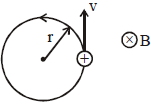
Magnetic moment\(M=i A\)
\(M=\left(\frac{q}{T}\right) \times \pi r^{2}=\frac{q \pi r^{2}}{\left(\frac{2 \pi r}{v}\right)}=\frac{q v r}{2}\)
\(M=\frac{q v}{2} \times \frac{v m}{q B}\)
\(M =\frac{ mv ^{2}}{2 B }\)
As we can see from the figure, direction of magnetic moment \((M)\) is opposite to magnetic field.
\(\overrightarrow{ M }=-\frac{ mv ^{2}}{2 B } \hat{ B }\)
\(=-\frac{m v^{2}}{2 B^{2}} \vec{B}\)
- 4. A circuit to verify \(Ohm's\) law uses ammeter and voltmeter in series or parallel connected correctly to the resistor. In the circuit 2020 Medium
- (A) ammeter is always connected series and voltmeter in parallel.
- (B) Both, ammeter and voltmeter mast be connected in series.
- (C) Both ammeter and voltmeter must be connected in parallel.
- (D) ammeter is always used in parallel and voltmeter is series.
Show answer and solution
Correct Answer: (A)
ConceptualOption \((1)\) is correct
Ammeter :- In series connection, the same current flows through all the components. It aims at measuring the curent flowing through the circuit and hence, it is connected in series.
Voltmeter :- A voltmeter measures voltage change between two points in a circuit, So we have to place the voltmeter in parallal with the circuit component.
-
- (A) \(10\, rad \,s ^{-1}\)
- (B) \(20\, \pi \operatorname{rad}\, s^{-1}\)
- (C) \(10\, \pi\, rad\, s ^{-1}\)
- (D) \(20\, rad\, s ^{-1}\)
Show answer and solution
Correct Answer: (A)
\(I _{ dia }=0.8 kg / m ^{2}\)\(M =20 Am ^{2}\)
\(U _{ i }+ K _{ i }= U _{ f }+ K _{ f }\)
\(0+0=- MB \cos 30^{\circ}+\frac{1}{2} I \omega^{2}\)
\(20 \times 4 \times \frac{\sqrt{3}}{2}=\frac{1}{2}(0.8) \omega^{2}\)
\(\omega=\sqrt{100 \sqrt{3}}=10(3)^{1 / 4}\)
-
- (A) \(15\)
- (B) \(20\)
- (C) \(35\)
- (D) \(30\)
Show answer and solution
Correct Answer: (B)
\(\vec{\tau}=\vec{m} \times \vec{B}\)\(\tau=N I \times A \times B\)
\(105=500 \times 3 \times 10^{-4} \times \frac{1}{2} \times B\)
\(B=20\)
-
- (A) \(9.9\)
- (B) \(8.9\)
- (C) \(7.9\)
- (D) \(10\)
Show answer and solution
Correct Answer: (A)
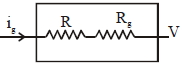
\(\mathrm{i}_{\mathrm{g}}=1 \mathrm{mA}, \mathrm{R}_{\mathrm{g}}=100 \Omega\)\(\mathrm{V}=\mathrm{i}_{\mathrm{g}}\left(\mathrm{R}+\mathrm{R}_{\mathrm{g}}\right)\)
\(10=1 \times 10^{-3}(\mathrm{R}+100)\)
\(\mathrm{R}=9.9 \mathrm{k} \Omega\)
-
- (A) \(3 \times 10^{-3} A / div\)
- (B) \(333^{\circ} A / div\)
- (C) \(6 \times 10^{-3} A / div\)
- (D) \(666^{\circ} A / div\)
Show answer and solution
Correct Answer: (A)
Figure of Merit \(= C =\frac{ i }{\theta}\)\(= C =\frac{6 \times 10^{-3}}{2}=3 \times 10^{-3} Am ^{2}\)
-
- (A) \(R_{1}\)
- (B) \(R_{1}+G\)
- (C) \(R_{1}-G\)
- (D) \(G\)
Show answer and solution
Correct Answer: (B)
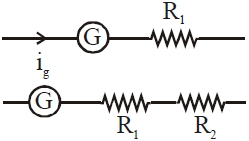
\(\Rightarrow 1=i_{g}\left(G+R_{1}\right) \quad \ldots(1)\)\(\Rightarrow 2= i _{ g }\left( R _{1}+ R _{2}+ G \right)\)\(...(2)\)
\((1)/(2)\)
\(\Rightarrow \frac{1}{2}=\frac{G+R_{1}}{G+R_{1}+R_{2}}\)
\(G + R _{1}+ R _{2}=2 G +2 h _{1}\)
\(\left( R _{2}= G + R _{1}\right)\)
-
- (A) \(\frac{2}{3}\)
- (B) \(\frac{3}{2}\)
- (C) \(\frac{1}{2}\)
- (D) \(2\)
Show answer and solution
Correct Answer: (A)
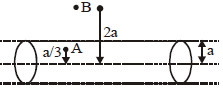
Let current density be J.\(\therefore\) Applying Ampere's law.
\(\oint \overrightarrow{\mathrm{B}} \cdot \mathrm{d} \vec{\ell}=\mu_{0} \mathrm{i} \Rightarrow \mathrm{B}_{\mathrm{A}} 2 \pi \frac{\mathrm{a}}{3}=\mu_{0} \mathrm{J} \pi\left(\frac{\mathrm{a}}{3}\right)^{2}\)
\(\therefore B_{A}=\frac{\mu_{0} J a}{6}\)
Similarly, \(B_{B}=\frac{\mu_{0} J a}{4}\)
\(\frac{B_{A}}{B_{B}}=\frac{\mu_{0} J a \times 4}{\mu_{0} J 6 a}=\frac{2}{3}\)
-
- (A) \(\frac{ q d B _{0}}{2 m }\)
- (B) \(\frac{q d B_{0}}{m}\)
- (C) \(\frac{2 q d B_{0}}{m}\)
- (D) \(\frac{q d B_{0}}{3 m}\)
Show answer and solution
Correct Answer: (B)
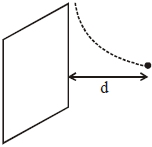
In uniform magnetic field particle moves in a circular path, if the radius of the circular path is \('d',\) particle will not hit the screen.\(d =\frac{ mv }{ qB _{0}}\)
\(v =\frac{ q B _{0} d }{ m }\)
\(\therefore\) correct option is \((2)\)
-
- (A) \(\mathrm{T}=\sqrt{\frac{\pi \mathrm{m}}{2 \mathrm{IB}}}\)
- (B) \(\mathrm{T}=\sqrt{\frac{2 \pi \mathrm{m}}{\mathrm{IB}}}\)
- (C) \(\mathrm{T}=\sqrt{\frac{\pi \mathrm{m}}{\mathrm{IB}}}\)
- (D) \(\mathrm{T}=\sqrt{\frac{2 \mathrm{m}}{\mathrm{IB}}}\)
Show answer and solution
Correct Answer: (B)
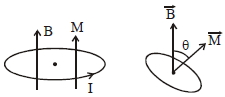
\(\overrightarrow{\mathrm{T}}=\overrightarrow{\mathrm{M}} \times \overrightarrow{\mathrm{B}}=-\mathrm{MB} \sin \theta\)\(\mathrm{I} \alpha=-\mathrm{MB} \sin \theta\)
for small \(\theta\)
\(\alpha=-\frac{\mathrm{MB}}{\mathrm{I}} \theta\)
\(\omega=\sqrt{\frac{\mathrm{MB}}{\mathrm{I}}}=\sqrt{\frac{(\mathrm{I})\left(\pi \mathrm{R}^{2}\right) \mathrm{B}}{\left(\frac{\mathrm{mR}^{2}}{2}\right)}}\)
\(\omega=\sqrt{\frac{2 \mathrm{I} \pi \mathrm{B}}{\mathrm{m}}}\)
\(\therefore \mathrm{T}=\frac{2 \pi}{\omega}=\sqrt{\frac{2 \pi \mathrm{m}}{\mathrm{IB}}}\)
-
- (A) \(\frac{2 \mu_{0} I^{2} a^{2}}{\pi b}\)
- (B) \(\frac{\mu_{0} I^{2} a^{3}}{2 \pi b^{2}}\)
- (C) \(\frac{\mu_{0} I^{2} a^{2}}{2 \pi b}\)Z
- (D) \(\frac{2 \mu_{0} I^{2} a^{3}}{\pi b^{2}}\)
Show answer and solution
Correct Answer: (A)
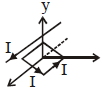
\(\overrightarrow{\tau}=\overrightarrow{ M } \times \overrightarrow{ B }\)\(=4 a ^{2} I \times \frac{\mu_{0} I }{2 \pi b }\)
-
- (A) \(\frac{2 \mu_{0} I^{2} a^{2} b}{\pi\left(a^{2}+b^{2}\right)}\)
- (B) \(\frac{\mu_{0} I^{2} a^{2} b}{2 \pi\left(a^{2}+b^{2}\right)}\)
- (C) \(\frac{\mu_{0} I^{2} a^{2}}{2 \pi b}\)
- (D) \(\frac{2 \mu_{0} I^{2} a^{2}}{\pi b}\)
Show answer and solution
Correct Answer: (A)
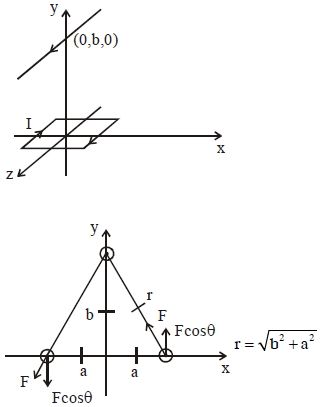
\(F = BI 2 a =\frac{\mu_{0} I }{2 \pi r } I \times 2 a\)\(F =\frac{\mu_{0} I ^{2} a }{\pi \sqrt{ b ^{2}+ a ^{2}}}\)
\(\tau= F \cos \theta \times 2 a\)
\(=\frac{\mu_{0} I^{2} a}{\pi \sqrt{b^{2}+a^{2}}} \times \frac{b}{\sqrt{b^{2}+a^{2}}} \times 2 a\)
\(\tau=\frac{2 \mu_{0} I^{2} a^{2} b}{\pi\left(a^{2}+b^{2}\right)}\)
If \(b \gg a\) then \(\tau=\frac{2 \mu_{0} I ^{2} a ^{2}}{\pi b }\)
But among the given options \((1)\) is most appropriate
-
- (A) \(\frac{\mu_{0} I}{2 R}\)
- (B) \(\frac{\mu_{0} I}{2 \pi R}(\pi+1)\)
- (C) \(\frac{\mu_{0} \mathrm{I}}{2 \pi \mathrm{R}}\left(\pi+\frac{1}{\sqrt{2}}\right)\)
- (D) \(\frac{\mu_{0} I}{2 \pi R}\left(\pi-\frac{1}{\sqrt{2}}\right)\)
Show answer and solution
Correct Answer: (C)
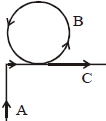
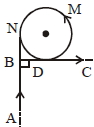
We say we have \(3\) parts \((A, B, C)\)\(\mathrm{B}=\mathrm{B}_{\mathrm{A}}+\mathrm{B}_{\mathrm{B}}+\mathrm{B}_{\mathrm{C}}\)
\(=\frac{\mu_{0} \mathrm{I}}{4 \pi \mathrm{R}}\left(\sin 90^{\circ}-\sin 45^{\circ}\right) \otimes+\frac{\mu_{0} \mathrm{I}}{2 \mathrm{R}} \odot+\frac{\mu_{0} \mathrm{I}}{4 \pi \mathrm{R}}\left(\sin 45^{\circ}+\sin 90^{\circ}\right) \odot\)
\(=\frac{\mu_{0} \mathrm{I}}{2 \pi \mathrm{R}}\left(\sin 45^{\circ}+\pi\right)\)
\(=\frac{\mu_{0} \mathrm{I}}{2 \pi \mathrm{R}}\left(\pi+\frac{1}{\sqrt{2}}\right)\)
-
- (A) \(4:6\)
- (B) \(6:4\)
- (C) \(6:5\)
- (D) \(2:5\)
Show answer and solution
Correct Answer: (C)
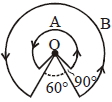
Given \(i_{A}=2, r_{A}=2 cm , \theta_{A}=2 \pi-\frac{\pi}{2}=\frac{3 \pi}{2}\)\(i_{B}=3, r_{B}=4 cm , \theta_{B}=2 \pi-\frac{\pi}{3}=\frac{5 \pi}{3}\)
\(B=\frac{\mu_{0} I \theta}{4 \pi R}\)
\(\frac{B_{A}}{B_{B}}=\frac{I_{A}}{I_{B}} \times \frac{\theta_{A} R_{B}}{\theta_{B} R_{A}}=\frac{6}{5}\)
-
- (A) \(\sqrt{2}\) \(abI\), along \(\left(\frac{\hat{j}}{\sqrt{2}}+\frac{\hat{ k }}{\sqrt{2}}\right)\)
- (B) \(\sqrt{2}\) \(abI,\) along \(\left(\frac{\hat{j}}{\sqrt{5}}+\frac{2 \hat{k}}{\sqrt{5}}\right)\)
- (C) \(abI,\) along \(\left(\frac{\hat{j}}{\sqrt{2}}+\frac{\hat{k}}{\sqrt{2}}\right)\)
- (D) \(abI,\) along \(\left(\frac{\hat{j}}{\sqrt{5}}+\frac{2 \hat{ k }}{\sqrt{5}}\right)\)
Show answer and solution
Correct Answer: (A)
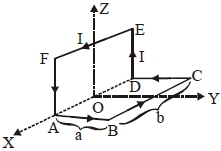
Sol. \(\quad M=N I A\)\(N =1\)
For \(ABCD\)
\(\overrightarrow{ M }_{1}= abI \hat{ K }\)
For \(DEFA\)
\(\overrightarrow{ M }_{2}= abI \hat{ j }\)
\(\overrightarrow{ M }=\overrightarrow{ M }_{1}+\overrightarrow{ M }_{2}\)
\(=\operatorname{ab} I (\hat{ k }+\hat{j})\)
\(=\operatorname{ab} I \sqrt{2}\left(\frac{\hat{j}}{\sqrt{2}}+\frac{\hat{ k }}{\sqrt{2}}\right)\)
-
- (A) \(\frac{\mathrm{e} \mu_{0} \mathrm{nIR}}{\mathrm{m}}\)
- (B) \(\frac{\mathrm{e} \mu_{0} \mathrm{nIR}}{2 \mathrm{m}}\)
- (C) \(\frac{2 \mathrm{e} \mu_{0} \mathrm{nIR}}{\mathrm{m}}\)
- (D) \(\frac{\mathrm{e} \mu_{0} \mathrm{nIR}}{4 \mathrm{m}}\)
Show answer and solution
Correct Answer: (B)
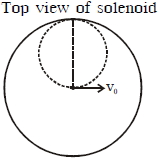
Maximum possible radius of electron \(=\frac{\mathrm{R}}{2}\)\(\therefore \frac{\mathrm{R}}{2}=\frac{\mathrm{mv}}{\mathrm{qB}}=\frac{\mathrm{mv}_{\max }}{\mathrm{e}\left(\mu_{0} \mathrm{ni}\right)}\)
\(\mathrm{v}_{\max }=\frac{\mathrm{R}}{2} \frac{\mathrm{e} \mu_{0} \mathrm{ni}}{\mathrm{m}}\)
-
- (A) \(5 \times 10^{-3} T ,\) along \(+ z\) direction
- (B) \(3 \times 10^{-4} T ,\) along \(- z\) direction
- (C) \(3 \times 10^{-4} T ,\) along \(+ z\) direction
- (D) \(5 \times 10^{-3} T ,\) along \(- z\) direction
Show answer and solution
Correct Answer: (A)
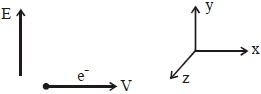
\(\overrightarrow{ B }\) must be in \(+ z\) axis.\(\overrightarrow{ V }=6 \times 10^{6} \hat{ i }\)
\(\overrightarrow{ E }=300 \hat{ j } V / cm =3 \times 10^{4} V / m\)
\(q \vec{ E }+q \vec{ V } \times \vec{ B }=0\)
\(E = VB\)
\(B =\frac{ E }{ V }=\frac{3 \times 10^{4}}{6 \times 10^{6}}=5 \times 10^{-3} T\)
-
- (A) \(250 \sqrt{3}\)
- (B) \(5 \sqrt{3}\)
- (C) \(500 \sqrt{3}\)
- (D) \(50 \sqrt{3}\)
Show answer and solution
Correct Answer: (C)
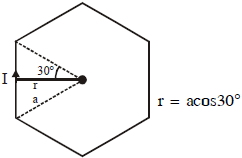
\(B =\frac{6 \mu_{0} I }{4 \pi a \cos 30^{\circ}} \times 2 \sin 30^{\circ} \times 50\)\(=\frac{\mu_{0} I}{\pi} \frac{150}{\sqrt{3} a }=\frac{50 \sqrt{3}}{0.1} \frac{\mu_{0} I}{\pi}\)
\(=500 \sqrt{3} \frac{\mu_{0} I}{\pi}\)
-
- (A) \(71\)
- (B) \(7.1\)
- (C) \(0.071\)
- (D) \(0.71\)
Show answer and solution
Correct Answer: (D)
\(\mathrm{a}=\frac{\mathrm{qvB}}{\mathrm{m}}\)\(\mathrm{B}=\frac{\mathrm{ma}}{\mathrm{qv}}=\frac{\mathrm{ma} \sqrt{\mathrm{m}}}{\sqrt{2 \mathrm{k}}}\)
\(=\frac{\mathrm{m}^{3 / 2} \mathrm{a}}{\mathrm{e} \sqrt{2 \mathrm{k}}}=\frac{\left(1.6 \times 10^{-27}\right)^{3 / 2} \times 10^{12}}{1.6 \times 10^{-19} \sqrt{2 \times 1 \times 10^{6} \times 1.6 \times 10^{-19}}}\)
\(=0.71 \mathrm{mT}\)
-
- (A) \(0.11\)
- (B) \(0.22\)
- (C) \(0.44\)
- (D) \(0.88\)
Show answer and solution
Correct Answer: (C)
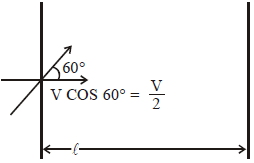
\(T =\frac{2 \pi m }{ qB }\)total time \(t=10 T\)
Kinematics
\(\ell=\frac{ V }{2} t\)
\(\ell=\frac{V}{2} 10 \times \frac{2 \pi m}{q B}\)
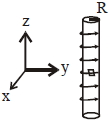
\(=4 \times 10^{5} \times 10 \times \frac{3.14 \times 1.67 \times 1 0^{-27}}{1.6 \times 10^{-19} \times 0.3}\)
\(=0.439\)
No questions on this page match these filters.