


Questions
6 questionsShowing 1–6 of 6 questions
-
- (A) \(\frac{1}{2}\)
- (B) \(\frac{1}{\sqrt{2}}\)
- (C) \(1\)
- (D) \(\sqrt{2}\)
Show answer and solution
Correct Answer: (D)
At equilibrium position\(V _{0}=\omega_{0} A =\sqrt{\frac{ K }{ m }} A....(i)\)
\(V =\omega A '=\sqrt{\frac{ K }{\frac{ m }{2}}} A '...(ii)\)
\(\therefore \quad A'= \sqrt{2} A\)
\(P_{i}=P_{f}\)
\(mV_0=\frac m{2} V\)
\(m(A \omega)=\frac{m}{2}\left(A^{\prime} \omega^{\prime}\right)\)
\(m A \sqrt{\frac{k}{m}}=\frac{m}{2} A^{\prime} \sqrt{\frac{k}{m / 2}}\)
\(m^{2} A^{2}\left[\frac{K}{m}\right]=\frac{m^{2}}{42}\left(A^{\prime}\right)^{2} \frac{k}{m} \times v\)
\(2 A^{2}=\left(A^{\prime}\right)^{2} \Rightarrow A^{\prime}=\sqrt{2}\)
-
- (A) \(\mathrm{L} \leftrightarrow \mathrm{m}, \mathrm{C} \leftrightarrow \frac{1}{\mathrm{k}}, \mathrm{R} \leftrightarrow \mathrm{b}\)
- (B) \(\mathrm{L} \leftrightarrow \frac{1}{\mathrm{b}}, \mathrm{C} \leftrightarrow \frac{1}{\mathrm{m}}, \mathrm{R} \leftrightarrow \frac{1}{\mathrm{k}}\)
- (C) \(\mathrm{L} \leftrightarrow \mathrm{m}, \mathrm{C} \leftrightarrow \mathrm{k}, \mathrm{R} \leftrightarrow \mathrm{b}\)
- (D) \(\mathrm{L} \leftrightarrow \mathrm{k}, \mathrm{C} \leftrightarrow \mathrm{b}, \mathrm{R} \leftrightarrow \mathrm{m}\)
Show answer and solution
Correct Answer: (A)
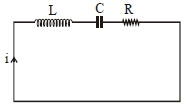
By \(kVL\)\(-\mathrm{L} \frac{\mathrm{di}}{\mathrm{dt}}-\frac{\mathrm{q}}{\mathrm{C}}-\mathrm{iR}=0\)
\(\mathrm{L} \frac{\mathrm{d}^{2} \mathrm{q}}{\mathrm{dt}^{2}}+\frac{1}{\mathrm{C}} \mathrm{q}+\mathrm{R} \frac{\mathrm{dq}}{\mathrm{dt}}=0\)
for damped oscillator
net force \(=-\mathrm{kx}-\mathrm{bv}=\mathrm{ma}\)
\(\frac{m d^{2} x}{d t^{2}}+k x+\frac{b d x}{d t}=0\)
by comparing : Equivalence is
\(\mathrm{L} \rightarrow \mathrm{m}: \mathrm{C} \rightarrow \frac{1}{\mathrm{K}} ; \mathrm{R} \rightarrow \mathrm{b}\)
-
- (A) \(\frac{2}{\sqrt{3}}\)
- (B) \(\frac{\sqrt{2}}{3}\)
- (C) \(\frac{2}{3}\)
- (D) \(\frac{3}{\sqrt{2}}\)
Show answer and solution
Correct Answer: (A)
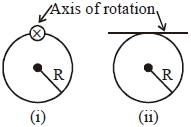
Moment of inertia in case \((i)\) is \(I _{1}\)Moment of inertia in case \((ii)\) is \(I_{2}\)
\(I_{1}=2 M R^{2}\)
\(I _{2}=\frac{3}{2} MR ^{2}\)
\(T _{1}=2 \pi \sqrt{\frac{ I _{1}}{ Mgd }} ; T _{2}=2 \pi \sqrt{\frac{ I _{2}}{ Mgd }}\)
\(\frac{ T _{1}}{ T _{2}}=\sqrt{\frac{ I _{1}}{ I _{2}}}=\sqrt{\frac{2 MR ^{2}}{\frac{3}{2} MR ^{2}}}=\frac{2}{\sqrt{3}}\)
-
- (A) \(f =\frac{1}{2 \pi} \sqrt{\frac{ YA }{ mL }}\)
- (B) \(f=\frac{1}{2 \pi} \sqrt{\frac{Y L}{m A}}\)
- (C) \(f=\frac{1}{2 \pi} \sqrt{\frac{m A}{Y L}}\)
- (D) \(f =\frac{1}{2 \pi} \sqrt{\frac{ mL }{ YA }}\)
Show answer and solution
Correct Answer: (A)
An elastic wire can be treated as a spring with\(K =\frac{ Y A }{\ell}\)
\(T =2 \pi \sqrt{\frac{ m }{ k }}\)
\(f=\frac{1}{2 \pi} \sqrt{\frac{k}{m}}=\frac{1}{2 \pi} \sqrt{\frac{Y A}{m \ell}}\)
-
- (A) \(( A ),( B )\) and \(( D )\)
- (B) \(( B ),( C )\) and \(( D )\)
- (C) \((A)\) and \((D)\)
- (D) \(( A ),( B )\) and \(( C )\)
Show answer and solution
Correct Answer: (D)
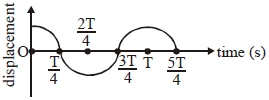
Sol. \((A)\) \(F =\) ma \(\quad a =-\omega^{2} x\)at \(\frac{3 T }{4}\) displacement zero \(( x =0),\) so \(a =0\)
\(F=0\)
\((B)\) at \(t=T \quad\) displacement \((x)=A\) \(x\) maximum, So acceleration is maximum.
\((C)\) \(V =\omega \sqrt{ A ^{2}- x ^{2}}\)
\(V _{\max }\) at \(x =0\)
\(V _{\max }= A \omega\)
at \(t =\frac{ T }{4}, x =0, \quad\) So \(V _{ max }\)
\((D)\) \(KE = PE\)
\(\therefore\) at \(x=\frac{A}{\sqrt{2}}\)
at \(t=\frac{T}{2} \quad x=-A \quad\) (So not possible)
-
- (A) \(\sqrt{\frac{g}{y_{0}}}\)
- (B) \(\sqrt{\frac{g}{2 y_{0}}}\)
- (C) \(\frac{1}{2} \sqrt{\frac{g}{y_{0}}}\)
- (D) \(\sqrt{\frac{2 g}{y_{0}}}\)
Show answer and solution
Correct Answer: (B)
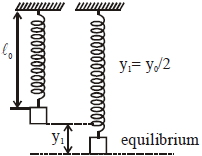
\(y = y _{0} \sin ^{2} \omega t\)\(y =\frac{ y _{0}}{2}(1-\cos 2 \omega t )\)
\(y -\frac{ y _{0}}{2}=-\frac{ y _{0}}{2} cos 2 \omega t\)
Amplitude : \(\frac{y_{0}}{2}\)
\(\frac{y_{0}}{2}=\frac{m g}{K}\)
\(2 \omega=\sqrt{\frac{K}{m}}=\sqrt{\frac{2 g}{y_{0}}}\)
\(\omega=\sqrt{\frac{g}{2 y_{0}}}\)
No questions on this page match these filters.