


Questions
15 questionsShowing 1–15 of 15 questions
-
- (A) \(0.1\)
- (B) \(5\)
- (C) \(1\)
- (D) \(1.5\)
Show answer and solution
Correct Answer: (C)
Intensity, \(I=3.3 Wm ^{-2}\)Area, \(A=3 \times 10^{-4} m ^{2}\)
Angular speed, \(\omega=31.4 rad / s\)
\(T=\frac{2 \pi}{\omega}\)
\(I = I _{0} \cos ^{2} \omega t\)
\(\because \cos ^{2} \theta =\frac{1}{2},\) in one time period
\(I=\frac{E}{A\cdot t}\)
\(\therefore\) Average energy \(=\frac{I_{0}}{2} \cdot \frac{2 \pi}{\omega} A=\frac{3.3 \times 3.14 \times 3 \times 10^{-4}}{31.4}=9.9 \times 10^{-5} \)
\(\approx 10 \times 10^{-5} \approx 1 \times 10^{-4} J\)
-
- (A) \(18.4\)
- (B) \(71.6\)
- (C) \(90\)
- (D) \(45\)
Show answer and solution
Correct Answer: (A)
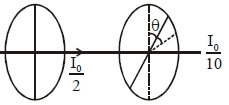
\(\frac{I_{0}}{10}=I=\frac{I_{0}}{2} \times \cos ^{2} \theta\)\(\cos \theta=\frac{1}{\sqrt{5}}\)
\(\theta=63.44^{\circ}\)
angle rotated \(=90-63.44^{\circ}=26.56^{\circ}\)
Closest is \(1\)
-
- (A) \(9\)
- (B) \(12\)
- (C) \(15\)
- (D) \(5\)
Show answer and solution
Correct Answer: (A)
\(I _{\max }= k\)\(I _{1}= I _{2}= K / 4\)
\(\Delta x =\lambda / 6 \Rightarrow \Delta \phi=\pi / 3\)
\(I = I _{1}+ I _{2}+2 \sqrt{ I _{1} I _{2}} \cos \phi\)
\(I =\frac{ K }{4}+\frac{ K }{4}+2 \times \frac{ K }{4} \frac{1}{2}\)
\(=\frac{ K }{2}+\frac{ K }{4}=\frac{3 K }{4}=\frac{9 K }{12}\)
\(n =9\)
-
- (A) \(0 : 1 : 4\)
- (B) \(4 : 1 : 0\)
- (C) \(0 : 1 : 2\)
- (D) \(2 : 1 : 0\)
Show answer and solution
Correct Answer: (D)
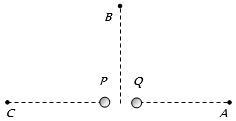
Since \(P\) is ahead of \(Q\) by \(90^\circ\) and path difference between \(P\) and \(Q\) is \(\lambda /4.\)Therefore at \(A\), phase difference is zero, so intensity is \(4I\). At \(C \) it is zero and at \(B\), the phase difference is \(90^\circ\), so intensity is \(2I.\) -
- (A) \(0.568\)
- (B) \(0.672\)
- (C) \(0.760\)
- (D) \(0.583\)
Show answer and solution
Correct Answer: (D)
\(I=I_{0} \cos ^{2}\left(\frac{\Delta \phi}{2}\right)\)\(\frac{I}{I_{0}}=\cos ^{2}\left(\frac{\Delta \phi}{2}\right)\)
\(\frac{I}{I_{0}}=\cos ^{2}\left(\frac{\frac{2 \pi}{\lambda} \times \frac{\lambda}{8}}{2}\right)\)
\(\frac{\mathrm{I}}{\mathrm{I}_{0}}=\cos ^{2}\left(\frac{\pi}{8}\right)\)
\(\frac{\mathrm{I}}{\mathrm{I}_{0}}=0.853\)
-
- (A) \(750\)
- (B) \(600\)
- (C) \(625\)
- (D) \(700\)
Show answer and solution
Correct Answer: (A)
The length of the screen used portion for \(15\) fringes, and also for ten fringes\(15 \times 500 \times \frac{D}{\lambda}=10 \times \frac{\lambda D}{\lambda}\)
\(15 \times 50=\lambda\)
\(\lambda=750 \mathrm{nm}\)
-
- (A) \(28\)
- (B) \(24\)
- (C) \(18\)
- (D) \(30\)
Show answer and solution
Correct Answer: (A)
Let the length of segment is " \(\ell^{\prime \prime}\)Let \(N\) is the no. of fringes in " \(\ell^{\prime \prime}\)
and \(w\) is fringe width.
\(\rightarrow\) We can write
\(N w =\ell\)
\(N \left(\frac{\lambda D }{ d }\right)=\ell\)
\(\frac{N_{1} \lambda_{1} D}{d}=\ell\)
\(\frac{ N _{2} \lambda_{2} D }{ d }=\ell\)
\(N _{1} \lambda_{1}= N _{2} \lambda_{2}\)
\(16 \times 700= N _{2} \times 400\)
\(N _{2}=28\)
-
- (A) \(0.07\)
- (B) \(0.17\)
- (C) \(1.7\)
- (D) \(0.57\)
Show answer and solution
Correct Answer: (D)
\(\Delta \theta_{0}=\left(\frac{\lambda}{ d } \times \frac{180}{\pi}\right)^{0}\)\(=0.57^{\circ}\)
-
- (A) \(6.9\)
- (B) \(5.9\)
- (C) \(4.9\)
- (D) \(3.9\)
Show answer and solution
Correct Answer: (B)
Finge width, \(\beta=\frac{\mathrm{D} \lambda}{\mathrm{d}}=\frac{1.5 \times 589 \times 10^{-9}}{0.15 \times 10^{-3}}\)\(=5.9 \times 10^{-3} \mathrm{m}\)
\(=5.9 \mathrm{mm}\)
-
- (A) \(1.27\)
- (B) \(2\)
- (C) \(2.87\)
- (D) \(2.05\)
Show answer and solution
Correct Answer: (A)
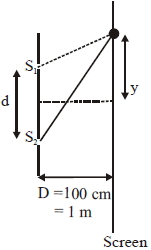
\(y=\frac{n D \lambda}{d}\)\(n=\frac{y d}{D \lambda}=\frac{1.27 \times 10^{-3} \times 10^{-3}}{1 \times 632.8 \times 10^{-9}}=2\)
Path difference \(\Delta x=n \lambda\)
\(=2 \times 632.8 nm\)
\(=1265.6 nm\)
\(=1.27 \mu m\)
-
- (A) \(198\)
- (B) \(156\)
- (C) \(147\)
- (D) \(187\)
Show answer and solution
Correct Answer: (A)
Condition for minimum,\(d \sin \theta= n \lambda\)
\(\therefore \sin \theta=\frac{n \lambda}{d}<1\)
\(n<\frac{d}{\lambda}=\frac{6 \times 10^{-5}}{6 \times 10^{-7}}=100\)
\(\therefore\) Total number of minima on one side \(=99\)
Total number of minima \(=198\)
Correct Answer is 1\(98\)
-
- (A) \(20\)
- (B) \(600\)
- (C) \(60\)
- (D) \(200\)
Show answer and solution
Correct Answer: (C)
Let distance is \(x\) then\(\mathrm{d} \theta=\frac{1.22 \lambda}{\mathrm{D}}(\mathrm{D}=\text { diameter })\)
\(\frac{\mathrm{x}}{\mathrm{d}}=\frac{1.22 \lambda}{\mathrm{D}}(\mathrm{d}=\text { distance between earth }\;and\; \text { moon })\)
\(\mathrm{x}=\frac{1.22 \times\left(5500 \times 10^{-10}\right) \times\left(4 \times 10^{8}\right)}{5}=53.68 \mathrm{m}\)
most appropriate is \(60 \mathrm{m}\)
-
- (A) \(12\)
- (B) \(3\)
- (C) \(5\)
- (D) \(2\)
Show answer and solution
Correct Answer: (B)
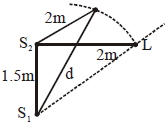
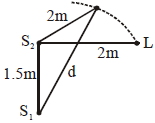
Initially \(S _{2} L =2 m\)\(S_{1} L=\sqrt{2^{2}+(3 / 2)^{2}}\)
\(S_{1} L=\frac{5}{2}=2.5 m\)
\(\Delta x =S_{1} L -S_{2} L =0.5 m\)
So since \(\lambda=1 m \quad \therefore \Delta x =\frac{\lambda}{2}\)
So while listener moves away from \(S_{1}\)
Then, \(\Delta x\left(=S_{1} L-S_{2} L\right)\) increases
and hence, at \(\Delta x=\lambda\) first maxima will appear. \(\Delta x=\lambda=S_{1} L-S_{2} L\)
\(1=d-2 \Rightarrow d=3 m\)
-
- (A) \(\frac{2 \pi}{\lambda}\left( n _{1} L _{1}- n _{2} L _{2}\right)\)
- (B) \(\frac{2 \pi}{\lambda}\left(\frac{ L _{2}}{ n _{1}}-\frac{ L _{1}}{ n _{2}}\right)\)
- (C) \(\frac{2 \pi}{\lambda}\left(\frac{ L _{1}}{ n _{1}}-\frac{ L _{2}}{ n _{2}}\right)\)
- (D) \(\frac{2 \pi}{\lambda}\left( n _{2} L _{1}- n _{1} L _{2}\right)\)
Show answer and solution
Correct Answer: (A)
\(\Delta p = n _{1} L _{1}- n _{2} L _{2}\)\(\Delta \phi=\frac{2 \pi}{\lambda} \Delta p\)
-
- (A) \(20\)
- (B) \(45\)
- (C) \(30\)
- (D) \(25\)
Show answer and solution
Correct Answer: (D)
\(\sin \theta=\frac{2 \lambda}{\omega}\)\(\sin 60^{\circ}=\frac{2 \lambda}{\omega}\)
\(\sin \theta_{1}=\frac{\lambda}{\omega}=\frac{\sqrt{3}}{4}\)
\(\theta_{1}=25^{\circ}\)
No questions on this page match these filters.