


All JEE Mains 2020 Physics questions
31 chaptersShowing 151–200 of 401 questions
-
- (A) \(80\)
- (B) \(75\)
- (C) \(85\)
- (D) \(82\)
Show answer and solution
Correct Answer: (B)
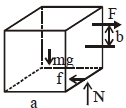
\(\mathrm{F}=\mu \mathrm{m} \mathrm{g}\dots (1)\)\(\mathrm{F}\left(\mathrm{b}+\frac{\mathrm{a}}{2}\right)=\mathrm{mg} \frac{\mathrm{a}}{2}\dots (2)\)
\(\mu m g\left(b+\frac{a}{2}\right)=m g \times \frac{a}{2}\)
\(\left(b+\frac{a}{2}\right) \mu=\frac{a}{2}\)
\(0.4=\mu=\frac{a}{2 b+a}\)
\(0.8 b+0.4 a=a\)
\(0.8 \mathrm{b}=0.6 \mathrm{a}\)
\(\frac{b}{a}=\frac{3}{4}\)
-
- (A) \(\frac{3}{7 \sqrt{2}} \frac{\mathrm{v}}{l}\)
- (B) \(\frac{3 \sqrt{2}}{7} \frac{v}{l}\)
- (C) \(\frac{4}{7} \frac{v}{l}\)
- (D) \(\frac{3}{7} \frac{v}{l}\)
Show answer and solution
Correct Answer: (B)
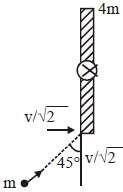
Let angular velocity of the system after collision be \(\omega\).By conservation of angular momentum about the hinge
\(\mathrm{m}\left(\frac{\mathrm{v}}{\sqrt{2}}\right)\left(\frac{\ell}{2}\right)=\left[\frac{4 \mathrm{m} \ell^{2}}{12}+\frac{\mathrm{m} \ell^{2}}{4}\right] \omega\)
On solving
\(\omega=\frac{3 \sqrt{2}}{7}\left(\frac{v}{l}\right)\)
-
- (A) \(\frac{3}{7 \sqrt{2}} \frac{\mathrm{v}}{l}\)
- (B) \(\frac{3 \sqrt{2}}{7} \frac{v}{l}\)
- (C) \(\frac{4}{7} \frac{v}{l}\)
- (D) \(\frac{3}{7} \frac{v}{l}\)
Show answer and solution
Correct Answer: (B)
Let angular velocity of the system after collision be \(\omega\).By conservation of angular momentum about the hinge
\(\mathrm{m}\left(\frac{\mathrm{v}}{\sqrt{2}}\right)\left(\frac{\ell}{2}\right)=\left[\frac{4 \mathrm{m} \ell^{2}}{12}+\frac{\mathrm{m} \ell^{2}}{4}\right] \omega\)
On solving
\(\omega=\frac{3 \sqrt{2}}{7}\left(\frac{v}{l}\right)\)
-
- (A) \(\sqrt{2}\)
- (B) \(2\)
- (C) \(4\)
- (D) \(2 \sqrt{2}\)
Show answer and solution
Correct Answer: (B)
\(I_{1}=\frac{M R^{2}}{2}=\frac{\rho\left(\pi R^{2}\right) t \cdot R^{2}}{2}\)\(I \propto R^{4}\)
\(\frac{I_{1}}{I_{2}}=\frac{R_{1}^{4}}{R_{2}^{4}}=\frac{1}{16}\)
\(\therefore \frac{R_{1}}{R_{2}}=\frac{1}{2}\)
-
- (A) \(1 / 2\)
- (B) \(2 / 3\)
- (C) \(1 / 8\)
- (D) \(1 / 4\)
Show answer and solution
Correct Answer: (D)
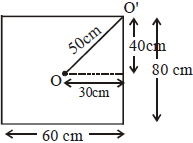
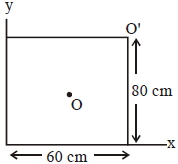
Rectangular sheet\(I _{ O }=\frac{ M }{12}\left[ L ^{2}+ B ^{2}\right]=\frac{ M }{12}\left[80^{2}+60^{2}\right]\)
\(I _{ O }= I _{0}+ Md ^{2}\{\) parallel axis theorem \(\}\)
\(\quad=\frac{ M }{12}\left[80^{2}+60^{2}\right]+ M [50]^{2}\)
\(\frac{ I _{ O }}{ I _{ O }}=\frac{ M / 12\left[80^{2}+60^{2}\right]}{\frac{ M }{12}\left[80^{2}+60^{2}\right]+ M [50]^{2}}=\frac{1}{4}\)
-
- (A) \(1 / 2\)
- (B) \(2 / 3\)
- (C) \(1 / 8\)
- (D) \(1 / 4\)
Show answer and solution
Correct Answer: (D)
Rectangular sheet\(I _{ O }=\frac{ M }{12}\left[ L ^{2}+ B ^{2}\right]=\frac{ M }{12}\left[80^{2}+60^{2}\right]\)
\(I _{ O }= I _{0}+ Md ^{2}\{\) parallel axis theorem \(\}\)
\(\quad=\frac{ M }{12}\left[80^{2}+60^{2}\right]+ M [50]^{2}\)
\(\frac{ I _{ O }}{ I _{ O }}=\frac{ M / 12\left[80^{2}+60^{2}\right]}{\frac{ M }{12}\left[80^{2}+60^{2}\right]+ M [50]^{2}}=\frac{1}{4}\)
-
- (A) \(2 \pi \mathrm{a}^{4}\left(\frac{\mathrm{A}}{4}+\frac{\mathrm{aB}}{5}\right)\)
- (B) \( \pi \mathrm{a}^{4}\left(\frac{\mathrm{A}}{4}+\frac{\mathrm{aB}}{5}\right)\)
- (C) \(2 \pi \mathrm{a}^{4}\left(\frac{\mathrm{aA}}{4}+\frac{\mathrm{B}}{5}\right)\)
- (D) \(2 \pi \mathrm{a}^{4}\left(\frac{\mathrm{A}}{4}+\frac{\mathrm{B}}{5}\right)\)
Show answer and solution
Correct Answer: (A)
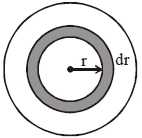
\(\mathrm{dI}=\mathrm{dm}^{2}\)\(\mathrm{dI}=\sigma 2 \pi \mathrm{r}\) dr \(\mathrm{r}^{2}\)
\(\mathrm{dI}=2 \pi(\mathrm{A}+\mathrm{Br}) \mathrm{r}^{3} \mathrm{dr}\)
\(\int \mathrm{dI}=2 \pi \int_{0}^{\mathrm{a}}\left(\mathrm{Ar}^{3}+\mathrm{Br}^{4}\right) \mathrm{dr}\)
\(I=2 \pi a^{4}\left(\frac{A}{4}+\frac{B a}{5}\right)\)
-
- (A) \(2 \pi \mathrm{a}^{4}\left(\frac{\mathrm{A}}{4}+\frac{\mathrm{aB}}{5}\right)\)
- (B) \( \pi \mathrm{a}^{4}\left(\frac{\mathrm{A}}{4}+\frac{\mathrm{aB}}{5}\right)\)
- (C) \(2 \pi \mathrm{a}^{4}\left(\frac{\mathrm{aA}}{4}+\frac{\mathrm{B}}{5}\right)\)
- (D) \(2 \pi \mathrm{a}^{4}\left(\frac{\mathrm{A}}{4}+\frac{\mathrm{B}}{5}\right)\)
Show answer and solution
Correct Answer: (A)
\(\mathrm{dI}=\mathrm{dm}^{2}\)\(\mathrm{dI}=\sigma 2 \pi \mathrm{r}\) dr \(\mathrm{r}^{2}\)
\(\mathrm{dI}=2 \pi(\mathrm{A}+\mathrm{Br}) \mathrm{r}^{3} \mathrm{dr}\)
\(\int \mathrm{dI}=2 \pi \int_{0}^{\mathrm{a}}\left(\mathrm{Ar}^{3}+\mathrm{Br}^{4}\right) \mathrm{dr}\)
\(I=2 \pi a^{4}\left(\frac{A}{4}+\frac{B a}{5}\right)\)
-
- (A) \(\sqrt{\frac{2}{3}}\)
- (B) \(\frac{3}{2}\)
- (C) \(\sqrt{\frac{3}{2}}\)
- (D) \(\frac{2}{3}\)
Show answer and solution
Correct Answer: (C)
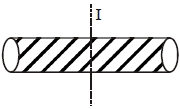
\(I=M\left(\frac{R^{2}}{4}+\frac{L^{2}}{12}\right)\)\(...(1)\)as mass is constant \(\Rightarrow m =\rho V =\) constant
\(V = constant\)
\(\pi^{2} R l=\) constant \(\Rightarrow R ^{2} L =\) constant
\(2 RL + R ^{2} \frac{ dL }{ dR }=0\)\(...(2)\)
From equation \((1)\)
\(\frac{ dI }{ clR }= M \left(\frac{2 R }{4}+\frac{2 L }{12} \times \frac{ dI }{ dr }\right)=0\)
\(\frac{ R }{2}+\frac{ L }{6} \frac{ dI }{ dR }=0\)
Substituting value of \(\frac{ dI }{ d R }\) from eqution \((2)\)
\(\frac{ R }{2}+\frac{ L }{6}\left(\frac{-2 L }{ R }\right)=0\)
\(\frac{ R }{2}=\frac{ L^{2}}{3 R } \Rightarrow \frac{ L }{ R }=\sqrt{\frac{3}{2}}\)
-
- (A) \(\sqrt{\frac{2}{3}}\)
- (B) \(\frac{3}{2}\)
- (C) \(\sqrt{\frac{3}{2}}\)
- (D) \(\frac{2}{3}\)
Show answer and solution
Correct Answer: (C)
\(I=M\left(\frac{R^{2}}{4}+\frac{L^{2}}{12}\right)\)\(...(1)\)as mass is constant \(\Rightarrow m =\rho V =\) constant
\(V = constant\)
\(\pi^{2} R l=\) constant \(\Rightarrow R ^{2} L =\) constant
\(2 RL + R ^{2} \frac{ dL }{ dR }=0\)\(...(2)\)
From equation \((1)\)
\(\frac{ dI }{ clR }= M \left(\frac{2 R }{4}+\frac{2 L }{12} \times \frac{ dI }{ dr }\right)=0\)
\(\frac{ R }{2}+\frac{ L }{6} \frac{ dI }{ dR }=0\)
Substituting value of \(\frac{ dI }{ d R }\) from eqution \((2)\)
\(\frac{ R }{2}+\frac{ L }{6}\left(\frac{-2 L }{ R }\right)=0\)
\(\frac{ R }{2}=\frac{ L^{2}}{3 R } \Rightarrow \frac{ L }{ R }=\sqrt{\frac{3}{2}}\)
-
- (A) \(10\)
- (B) \(13\)
- (C) \(15\)
- (D) \(18\)
Show answer and solution
Correct Answer: (C)
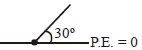
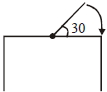
From mechanical energy conservation,\(\mathrm{U}_{\mathrm{i}}+\mathrm{K}_{\mathrm{i}}=\mathrm{U}_{\mathrm{f}}+\mathrm{K}_{\mathrm{r}}\)
\(\Rightarrow \mathrm{mg} \frac{\ell}{2} \sin 30^{\circ}+0=0+\frac{1}{2} \mathrm{I} \omega^{2}\)
\(\Rightarrow \operatorname{mg} \times \frac{1}{2} \times \frac{1}{2}+0=0+\frac{1}{2} \times \frac{\mathrm{m}(1)^{2}}{3} \omega^{2}\)
\(\Rightarrow \omega^{2}=\frac{3 \mathrm{g}}{2} \Rightarrow \omega=\sqrt{15}\)
\(\therefore n=15\)
-
- (A) \(10\)
- (B) \(13\)
- (C) \(15\)
- (D) \(18\)
Show answer and solution
Correct Answer: (C)
From mechanical energy conservation,\(\mathrm{U}_{\mathrm{i}}+\mathrm{K}_{\mathrm{i}}=\mathrm{U}_{\mathrm{f}}+\mathrm{K}_{\mathrm{r}}\)
\(\Rightarrow \mathrm{mg} \frac{\ell}{2} \sin 30^{\circ}+0=0+\frac{1}{2} \mathrm{I} \omega^{2}\)
\(\Rightarrow \operatorname{mg} \times \frac{1}{2} \times \frac{1}{2}+0=0+\frac{1}{2} \times \frac{\mathrm{m}(1)^{2}}{3} \omega^{2}\)
\(\Rightarrow \omega^{2}=\frac{3 \mathrm{g}}{2} \Rightarrow \omega=\sqrt{15}\)
\(\therefore n=15\)
-
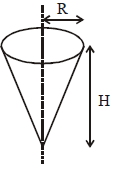
- (A) \(\frac{ MR ^{2}}{2}\)
- (B) \(\frac{ MH ^{2}}{3}\)
- (C) \(\frac{ MR ^{2}}{3}\)
- (D) \(\frac{ M \left( R ^{2}+ H ^{2}\right)}{4}\)
Show answer and solution
Correct Answer: (A)
Explanation:
Let us derive the moment of inertia of a hollow cone step-by-step using calculus based on the System of Particles and Rotational Motion chapter of the NCERT Class 11 Physics textbook:
Step 1: Understand the Geometry of the Cone
Let the apex (vertex) of the cone be at the origin, pointing downwards. - Slant height of the cone, \(l = \sqrt{R^2 + H^2}\)
- If \(\theta\) is the semi-vertical angle of the cone, then:
\(\tan\theta = \frac{R}{H}\) and \(\cos\theta = \frac{H}{l} = \frac{H}{\sqrt{R^2+H^2}}\)
The total curved surface area of this hollow cone is \(A = \pi R l = \pi R \sqrt{R^2 + H^2}\).
Therefore, the mass per unit area (\(\sigma\)) of the uniform hollow cone is:
\(\sigma = \frac{M}{\pi R \sqrt{R^2 + H^2}}\)
Step 2: Choose a Circular Element
Consider an elemental circular ring of radius \(r\) at a vertical distance \(h\) from the vertex along the axis. The slant width of this element is \(dl\).
From the geometry of the triangle:
\(r = h \tan\theta\)
\(dl = \frac{dh}{\cos\theta}\)
The area of this elemental ring is given by:
\(dA = 2\pi r \cdot dl = 2\pi (h \tan\theta) \frac{dh}{\cos\theta}\)
Step 3: Calculate the Mass of the Element (\(dm\))
Multiply the area of the element by the surface mass density (\(\sigma\)):
\(dm = \sigma \cdot dA = \left(\frac{M}{\pi R \sqrt{R^2 + H^2}}\right) \cdot \left(2\pi h \frac{\tan\theta}{\cos\theta} dh\right)\)
\(dm = \frac{2M \tan\theta}{R \sqrt{R^2 + H^2} \cos\theta} h dh\)
Step 4: Integrate to Find the Total Moment of Inertia (\(I\))
The moment of inertia of a thin ring of radius \(r\) and mass \(dm\) about its central axis is \(dI = (dm)r^2\).
Substituting \(r = h \tan\theta\):
\(dI = (dm)(h \tan\theta)^2 = \left(\frac{2M \tan\theta}{R \sqrt{R^2 + H^2} \cos\theta} h dh\right) \cdot h^2 \tan^2\theta\)
\(dI = \frac{2M \tan^3\theta}{R \sqrt{R^2 + H^2} \cos\theta} h^3 dh\)
Integrating from \(h = 0\) to \(h = H\):
\(I = \int_0^H \frac{2M \tan^3\theta}{R \sqrt{R^2 + H^2} \cos\theta} h^3 dh = \frac{2M \tan^3\theta}{R \sqrt{R^2 + H^2} \cos\theta} \left[ \frac{h^4}{4} \right]_0^H\)
\(I = \frac{2M \tan^3\theta}{R \sqrt{R^2 + H^2} \cos\theta} \cdot \frac{H^4}{4}\)
Step 5: Substitute Trigonometric Values for Simplification
Substitute \(\tan\theta = \frac{R}{H}\) and \(\cos\theta = \frac{H}{\sqrt{R^2+H^2}}\) back into the equation:
\(I = \frac{2M \left(\frac{R^3}{H^3}\right)}{R \sqrt{R^2 + H^2} \left(\frac{H}{\sqrt{R^2 + H^2}}\right)} \cdot \frac{H^4}{4}\)
\(I = \frac{2M R^2}{H^4} \cdot \frac{H^4}{4} = \frac{MR^2}{2}\)
Hence, Option A is the correct choice.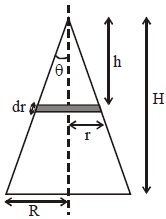
-
- (A) \(\frac{ MR ^{2}}{2}\)
- (B) \(\frac{ MH ^{2}}{3}\)
- (C) \(\frac{ MR ^{2}}{3}\)
- (D) \(\frac{ M \left( R ^{2}+ H ^{2}\right)}{4}\)
Show answer and solution
Correct Answer: (A)
Area \(=\pi R \ell=\pi R \left(\sqrt{ H ^{2}+ R ^{2}}\right)\)Area of element \(d A =2 \pi rd \ell==2 \pi r \frac{ dh }{\cos \theta}\)
mass of element \(dm =\frac{ M }{\pi R \sqrt{ H ^{2}+ R ^{2}}} \times \frac{2 \pi rdh }{\cos \theta}\)
\(dm =\frac{2 Mh \tan \theta dh }{ R \sqrt{ H ^{2}+ R ^{2}} \cos \theta} \quad\) (here \(\left. r = h \tan \theta\right)\)
\(I =\int( dm ) r ^{2}=\int \frac{ h ^{2} \tan ^{2} \theta}{\cos \theta}\left(\frac{2 m }{ R } \frac{ h \tan \theta}{\sqrt{ R ^{2}+ H ^{2}}}\right) dh\)
\(=\frac{2 M }{\cos \theta R } \frac{\tan ^{3} \theta}{\sqrt{ R ^{2}+ H ^{2}}}\)
\(\int_{0}^{ H } h ^{3} dh =\frac{ MR ^{2} H ^{4}}{2 RH ^{3} \sqrt{ R ^{2}+ H ^{2}} \cos \theta}\)
\(=\frac{ MR ^{2} H \sqrt{ R ^{2}+ H ^{2}}}{2 \sqrt{ R ^{2}+ H ^{2}} \times H }\)
\(=\frac{ MR ^{2}}{2}\)
-
- (A) \(2\)
- (B) \(0.5\)
- (C) \(0.75\)
- (D) \(1\)
Show answer and solution
Correct Answer: (D)
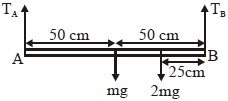
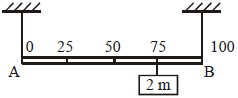
\(\tau_{ B }=0\) (torque about point \(B\) is zero \()\)\(\left(T_{A}\right) \times 100-(m g) \times 50-(2 m g) \times 25=0\)
\(100 T _{ A }=100 mg\)
\(T_{A}=1 mg\)
-
- (A) \(2\)
- (B) \(0.5\)
- (C) \(0.75\)
- (D) \(1\)
Show answer and solution
Correct Answer: (D)
\(\tau_{ B }=0\) (torque about point \(B\) is zero \()\)\(\left(T_{A}\right) \times 100-(m g) \times 50-(2 m g) \times 25=0\)
\(100 T _{ A }=100 mg\)
\(T_{A}=1 mg\)
- 168. The centre of mass of a solid hemisphere of radius \(8\, cm\) is \(X \,cm\) from the centre of the flat surface. Then value of \(x\) is\(......\) 2020 Medium
- (A) \(5\)
- (B) \(3\)
- (C) \(9\)
- (D) \(10\)
Show answer and solution
Correct Answer: (B)
\(x=\frac{3 R}{8}=3 c m\)\(x=3\)

- 169. The centre of mass of a solid hemisphere of radius \(8\, cm\) is \(X \,cm\) from the centre of the flat surface. Then value of \(x\) is\(......\) 2020 Medium
- (A) \(5\)
- (B) \(3\)
- (C) \(9\)
- (D) \(10\)
Show answer and solution
Correct Answer: (B)
\(x=\frac{3 R}{8}=3 c m\)\(x=3\)
-
- (A) \((1.25\; \mathrm{m}, 1.50\; \mathrm{m})\)
- (B) \((1\; \mathrm{m}, 1.75\; \mathrm{m})\)
- (C) \((0.75\; \mathrm{m}, 0.75\; \mathrm{m})\)
- (D) \((0.75\; \mathrm{m}, 1.75\; \mathrm{m})\)
Show answer and solution
Correct Answer: (D)
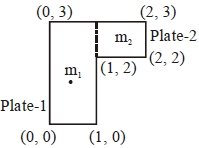
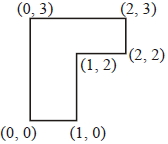
\(\mathrm{m}_{1}=3 \mathrm{kg}\)\(\mathrm{m}_{2}=1 \mathrm{kg}\)
Mass of plate- 1 is assumed to be concentrated at \((0.5,1.5)\)
Mass of plate- 2 is assumed to be concentrated at \((1.5,2.5)\)
\(\mathrm{x}_{\mathrm{cm}}=\frac{\mathrm{m}_{1} \mathrm{x}_{1}+\mathrm{m}_{2} \mathrm{x}_{2}}{\mathrm{m}_{1}+\mathrm{m}_{2}}=\frac{3 \times 0.5+1 \times 1.5}{4}=0.75\)
\(\mathrm{y}_{\mathrm{cm}}=\frac{\mathrm{m}_{1} \mathrm{y}_{1}+\mathrm{m}_{2} \mathrm{y}_{2}}{\mathrm{m}_{1}+\mathrm{m}_{2}}=\frac{3 \times 1.5+1 \times 2.5}{4}=1.75\)
-
- (A) \((1.25\; \mathrm{m}, 1.50\; \mathrm{m})\)
- (B) \((1\; \mathrm{m}, 1.75\; \mathrm{m})\)
- (C) \((0.75\; \mathrm{m}, 0.75\; \mathrm{m})\)
- (D) \((0.75\; \mathrm{m}, 1.75\; \mathrm{m})\)
Show answer and solution
Correct Answer: (D)
\(\mathrm{m}_{1}=3 \mathrm{kg}\)\(\mathrm{m}_{2}=1 \mathrm{kg}\)
Mass of plate- 1 is assumed to be concentrated at \((0.5,1.5)\)
Mass of plate- 2 is assumed to be concentrated at \((1.5,2.5)\)
\(\mathrm{x}_{\mathrm{cm}}=\frac{\mathrm{m}_{1} \mathrm{x}_{1}+\mathrm{m}_{2} \mathrm{x}_{2}}{\mathrm{m}_{1}+\mathrm{m}_{2}}=\frac{3 \times 0.5+1 \times 1.5}{4}=0.75\)
\(\mathrm{y}_{\mathrm{cm}}=\frac{\mathrm{m}_{1} \mathrm{y}_{1}+\mathrm{m}_{2} \mathrm{y}_{2}}{\mathrm{m}_{1}+\mathrm{m}_{2}}=\frac{3 \times 1.5+1 \times 2.5}{4}=1.75\)
-
- (A) \(0.416\)
- (B) \(0.428\)
- (C) \(0.4\)
- (D) \(0.388\)
Show answer and solution
Correct Answer: (D)
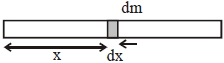
\(I =\int r ^{2} dm =\int x ^{2} \lambda dx\)\(I =\int_{0}^{ L } x ^{2} \lambda_{0}\left(1+\frac{ x }{ L }\right) dx\)
\(I=\lambda_{0} \int_{0}^{L}\left(x^{2}+\frac{x^{3}}{L}\right) d x\)
\(I=\lambda\left[\frac{L^{3}}{3}+\frac{L^{3}}{4}\right]\)
\(I =\frac{7 L ^{3} \lambda_{0}}{12}\) \(...(i)\)
\(M=\int_{0}^{L} \lambda \cdot d x=\int_{0}^{L} \lambda_{0}\left(1+\frac{ x }{ L }\right) dx\)
\(M=\lambda_{0}\left(L+\frac{L}{2}\right)=\lambda_{0} \frac{3 L}{2}\)
\(\frac{2}{3} M =\left(\lambda_{0} L \right)\)\(...(ii)\)
\(From\) \((i)\) \(\&\) \((ii)\)
.\(I=\frac{7}{12}\left(\frac{2}{3} M\right) L^{2}=\frac{7 M L^{2}}{18}\)
-
- (A) \(0.416\)
- (B) \(0.428\)
- (C) \(0.4\)
- (D) \(0.388\)
Show answer and solution
Correct Answer: (D)
\(I =\int r ^{2} dm =\int x ^{2} \lambda dx\)\(I =\int_{0}^{ L } x ^{2} \lambda_{0}\left(1+\frac{ x }{ L }\right) dx\)
\(I=\lambda_{0} \int_{0}^{L}\left(x^{2}+\frac{x^{3}}{L}\right) d x\)
\(I=\lambda\left[\frac{L^{3}}{3}+\frac{L^{3}}{4}\right]\)
\(I =\frac{7 L ^{3} \lambda_{0}}{12}\) \(...(i)\)
\(M=\int_{0}^{L} \lambda \cdot d x=\int_{0}^{L} \lambda_{0}\left(1+\frac{ x }{ L }\right) dx\)
\(M=\lambda_{0}\left(L+\frac{L}{2}\right)=\lambda_{0} \frac{3 L}{2}\)
\(\frac{2}{3} M =\left(\lambda_{0} L \right)\)\(...(ii)\)
\(From\) \((i)\) \(\&\) \((ii)\)
.\(I=\frac{7}{12}\left(\frac{2}{3} M\right) L^{2}=\frac{7 M L^{2}}{18}\)
-
- (A) \(\frac{1}{8} l\)
- (B) \(\sqrt{\frac{7}{48}} l\)
- (C) \(\sqrt{\frac{3}{8}} l\)
- (D) \(\frac{1}{4} l\)
Show answer and solution
Correct Answer: (B)
\(\mathrm{m} \frac{l^{2}}{12}+\mathrm{m} \frac{l^{2}}{16}=\mathrm{mk}^{2}\)\(\frac{7 l^{2}}{48}=k^{2}\)
-
- (A) \(\frac{1}{8} l\)
- (B) \(\sqrt{\frac{7}{48}} l\)
- (C) \(\sqrt{\frac{3}{8}} l\)
- (D) \(\frac{1}{4} l\)
Show answer and solution
Correct Answer: (B)
\(\mathrm{m} \frac{l^{2}}{12}+\mathrm{m} \frac{l^{2}}{16}=\mathrm{mk}^{2}\)\(\frac{7 l^{2}}{48}=k^{2}\)
-
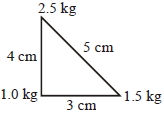
- (A) \(1.5\; cm\) right and \(1.2\; cm\) above \(1\; kg\) mass
- (B) \(0.9\; cm\) right and \(2.0\; cm\) above \(1\; kg\) mass
- (C) \(0.6\; cm\) right and \(2.0\; cm\) above \(1\; kg\) mass
- (D) \(2.0\; cm\) right and \(0.9\; cm\) above \(1\; kg\) mass
Show answer and solution
Correct Answer: (B)
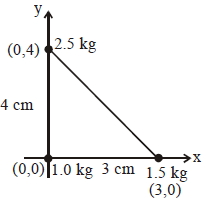
Let \(1 \mathrm{kg}\) as origin and \(\mathrm{x}\) -y axis as shown\({\mathrm{x}_{\mathrm{cm}}=\frac{1(0)+1.5(3)+2.5(0)}{5}=0.9 \mathrm{cm}}\)
\({\mathrm{y}_{\mathrm{cm}}=\frac{1(0)+1.5(0)+2.5(4)}{5}=2 \mathrm{cm}}\)
-
- (A) \(1.5\; cm\) right and \(1.2\; cm\) above \(1\; kg\) mass
- (B) \(0.9\; cm\) right and \(2.0\; cm\) above \(1\; kg\) mass
- (C) \(0.6\; cm\) right and \(2.0\; cm\) above \(1\; kg\) mass
- (D) \(2.0\; cm\) right and \(0.9\; cm\) above \(1\; kg\) mass
Show answer and solution
Correct Answer: (B)
Let \(1 \mathrm{kg}\) as origin and \(\mathrm{x}\) -y axis as shown\({\mathrm{x}_{\mathrm{cm}}=\frac{1(0)+1.5(3)+2.5(0)}{5}=0.9 \mathrm{cm}}\)
\({\mathrm{y}_{\mathrm{cm}}=\frac{1(0)+1.5(0)+2.5(4)}{5}=2 \mathrm{cm}}\)
-
- (A) \(\frac{13}{23}\)
- (B) \(\frac{15}{13}\)
- (C) \(\frac{23}{13}\)
- (D) \(\frac{13}{15}\)
Show answer and solution
Correct Answer: (A)
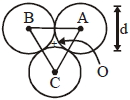
From parallel axis theorem\(I_{0}=3 \times\left[\frac{2}{5} M\left(\frac{d}{2}\right)^{2}+M\left(\frac{d}{\sqrt{3}}\right)^{2}\right]=\frac{13}{10} M d^{2}\)
\(\mathrm{I}_{\mathrm{A}}=\mathrm{I}_{0}+3 \mathrm{M}\left(\frac{\mathrm{d}}{\sqrt{3}}\right)^{2}\)
\(=\frac{13}{10} \mathrm{Md}^{2}+\mathrm{Md}^{2}\)
\(=\frac{23}{10} \mathrm{Md}^{2}\)
\(\frac{\mathrm{I}_{0}}{\mathrm{I}_{\mathrm{A}}}=\frac{13}{23}\)
-
- (A) \(3.33\)
- (B) \(0.67\)
- (C) \(1.67\)
- (D) \(6.67\)
Show answer and solution
Correct Answer: (D)
Both discs are rotating in same senseAngular momentum conserved for the system
i.e. \(\quad L _{1}+ L _{2}= L _{\text {final }}\)
\(I _{1} \omega_{1}+ I _{2} \omega_{2}=\left( I _{1}+ I _{2}\right) \omega_{ f }\)
\(0.1 \times 10+0.2 \times 5=(0.1+0.2) \times \omega_{f}\)
\(\omega_{ f }=\frac{20}{3}\)
Kinetic energy of combined disc system
\(\Rightarrow \frac{1}{2}\left( I _{1}+ I _{2}\right) \omega_{ f }^{2}\)
\(=\frac{1}{2}(0.1+0.2) \cdot\left(\frac{20}{3}\right)^{2}\)
\(=\frac{0.3}{2} \times \frac{400}{9}=\frac{120}{18}=\frac{20}{3} J\)
-
- (A) \(12\)
- (B) \(4\)
- (C) \(5\)
- (D) \(2\)
Show answer and solution
Correct Answer: (B)
Pitch \(=\frac{2 \pi m }{ qB } v \cos \theta\)Pitch \(=\frac{2(3.14)\left(1.67 \times 10^{-27}\right) \times 4 \times 10^{5} \times \cos 60}{\left(1.69 \times 10^{-19}\right)(0.3)}\)
Pitch \(=0.04 m =4 cm\)
-
- (A) \(-0.30 \hat{ i }+0.32 \hat{ j }-0.09 \hat{ k }\)
- (B) \(-300 \hat{ i }+320 \hat{ j }-90 \hat{ k }\)
- (C) \(-30 \hat{ i }+32 \hat{ j }-9 \hat{ k }\)
- (D) \(-3.0 \hat{ i }+3.2 \hat{ j }-0.9 \hat{ k }\)
Show answer and solution
Correct Answer: (C)
\(\overrightarrow{ F }=q(\overrightarrow{ V } \times \overrightarrow{ B })\) (Force on charge particle moving in magnetic field)\(\overrightarrow{ V } \times \overrightarrow{ B }=(2 \hat{ i }+3 \hat{ j }+4 \hat{ k }) \times(5 \hat{ i }+3 \hat{ j }-6 \hat{ k }) \times 10^{-3}\)
\(=\left|\begin{array}{ccc}\hat{i} & \hat{j} & \hat{k} \\ 2 & 3 & 4 \\ 5 & 3 & -6\end{array}\right| \times 10^{-3}\)
\(=[\hat{i}[-18-12]-\hat{j}[-12-20]+\hat{k}[6-15]] \times 10^{-3}\)
\(=[\hat{i}[-30]+\hat{j}[32]+\hat{k}[-9]] \times 10^{-3}\)
Force \(=10^{-6}[-30 \hat{i}+32 \hat{j}-9 \hat{k}] \times 10^{-3}\)
\(=10^{-9}[-30 \hat{ i }+32 \hat{ j }-9 \hat{ k }]\)
-
- (A) \(-\frac{ mv ^{2} \overrightarrow{ B }}{ B ^{2}}\)
- (B) \(-\frac{m v^{2} \vec{B}}{2 \pi B^{2}}\)
- (C) \(\frac{m v^{2} \vec{B}}{2 B^{2}}\)
- (D) \(-\frac{m v^{2} \vec{B}}{2 B^{2}}\)
Show answer and solution
Correct Answer: (D)
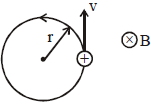
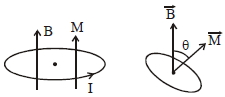
Magnetic moment\(M=i A\)
\(M=\left(\frac{q}{T}\right) \times \pi r^{2}=\frac{q \pi r^{2}}{\left(\frac{2 \pi r}{v}\right)}=\frac{q v r}{2}\)
\(M=\frac{q v}{2} \times \frac{v m}{q B}\)
\(M =\frac{ mv ^{2}}{2 B }\)
As we can see from the figure, direction of magnetic moment \((M)\) is opposite to magnetic field.
\(\overrightarrow{ M }=-\frac{ mv ^{2}}{2 B } \hat{ B }\)
\(=-\frac{m v^{2}}{2 B^{2}} \vec{B}\)
- 185. A circuit to verify \(Ohm's\) law uses ammeter and voltmeter in series or parallel connected correctly to the resistor. In the circuit 2020 Medium
- (A) ammeter is always connected series and voltmeter in parallel.
- (B) Both, ammeter and voltmeter mast be connected in series.
- (C) Both ammeter and voltmeter must be connected in parallel.
- (D) ammeter is always used in parallel and voltmeter is series.
Show answer and solution
Correct Answer: (A)
ConceptualOption \((1)\) is correct
Ammeter :- In series connection, the same current flows through all the components. It aims at measuring the curent flowing through the circuit and hence, it is connected in series.
Voltmeter :- A voltmeter measures voltage change between two points in a circuit, So we have to place the voltmeter in parallal with the circuit component.
-
- (A) \(10\, rad \,s ^{-1}\)
- (B) \(20\, \pi \operatorname{rad}\, s^{-1}\)
- (C) \(10\, \pi\, rad\, s ^{-1}\)
- (D) \(20\, rad\, s ^{-1}\)
Show answer and solution
Correct Answer: (A)
\(I _{ dia }=0.8 kg / m ^{2}\)\(M =20 Am ^{2}\)
\(U _{ i }+ K _{ i }= U _{ f }+ K _{ f }\)
\(0+0=- MB \cos 30^{\circ}+\frac{1}{2} I \omega^{2}\)
\(20 \times 4 \times \frac{\sqrt{3}}{2}=\frac{1}{2}(0.8) \omega^{2}\)
\(\omega=\sqrt{100 \sqrt{3}}=10(3)^{1 / 4}\)
-
- (A) \(15\)
- (B) \(20\)
- (C) \(35\)
- (D) \(30\)
Show answer and solution
Correct Answer: (B)
\(\vec{\tau}=\vec{m} \times \vec{B}\)\(\tau=N I \times A \times B\)
\(105=500 \times 3 \times 10^{-4} \times \frac{1}{2} \times B\)
\(B=20\)
-
- (A) \(9.9\)
- (B) \(8.9\)
- (C) \(7.9\)
- (D) \(10\)
Show answer and solution
Correct Answer: (A)
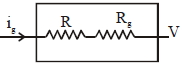
\(\mathrm{i}_{\mathrm{g}}=1 \mathrm{mA}, \mathrm{R}_{\mathrm{g}}=100 \Omega\)\(\mathrm{V}=\mathrm{i}_{\mathrm{g}}\left(\mathrm{R}+\mathrm{R}_{\mathrm{g}}\right)\)
\(10=1 \times 10^{-3}(\mathrm{R}+100)\)
\(\mathrm{R}=9.9 \mathrm{k} \Omega\)
-
- (A) \(3 \times 10^{-3} A / div\)
- (B) \(333^{\circ} A / div\)
- (C) \(6 \times 10^{-3} A / div\)
- (D) \(666^{\circ} A / div\)
Show answer and solution
Correct Answer: (A)
Figure of Merit \(= C =\frac{ i }{\theta}\)\(= C =\frac{6 \times 10^{-3}}{2}=3 \times 10^{-3} Am ^{2}\)
-
- (A) \(R_{1}\)
- (B) \(R_{1}+G\)
- (C) \(R_{1}-G\)
- (D) \(G\)
Show answer and solution
Correct Answer: (B)
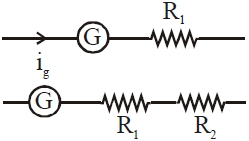
\(\Rightarrow 1=i_{g}\left(G+R_{1}\right) \quad \ldots(1)\)\(\Rightarrow 2= i _{ g }\left( R _{1}+ R _{2}+ G \right)\)\(...(2)\)
\((1)/(2)\)
\(\Rightarrow \frac{1}{2}=\frac{G+R_{1}}{G+R_{1}+R_{2}}\)
\(G + R _{1}+ R _{2}=2 G +2 h _{1}\)
\(\left( R _{2}= G + R _{1}\right)\)
-
- (A) \(\frac{2}{3}\)
- (B) \(\frac{3}{2}\)
- (C) \(\frac{1}{2}\)
- (D) \(2\)
Show answer and solution
Correct Answer: (A)
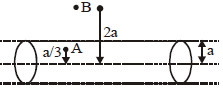
Let current density be J.\(\therefore\) Applying Ampere's law.
\(\oint \overrightarrow{\mathrm{B}} \cdot \mathrm{d} \vec{\ell}=\mu_{0} \mathrm{i} \Rightarrow \mathrm{B}_{\mathrm{A}} 2 \pi \frac{\mathrm{a}}{3}=\mu_{0} \mathrm{J} \pi\left(\frac{\mathrm{a}}{3}\right)^{2}\)
\(\therefore B_{A}=\frac{\mu_{0} J a}{6}\)
Similarly, \(B_{B}=\frac{\mu_{0} J a}{4}\)
\(\frac{B_{A}}{B_{B}}=\frac{\mu_{0} J a \times 4}{\mu_{0} J 6 a}=\frac{2}{3}\)
-
- (A) \(\frac{ q d B _{0}}{2 m }\)
- (B) \(\frac{q d B_{0}}{m}\)
- (C) \(\frac{2 q d B_{0}}{m}\)
- (D) \(\frac{q d B_{0}}{3 m}\)
Show answer and solution
Correct Answer: (B)
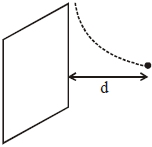
In uniform magnetic field particle moves in a circular path, if the radius of the circular path is \('d',\) particle will not hit the screen.\(d =\frac{ mv }{ qB _{0}}\)
\(v =\frac{ q B _{0} d }{ m }\)
\(\therefore\) correct option is \((2)\)
-
- (A) \(\mathrm{T}=\sqrt{\frac{\pi \mathrm{m}}{2 \mathrm{IB}}}\)
- (B) \(\mathrm{T}=\sqrt{\frac{2 \pi \mathrm{m}}{\mathrm{IB}}}\)
- (C) \(\mathrm{T}=\sqrt{\frac{\pi \mathrm{m}}{\mathrm{IB}}}\)
- (D) \(\mathrm{T}=\sqrt{\frac{2 \mathrm{m}}{\mathrm{IB}}}\)
Show answer and solution
Correct Answer: (B)
\(\overrightarrow{\mathrm{T}}=\overrightarrow{\mathrm{M}} \times \overrightarrow{\mathrm{B}}=-\mathrm{MB} \sin \theta\)\(\mathrm{I} \alpha=-\mathrm{MB} \sin \theta\)
for small \(\theta\)
\(\alpha=-\frac{\mathrm{MB}}{\mathrm{I}} \theta\)
\(\omega=\sqrt{\frac{\mathrm{MB}}{\mathrm{I}}}=\sqrt{\frac{(\mathrm{I})\left(\pi \mathrm{R}^{2}\right) \mathrm{B}}{\left(\frac{\mathrm{mR}^{2}}{2}\right)}}\)
\(\omega=\sqrt{\frac{2 \mathrm{I} \pi \mathrm{B}}{\mathrm{m}}}\)
\(\therefore \mathrm{T}=\frac{2 \pi}{\omega}=\sqrt{\frac{2 \pi \mathrm{m}}{\mathrm{IB}}}\)
-
- (A) \(\frac{2 \mu_{0} I^{2} a^{2}}{\pi b}\)
- (B) \(\frac{\mu_{0} I^{2} a^{3}}{2 \pi b^{2}}\)
- (C) \(\frac{\mu_{0} I^{2} a^{2}}{2 \pi b}\)Z
- (D) \(\frac{2 \mu_{0} I^{2} a^{3}}{\pi b^{2}}\)
Show answer and solution
Correct Answer: (A)
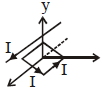
\(\overrightarrow{\tau}=\overrightarrow{ M } \times \overrightarrow{ B }\)\(=4 a ^{2} I \times \frac{\mu_{0} I }{2 \pi b }\)
-
- (A) \(\frac{2 \mu_{0} I^{2} a^{2} b}{\pi\left(a^{2}+b^{2}\right)}\)
- (B) \(\frac{\mu_{0} I^{2} a^{2} b}{2 \pi\left(a^{2}+b^{2}\right)}\)
- (C) \(\frac{\mu_{0} I^{2} a^{2}}{2 \pi b}\)
- (D) \(\frac{2 \mu_{0} I^{2} a^{2}}{\pi b}\)
Show answer and solution
Correct Answer: (A)
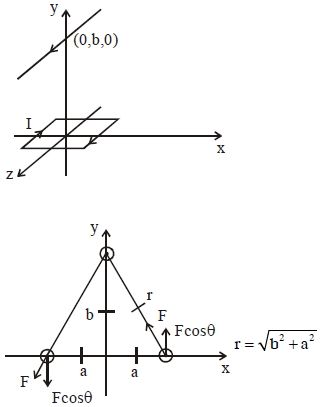
\(F = BI 2 a =\frac{\mu_{0} I }{2 \pi r } I \times 2 a\)\(F =\frac{\mu_{0} I ^{2} a }{\pi \sqrt{ b ^{2}+ a ^{2}}}\)
\(\tau= F \cos \theta \times 2 a\)
\(=\frac{\mu_{0} I^{2} a}{\pi \sqrt{b^{2}+a^{2}}} \times \frac{b}{\sqrt{b^{2}+a^{2}}} \times 2 a\)
\(\tau=\frac{2 \mu_{0} I^{2} a^{2} b}{\pi\left(a^{2}+b^{2}\right)}\)
If \(b \gg a\) then \(\tau=\frac{2 \mu_{0} I ^{2} a ^{2}}{\pi b }\)
But among the given options \((1)\) is most appropriate
-
- (A) \(\frac{\mu_{0} I}{2 R}\)
- (B) \(\frac{\mu_{0} I}{2 \pi R}(\pi+1)\)
- (C) \(\frac{\mu_{0} \mathrm{I}}{2 \pi \mathrm{R}}\left(\pi+\frac{1}{\sqrt{2}}\right)\)
- (D) \(\frac{\mu_{0} I}{2 \pi R}\left(\pi-\frac{1}{\sqrt{2}}\right)\)
Show answer and solution
Correct Answer: (C)
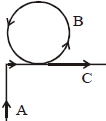
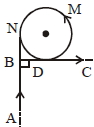
We say we have \(3\) parts \((A, B, C)\)\(\mathrm{B}=\mathrm{B}_{\mathrm{A}}+\mathrm{B}_{\mathrm{B}}+\mathrm{B}_{\mathrm{C}}\)
\(=\frac{\mu_{0} \mathrm{I}}{4 \pi \mathrm{R}}\left(\sin 90^{\circ}-\sin 45^{\circ}\right) \otimes+\frac{\mu_{0} \mathrm{I}}{2 \mathrm{R}} \odot+\frac{\mu_{0} \mathrm{I}}{4 \pi \mathrm{R}}\left(\sin 45^{\circ}+\sin 90^{\circ}\right) \odot\)
\(=\frac{\mu_{0} \mathrm{I}}{2 \pi \mathrm{R}}\left(\sin 45^{\circ}+\pi\right)\)
\(=\frac{\mu_{0} \mathrm{I}}{2 \pi \mathrm{R}}\left(\pi+\frac{1}{\sqrt{2}}\right)\)
-
- (A) \(4:6\)
- (B) \(6:4\)
- (C) \(6:5\)
- (D) \(2:5\)
Show answer and solution
Correct Answer: (C)
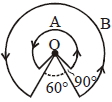
Given \(i_{A}=2, r_{A}=2 cm , \theta_{A}=2 \pi-\frac{\pi}{2}=\frac{3 \pi}{2}\)\(i_{B}=3, r_{B}=4 cm , \theta_{B}=2 \pi-\frac{\pi}{3}=\frac{5 \pi}{3}\)
\(B=\frac{\mu_{0} I \theta}{4 \pi R}\)
\(\frac{B_{A}}{B_{B}}=\frac{I_{A}}{I_{B}} \times \frac{\theta_{A} R_{B}}{\theta_{B} R_{A}}=\frac{6}{5}\)
-
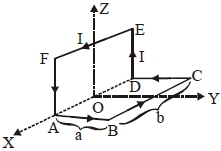
- (A) \(\sqrt{2}\) \(abI\), along \(\left(\frac{\hat{j}}{\sqrt{2}}+\frac{\hat{ k }}{\sqrt{2}}\right)\)
- (B) \(\sqrt{2}\) \(abI,\) along \(\left(\frac{\hat{j}}{\sqrt{5}}+\frac{2 \hat{k}}{\sqrt{5}}\right)\)
- (C) \(abI,\) along \(\left(\frac{\hat{j}}{\sqrt{2}}+\frac{\hat{k}}{\sqrt{2}}\right)\)
- (D) \(abI,\) along \(\left(\frac{\hat{j}}{\sqrt{5}}+\frac{2 \hat{ k }}{\sqrt{5}}\right)\)
Show answer and solution
Correct Answer: (A)
Sol. \(\quad M=N I A\)\(N =1\)
For \(ABCD\)
\(\overrightarrow{ M }_{1}= abI \hat{ K }\)
For \(DEFA\)
\(\overrightarrow{ M }_{2}= abI \hat{ j }\)
\(\overrightarrow{ M }=\overrightarrow{ M }_{1}+\overrightarrow{ M }_{2}\)
\(=\operatorname{ab} I (\hat{ k }+\hat{j})\)
\(=\operatorname{ab} I \sqrt{2}\left(\frac{\hat{j}}{\sqrt{2}}+\frac{\hat{ k }}{\sqrt{2}}\right)\)
-
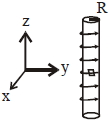
- (A) \(\frac{\mathrm{e} \mu_{0} \mathrm{nIR}}{\mathrm{m}}\)
- (B) \(\frac{\mathrm{e} \mu_{0} \mathrm{nIR}}{2 \mathrm{m}}\)
- (C) \(\frac{2 \mathrm{e} \mu_{0} \mathrm{nIR}}{\mathrm{m}}\)
- (D) \(\frac{\mathrm{e} \mu_{0} \mathrm{nIR}}{4 \mathrm{m}}\)
Show answer and solution
Correct Answer: (B)
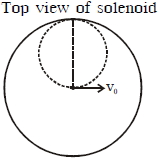
Maximum possible radius of electron \(=\frac{\mathrm{R}}{2}\)\(\therefore \frac{\mathrm{R}}{2}=\frac{\mathrm{mv}}{\mathrm{qB}}=\frac{\mathrm{mv}_{\max }}{\mathrm{e}\left(\mu_{0} \mathrm{ni}\right)}\)
\(\mathrm{v}_{\max }=\frac{\mathrm{R}}{2} \frac{\mathrm{e} \mu_{0} \mathrm{ni}}{\mathrm{m}}\)
-
- (A) \(5 \times 10^{-3} T ,\) along \(+ z\) direction
- (B) \(3 \times 10^{-4} T ,\) along \(- z\) direction
- (C) \(3 \times 10^{-4} T ,\) along \(+ z\) direction
- (D) \(5 \times 10^{-3} T ,\) along \(- z\) direction
Show answer and solution
Correct Answer: (A)
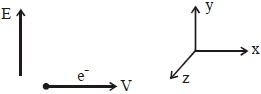
\(\overrightarrow{ B }\) must be in \(+ z\) axis.\(\overrightarrow{ V }=6 \times 10^{6} \hat{ i }\)
\(\overrightarrow{ E }=300 \hat{ j } V / cm =3 \times 10^{4} V / m\)
\(q \vec{ E }+q \vec{ V } \times \vec{ B }=0\)
\(E = VB\)
\(B =\frac{ E }{ V }=\frac{3 \times 10^{4}}{6 \times 10^{6}}=5 \times 10^{-3} T\)
No questions on this page match these filters.