


All JEE Mains 2020 Physics questions
31 chaptersShowing 51–100 of 401 questions
-
- (A) \(\frac{-\mathrm{h}}{|\mathrm{e}| \mathrm{Et}^{2}}\)
- (B) \(\frac{|\mathrm{e}| \mathrm{Et}}{\mathrm{h}}\)
- (C) \(-\frac{\mathrm{h}}{|\mathrm{e}| \mathrm{E} \sqrt{\mathrm{t}}}\)
- (D) \(-\frac{\mathrm{h}}{|\mathrm{e}| \mathrm{Et}}\)
Show answer and solution
Correct Answer: (A)
\(\mathrm{a}=\frac{\mathrm{eE}}{\mathrm{m}}\)\(\mathrm{v}=\mathrm{u}+\mathrm{at}=\left(\frac{\mathrm{eE}}{\mathrm{m}}\right) \mathrm{t}\)
\(\lambda=\frac{\mathrm{h}}{\mathrm{mv}}\)
\(\frac{\mathrm{d} \lambda}{\mathrm{dt}}=\frac{-(\mathrm{hm}) \cdot \frac{\mathrm{dv}}{\mathrm{dt}}}{(\mathrm{mv})^{2}}\)\(=-\frac{\mathrm{ah}}{\mathrm{mv}^{2}}=-\frac{\mathrm{h}}{| \mathrm{et}^{2}}\)
-
- (A) \(0.34\)
- (B) \(0.24\)
- (C) \(0.20\)
- (D) \(0.44\)
Show answer and solution
Correct Answer: (B)
\(v_{ ms }=\sqrt{\frac{3 KT }{ m }}\)\(m \rightarrow\) mass of one molecule (in \(kg\) ) \(=\) \(\frac{\text { molar mass }}{ NA }\)
de-Broglie wavelenth,
\(\lambda=\frac{ h }{ mv }\)
given, \(v = v _{ rms }\)
\(\lambda=\frac{ h }{ m \sqrt{\frac{3 KT }{ m }}}\)
\(\lambda=\frac{ h }{\sqrt{3 K T m }}\)
\(=\frac{6.63\times 10^{-34}}{\sqrt{3 \times 1.38 \times 10^{-23} \times 400 \times\left(\frac{28 \times 10^{-3}}{6.023 \times 10^{-23}}\right)}}\)
\(\lambda=\frac{6.63 \times 10^{-11}}{2.77}=2.39 \times 10^{-11} m\)
\(\lambda=0.24\dot A\)
-
- (A) \(2.27\)
- (B) \(2.59\)
- (C) \(1.93\)
- (D) \(2.10\)
Show answer and solution
Correct Answer: (A)
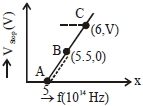
Graph of \(V_{s}\) and \(f\) given \((B\,5.5,0)\)\(hv =\phi+ eV _{ s }\)
at \(B \quad V _{ s }=0, \quad v=5.5\)
\(\Rightarrow \quad h \times 5.5 \times 10^{14}=\phi\)
\(\phi=\frac{6.62 \times 10^{-34} \times 5.5 \times 10^{14}}{1.6 \times 10^{-19}} eV =2.27 eV\)
-
- (A) Slope of the straight line get more steep
- (B) Straight line shifts to left
- (C) Graph does not change
- (D) Straight line shifts to right
Show answer and solution
Correct Answer: (C)
\(eV =\frac{ hc }{\lambda}-\phi\)\(V =\left(\frac{ hc }{ e }\right)\left(\frac{1}{\lambda}\right)-\phi\)
Slope of the line in above equation and all other terms are independent of intensity.
The graph does not change.
-
- (A) \(\Delta \lambda=4 \lambda_{0}\)
- (B) \(\Delta \lambda=\frac{5}{2} \lambda_{0}\)
- (C) \(\Delta \lambda=2 \lambda_{0}\)
- (D) \(\Delta \lambda=\frac{3}{2} \lambda_{0}\)
Show answer and solution
Correct Answer: (A)
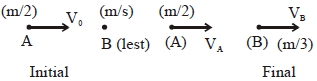
Applying momentum conservation\(\frac{m}{2} \times V_{0}+\frac{m}{3} \times(0)=\frac{m}{2} V_{A}+\frac{m}{3} V_{B}\)
\(=\frac{V_{0}}{2}=\frac{V_{A}}{2}+\frac{V_{B}}{3}\) \(....(1)\)
since, collision is elastic \(( e =1)\)
\(e =1=\frac{ V _{ B }- V _{ A }}{ V _{0}} \Rightarrow V _{0}= V _{ B }- V _{ A } \ldots(2)\)
On solving \((1) \&(2): V_{A}=\frac{V_{0}}{5}\)
Now, \(De-\)Broglie wavelength of \(A\) before collision :
\(\lambda_{0}=\frac{ h }{ m _{ A } V _{0}}=\frac{ h }{\left(\frac{ m }{2}\right) V _{0}}\)
\(\Rightarrow \lambda_{0}=\frac{2 h }{ mV _{0}}\)
Final \(De-\)Broglie wavelength :
\(\lambda_{ f }=\frac{ h }{ m _{ A } V _{0}}=\frac{ h }{\frac{ m }{2} \times \frac{ V _{ o }}{5}} \Rightarrow \lambda_{ f }=\frac{10 h }{ mV _{ o }}\)
Now \(\Delta \lambda=\lambda_{f}-\lambda_{0}\)
\(\Delta \lambda=\frac{10 h }{ mV _{0}}-\frac{2 h }{ mV _{0}}\)
\(\Rightarrow \Delta \lambda=\frac{8 h }{ mv _{0}} \Rightarrow \Delta \lambda=4 \times \frac{2 h }{ mv _{0}}\)
\(\Rightarrow \Delta \lambda=4 \lambda_{0}\)
-
- (A) \(1.8\)
- (B) \(0.8\)
- (C) \(1.1\)
- (D) \(1.6\)
Show answer and solution
Correct Answer: (C)
Let the work function be \(\phi\)\(\therefore \quad \mathrm{KE}_{\max }=\frac{\mathrm{hc}}{\lambda}-\phi\)
Again, \(\mathrm{R}_{\max }=\frac{\sqrt{2 \mathrm{mKE}_{\max }}}{\mathrm{qB}}=\frac{\sqrt{2 \mathrm{m}\left(\frac{\mathrm{hc}}{\lambda}-\phi\right)}}{\mathrm{qB}}\)
\(\therefore \quad \frac{\mathrm{R}_{\max }^{2} \mathrm{q}^{2} \mathrm{B}^{2}}{2 \mathrm{m}}=\frac{\mathrm{hc}}{\lambda}-\phi\)
\(\therefore \quad \phi=\frac{\mathrm{hc}}{\lambda}-\frac{\mathrm{R}_{\mathrm{max}}^{2} \mathrm{q}^{2} \mathrm{B}^{2}}{2 \mathrm{m}}=1.0899 \mathrm{eV} \approx 1.1 \mathrm{eV}\)
-
- (A) \(2\)
- (B) \(4\)
- (C) \(8\)
- (D) \(10\)
Show answer and solution
Correct Answer: (A)
\(E _{1}=\phi+ K _{1} \ldots(1)\)\(E _{2}=\phi+ K _{2}\) \(...(2)\)
\(E _{1}- E _{2}= K _{1}- K _{2}\)
Now \(\frac{ V _{1}}{ V _{2}}=2\)
\(\frac{ K _{1}}{ K _{2}}=4\)
\(K _{1}=4 K _{2}\)
Now from equation \((2)\)
\(\Rightarrow 4-2.5=4 K _{2}- K _{2}\)
\(1.5=3 K _{2}\)
\(K _{2}=0.5 eV\)
Now putting This
Value in equation \(( 2 )\)
\(2.5=\phi+0.5 eV\)
\(\phi=2 ev\)
-
- (A) \(\frac{1}{500}\)
- (B) \(500\)
- (C) \(250\)
- (D) \(\frac{1}{250}\)
Show answer and solution
Correct Answer: (A)
\(P=\frac{n h c}{\lambda t}\)\(\therefore \frac{n_{1}}{n_{2}}=\frac{\lambda_{1}}{\lambda_{2}}=\frac{1}{5}\)
-
- (A) \(3\)
- (B) \(2\)
- (C) \(4\)
- (D) \(1.5\)
Show answer and solution
Correct Answer: (C)
\(\lambda_{\mathrm{B}}=2 \lambda_{\mathrm{A}}\)\(\Rightarrow \frac{\mathrm{h}}{\sqrt{2 \mathrm{T}_{\mathrm{B}} \mathrm{m}}}=\frac{2 \mathrm{h}}{\sqrt{2 \mathrm{T}_{\mathrm{A}} \mathrm{m}}}\)
\(\mathrm{T}_{\mathrm{A}}=4 \mathrm{T}_{\mathrm{B}}\) and \(\mathrm{T}_{\mathrm{B}}=\left(\mathrm{T}_{\mathrm{A}}-1.5\right)\) eV
\(3 \mathrm{T}_{\mathrm{B}} 1.5 \mathrm{eV} \Rightarrow \mathrm{T}_{\mathrm{B}}=0.5 \mathrm{eV}\)
\(\mathrm{T}_{\mathrm{B}}=0.5 \mathrm{eV}=4.5 \mathrm{eV}-\phi_{\mathrm{B}}\)
\(\phi=4 \mathrm{eV}\)
-
- (A) \(9\)
- (B) \(3\)
- (C) \(11\)
- (D) \(16\)
Show answer and solution
Correct Answer: (A)
\(\frac{ hc }{\lambda}=\frac{ hc }{\lambda_{0}}+ eV\)\(...(i)\)\(\frac{ hc }{3 \lambda}=\frac{ hc }{\lambda_{0}}+\frac{ e \cdot V }{4}\)\(...(ii)\)
(multiply by \(4\))
\(\frac{4 hc }{3 \lambda}=\frac{4 hc }{\lambda_{0}}+ eV\)\(...(iii)\)
From \((i)\) \(\&\) \((iii)\)
\(\frac{h c}{\lambda}-\frac{h c}{\lambda_{0}}=\frac{4 h c}{3 \lambda}-\frac{4 h c}{\lambda_{0}}\)
\(-\frac{ hc }{3 \lambda}=-\frac{3 hc }{\lambda_{0}}\)
\(9 \lambda=\lambda_{0}\)
\(n=9\)
-
- (A) \(0.61\)
- (B) \(0.52\)
- (C) \(0.81\)
- (D) \(1.02\)
Show answer and solution
Correct Answer: (A)
\(\frac{3}{1}=\frac{\frac{ hc }{200 nm }-\phi}{\frac{ hc }{500 nm }-\phi}, hc =1240 eV - nm\)On solving \(\phi=0.61 eV\)
-
- (A) \(\frac{{2} m v_{0}}{q E_{0}}\)
- (B) \(\frac{\sqrt{2} m v_{0}}{q E_{0}}\)
- (C) \(\frac{\sqrt{3} m v_{0}}{q E_{0}}\)
- (D) \(\frac{{3} m v_{0}}{q E_{0}}\)
Show answer and solution
Correct Answer: (C)
\(\left(2 \mathrm{V}_{0}\right)^{2}=\mathrm{v}_{0}^{2}+\mathrm{v}_{\mathrm{x}}^{2}\)\(v_{x}=\sqrt{3} v_{0}\)
\(\sqrt{3} \mathrm{v}_{0}=0+\frac{\mathrm{qE}_{0}}{\mathrm{m}} \mathrm{t}\)
\(\mathrm{t}=\frac{\sqrt{3} \mathrm{v}_{0} \mathrm{m}}{\mathrm{q} \mathrm{E}_{0}}\)
-
- (A) \(180\)
- (B) \(160\)
- (C) \(150\)
- (D) \(190\)
Show answer and solution
Correct Answer: (B)
Energy density \(\frac{ dU }{ dV }=\frac{ B _{0}^{2}}{2 \mu_{0}}\)\(1.02 \times 10^{-8}=\frac{ B _{0}^{2}}{2 \times 4 \pi \times 10^{-7}}\)
\(B _{0}^{2}=\left(1.02 \times 10^{-8}\right) \times\left(8 \pi \times 10^{-7}\right)\)
\(B _{0}=16 \times 10^{-8} T =160 nT\)
-
- (A) \(\mathrm{B}_{0} \frac{\hat{\mathrm{i}}-\hat{\mathrm{j}}}{\sqrt{2}} \cos \left(\omega \mathrm{t}-\mathrm{k} \frac{\hat{\mathrm{i}}+\hat{\mathrm{j}}}{\sqrt{2}}\right)\)
- (B) \(\mathrm{B}_{0} \frac{\hat{\mathrm{i}}+\hat{\mathrm{j}}}{\sqrt{2}} \cos \left(\omega \mathrm{t}-\mathrm{k} \frac{\hat{\mathrm{i}}+\hat{\mathrm{j}}}{\sqrt{2}}\right)\)
- (C) \(\mathrm{B}_{0} \hat{\mathrm{k}} \cos \left(\omega \mathrm{t}-\mathrm{k} \frac{\hat{\mathrm{i}}+\hat{\mathrm{j}}}{\sqrt{2}}\right)\)
- (D) \(\mathrm{B}_{0} \frac{\hat{\mathrm{j}}-\hat{\mathrm{i}}}{\sqrt{2}} \cos \left(\omega \mathrm{t}+\mathrm{k} \frac{\hat{\mathrm{i}}+\hat{\mathrm{j}}}{\sqrt{2}}\right)\)
Show answer and solution
Correct Answer: (A)
Direction of polarisation \(=\hat{\mathrm{E}}=\hat{\mathrm{k}}\)Direction of propagation \(=\hat{\mathrm{E}} \times \hat{\mathrm{B}}=\frac{\hat{\mathrm{i}}+\hat{\mathrm{j}}}{\sqrt{2}}\)
\(\therefore \hat{\mathrm{E}} \times \hat{\mathrm{B}}=\frac{\hat{\mathrm{i}}+\hat{\mathrm{j}}}{\sqrt{2}}\)
\(\hat{\mathrm{B}}=\frac{\hat{\mathrm{i}}-\hat{\mathrm{j}}}{\sqrt{2}}\)
-
- (A) \(1.66 \times 10^{-16} \hat{\mathrm{i}} \;\mathrm{V} / \mathrm{m}\)
- (B) \(15 \hat{\mathrm{i}}\; \mathrm{V} / \mathrm{m}\)
- (C) \(-1.66 \times 10^{-16} \hat{i} \;\mathrm{V} / \mathrm{m}\)
- (D) \(-15 \hat{\mathrm{i}}\; \mathrm{V} / \mathrm{m}\)
Show answer and solution
Correct Answer: (B)
\(\mathrm{E}=\overrightarrow{\mathrm{B}} \times \overrightarrow{\mathrm{V}}\)\(=\left(5 \times 10^{-8} \hat{j}\right) \times\left(3 \times 10^{8} \hat{\mathrm{k}}\right)\)
\(=15 \hat{\mathrm{i}}\; \mathrm{V} / \mathrm{m}\)
-
- (A) \(1.6 \times 10^{-19} N\)
- (B) \(4.8 \times 10^{-19} N\)
- (C) \(3.2 \times 10^{-18} N\)
- (D) \(2.4 \times 10^{-18} N\)
Show answer and solution
Correct Answer: (B)
\(\Rightarrow E =\overrightarrow{ E }=30 \hat{ j } \sin \left(1.5 \times 10^{7} t -5 \times 10^{-2} x \right) V / m\)\(\Rightarrow B \Rightarrow E / V \Rightarrow \frac{30}{1.5 \times 10^{7}} \times 5 \times 10^{-2}\)
\(\Rightarrow 10^{-7}\) Tesla
\(\Rightarrow F _{ mag }= q (\overrightarrow{ V } \times \overrightarrow{ B })=| q VB |\)
\(=1.6 \times 10^{-19} \times 0.1 \times 3 \times 10^{8} \times 10^{-7}\)
\(=4.8 \times 10^{-19} N\)
- 67. Choose the correct option relating wavelengths of differnet parts of electromagnetic wave spectrum 2020 Medium
- (A) \(\lambda_{ x -\text { ays }}<\lambda_{\text {micro waves }}<\lambda_{\text {radio waves }}<\lambda_{\text {visible }}\)
- (B) \(\lambda_{\text {visible }}>\lambda_{\text {x-rays }}>\lambda_{\text {radio waves }}>\lambda_{\text {micro waves }}\)
- (C) \(\lambda_{\text {radio waves }}>\lambda_{\text {micro waves }}>\lambda_{\text {visible }}>\lambda_{\text {x-rays }}\)
- (D) \(\lambda_{\text {visible }}<\lambda_{\text {micro waves }}<\lambda_{\text {radio waves }}<\lambda_{ x -\text { rays }}\)
Show answer and solution
Correct Answer: (C)
Information based\(\lambda_{\text {radiowaves }}>\lambda_{\text {microwaves }}>\lambda_{\text {visible }}>\lambda_{ x -\text { rays }}\)
-
- (A) \(\overrightarrow{ E }( x , t )=\left[36 \sin \left(0.5 \times 10^{3} x +1.5 \times 10^{11} t \right) \hat{ k }\right] \frac{ v }{ m }\)
- (B) \(\overrightarrow{ E }( x , t )=\left[-36 \sin \left(0.5 \times 10^{3} x +1.5 \times 10^{11} t \right) \hat{ j }\right] \frac{ v }{ m }\)
- (C) \(\overrightarrow{ E }( x , t )=\left[-36 \sin \left(1 \times 10^{3} x +1.5 \times 10^{11} t \right) \hat{ j }\right] \frac{ v }{ m }\)
- (D) \(\overrightarrow{ E }( x , t )=\left[36 \sin \left(1 \times 10^{3} x +1.5 \times 10^{11} t \right) \hat{ j }\right] \frac{ v }{ m }\)
Show answer and solution
Correct Answer: (B)
\(\overrightarrow{ E }\) and \(\overrightarrow{ B }\) are perpendicular for \(EM\) wave\(E _{0}= CB _{0}\)
\(=3 \times 10^{8} \times 1.2 \times 10^{-7}\)
\(=36\)
Having same phase
Propagation is along \(-x-\)axis, \(\overrightarrow{ B }\) is along \(z-\)axis
hence \(\overrightarrow{ E }\) must be along \(y-\)axis.
-
- (A) \(\overrightarrow{\mathrm{E}}=\left(9 \sin \left(1.6 \times 10^{3} \mathrm{x}+48 \times 10^{10} \mathrm{t}\right) \hat{\mathrm{k}} \;\mathrm{V} / \mathrm{m}\right)\)
- (B) \(\left.\overrightarrow{\mathrm{E}}=\left(3 \times 10^{-8} \sin \left(1.6 \times 10^{3} \mathrm{x}+48 \times 10^{10} \mathrm{t}\right)\right) \hat{\mathrm{i}}\; \mathrm{V} / \mathrm{m}\right)\)
- (C) \(\overrightarrow{\mathrm{E}}=\left(60 \sin \left(1.6 \times 10^{3} \mathrm{x}+48 \times 10^{10} \mathrm{t}\right) \hat{\mathrm{k}}\; \mathrm{V} / \mathrm{m}\right)\)
- (D) \(\overrightarrow{\mathrm{E}}=\left(3 \times 10^{-8} \sin \left(1.6 \times 10^{3} \mathrm{x}+48 \times 10^{10} \mathrm{t}\right) \hat{\mathrm{j}} \;\mathrm{V} / \mathrm{m}\right)\)
Show answer and solution
Correct Answer: (A)
\(\overrightarrow{\mathrm{E}} \times \overrightarrow{\mathrm{B}}=\overrightarrow{\mathrm{C}}=-\hat{\mathrm{i}}\)where \(\overrightarrow{\mathrm{B}}\) is along \(\hat{\mathrm{j}}\)
\(\frac{E}{B}=C\)
\(\mathrm{E}=3 \times 10^{-8} \times 3 \times 10^{8}=9 \mathrm{V} / \mathrm{m}\)
-
- (A) \(\frac{1}{\sqrt{2}}(\hat{ i }+\hat{j})\)
- (B) \(\frac{1}{\sqrt{5}}(\hat{ i }+2 \hat{ j })\)
- (C) \(\frac{1}{\sqrt{5}}(2 \hat{ i }+\hat{ j })\)
- (D) \(\frac{1}{\sqrt{2}}(\hat{j}+\hat{k})\)
Show answer and solution
Correct Answer: (A)
\(\hat{ E }=\hat{ k }\)\(\overrightarrow{ B }=2 \hat{ i }-2 \hat{ j } \Rightarrow \hat{ B }=\frac{\overrightarrow{ B }}{| B |}=\frac{2 \hat{ i }-2 \hat{ j }}{2 \sqrt{2}}\)
\(\Rightarrow \hat{ B }=\frac{1}{\sqrt{2}}(\hat{ i }-\hat{j})\)
Direction of wave propagation \(=\hat{ C }=\hat{ E } \times \hat{ B }\)
\(\hat{ C }=\hat{ k } \times\left[\frac{1}{\sqrt{2}}(\hat{ i }-\hat{ j })\right]\)
\(\hat{ C }=\frac{1}{\sqrt{2}}(\hat{ k } \times \hat{ i }-\hat{ k } \times \hat{ j })\)
\(\hat{ C }=\frac{1}{\sqrt{2}}(\hat{ i }+\hat{ j })\)
-
- (A) \(176\)
- (B) \(186\)
- (C) \(194\)
- (D) \(200\)
Show answer and solution
Correct Answer: (C)
\(I =\epsilon_{0} E _{ rms }^{2} C\)\(E _{ rms }^{2}=\frac{ I }{\epsilon_{0} C }\)
\(=\frac{315}{\pi \epsilon_{0}} \times \frac{1}{ C }\)
\(=\frac{4 \times 315}{4 \pi \epsilon_{0}} \times \frac{1}{3 \times 10^{8}}\)
\(=\frac{4 \times 315 \times 9 \times 10^{9}}{3 \times 10^{8}}\)
\(E _{ rms }^{2}=4 \times 315 \times 30\)
\(E _{ rms }=2 \sqrt{315 \times 30}\)
\(=194.42\)
-
- (A) \((a)-(ii), (b)-(i), (c)-(iv), (d)-(iii)\)
- (B) \((a)-(i), (b)-(iii), (c)-(iv), (d)-(ii)\)
- (C) \((a)-(iii), (b)-(ii), (c)-(i), (d)-(iv)\)
- (D) \((a)-(iv), (b)-(ii), (c)-(i), (d)-(iii)\)
Show answer and solution
Correct Answer: (D)
Energes of given Radiation can haveThe following relation
\(E _{\gamma- Rays }> E _{ X - Rays }> E _{ microwave }> E _{ AM }\) Rodiowaves
\(\therefore \lambda_{\gamma- Rays }<\lambda_{ X - Rays }<\lambda_{ microwave }<\lambda_{ AM }\) Rodiowaves
According To tres.
\((a)\) Microwave \(\rightarrow 10^{-3} m\) \((iv)\)
\((b)\) Gamma Rays \(\rightarrow 10^{-15} m\) \((ii)\)
\((c)\) \(AM\) Radio wave \(\rightarrow 100 m\) \((i)\)
\((d)\) \(X-\)Rays \(\rightarrow 10^{-10} m\) \((iii)\)
-
- (A) \(0\)
- (B) parallel to \(\frac{\mathrm{i}+\mathrm{j}}{\sqrt{2}}\)
- (C) antiparallel to \(\frac{\hat{\mathrm{i}}+\hat{\mathrm{j}}}{\sqrt{2}}\)
- (D) parallel to \(\hat{\mathrm{k}}\)
Show answer and solution
Correct Answer: (C)
\(\overrightarrow{\mathrm{F}}=\mathrm{q}(\overrightarrow{\mathrm{E}}+\overrightarrow{\mathrm{v}} \times \overrightarrow{\mathrm{B}})\)\(\overrightarrow{\mathrm{E}}=\mathrm{E}_{0}\left(\frac{\hat{\mathrm{i}}+\hat{\mathrm{j}}}{\sqrt{2}}\right) \cos \pi\)
\(=-\mathrm{E}_{0} \frac{\hat{\mathrm{i}}+\hat{\mathrm{j}}}{\sqrt{2}}\)
as \(\quad \overrightarrow{E} \times \overrightarrow{B}=\overrightarrow{\mathrm{c}}\)
\(+\mathrm{E}_{0}\left(\frac{\hat{\mathrm{i}}+\hat{\mathrm{j}}}{\sqrt{2}}\right) \times \overrightarrow{\mathrm{B}}=\mathrm{c} \hat{\mathrm{k}}\)
\(\Rightarrow \overrightarrow{\mathrm{B}}=-\left(\frac{\hat{\mathrm{i}}-\hat{\mathrm{j}}}{\sqrt{2}}\right) \frac{\mathrm{E}_{0}}{\mathrm{c}}\)
\(\overline{\mathrm{F}}=\mathrm{q}\left(-\mathrm{E}_{0} \frac{(\hat{\mathrm{i}}+\hat{\mathrm{j}})}{\sqrt{2}}-\frac{\mathrm{v}_{0} \hat{\mathrm{k}}}{\mathrm{c}} \times(\hat{\mathrm{i}}-\hat{\mathrm{j}}) \mathrm{E}_{\mathrm{o}}\right)\)
since \(\frac{v_{0}}{c}<<1\)
\(\Rightarrow \mathrm{F}\) is antiparallel to \(\frac{\mathrm{i}+\mathrm{j}}{\sqrt{2}}\)
-
- (A) \(\frac{ E _{0}}{ c }(\hat{ x }-\hat{ y }) \cos ( kz -\omega t )\)
- (B) \(\frac{ E _{0}}{ c }(-\hat{ x }+\hat{ y }) \sin ( kz -\omega t )\)
- (C) \(\frac{ E _{0}}{ c }(\hat{ x }-\hat{ y }) \sin ( kz -\omega t )\)
- (D) \(\frac{ E _{0}}{ c }(\hat{ x }+\hat{ y }) \sin ( kz -\omega t )\)
Show answer and solution
Correct Answer: (B)
\(\overrightarrow{ E }= E _{0}(\hat{ x }+\hat{ y }) \sin ( kz -\omega t )\)direction of propagation \(=+\hat{ k }\)
\(\hat{ E }=\frac{\hat{ i }+\hat{ j }}{\sqrt{2}}\)
\(\hat{ k }=\hat{ E } \times \hat{ B }\)
\(\hat{ k }=\left(\frac{\hat{ i }+\hat{ j }}{\sqrt{2}}\right) \times \hat{ B } \quad \Rightarrow \hat{ B }=\frac{-\hat{ i }+\hat{ j }}{\sqrt{2}}\)
\(\therefore \overrightarrow B =\frac{ E _{0}}{ C }(-\hat{ x }+\hat{ y }) \sin ( kz -\omega t )\)
-
- (A) \(\overrightarrow{ B }= E _{0} \sqrt{\mu_{0} \epsilon_{0}} \cos ( kx ) \hat{ j }\)
- (B) \(\overrightarrow{ B }=\frac{ E _{0}}{\sqrt{\mu_{0} \epsilon_{0}}} \cos ( kx ) \hat{ k }\)
- (C) \(\overrightarrow{ B }= E _{0} \sqrt{\mu_{0} \epsilon_{0}} \cos ( kx ) \hat{ k }\)
- (D) \(\overrightarrow{ B }=\frac{ E _{0}}{\sqrt{\mu_{0} \in_{0}}} \cos ( kx ){\hat{j}}\)
Show answer and solution
Correct Answer: (C)
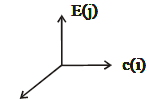
\(\therefore \overrightarrow{ B }(\hat{ k })\)\(\Rightarrow \overrightarrow{ B }= B _{0} \cos ( wt - kx ) \hat{ k }\)
Now put \(t=0\)
-
- (A) \(\mathrm{E}_{0} \mathrm{q}(-0.8 \hat{\mathrm{i}}+\hat{\mathrm{j}}+\hat{\mathrm{k}})\)
- (B) \(\mathrm{E}_{0} \mathrm{q}(0.8 \hat{\mathrm{i}}-\hat{\mathrm{j}}+0.4 \hat{\mathrm{k}})\)
- (C) \(\mathrm{E}_{0} \mathrm{q}(0.8 \hat{\mathrm{i}}+\hat{\mathrm{j}}+0.2 \hat{\mathrm{k}})\)
- (D) \(\mathrm{E}_{0} \mathrm{q}(0.4 \hat{\mathrm{i}}-3 \hat{\mathrm{j}}+0.8 \hat{\mathrm{k}})\)
Show answer and solution
Correct Answer: (C)
\(\overrightarrow{\mathrm{E}}_{1}=\mathrm{E}_{0} \mathrm{j} \cos (\omega \mathrm{t}-\mathrm{kx})\)Its corresponding magnetic field will be
\(\overrightarrow{\mathrm{B}}_{1}=\frac{\mathrm{E}_{0}}{\mathrm{c}} \hat{\mathrm{k}} \cos (\omega \mathrm{t}-\mathrm{kx})\)
\(\overrightarrow{\mathrm{E}}_{2}=\mathrm{E}_{0} \hat{\mathrm{k}} \cos (\omega \mathrm{t}-\mathrm{ky})\)
\(\overrightarrow{\mathrm{B}}_{2}=\frac{\mathrm{E}_{0}}{\mathrm{c}} \hat{\mathrm{i}} \cos (\omega \mathrm{t}-\mathrm{ky})\)
Net force on charge particle
\(=\mathrm{q} \overrightarrow{\mathrm{E}}_{1}+\mathrm{q} \overrightarrow{\mathrm{E}}_{2}+\mathrm{q} \overrightarrow{\mathrm{v}} \times \mathrm{B}_{1}+\mathrm{q} \overrightarrow{\mathrm{v}} \times \overrightarrow{\mathrm{B}}_{2}\)
\(=\mathrm{q} \mathrm{E}_{0} \hat{\mathrm{j}}+\mathrm{q} \mathrm{E}_{0} \hat{\mathrm{k}}+\mathrm{q}(0.8 \mathrm{c} \hat{\mathrm{j}}) \times\left(\frac{\mathrm{E}_{0}}{\mathrm{c}} \hat{\mathrm{k}}\right)+\mathrm{q}(0.8 \mathrm{c} \hat{\mathrm{j}}) \times\left(\frac{\mathrm{E}_{0}}{\mathrm{c}} \hat{\mathrm{i}}\right)\)
\(=\mathrm{q} \mathrm{E}_{0} \hat{\mathrm{j}}+\mathrm{q} \mathrm{E}_{0} \hat{\mathrm{k}}+0.8 \mathrm{q} \mathrm{E}_{0} \hat{\mathrm{i}}-0.8 \mathrm{q} \mathrm{E}_{0} \hat{\mathrm{k}}\)
\(\overrightarrow{\mathrm{F}}=\mathrm{q} \mathrm{E}_{0}[0.8 \hat{\mathrm{i}}+1 \hat{\mathrm{j}}+0.2 \hat{\mathrm{k}}]\)
-
- (A) \(\overrightarrow{ E }=-10^{-6} \sin [200 \pi( y + ct )] \hat{ k }\, \;V / m\)
- (B) \(\overrightarrow{ E }=-9 \sin [200 \pi( y + ct )] \hat{ k }\, \;V / m\)
- (C) \(\overrightarrow{ E }=9 \sin [200 \pi( y + ct )] \hat{ k }\, \;V / m\)
- (D) \(\overrightarrow{ E }=3 \times 10^{-8} \sin [200 \pi( y + ct )] \hat{ k }\, \;V / m\)
Show answer and solution
Correct Answer: (B)
\(\overrightarrow{ B }=3 \times 10^{-8} \sin [200 \pi( y + ct )] \hat{ i } T\)\(E _{0}= CB _{0} \Rightarrow E _{0}=3 \times 10^{8} \times 3 \times 10^{-8}\)
\(=9 V / m\)
and direction of wave propagation is given as
\((\overrightarrow{ E } \times \overrightarrow{ B }) \| \overrightarrow{ C }\)
\(\hat{ B }=\hat{ i } \quad \& \quad \hat{ C }=-\hat{ j }\)
so \(\hat{ E }=-\hat{ k }\)
\(\therefore \overrightarrow{ E }= E _{0} \sin [200 \pi( y + ct )](-\hat{ k }) V / m\)
-
- (A) \(0.1\)
- (B) \(5\)
- (C) \(1\)
- (D) \(1.5\)
Show answer and solution
Correct Answer: (C)
Intensity, \(I=3.3 Wm ^{-2}\)Area, \(A=3 \times 10^{-4} m ^{2}\)
Angular speed, \(\omega=31.4 rad / s\)
\(T=\frac{2 \pi}{\omega}\)
\(I = I _{0} \cos ^{2} \omega t\)
\(\because \cos ^{2} \theta =\frac{1}{2},\) in one time period
\(I=\frac{E}{A\cdot t}\)
\(\therefore\) Average energy \(=\frac{I_{0}}{2} \cdot \frac{2 \pi}{\omega} A=\frac{3.3 \times 3.14 \times 3 \times 10^{-4}}{31.4}=9.9 \times 10^{-5} \)
\(\approx 10 \times 10^{-5} \approx 1 \times 10^{-4} J\)
-
- (A) \(18.4\)
- (B) \(71.6\)
- (C) \(90\)
- (D) \(45\)
Show answer and solution
Correct Answer: (A)
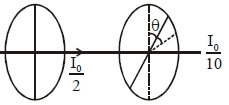
\(\frac{I_{0}}{10}=I=\frac{I_{0}}{2} \times \cos ^{2} \theta\)\(\cos \theta=\frac{1}{\sqrt{5}}\)
\(\theta=63.44^{\circ}\)
angle rotated \(=90-63.44^{\circ}=26.56^{\circ}\)
Closest is \(1\)
-
- (A) \(9\)
- (B) \(12\)
- (C) \(15\)
- (D) \(5\)
Show answer and solution
Correct Answer: (A)
\(I _{\max }= k\)\(I _{1}= I _{2}= K / 4\)
\(\Delta x =\lambda / 6 \Rightarrow \Delta \phi=\pi / 3\)
\(I = I _{1}+ I _{2}+2 \sqrt{ I _{1} I _{2}} \cos \phi\)
\(I =\frac{ K }{4}+\frac{ K }{4}+2 \times \frac{ K }{4} \frac{1}{2}\)
\(=\frac{ K }{2}+\frac{ K }{4}=\frac{3 K }{4}=\frac{9 K }{12}\)
\(n =9\)
-
- (A) \(0 : 1 : 4\)
- (B) \(4 : 1 : 0\)
- (C) \(0 : 1 : 2\)
- (D) \(2 : 1 : 0\)
Show answer and solution
Correct Answer: (D)
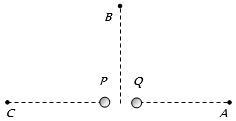
Since \(P\) is ahead of \(Q\) by \(90^\circ\) and path difference between \(P\) and \(Q\) is \(\lambda /4.\)Therefore at \(A\), phase difference is zero, so intensity is \(4I\). At \(C \) it is zero and at \(B\), the phase difference is \(90^\circ\), so intensity is \(2I.\) -
- (A) \(0.568\)
- (B) \(0.672\)
- (C) \(0.760\)
- (D) \(0.583\)
Show answer and solution
Correct Answer: (D)
\(I=I_{0} \cos ^{2}\left(\frac{\Delta \phi}{2}\right)\)\(\frac{I}{I_{0}}=\cos ^{2}\left(\frac{\Delta \phi}{2}\right)\)
\(\frac{I}{I_{0}}=\cos ^{2}\left(\frac{\frac{2 \pi}{\lambda} \times \frac{\lambda}{8}}{2}\right)\)
\(\frac{\mathrm{I}}{\mathrm{I}_{0}}=\cos ^{2}\left(\frac{\pi}{8}\right)\)
\(\frac{\mathrm{I}}{\mathrm{I}_{0}}=0.853\)
-
- (A) \(750\)
- (B) \(600\)
- (C) \(625\)
- (D) \(700\)
Show answer and solution
Correct Answer: (A)
The length of the screen used portion for \(15\) fringes, and also for ten fringes\(15 \times 500 \times \frac{D}{\lambda}=10 \times \frac{\lambda D}{\lambda}\)
\(15 \times 50=\lambda\)
\(\lambda=750 \mathrm{nm}\)
-
- (A) \(28\)
- (B) \(24\)
- (C) \(18\)
- (D) \(30\)
Show answer and solution
Correct Answer: (A)
Let the length of segment is " \(\ell^{\prime \prime}\)Let \(N\) is the no. of fringes in " \(\ell^{\prime \prime}\)
and \(w\) is fringe width.
\(\rightarrow\) We can write
\(N w =\ell\)
\(N \left(\frac{\lambda D }{ d }\right)=\ell\)
\(\frac{N_{1} \lambda_{1} D}{d}=\ell\)
\(\frac{ N _{2} \lambda_{2} D }{ d }=\ell\)
\(N _{1} \lambda_{1}= N _{2} \lambda_{2}\)
\(16 \times 700= N _{2} \times 400\)
\(N _{2}=28\)
-
- (A) \(0.07\)
- (B) \(0.17\)
- (C) \(1.7\)
- (D) \(0.57\)
Show answer and solution
Correct Answer: (D)
\(\Delta \theta_{0}=\left(\frac{\lambda}{ d } \times \frac{180}{\pi}\right)^{0}\)\(=0.57^{\circ}\)
-
- (A) \(6.9\)
- (B) \(5.9\)
- (C) \(4.9\)
- (D) \(3.9\)
Show answer and solution
Correct Answer: (B)
Finge width, \(\beta=\frac{\mathrm{D} \lambda}{\mathrm{d}}=\frac{1.5 \times 589 \times 10^{-9}}{0.15 \times 10^{-3}}\)\(=5.9 \times 10^{-3} \mathrm{m}\)
\(=5.9 \mathrm{mm}\)
-
- (A) \(1.27\)
- (B) \(2\)
- (C) \(2.87\)
- (D) \(2.05\)
Show answer and solution
Correct Answer: (A)
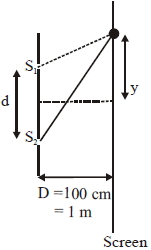
\(y=\frac{n D \lambda}{d}\)\(n=\frac{y d}{D \lambda}=\frac{1.27 \times 10^{-3} \times 10^{-3}}{1 \times 632.8 \times 10^{-9}}=2\)
Path difference \(\Delta x=n \lambda\)
\(=2 \times 632.8 nm\)
\(=1265.6 nm\)
\(=1.27 \mu m\)
-
- (A) \(198\)
- (B) \(156\)
- (C) \(147\)
- (D) \(187\)
Show answer and solution
Correct Answer: (A)
Condition for minimum,\(d \sin \theta= n \lambda\)
\(\therefore \sin \theta=\frac{n \lambda}{d}<1\)
\(n<\frac{d}{\lambda}=\frac{6 \times 10^{-5}}{6 \times 10^{-7}}=100\)
\(\therefore\) Total number of minima on one side \(=99\)
Total number of minima \(=198\)
Correct Answer is 1\(98\)
-
- (A) \(20\)
- (B) \(600\)
- (C) \(60\)
- (D) \(200\)
Show answer and solution
Correct Answer: (C)
Let distance is \(x\) then\(\mathrm{d} \theta=\frac{1.22 \lambda}{\mathrm{D}}(\mathrm{D}=\text { diameter })\)
\(\frac{\mathrm{x}}{\mathrm{d}}=\frac{1.22 \lambda}{\mathrm{D}}(\mathrm{d}=\text { distance between earth }\;and\; \text { moon })\)
\(\mathrm{x}=\frac{1.22 \times\left(5500 \times 10^{-10}\right) \times\left(4 \times 10^{8}\right)}{5}=53.68 \mathrm{m}\)
most appropriate is \(60 \mathrm{m}\)
-
- (A) \(12\)
- (B) \(3\)
- (C) \(5\)
- (D) \(2\)
Show answer and solution
Correct Answer: (B)
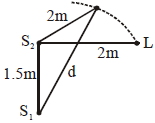
Initially \(S _{2} L =2 m\)\(S_{1} L=\sqrt{2^{2}+(3 / 2)^{2}}\)
\(S_{1} L=\frac{5}{2}=2.5 m\)
\(\Delta x =S_{1} L -S_{2} L =0.5 m\)
So since \(\lambda=1 m \quad \therefore \Delta x =\frac{\lambda}{2}\)
So while listener moves away from \(S_{1}\)
Then, \(\Delta x\left(=S_{1} L-S_{2} L\right)\) increases
and hence, at \(\Delta x=\lambda\) first maxima will appear. \(\Delta x=\lambda=S_{1} L-S_{2} L\)
\(1=d-2 \Rightarrow d=3 m\)
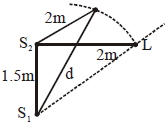
-
- (A) \(\frac{2 \pi}{\lambda}\left( n _{1} L _{1}- n _{2} L _{2}\right)\)
- (B) \(\frac{2 \pi}{\lambda}\left(\frac{ L _{2}}{ n _{1}}-\frac{ L _{1}}{ n _{2}}\right)\)
- (C) \(\frac{2 \pi}{\lambda}\left(\frac{ L _{1}}{ n _{1}}-\frac{ L _{2}}{ n _{2}}\right)\)
- (D) \(\frac{2 \pi}{\lambda}\left( n _{2} L _{1}- n _{1} L _{2}\right)\)
Show answer and solution
Correct Answer: (A)
\(\Delta p = n _{1} L _{1}- n _{2} L _{2}\)\(\Delta \phi=\frac{2 \pi}{\lambda} \Delta p\)
-
- (A) \(20\)
- (B) \(45\)
- (C) \(30\)
- (D) \(25\)
Show answer and solution
Correct Answer: (D)
\(\sin \theta=\frac{2 \lambda}{\omega}\)\(\sin 60^{\circ}=\frac{2 \lambda}{\omega}\)
\(\sin \theta_{1}=\frac{\lambda}{\omega}=\frac{\sqrt{3}}{4}\)
\(\theta_{1}=25^{\circ}\)
-
- (A) \(50\)
- (B) \(55\)
- (C) \(60\)
- (D) \(62\)
Show answer and solution
Correct Answer: (A)
Final image at \(\infty\)\(\Rightarrow\) obj. for eye piece at \(5 cm\)
\(\Rightarrow\) image for objective at \(5 cm\)
\(\frac{1}{v}-\frac{1}{u}=\frac{1}{f}\)
\(\frac{1}{5}+\frac{1}{x}=1\)
\(\frac{1}{x}=1-\frac{1}{5}=\frac{4}{5} \Rightarrow x=\frac{5}{4}\)
-
- (A) \(0.5\)
- (B) \(2\)
- (C) \(1.5\)
- (D) \(0.33\)
Show answer and solution
Correct Answer: (D)
\(R _{1}= R _{2}= R\)Power \((P)\)
Refractive index is assume \(\left(\mu_{\ell}\right)\)
\(P =\frac{1}{ f }=\left(\mu_{\ell}-1\right)\left(\frac{2}{ R }\right)\) \(...(i)\)
\(P ^{\prime}=\frac{1}{ f ^{\prime}}=\left(\mu_{\ell}-1\right)\left(\frac{1}{ R ^{\prime}}\right)\)\(....(ii)\)
\(P ^{\prime}=\frac{3}{2} P\)
\(\left(\mu_{\ell}-1\right)\left(\frac{1}{ R ^{\prime}}\right)=\mu \frac{3}{2}\left(\mu_{\ell}-1\right)\left(\frac{2}{ R }\right)\)
\(\therefore \quad R ^{\prime}=\frac{ R }{3}\)

-
- (A) \(85\)
- (B) \(90\)
- (C) \(80\)
- (D) \(75\)
Show answer and solution
Correct Answer: (B)
By Snell's law at \(A\)\(1 \times \sin 60^{\circ}=\sqrt{3} \times \sin \theta\)
\(\frac{\sqrt{3}}{2}=\sqrt{3} \sin \theta\)
\(\sin \theta=\frac{1}{2} \Rightarrow \theta=30^{\circ}\)
So at \(B:\)
\(\theta+60^{\circ}+\alpha=180^{\circ}\)
\(30^{\circ}+60^{\circ}+\alpha=180^{\circ}\)
\(\alpha=90^{\circ}\)
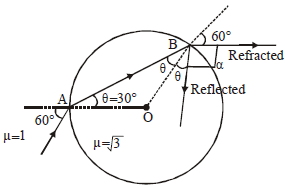
-
- (A) \(1\, m\) from the mirror, virtual
- (B) \(1\, m\) from the mirror, real
- (C) \(2.6\, m\) from the mirror, real
- (D) \(2.6\, m\) from the mirror, virtual
Show answer and solution
Correct Answer: (C)
Object is at \(2 f\). So image will also be at \(2 f\).\(\left( I _{1}\right)\)
Image of \(I_{1}\) will be \(1\, m\) behind mirror.
i.e. \(\Rightarrow I _{2}\)
Now \(I \)\(_{2}\) will be object for lens.
\(\therefore u \Rightarrow-3 m\)
\(f \Rightarrow+0.5 m\)
\(\frac{1}{v} \Rightarrow \frac{1}{f}+\frac{1}{u}\)
\(\Rightarrow \frac{1}{+0.5}+\frac{1}{-3}\)
\(v \Rightarrow \frac{3}{5} \Rightarrow 0.6 m\)
So total distance from mirror \(\Rightarrow 2+0.6\)
\(\Rightarrow 2.6 m\) and real image
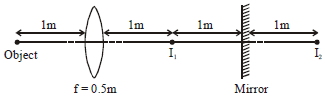
-
- (A) \(58\)
- (B) \(62\)
- (C) \(60\)
- (D) \(67\)
Show answer and solution
Correct Answer: (C)
Using Lens-Maker's formula\(\frac{1}{f}=(\mu-1)\left(\frac{1}{R_{1}}-\frac{1}{R_{2}}\right)\)
\(\Rightarrow \frac{1}{f}=(1.5-1)\left(\frac{1}{30}-0\right)\)
\(\mathrm{f}=60 \mathrm{cm}\)
-
- (A) \(5\)
- (B) \(8\)
- (C) \(10\)
- (D) \(15\)
Show answer and solution
Correct Answer: (A)
\(\delta_{\min }=(\mu-1) A\)\(=(1.5-1) 1\)
\(=0.5\)
\(\delta_{\min }=\frac{5}{10}\)
\(N=5\)
-
- (A) Inverted, real and magnified
- (B) Erect, virtual and magnified
- (C) Erect, virtual and unmagnified
- (D) Inverted, real and unmagnified
Show answer and solution
Correct Answer: (D)
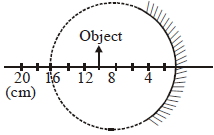
\(f =\frac{-8}{2}=-4 cm\)\(u =-10 cm\)
\(v=?\)
as \(\frac{1}{v}+\frac{1}{u}=\frac{1}{f}\)
\(\frac{1}{v}+\left(\frac{1}{-10}\right)=\frac{1}{-4}\)
\(\frac{1}{v}=\frac{1}{10}-\frac{1}{4}\)
\(\frac{1}{v}=\frac{4-10}{40}\)
\(v=\frac{40}{-6}\)
\(V =\frac{-20}{3}\)
\(m =\frac{- V }{ u }\)
\(m=\frac{-\left(-\frac{20}{3}\right)}{-10} \Rightarrow m=\frac{-2}{3}\)
or image will be real, inverted and unmagnified.
-
- (A) \(1\)
- (B) \(5\)
- (C) \(9\)
- (D) \(17\)
Show answer and solution
Correct Answer: (C)
Using \(\frac{1}{f}=\left(\frac{\mu_{2}}{\mu_{1}}-1\right)\left(\frac{1}{R_{1}}-\frac{1}{R_{2}}\right)\)\(\frac{1}{f}=\left(\frac{1.5}{1}-1\right)\left(\frac{1}{R_{1}}-\frac{1}{R_{2}}\right)\dots ( 1)\)
and \(\frac{1}{f_{l}}=\left(\frac{1.5}{1.42}-1\right)\left(\frac{1}{R_{1}}-\frac{1}{R_{2}}\right)\dots (2)\)
equation \((1) /(2)\)
we get \(\frac{f_{ળ}}{f}=\frac{0.5}{0.056}\)
\(=8.93 \approx 9\)

No questions on this page match these filters.