


Questions
15 questionsShowing 1–15 of 15 questions
-
- (A) \(20\)
- (B) \(30\)
- (C) \(26\)
- (D) \(15\)
Show answer and solution
Correct Answer: (D)
\(r=0.1 m \quad \frac{ T }{2}=0.2 sec\)\(B =3 \times 10^{-5} m \quad T =0.4 sec\)
At any time
\(flux \phi= BA \cos \omega t\)
\(| emf |=\left|\frac{ d \phi}{ dt }\right|=| BA \omega \sin \omega t |\)
\(( emf )_{\max }= BA \omega= BA \quad \frac{2 \pi}{ T }\)
\(=\frac{3 \times 10^{-5} \times \pi \times(0.1)^{2} \times 2 \pi}{0.4}\)
\(=\frac{6 \pi^{2}}{4} \times 10^{-6}\) \(\left(\begin{array}{c}\pi^{2}=10 \text { take }\end{array}\right)\)
\(=15 \times 10^{-6}\)
\(=15 \mu V\)
-
- (A) At \(t=0.5\) direction of \(I_{R}\) reverses and \(V_{R}\) is zero
- (B) Direction of \(I_R\) remains unchanged and \(\mathrm { V } _ { \mathrm { R } }\) is zero at \(t=0.25\)
- (C) Direction of \(I_R\) remains unchanged and \(V_R \) is maximum at \(t=0.5\)
- (D) At \(t=0.25\) direction of \(I_{R}\) reverses and \(V_{R}\) is maximum
Show answer and solution
Correct Answer: (A)
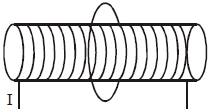
Magnetic flux ( \(\phi\) ) through ring is \(\phi=\pi(R)^{2} . B\)\(\phi=\left(\pi \mathrm{R}^{2}\right)\left(\mu_{0} \mathrm{n} \mathrm{I}\right)=\left(\pi \mathrm{R}^{2} \mu_{0} \mathrm{n} \mathrm{I}_{0}\right)\left(\mathrm{t}-\mathrm{t}^{2}\right)\)
Induced e.m.f. of \(\mathrm{V}_{\mathrm{R}}=\frac{-\mathrm{d} \phi}{\mathrm{dt}}\)
\(=\left(\pi \mathrm{R}^{2} \mu_{0} \mathrm{nI}_{0}\right)(2 \mathrm{t}-1)\)
and induced current \(\mathrm{I}_{\mathrm{R}}=\frac{\pi \mathrm{R}^{2} \mu_{0} \mathrm{nI}_{0}(2 \mathrm{t}-1)}{\mathrm{R}_{\mathrm{R}}}\)
\(\left(\mathrm{R}_{\mathrm{R}} \rightarrow \text { Resistance of Ring }\right)\)
Clearly \(\mathrm{V}_{\mathrm{R}}\) and \(\mathrm{I}_{\mathrm{R}}\) are zero at \(\mathrm{t}=\frac{1}{2}=0.5 \mathrm{sec}\)
and their sign also changes at \(t=0.5\) sec.
-
- (A) \(169\)
- (B) \(200\)
- (C) \(196\)
- (D) \(175\)
Show answer and solution
Correct Answer: (D)
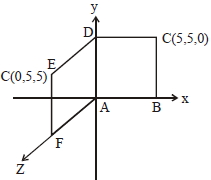
\(\overrightarrow{\mathrm{A}}_{\mathrm{ABCD}}=25 \hat{\mathrm{k}}\)\(\overrightarrow{\mathrm{A}}_{\mathrm{ADEF}}=25 \hat{\mathrm{i}}\)
\(\overrightarrow{\mathrm{A}}_{\mathrm{net}}=25 \hat{\mathrm{i}}+25 \hat{\mathrm{k}}\)
\(\overrightarrow{\mathrm{B}}=3 \hat{\mathrm{i}}+4 \hat{\mathrm{k}}\)
\(\phi=\overrightarrow{\mathrm{B}} \cdot \overrightarrow{\mathrm{A}}\)
\(=25 \times 3+25 \times 4\)
\(\phi=175 \mathrm{W}{\mathrm{b}}\)
-
- (A) \(33\)
- (B) \(28\)
- (C) \(38\)
- (D) \(23\)
Show answer and solution
Correct Answer: (A)
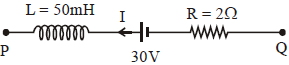
\(\frac{ L di }{ dt }=5\)\(V _{ P }-5-30+2 \times 1= VQ\)
\(V _{ P }- V _{ Q }=33\) volt

-
- (A) \(2.5\; s\) and \(7.5 \;s\)
- (B) \(5.0\; s\) and \(7.5 \;s\)
- (C) \(5.0\; s\) and \(10.0 \;s\)
- (D) \(2.5\; s\) and \(5.0 \;s\)
Show answer and solution
Correct Answer: (D)
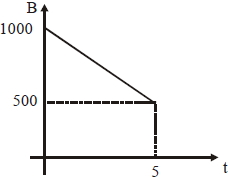
\(\operatorname{Fiux} \phi=\overline{B} \cdot \overline{A}=\mathbf{B A} \cos \theta=\mathbf{B A} \cos \omega t\)\(|\) Induced emf \(|=| \mathrm{e}|=| \frac{\mathrm{d} \phi}{\mathrm{dt}}|=| \mathrm{BA} \omega \sin \omega t |\)
le \(|\) will be maximum at \(\omega t=\frac{\pi}{2}\)
\(\left(\frac{2 \pi}{\mathrm{T}}\right) \mathrm{t}=\frac{\pi}{2}\)
\(\left(\frac{2 \pi}{10}\right) \mathrm{t}=\frac{\pi}{2} \Rightarrow \mathrm{t}=2.5 \mathrm{sec}\)
\(|\mathrm{e}|\) will be minimum at \(\omega \mathrm{t}=\pi\)
\(\left(\frac{2 \pi}{10}\right) t=\pi \Rightarrow t=5 \sec\)
-
- (A) \(\frac{ L }{ R } \ln \left(\frac{\sqrt{ n }-1}{\sqrt{ n }}\right)\)
- (B) \(\frac{ L }{ R } \ln \left(\frac{\sqrt{ n }}{\sqrt{ n }+1}\right)\)
- (C) \(\frac{ L }{ R } \ln \left(\frac{\sqrt{ n }}{\sqrt{ n -1}}\right)\)
- (D) \(\frac{ L }{ R } \ln \left(\frac{\sqrt{ n }+1}{\sqrt{ n }-1}\right)\)
Show answer and solution
Correct Answer: (C)
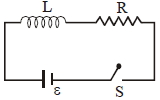
\(U _{\max }=\frac{1}{2} L I _{ max }^{2}\)\(i = I _{\max }\left(1- e ^{- Rt / L }\right)\)
For \(U\) to be \(\frac{ U _{\max }}{ n } ;\) i has to be \(\frac{ I _{ max }}{\sqrt{ n }}\)
\(\frac{I_{\max }}{\sqrt{n}}=I_{\max }\left(1-e^{-R t / L}\right)\)
\(e ^{- Rt / L }=1-\frac{1}{\sqrt{ n }}=\frac{\sqrt{ n }-1}{\sqrt{ n }}\)
\(-\frac{ Rt }{ L }=\ln \left(\frac{\sqrt{ n }-1}{\sqrt{ n }}\right)\)
\(t =\frac{ L }{ R } \ln \left(\frac{\sqrt{ n }}{\sqrt{ n }-1}\right)\)
-
- (A) \(\frac{\varepsilon \mathrm{L}}{\mathrm{R}^{2}}\left(1-\frac{1}{\mathrm{e}}\right)\)
- (B) \(\frac{\varepsilon \mathrm{R}}{\mathrm{e} \mathrm{L}^{2}}\)
- (C) \(\frac{\varepsilon \mathrm{I}}{\mathrm{R}^{2}}\)
- (D) \(\frac{\varepsilon \mathrm{I}}{\mathrm{e} \mathrm{R}^{2}}\)
Show answer and solution
Correct Answer: (D)
\(\mathrm{i}=\mathrm{i}_{0}\left(1-\mathrm{e}^{-\mathrm{R}t / \mathrm{L}}\right)=\mathrm{i}_{0}\left(1-\mathrm{e}^{-t / T_{\mathrm{C}}}\right)\)\(\mathrm{q}=\int_{0}^{\mathrm{T}_{\mathrm{C}}} \mathrm{i} \mathrm{dt}\)
\(=\int_{0}^{T_{c}} \frac{\varepsilon}{R}\left(1-e^{-t / T_{c}}\right)\)
\(=\left.\frac{\varepsilon}{R}\left(t-\frac{e^{-t / T_{c}}}{-1 / T_{c}}\right)\right|_{0} ^{T_{c}}\)
\(=\frac{e}{R}\left(T_{c}-T_{c} e^{-1}\right)-\frac{e}{R}\left(0+T_{c}\right)\)
\(\mathrm{q}=\frac{\mathrm{e}}{\mathrm{R}} \times \mathrm{T}_{\mathrm{C}} \mathrm{e}^{-1}\)
\(=\frac{\varepsilon}{\mathrm{R}} \times \frac{\mathrm{L}}{\mathrm{R}} \frac{1}{\mathrm{e}}\)
\(=\frac{\varepsilon \mathrm{L}}{\mathrm{e} \mathrm{R}^{2}}\)
-
- (A) \(0.61\)
- (B) \(0.34\)
- (C) \(0.43\)
- (D) \(0.53\)
Show answer and solution
Correct Answer: (A)
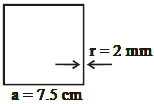
\(q _{ i }=\frac{ d \left( Ba ^{2}\right)}{ dt }= a ^{2} \frac{ dB }{ dt }\)\(i =\frac{ q }{ R }=\frac{ a ^{2} d B / dt }{\frac{\rho(40)}{\pi r ^{2}}}\)
-
- (A) \(\frac{\pi^{2} a ^{2} b ^{2} B ^{2} \omega^{2}}{2 R }\)
- (B) Zero
- (C) \(\frac{\pi^{2} a^{2} b^{2} B^{2} \omega^{2}}{R}\)
- (D) \(\frac{\pi abB \omega}{ R }\)
Show answer and solution
Correct Answer: (A)
\(\in= NAB \omega \cos \omega t \quad[ N =1]\)\(P _{ avg }=<\frac{\epsilon^{2}}{ R }>=<\frac{( AB \omega \cos \omega t )^{2}}{ R }>\)
\(=\frac{ A ^{2} B ^{2} \omega^{2}}{ R } \frac{1}{2}=\frac{\pi^{2} a ^{2} b ^{2} B ^{2} \omega^{2}}{2 R }\)
-
- (A) \(1.06\)
- (B) \(1.15\)
- (C) \(1.46\)
- (D) \(0.84\)
Show answer and solution
Correct Answer: (B)
\(\mathrm{i}=\mathrm{i}_{0}\left(1-\mathrm{e}^{-\mathrm{R}t/ \mathrm{L}}\right)\)\(\frac{\mathrm{i}_{0}}{\mathrm{i}}=\frac{1}{1-\mathrm{e}^{-2 \times 10^{4}}}\)
\(\frac{i_{0}}{i}=1\)
-
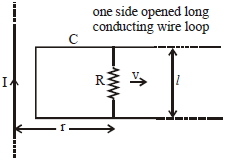
- (A) \(\frac{\mu_{0}}{\pi} \frac{ Iv l}{ Rr }\)
- (B) \(\frac{\mu_{0}}{2 \pi} \frac{ Ivl }{ Rr }\)
- (C) \(\frac{2 \mu_{0}}{\pi} \frac{ Ivl }{ Rr }\)
- (D) \(\frac{\mu_{0}}{4 \pi} \frac{ Iv l}{ Rr }\)
Show answer and solution
Correct Answer: (B)
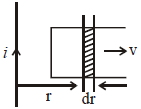
\(B =\frac{\mu_{0} i }{2 \pi r }\)\(\phi=\frac{\mu_{0} i }{2 \pi r } \ell dr\)
\(\Rightarrow \frac{ d \phi}{ dt }=\frac{\mu_{0} i \ell}{2 \pi r } \cdot \frac{ dr }{ dt }\)
\(\Rightarrow e =\frac{\mu_{0}}{2 \pi} \cdot \frac{ iv \ell}{ r }\)
\(i =\frac{ e }{ R }=\frac{\mu_{0}}{2 \pi} \cdot \frac{ iv \ell}{ Rr }\)
-
- (A) \(36\)
- (B) \(48\)
- (C) \(56\)
- (D) \(28\)
Show answer and solution
Correct Answer: (C)
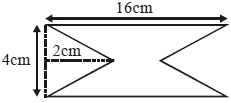
\(\frac{\mathrm{dB}}{\mathrm{dt}}=100\)\(A=16 \times 4-4 \times 2=56 \mathrm{cm}^{2}\)
\(\varepsilon=\frac{\mathrm{d} \mathrm{B}}{\mathrm{dt}} \mathrm{A}=100 \times 10^{-4} \times 56 \times 10^{-4}\)
-
- (A) \(\phi_{i}=-\phi_{0}\)
- (B) \(\phi_{i}=\phi_{0}\)
- (C) \(\phi_{i} < \phi_{0}\)
- (D) \(\phi_{i} > \phi_{0}\)
Show answer and solution
Correct Answer: (A)
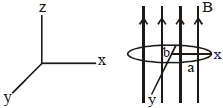
As current is flowing in the circular coil. The magnetic field in the region of the circular coil area is maximum than in the area of plane excluding the circular coil.\(\Phi=\text { flux }=\vec{B} \cdot \vec{A}\)
\(\because \overrightarrow{ B }_{0}>\overrightarrow{ B }_{ i }\)
\(\Phi_{0}=\overrightarrow{ Bo } \cdot \overrightarrow{ A }\)
\(\Phi_{i}=\vec{B}_{i} \cdot \vec{A}\)
Magnetic field B in the circular region is more than outside \(\because \overrightarrow{ B }_{0}>\overrightarrow{ B }_{ i }\)
\(\therefore \Phi_{0}>\Phi_{ i }\)
-
- (A) \(15\)
- (B) \(10\)
- (C) \(20\)
- (D) \(25\)
Show answer and solution
Correct Answer: (B)
\(\mathrm{V}=\left|\mathrm{L} \frac{\mathrm{di}}{\mathrm{dt}}\right|\)\(\Rightarrow \mathrm{L}=\frac{\mathrm{V}}{\left|\frac{\mathrm{di}}{\mathrm{dt}}\right|}=\cfrac{100}{\frac{0.25}{0.025 \times 10^{-3}}}=10 \mathrm{mH}\)
-
- (A) \(5\)
- (B) \(8\)
- (C) \(10\)
- (D) \(12\)
Show answer and solution
Correct Answer: (A)
\(B =\frac{\mu_{0} NI }{2 R }\)\(\phi=\frac{\mu_{0} NN ^{\prime} I }{2 R } \pi r ^{2}\)
\(\varepsilon=\frac{ d \phi}{ dt }=\frac{2 \pi \times 10^{-7} \times 10^{5} \times \pi \times 10^{-4}}{0.2}\)
\(=8 \times 10^{-4}=0.8 mV\)

No questions on this page match these filters.