


All JEE Mains 2020 Physics questions
31 chaptersShowing 351–400 of 401 questions
-
- (A) \(\frac{2 m \omega^{2}}{k}\)
- (B) \(\frac{m \omega^{2}}{3 k}\)
- (C) \(\sqrt{\frac{2}{3}}\left(\frac{\mathrm{m} \omega^{2}}{\mathrm{k}}\right)\)
- (D) \(\frac{m \omega^{2}}{k}\)
Show answer and solution
Correct Answer: (D)
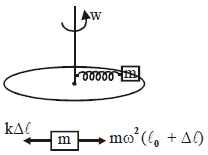
\(\mathrm{k} \Delta \ell=\mathrm{m} \omega^{2}\left(\ell_{0}+\Delta \ell\right)\)\(\Delta \ell=\frac{m \omega^{2} \ell_{0}}{k-m \omega^{2}} \approx \frac{m \omega \ell_{0}}{k}\)
\(\frac{\Delta \ell}{\ell_{0}}=\) Relative change \(=\frac{\mathrm{m} \omega^{2}}{\mathrm{k}}\)
-
- (A) \(60\)
- (B) \(15\)
- (C) \(-45\)
- (D) \(105\)
Show answer and solution
Correct Answer: (D)
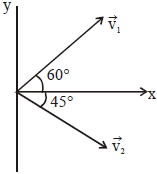
\(\overrightarrow{ v }_{01}=(\sqrt{3 \hat{ i }}+\hat{ j }) m / s\)\(\overrightarrow{ v }_{02}=\overrightarrow{0}\)
\(m _{1}=2 m _{2}\)
After collision, \(\overrightarrow{ v }_{1}=(\hat{ i }+\sqrt{3} \hat{ j }) m / s\)
\(\overrightarrow{ v }_{2}=?\)
Applying conservation of linear momentum,
\(m _{1} \overrightarrow{ v }_{01}+ m _{2} \overrightarrow{ v }_{0 2}= m _{1} \overrightarrow{ v }_{1}+ m _{2} \overrightarrow{ v }_{2}\)
\(2 m_{2}(\sqrt{3 \hat{i}}+\hat{j})+0=2 m_{2}(\hat{i}+\sqrt{3} \hat{j})+m_{2} \vec{v}_{2}\)
\(\overrightarrow{ v }_{2}=2(\sqrt{3 \hat{ i }}+\hat{ j })-2(\hat{ i }+\sqrt{3} \hat{ j })\)
\(=2(\sqrt{3 \hat{1}}-\hat{j})+2(\hat{i}-\sqrt{3} \hat{j})\)
\(\overrightarrow{ v }_{2}=2(\sqrt{3}-1)(\hat{ i }-\hat{ j })\)
for angle between \(\overrightarrow{ v }_{1} \& \overrightarrow{ v }_{2}\)
\(\cos \theta=\frac{\overrightarrow{ v }_{1} \cdot \overrightarrow{ v }_{2}}{\overrightarrow{ v }_{1} \overrightarrow{ v }_{2}}=\frac{2(\sqrt{3}-1)(1-\sqrt{3})}{2 \times 2 \sqrt{2}(\sqrt{3}-1)}\)
\(\cos \theta=\frac{1-\sqrt{3}}{2 \sqrt{2}} \Rightarrow \theta=105^{\circ}\)
-
- (A) \(1\)
- (B) \(2\)
- (C) \(\frac{1}{\sqrt{2}}\)
- (D) \(\sqrt{2}\)
Show answer and solution
Correct Answer: (C)
\(V_{\text {orbit }}=\sqrt{\frac{G M}{R}}\)\(V_{\text {escape }}=\sqrt{\frac{2 G M}{R}}\)
\(\frac{V_{\text {orbit }}}{V_{\text {escape }}}=\frac{1}{\sqrt{2}}\)
-
- (A) \(195.66\)
- (B) \(194.66\)
- (C) \(194.32\)
- (D) \(195.32\)
Show answer and solution
Correct Answer: (D)
at equater\(\mathrm{W}=mg-\mathrm{m} \omega^{2} \mathrm{R}\)\(=196-(19.6)\left[\frac{2 \pi}{24 \times 3600}\right]^{2} \times 6400 \times 10^{3}\)
\(=195.33 \mathrm{N}\)
-
- (A) \(1:6\)
- (B) \(3:4\)
- (C) \(1:3\)
- (D) \(1:2\)
Show answer and solution
Correct Answer: (A)
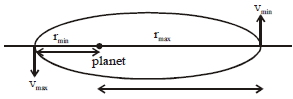
By angular momentum conservation\(r _{\min } V _{\max }= r _{\max } V _{\min } \quad \ldots( i )\)
Given \(V _{\min }=\frac{ V _{ max }}{6}\)
from equation \((i)\)
\(\frac{r_{\min }}{r_{\max }}=\frac{V_{\min }}{V_{\max }}=\frac{1}{6}\)
-
- (A) \(4\)
- (B) \(3\)
- (C) \(2\)
- (D) \(2.5\)
Show answer and solution
Correct Answer: (B)
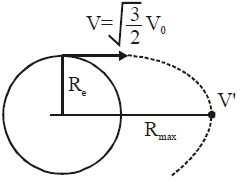
\(V _{0}=\sqrt{\frac{ GM }{ R _{ e }}}\)\(\frac{- GMm }{ R _{ e }}+\frac{1}{2} mv ^{2}=\frac{- GMm }{ R _{ max }}+\frac{1}{2} mv ^{\prime 2}\)\(...(i)\)
\(VR _{ e }= V ^{\prime} R _{\max }\)\(...(ii)\)
Solving \((i)\) \(\&\) \((ii)\)
\(R _{ max }=3 R _{e}\)
-
- (A) \(\frac{\mathrm{m}}{20}\left(\mathrm{u}-\sqrt{\frac{2 \mathrm{GM}}{3 \mathrm{R}}}\right)^{2}\)
- (B) \(5 \mathrm{m}\left(\mathrm{u}^{2}-\frac{119}{200} \frac{\mathrm{GM}}{\mathrm{R}}\right)\)
- (C) \(\frac{3 m}{8}\left(u+\sqrt{\frac{5 G M}{6 R}}\right)^{2}\)
- (D) \(\frac{m}{20}\left(u^{2}+\frac{113}{200} \frac{G M}{R}\right)\)
Show answer and solution
Correct Answer: (B)
Applying energy conservationApplying energy conservation
\({\mathrm{K}_{1}+\mathrm{U}_{\mathrm{i}}=\mathrm{K}_{\mathrm{f}}+\mathrm{U}_{\mathrm{f}}}\)
\({\frac{1}{2} \mathrm{mu}^{2}+\left(-\frac{\mathrm{GMm}}{\mathrm{R}}\right)=\frac{1}{2} \mathrm{mv}^{2}-\frac{\mathrm{GMm}}{2 \mathrm{R}}}\)
\(\mathrm{v}=\sqrt{\mathrm{u}^{2}-\frac{\mathrm{GM}}{\mathrm{R}}}\)
By momentum conservation, we have
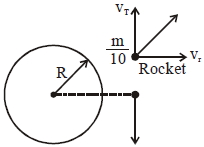
\(\frac{\mathrm{m}}{10} \mathrm{v}_{\mathrm{T}}=\frac{9 \mathrm{m}}{10} \sqrt{\frac{\mathrm{GM}}{2 \mathrm{R}}}\)
and \(\frac{\mathrm{m}}{10} \mathrm{v}_{\mathrm{r}}=\mathrm{mv}\)
\(\Rightarrow \frac{\mathrm{m}}{10} \mathrm{v}_{\mathrm{r}}=\mathrm{m} \sqrt{\mathrm{u}^{2}-\frac{\mathrm{GM}}{\mathrm{R}}}\)
Kinetic energy of rocket
\({=\frac{1}{2} \mathrm{m}\left(\mathrm{v}_{\mathrm{T}}^{2}+\mathrm{v}_{\mathrm{r}}^{2}\right)}\)
\({=\frac{\mathrm{m}}{20}\left(81 \frac{\mathrm{GM}}{2 \mathrm{R}}+100 \mathrm{u}^{2}-100 \frac{\mathrm{GM}}{\mathrm{R}}\right)}\)
\({=\frac{\mathrm{m}}{20}\left(100 \mathrm{u}^{2}-\frac{119 \mathrm{GM}}{2 \mathrm{R}}\right)}\)
\({=5 \mathrm{m}\left(\mathrm{u}^{2}-\frac{119 \mathrm{GM}}{200 \mathrm{R}}\right)}\)
-
- (A) \(20\)
- (B) \(24\)
- (C) \(14\)
- (D) \(16\)
Show answer and solution
Correct Answer: (D)
\(\mathrm{U}_{1}+\mathrm{K}_{1}=\mathrm{U}_{2}+\mathrm{K}_{2}\)\(-\frac{\mathrm{GM}_{\mathrm{e}} \mathrm{m}}{10 \mathrm{R}}+\frac{1}{2} \mathrm{mv}_{0}^{2}=-\frac{\mathrm{GM}_{\mathrm{e}} \mathrm{m}}{\mathrm{R}}+\frac{1}{2} \mathrm{mv}^{2}\)
\(+\frac{9}{10} \times \frac{\mathrm{GM}_{\mathrm{e}} \mathrm{m}}{\mathrm{R}}+\frac{1}{2} \mathrm{mv}_{0}^{2}=\frac{1}{2} \mathrm{mv}^{2}\)
\(\frac{9}{10} \times \frac{1}{2} \mathrm{M} \times \mathrm{v}_{\mathrm{e}}^{2}+\frac{1}{2} \mathrm{mv}_{0}^{2}=\frac{1}{2} \mathrm{mv}^{2}\)
\(\mathrm{v}^{2}=\frac{9}{10} \mathrm{v}_{e}^{2}+\mathrm{v}_{0}^{2}\)
\(=\frac{9}{10} \times(11.2)^{2}+(12)^{2}\)
\(\mathrm{v}^{2}=112.896+144\)
\(\mathrm{v}=16.027\)
\(\mathrm{v}=16 \mathrm{km} / \mathrm{s}\)
-
- (A) \(\frac{1}{2}\)
- (B) \(\frac{2}{3}\)
- (C) \(\frac{1}{3}\)
- (D) \(\frac{1}{6}\)
Show answer and solution
Correct Answer: (D)
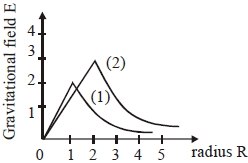
Gravitational field on the surface of a solid sphere \(I_{g}=\frac{G M}{R^{2}}\)By the graph
\(\frac{\mathrm{GM}_{1}}{(1)^{2}}=2\)
and \(\frac{\mathrm{GM}_{2}}{(2)^{2}}=3\)
On solving
\(\frac{\mathrm{M}_{1}}{\mathrm{M}_{2}}=\frac{1}{6}\)
-
- (A) \(\frac{A}{\left(x^{2}+a^{2}\right)^{1 / 2}}\)
- (B) \(\frac{A}{\left(x^{2}+a^{2}\right)^{3 / 2}}\)
- (C) \(A \left( x ^{2}+ a ^{2}\right)^{3 / 2}\)
- (D) \(A\left(x^{2}+a^{2}\right)^{1 / 2}\)
Show answer and solution
Correct Answer: (A)
Given \(E _{ G }=\frac{ Ax }{\left( x ^{2}+ a ^{2}\right)^{3 / 2}}, V _{\infty}=0\)\(\int_{V_{\infty}}^{V_{x}} d V=-\int_{\infty}^{x} \vec{E}_{G} \cdot \vec{d}_{x}\)
\(V _{ x }- V _{\infty}=-\int_{\infty}^{ x } \frac{ Ax }{\left( x ^{2}+ a ^{2}\right)^{3 / 2}} d x\)
put \(x^{2}+a^{2}=z\)
\(2 x dx = dz\)
\(V_{x}-0=-\int_{\infty}^{x} \frac{A d z}{2(z)^{3 / 2}}=\left[\frac{A}{z^{1 / 2}}\right]_{\infty}^{x}=\left[\frac{A}{\left(x^{2}+a^{2}\right)^{1 / 2}}\right]_{\infty}^{x}\)
\(V_{x}=\frac{A}{\left(x^{2}+a^{2}\right)^{1 / 2}}-0=\frac{A}{\left(x^{2}+a^{2}\right)^{1 / 2}}\)
-
- (A) \(4\)
- (B) \(1\)
- (C) \(2\)
- (D) \(3\)
Show answer and solution
Correct Answer: (A)
\(\mathrm{V}_{\mathrm{e}}=\sqrt{\frac{2 \mathrm{GM}}{\mathrm{R}}}\) (Escape velocity)\(V_{A}=\sqrt{\frac{2 G M}{R}}\)
\(V_{B}=\sqrt{\frac{2 G[M / 2]}{R / 2}}=\sqrt{\frac{2 G M}{R}}\)
\(\frac{\mathrm{V}_{\mathrm{A}}}{\mathrm{V}_{\mathrm{B}}}=1=\frac{\mathrm{n}}{4} \Rightarrow \mathrm{n}=4\)
-
- (A) \(\frac{ R ^{2} \omega^{2}}{8 g }\)
- (B) \(\frac{ R ^{2} \omega^{2}}{4 g }\)
- (C) \(\frac{ R ^{2} \omega^{2}}{ g }\)
- (D) \(\frac{ R ^{2} \omega^{2}}{2 g }\)
Show answer and solution
Correct Answer: (D)
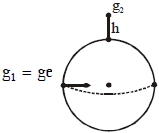
\(g _{ e }= g - R \omega^{2}\)\(g_{2}=g\left(1-\frac{2 h}{R}\right)\)
\(g_{2}=g-\frac{2 g h}{R}\)
Now \(R \omega^{2}=\frac{2 g h}{R}\)
\(h=\frac{R^{2} \omega^{2}}{2 g}\)
-
- (A) \(\frac{\sqrt{5} R - R }{2}\)
- (B) \(\frac{\sqrt{5}}{2} R - R\)
- (C) \(\frac{ R }{2}\)
- (D) \(\frac{\sqrt{3} R - R }{2}\)
Show answer and solution
Correct Answer: (A)
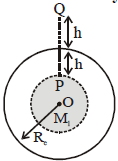
\(M =\) mass of earth\(M _{1}= mass\) of shaded portion
\(R =\) Radius of earth
\(M_{1}=\frac{M}{\frac{4}{3} \pi R^{3}} \cdot \frac{4}{3} \pi(R-h)^{3}\)
\(=\frac{M(R-h)^{3}}{R}\)
Weight of body is same at \(P\) and \(Q\)
i.e. \(mg _{ P }= mg _{ Q }\)
\(g _{ P }= g _{ Q }\)
\(\frac{G M_{1}}{(R-h)^{2}}=\frac{G M}{(R+h)^{2}}\)
\(\frac{G M(R-h)^{3}}{(R-h)^{2} R^{3}}=\frac{G M}{(R+h)^{2}}\)
\(( R - h )( R + h )^{2}= R ^{3}\)
\(R^{3}-h R^{2}-h^{2} R-h^{3}+2 R^{2} h-2 R h^{2}=R^{3}\)
\(R^{2}-R h^{2}-h^{3}=0\)
\(R^{2}-R h-h^{2}=0\)
\(h ^{2}+ Rh - R ^{2}=0 \Rightarrow h =\frac{- R \pm \sqrt{ R ^{2}+4 R ^{2}}}{2}\)
ie \(h =\frac{- R +\sqrt{5} R }{2}=\left(\frac{\sqrt{5}-1}{2}\right) R\)
-
- (A) \(r =\frac{1}{\sqrt{3}} R\)
- (B) \(r=\sqrt{\frac{5}{9}} R\)
- (C) \(r=\sqrt{\frac{3}{4}} R\)
- (D) \(r=R\)
Show answer and solution
Correct Answer: (B)
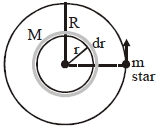
\(E 4 \pi r ^{2}=\int \rho_{0} 4 \pi r ^{2} dr\)\(\Rightarrow Er ^{2}=4 \pi G \int \limits_{0}^{ r } \rho_{0}\left(1-\frac{ r ^{2}}{ R ^{2}}\right) r ^{2} dr\)
\(\Rightarrow E =4 \pi G \rho_{0}\left(\frac{ r ^{3}}{3}-\frac{ r ^{5}}{5 R ^{2}}\right)\)
\(\frac{ d E }{ dr }=0 \therefore r =\sqrt{\frac{5}{9}} R\)
-
- (A) \(T \propto R\)
- (B) \(T ^{2} \propto \frac{1}{ R ^{3}}\)
- (C) \(T ^{2} \propto R\)
- (D) \(T ^{2} \propto R ^{3}\)
Show answer and solution
Correct Answer: (C)
\(dm =\rho dv\)\(dm =\left(\frac{ k }{ r }\right)\left(4 \pi r ^{2} dr \right)\)
\(dm =4 \pi krdr\)
\(M =\int_{0}^{ R } d m =\int_{0}^{ R } 4 \pi krdr\)
\(M=\left.4 \pi k \frac{r^{2}}{2}\right|_{0} ^{R}\)
\(M =2 \pi k \left( R ^{2}-0\right)\)
\(M =2 \pi kR ^{2}\)
for circular motion gravitational force will provide required centripital force or
\(\frac{ GMm }{ R ^{2}}=\frac{ mv ^{2}}{ R }\)
\(\frac{G\left(2 \pi kR ^{2}\right) m }{ R ^{2}}=\frac{ mv ^{2}}{ R } \Rightarrow v =\sqrt{2 \pi GkR }\)
Time period \(\quad T =\frac{2 \pi R }{ v }\)
\(T =\frac{2 \pi R }{\sqrt{2 \pi GkR }} \propto \sqrt{ R }\)
or \(T^{2} \propto R\)
-
- (A) \(\frac{7}{9}\)
- (B) \(\frac{4}{9}\)
- (C) \(\frac{1}{3}\)
- (D) \(\frac{5}{9}\)
Show answer and solution
Correct Answer: (D)
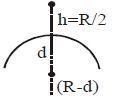
\(g_{1}=\frac{G M}{\left(R+\frac{R}{2}\right)^{2}} \ldots(1)\)\(g_{2}=\frac{G M(R-d)}{R^{3}} \ldots(2)\)
\(g_{1}=g_{2}\)
\(\frac{G M}{\left(\frac{3 R}{2}\right)^{2}}=\frac{G M(R-d)}{R^{3}}\)
\(\Rightarrow \frac{4}{9}=\frac{( R - d )}{ R }\)
\(4 R=9 R-9 d\)
\(5 R =9 d \Rightarrow \frac{ d }{ R }=\frac{5}{9}\)
-
- (A) \(\sqrt{\frac{ GM ^{2}}{ ma }}\)
- (B) \(\frac{3}{2} \sqrt{\frac{5 GM }{ a }}\)
- (C) \(4 \sqrt{\frac{ GM }{ a }}\)
- (D) \(2 \sqrt{\frac{ GM }{ a }}\)
Show answer and solution
Correct Answer: (B)
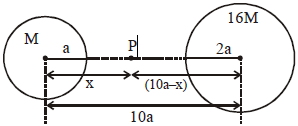
\(\frac{G M}{x^{2}}=\frac{G(16 M)}{(10 a-x)^{2}}\)\(\frac{1}{x}=\frac{4}{(10 a-x)} \quad \Rightarrow 4 x=10 a-x\)
\(x=2 a\) \(....(i)\)
\(COME\)
\(-\frac{ GMm }{8 a }-\frac{ G (16 M ) m }{2 a }+ KE\)
\(=-\frac{ GMm }{2 a }-\frac{ G (16 M ) m }{8 a }\)
\(KE = GMm \left[\frac{1}{8 a }+\frac{16}{2 a }-\frac{1}{2 a }-\frac{16}{8 a }\right]\)
\(KE = GMm \left[\frac{1+64-4-16}{8 a }\right]\)
\(\frac{1}{2} mv ^{2}= GMm \left[\frac{45}{8 a }\right]\)
\(V =\sqrt{\frac{90 GM }{8 a }}\)
\(V =\frac{3}{2} \sqrt{\frac{5 GM }{ a }}\)
-
- (A) \(1.7\)
- (B) \(2\)
- (C) \(1.9\)
- (D) \(1.5\)
Show answer and solution
Correct Answer: (C)
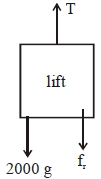
Let elevator is moving upward with constant speed V.
Tension in cable\(\mathrm{T}=2000 \mathrm{g}+\mathrm{f}_{\mathrm{r}}=2000+4000\)
\(\mathrm{T}=24000 \mathrm{N}\)
10.Power \(P=T V\)
\(\Rightarrow 60 \times 746=(24000) \mathrm{V}\)
\(\mathrm{V}=\frac{60 \times 746}{24000}=1.865 \approx 1.9 \mathrm{m} / \mathrm{s}\)
-
- (A) \(21\)
- (B) \(23\)
- (C) \(19\)
- (D) \(20\)
Show answer and solution
Correct Answer: (A)
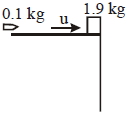
\(p _{ i }= p _{ f } \Rightarrow 0.1 \times 20=2 v\)\(\therefore v =1 m / s\)
\(KF _{ f }= mgh +\frac{1}{2} mv ^{2}=20+1=21\)
-
- (A) \(4\)
- (B) \(2\)
- (C) \(3\)
- (D) \(1\)
Show answer and solution
Correct Answer: (D)
By conservation of linear momentum :\((0.1)(3 \hat{\mathrm{i}})+(0.1)(5 \hat{\mathrm{j}})=(0.1)(4)(\hat{\mathrm{i}}+\hat{\mathrm{j}})+(0.1) \overline{\mathrm{v}}\)
\(\Rightarrow \overrightarrow{\mathrm{v}}=-\hat{\mathrm{i}}+\hat{\mathrm{j}}\)
Speed of \(\mathrm{B}\) after collision \(|\overrightarrow{\mathrm{v}}|=\sqrt{2}\)
Now, kinetic energy \(=\frac{1}{2} \mathrm{mV}^{2}=\frac{1}{2}(0.1)(2)=\frac{1}{10}\)
\(\therefore \mathrm{x}=1\)
-
- (A) starts moving in an elliptical orbit around the planet
- (B) continues to move in a circular orbit
- (C) Falls vertically downwards towards the planet
- (D) Escapes from the Planet's Gravitational field.
Show answer and solution
Correct Answer: (A)
Initially, the body of mass \(\mathrm{m}\) is moving in a circular orbit of radius \(\mathrm{R} .\) So it must be moving with orbital speed.\(\mathrm{v}_{0}=\sqrt{\frac{\mathrm{GM}}{\mathrm{R}}}\)
After collision, let the combined mass moves with speed \(v_{1 }\)
\({\mathrm{mv}_{0}+\frac{\mathrm{m}}{2} \frac{\mathrm{v}_{0}}{2}=\left(\frac{3 \mathrm{m}}{2}\right) \mathrm{v}_{1}}\)
\({\mathrm{v}_{1}=\frac{5 \mathrm{v}_{0}}{6}}\)
since after collision, the speed is not equal to orbital speed at that point. So motion cannot be circular. since velocity will remain tangential, so it cannot fall vertically towards the planet. Their speed after collision is less than escape speed \(\sqrt{2} v_{0}, \quad\)
so they cannot escape gravitational field. So their motion will be elliptical around the planet.
-
- (A) \(28\)
- (B) \(25\)
- (C) \(20\)
- (D) \(18\)
Show answer and solution
Correct Answer: (D)
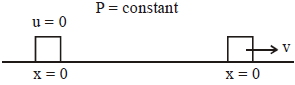
\(P=m a v\)\(m \frac{d v}{d t} v=P\)
\(\int_{0}^{v} v d v=\frac{P^{t}}{m} \int_{0}^{t} d t\)
\(\frac{v^{2}}{2}=\frac{P t}{m} \Rightarrow v=\left(\frac{2 P t}{m}\right)^{1 / 2}\)
\(\frac{d x}{d t}=\sqrt{\frac{2 P}{m}} t^{1 / 2}\)
\(\int_{0}^{{x}} d x=\sqrt{\frac{2 P}{m}} \int_{0}^{t} t^{1 / 2} d t\)
\(x=\sqrt{\frac{2 P}{m}} \frac{t^{3 / 2}}{3 / 2}=\sqrt{\frac{2 P}{m}} \times \frac{2}{3} t^{3 / 2}\)
\(=\sqrt{\frac{2 \times 1}{2}} \times \frac{2}{3} \times 9^{3 / 2}\)
\(=\frac{2}{3} \times 27=18\)
-
- (A) \(200\)
- (B) \(150\)
- (C) \(275\)
- (D) \(325\)
Show answer and solution
Correct Answer: (B)
\(W _{ F }=\frac{1}{2} mv ^{2}= mgh\)\(F ( S )= mgh\)
\(F (0.2)=(0.15)(10)(20)\)
\(F =150 N\)
-
- (A) \(8\)
- (B) \(10\)
- (C) \(15\)
- (D) \(13\)
Show answer and solution
Correct Answer: (B)
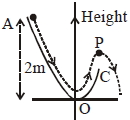
Mechanical energy conservation between\(A\;and\;P\)
\(\mathrm{U}_{1}+\mathrm{K}_{1}(=0)=\mathrm{K}_{2}+\mathrm{U}_{2}\)
\(\mathrm{mg} \times 2=\mathrm{mg} \times 1+\mathrm{K}_{2}\)
\(\mathrm{K}_{2}=\mathrm{mg} \times 1=10 \mathrm{J}\)
-
- (A) quantity \(\overrightarrow{ v } \cdot \overrightarrow{ a }\) is constant in time.
- (B) kinetic energy of particle is constant in time.
- (C) quantity \(\overrightarrow{ v } \times \overrightarrow{ a }\) is constant in lime.
- (D) \(\overrightarrow{ F }\) arises due to a magnetic field.
Show answer and solution
Correct Answer: (C)
\(\frac{ dv _{ x }}{ dt }=\frac{ k }{ m } v _{ y }\)\(\frac{ dv _{ y }}{ dt }=\frac{ k }{ m } v _{ x }\)
\(\frac{ d v_{ y }}{ dv _{ x }}=\frac{ v _{ x }}{ v _{ y }} \Rightarrow \int v _{ y } dv _{ y }=\int v _{ x } dv _{ x }\)
\(v_{y}^{2}=v_{x}^{2}+C\)
\(v _{ y }^{2}- v _{ x }^{2}= constant\)
Option \((3)\)
\(\overrightarrow{ v } \times \overrightarrow{ a }=\left( v _{ x } \hat{ i }+ v _{ y } \hat{ j }\right) \times \frac{ k }{ m }\left( v _{ y } \hat{ i }+ v _{ x } \hat{ j }\right)\)
\(=\left( v _{ x }^{2} \hat{ k }- v _{ y }^{2} \hat{ k }\right) \frac{ k }{ m }\)
\(=\left(v_{x}^{2}-v_{y}^{2}\right) \frac{k}{m} \hat{k}\)
\(=\) \(Constant\)
-
- (A) \({\frac{1}{2}}\)
- (B) \(\sqrt{\frac{1}{2}}\)
- (C) \(\sqrt{\frac{3}{4}}\)
- (D) \(\sqrt{\frac{3}{2}}\)
Show answer and solution
Correct Answer: (D)
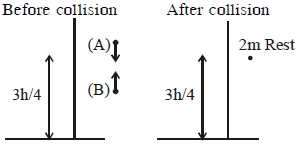
Particles will collide after time \(\mathrm{t}_{0}=\frac{\mathrm{h}}{\sqrt{2 \mathrm{gh}}}\)
at collision, \(\mathrm{v}_{\mathrm{A}}=\mathrm{gt}_{0} \quad \mathrm{v}_{\mathrm{B}}=\mathrm{u}_{\mathrm{B}}-\mathrm{gt}_{0}\)
\(\Rightarrow \mathrm{v}_{\mathrm{A}}=-\mathrm{v}_{\mathrm{B}}\)Time taken by combined mass to reach the ground
time \(=\sqrt{\frac{2 \times 3 \mathrm{h} / 4}{\mathrm{g}}}=\sqrt{\frac{3 \mathrm{h}}{2 \mathrm{g}}}\)
-
- (A) \(20\)
- (B) \(26\)
- (C) \(10\)
- (D) \(15\)
Show answer and solution
Correct Answer: (C)
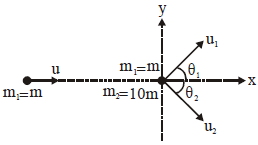
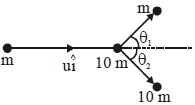
By momentum conservation along \(y\)\(m _{1} u _{1} \sin \theta_{1}= m _{2} u _{2} \sin \theta_{2}\)
i.e. \(mu _{1} \sin \theta_{1}=10 mu _{2} \sin \theta_{2}\)
\(\Rightarrow u _{1} \sin \theta_{1}=10 u _{2} \sin \theta_{2}\) \(...(i)\)
\(kf _{ m _{ 1 }}=\frac{1}{2} ki _{ m _{ 1 }}\) i.e. \(\frac{1}{2} mu _{1}^{2}=\frac{1}{2} \times \frac{1}{2} mu ^{2}\)
i.e. \(\sqrt{ u _{1}=\frac{ u }{\sqrt{2}}}\) \(...(ii)\)
Also collision is elastic : \(k _{ i }= k _{ f }\)
\(\frac{1}{2} m u^{2}=\frac{1}{2} m u_{1}^{2}+\frac{1}{2} \cdot 10 m \cdot u_{2}^{2}\)
\(\frac{1}{2} mu ^{2}=\frac{1}{2} \times \frac{1}{2} mu ^{2}+\frac{1}{2} \times 10 m \cdot u _{2}^{2}\)
\(\frac{1}{4} mu ^{2}=\frac{1}{2} \times 10 \times mu _{2}^{2}\)
\(u _{2}=\frac{ u }{\sqrt{20}}\)\(...(iii)\)
Putting \((ii)\) \(\&\) \((iii)\) in \((i)\)
\(\frac{ u }{\sqrt{2}} \sin \theta_{1}=10 \cdot \frac{ u }{\sqrt{20}} \sin \theta_{2}\)
\(\sin \theta_{1}=\sqrt{10} \sin \theta_{2} \quad \rightarrow\) Hence \(n =10\)
-
- (A) \(\frac{3 \sqrt{2}}{4} \frac{u^{2}}{g}\)
- (B) \(2 \sqrt{2} \frac{\mathrm{u}^{2}}{\mathrm{g}}\)
- (C) \(\frac{3 \sqrt{3}}{8} \frac{u^{2}}{g}\)
- (D) \(\frac{5}{8} \frac{\mathrm{u}^{2}}{\mathrm{g}}\)
Show answer and solution
Correct Answer: (C)
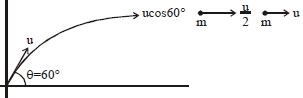
By momentum conservation,\(\frac{\mathrm{mu}}{2}+\mathrm{mu}=2 \mathrm{mv}^{\prime}\)
\(v^{\prime}=\frac{3 v}{4}\)
Range after collision \(=\frac{3 \mathrm{v}}{4} \sqrt{\frac{2 \mathrm{H}}{\mathrm{g}}}\)
\(=\frac{3 v}{4} \sqrt{\frac{2 \cdot u^{2} \sin ^{2} 60^{\circ}}{g 2 g}}\)
\(=\frac{3}{4} \frac{\sqrt{3}}{2} \cdot \frac{u^{2}}{g}=\frac{3 \sqrt{3} u^{2}}{8 g}\)
-
- (A) \(v=\sqrt{\frac{2}{3}} u\)
- (B) \(v =\frac{1}{\sqrt{6}} u\)
- (C) \(v=\frac{u}{\sqrt{3}}\)
- (D) \(v=\frac{u}{\sqrt{2}}\)
Show answer and solution
Correct Answer: (D)
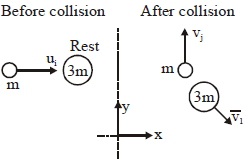
From momentum conservation\(\overrightarrow{ P }_{ i }=\overrightarrow{ P }_{ f }\)
\(m ( ui )+3 m ( D )= mvj +3 m \overline{ v }_{2}\)
\(mui - mvj =3 m \overline{ v }_{1}\)
\(\bar{v}_{1}=\frac{u i-v j}{3}\)
or \(\left| v _{1}\right|=\frac{\sqrt{ u ^{2}+ v ^{2}}}{3}\)
or \(v_{1}^{2}=\frac{u^{2}+v^{2}}{9} \ldots .(1)\)
As collision is perfectely elastic hence
\(k_{i}=k_{j}\)
\(\frac{1}{2} m u^{2}+\frac{1}{2} 3 m 0^{2}=\frac{1}{2} m v^{2}+\frac{1}{2} 3 m v_{1}^{2}\)
\(\Rightarrow u ^{2}= v ^{2}+3 v _{1}^{2}\)
\(u ^{2}= v ^{2}+3 \frac{\left( u ^{2}+ v ^{2}\right)}{9}\)
\(\Rightarrow 3 u ^{2}=3 v ^{2}+ u ^{2}+ v ^{2}\)
\(\Rightarrow 2 u ^{2}=4 v ^{2}\)
\(v =\frac{ u }{\sqrt{2}}\)
-
- (A) \(5690\)
- (B) \(5250\)
- (C) \(3280\)
- (D) \(2780\)
Show answer and solution
Correct Answer: (B)
\(F =200 N \quad\) for \(0 \leq x \leq 15\)\(=200-\frac{100}{15}( x -15)\) for \(15 \leq x <30\)
\(W =\int F dx\)
\(=\int_{0}^{15} 200 dx +\int_{15}^{30}\left(300-\frac{100}{15} x \right) dx\)
\(=200 \times 15+300 \times 15-\frac{100}{15} \times \frac{\left(30^{2}-15^{2}\right)}{2}\)
\(=3000+4500-2250\)
\(=5250 J\)
-
- (A) \(56300\)
- (B) \(48000\)
- (C) \(66000\)
- (D) \(62360\)
Show answer and solution
Correct Answer: (C)
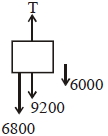
elevater moving with constant speed hence \(\mathrm{T}=6800+9200+6000\)\(\mathrm{T}=22000 \mathrm{N}\)
10.Power \(=\mathrm{T} \cdot \mathrm{v}=22000 \times 3\)
\(=66000 \mathrm{W}\)
-
- (A) \(77\)
- (B) \(37\)
- (C) \(87\)
- (D) \(94\)
Show answer and solution
Correct Answer: (D)
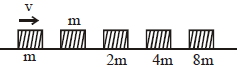
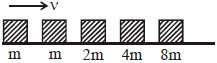
All collisions are perfectly inelastic, so affer the final collision, all blocks are moving together. So let the final velocity be \(v^{\prime},\) so on applying momentum conservation:\(mv =16 m v ^{\prime} \Rightarrow v ^{\prime}= v / 16\)
Now initial energy \(E _{1}=\frac{1}{2} mv ^{2}\)
Final energy \(: E _{ f }=\frac{1}{2} \times 16 m \times\left(\frac{ v }{16}\right)^{2}\)
\(\Rightarrow E _{ f }=\frac{1}{2} m \frac{ v ^{2}}{16}\)
Energy loss : \(E _{ i }- E _{ f }\)
\(\Rightarrow \frac{1}{2} mv ^{2}-\frac{1}{2} m \frac{ v ^{2}}{16}\)
\(\Rightarrow \frac{1}{2} mv ^{2}\left[1-\frac{1}{16}\right] \Rightarrow \frac{1}{2} mv ^{2}\left[\frac{15}{16}\right]\)
\(\% p=\frac{\text { Energy loss }}{\text { Original energy }} \times 100\)
\(=\frac{\frac{1}{2} mv ^{2}\left[\frac{15}{16}\right]}{\frac{1}{2} mv ^{2}} \times 100=93.75 \%\)
\(\Rightarrow\) Value of \(P\) is close to \(94\)
-
- (A) \(1.5\)
- (B) \(1\)
- (C) \(2\)
- (D) \(0.5\)
Show answer and solution
Correct Answer: (B)
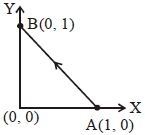
\(\mathrm{W}=\int_{\vec{r_i}}^{\vec{r_g}} \overrightarrow{\mathrm{F}} \cdot \mathrm{d} \overrightarrow{\mathrm{r}}\)\(\mathrm{W}=\int_{1}^{0}-\mathrm{x} \mathrm{d} \mathrm{x}+\int_{0}^{1} \mathrm{ydy}\)
\(W=\left.\frac{-x^{2}}{2}\right|_{1} ^{0}+\left.\frac{y^{2}}{2}\right|_{0} ^{1}\)
\(=-\left(\frac{0^{2}}{2}-\frac{1^{2}}{2}\right)+\left(\frac{1^{2}}{2}-\frac{0^{2}}{2}\right)\)
\(\mathrm{W}=1 \mathrm{J}\)
-
- (A) \(\left(\frac{ B }{ A }\right)^{1 / 6}, 0\)
- (B) \(\left(\frac{ B }{2 A }\right)^{1 / 6},-\frac{ A ^{2}}{2 B }\)
- (C) \(\left(\frac{2 B }{ A }\right)^{1 / 6},-\frac{ A ^{2}}{4 B }\)
- (D) \(\left(\frac{2 B }{ A }\right)^{1 / 6},-\frac{ A ^{2}}{2 B }\)
Show answer and solution
Correct Answer: (C)
\(U =\frac{- A }{ r ^{6}}+\frac{ B }{ r ^{12}}\)\(F =-\frac{ dU }{ dr }=-\left( A \left(-6 r ^{-7}\right)\right)+ B \left(-12 r ^{-13}\right)\)
\(0=\frac{6 A }{ r ^{7}}-\frac{12 B }{ r ^{13}}\)
\(\frac{6 A }{12 B }=\frac{1}{ r ^{6}} \Rightarrow r =\left(\frac{2 B }{ A }\right)^{1 / 6}\)
\(U \left( r =\left(\frac{2 B }{ A }\right)^{1 / 6}\right)=-\frac{ A }{2 B / A }+\frac{ B }{4 B ^{2} / A ^{2}}\)
\(=\frac{- A ^{2}}{2 B }+\frac{ A ^{2}}{4 B }=\frac{- A ^{2}}{4 B }\)
-
- (A) \(100\)
- (B) \(120\)
- (C) \(125\)
- (D) \(130\)
Show answer and solution
Correct Answer: (B)
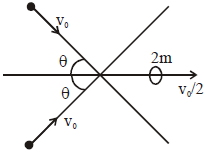
Momentum conservation along \(x\)\(2 mv _{0} \cos \theta=2 m \frac{ v _{0}}{2}\)
\(\cos \theta=\frac{1}{2}\)
\(\theta=60\)
Angle is \(2 \theta=120\)
-
- (A) \(\frac{3}{4} \mathrm{mu}^{2}\)
- (B) \(\frac{1}{8} \mathrm{mu}^{2}\)
- (C) \(\sqrt{\frac{2}{3}} \mathrm{mu}^{2}\)
- (D) \(\frac{1}{3} \mathrm{mu}^{2}\)
Show answer and solution
Correct Answer: (B)
From momentum conservation\(\operatorname{mu\hat{i}}+\operatorname{mu}\left(\frac{\hat{\mathrm{i}}+\hat{\mathrm{j}}}{2}\right)=(\mathrm{m}+\mathrm{m}) \overline{\mathrm{v}}\)
\(\Rightarrow \overline{\mathrm{v}}=\frac{3}{4} \mathrm{u} \hat{\mathrm{i}}+\frac{\mathrm{u}}{4} \hat{\mathrm{j}}\)
\(\Rightarrow|\mathrm{v}|=\frac{\mathrm{u}}{4} \sqrt{10}\)
Final kinetic energy \(=\frac{1}{2} 2 \mathrm{m}\left(\frac{\mathrm{u}}{4} \sqrt{10}\right)^{2}=\frac{5}{8} \mathrm{mu}^{2}\)
Initial kinetic energy
\(=\frac{1}{2} \mathrm{mu}^{2}+\frac{1}{2} \mathrm{m}\left(\frac{\mathrm{u}}{\sqrt{2}}\right)^{2}=\frac{6}{8} \mathrm{mu}^{2}\)
Loss in \(\mathrm{K.E.}=\mathrm{k}_{\mathrm{i}}-\mathrm{k}_{\mathrm{f}}=\frac{1}{8} \mathrm{mu}^{2}\)
-
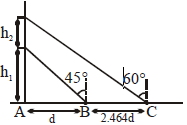
- (A) \(d\)
- (B) \(0.732d\)
- (C) \(1.464d\)
- (D) \(0.464d\)
Show answer and solution
Correct Answer: (A)
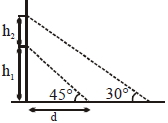
\(\frac{ h _{1}}{ d }=\tan 45^{\circ} \Rightarrow h _{1}= d \ldots(1)\)\(\frac{ h _{1}+ h _{2}}{ d +2.464 d }=\tan 30^{\circ}\)
\(\Rightarrow\left( h _{1}+ h _{2}\right) \times \sqrt{3}=3.46 d\)
\(\left(h_{1}+h_{2}\right)=\frac{3.46 d }{\sqrt{3}}\)
\(\Rightarrow d + h _{2}=\frac{3.46 d }{\sqrt{3}}\)
\(h _{2}= d\)
-
- (A) \(441\)
- (B) \(600\)
- (C) \(580\)
- (D) \(484\)
Show answer and solution
Correct Answer: (C)
\(x=10+8 t-3 t^{2}\)\(v_{x}=8-6 t\)
\(\left(\mathrm{v}_{\mathrm{x}}\right)_{\mathrm{t}=1}=2 \hat{\mathrm{i}}\)
\(y=5-8 t^{3}\)
\(\mathrm{v}_{\mathrm{y}}=-24 \mathrm{t}^{2}\)
\(\left(v_{y}\right)_{t=1}=-24 \hat{j}\)
\(\mathrm{Now}\)
\(\sqrt{\mathrm{v}}=\sqrt{(24)^{2}+(2)^{2}}=\sqrt{580}\)
\(\therefore \mathrm{v}=580 \mathrm{m}^{2} / \mathrm{s}^{2}\)
-
- (A) \(\overrightarrow{\mathrm{v}}\) is perpendicular to \(\overrightarrow{\mathrm{r}}\) and \(\overrightarrow{\mathrm{a}}\) is directed towards the origin
- (B) \(\overrightarrow{\mathrm{v}}\) and \(\overrightarrow{\mathrm{a}}\) both are parallel to \(\overrightarrow{\mathrm{r}}\)
- (C) \(\overrightarrow{\mathrm{v}}\) and \(\overrightarrow{\mathrm{a}}\) both are perpendicular to \(\overrightarrow{\mathrm{r}}\)
- (D) \(\overrightarrow{\mathrm{v}}\) is perpendicular to \(\overrightarrow{\mathrm{r}}\) and \(\overrightarrow{\mathrm{a}}\) is directed away from the origin
Show answer and solution
Correct Answer: (A)
\(\overrightarrow{\mathrm{r}}(\mathrm{t})=\cos \omega \hat{\mathrm{i}}+\sin \omega \mathrm{t} \hat{\mathrm{j}}\)On diff. we get
\({\overrightarrow{\mathrm{v}}=-\omega \sin \omega \mathrm{t} \hat{\mathrm{i}}+\omega \cos \omega \mathrm{t} \hat{\mathrm{j}}}\)
\({\overrightarrow{\mathrm{a}}=-\omega^{2} \overrightarrow{\mathrm{r}}}\)
\({\overrightarrow{\mathrm{v}} \cdot \overrightarrow{\mathrm{r}}=0}\)
-
- (A) \(50\)
- (B) \(32\)
- (C) \(60\)
- (D) \(40\)
Show answer and solution
Correct Answer: (C)
\(\mathrm{x}=\mathrm{u}_{\mathrm{x}} \mathrm{t}+\frac{1}{2} \mathrm{a}_{\mathrm{x}} \mathrm{t}^{2}\)\(\mathrm{y}=\mathrm{u}_{\mathrm{y}} \mathrm{t}+\frac{1}{2} \mathrm{a}_{\mathrm{y}} \mathrm{t}^{2}\)
\(32=0 \times t+\frac{1}{2}(4)(t)^{2}\)
\(t^{2}=16\)
\(t=4 \mathrm{sec}\)
\(x=3 \times 4+\frac{1}{2} \times 6 \times 4^{2}\)
\(=12+48=60 \mathrm{m}\)
-
- (A) \(4\, s\) and \(52\, m\)
- (B) \(2\, s\) and \(24\, m\)
- (C) \(2\,s\) and \(18\, m\)
- (D) \(5\, s\) and \(25\, m\)
Show answer and solution
Correct Answer: (C)
Given \(\quad \overrightarrow{ u }=5 \hat{ j } m / s , \overrightarrow{ a }=10 \hat{ i }+4 \hat{ j }, \quad\) final coordinate \(\left(20, y_{0}\right)\) in time \(t\)\(S_{x}=4 u_x \times {t}+\frac{1}{2} a_{x} t^{2}\)
\(\frac{1}{2} \times 10 \times t^{2}\)
\(t=2 \sec\)
\(S_{y}=u_{y} \times t+\frac{1}{2} a_{y} t^{2}\)
\(y_{0}=5 \times 2+\frac{1}{2} 4 \times 2^{2}=18 m\)
\(2 \sec\) and \(18\, m\)
-
- (A) \(0.41\)
- (B) \(0.50\)
- (C) \(0.37\)
- (D) \(0.73\)
Show answer and solution
Correct Answer: (D)
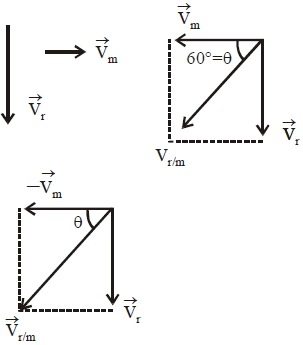
Rain is falling vertically downwards.\(\vec{v}_{r / m}=\vec{v}_{r}-\vec{v}_{m}\)
\(\tan 60^{\circ}=\frac{ V _{ r }}{ v _{ m }}=\sqrt{3}\)
\(v _{ r }= v _{ m } \sqrt{3}= v \sqrt{3}\)
Now, \(v _{ m }=(1+ B ) v\)
and \(\theta=45^{\circ}\)
\(\tan 45=\frac{ v _{ r }}{ v _{ m }}=1\)
\(v _{ r }= v _{ m }\)
\(v \sqrt{3}=(1+\beta) v\)
\(\sqrt{3}=1+\beta\)
\(\Rightarrow \beta=\sqrt{3}-1=0.73\)
-
- (A) \(6.5\)
- (B) \(8\)
- (C) \(10.3\)
- (D) \(5.4\)
Show answer and solution
Correct Answer: (B)
Time to travel \(81 \mathrm{m}\) is t sec.Time to travel \(100 \mathrm{m}\) is \(\mathrm{t}+\frac{1}{2} \mathrm{sec}\)
\(81=\frac{1}{2} \times \mathrm{a} \times \mathrm{t}^{2} \quad \Rightarrow \mathrm{t}=9 \sqrt{\frac{2}{\mathrm{a}}}\)
\(100=\frac{1}{2} \times \mathrm{a} \times\left(\mathrm{t}+\frac{1}{2}\right)^{2} \Rightarrow \mathrm{t}+\frac{1}{2}=10 \sqrt{\frac{2}{\mathrm{a}}}\)
\(9 \sqrt{\frac{2}{a}}+\frac{1}{2}=10 \sqrt{\frac{2}{a}}\)
\(\frac{1}{2}=\sqrt{\frac{2}{a}}\)
\(a=8 \mathrm{m} / \mathrm{s}^{2}\)
-
- (A) \(t =\sqrt{\frac{2 h }{3 g }}\)
- (B) \(t=1.8 \sqrt{\frac{h}{g}}\)
- (C) \(t=3.4 \sqrt{\left(\frac{h}{g}\right)}\)
- (D) \(t=\frac{2}{3} \sqrt{\left(\frac{h}{g}\right)}\)
Show answer and solution
Correct Answer: (C)
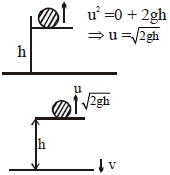
\(t_{0}=\sqrt{\frac{2 h}{g}}\)\(\Rightarrow \quad u=\sqrt{\frac{2 h}{g}} \times g=\sqrt{2 g h}\)
\(\therefore \quad t_{1}=\)time to reach top \(=\frac{u}{g}=\sqrt{\frac{2 h}{g}}\)
\(\therefore \quad H=h+h^{\prime}=2 h\)
\(t_{2}=\) time of fall \(=\sqrt{\frac{2 \times(2 h)}{g}}\)
\(\quad=2 \sqrt{\frac{h}{g}}\)
Total time \(=t_{1}+t_{2}\)
\(\quad=(2+\sqrt{2}) \sqrt{\frac{h}{g}}\)
\(\quad=3.4 \sqrt{\frac{h}{g}}\)
-
- (A) \(9\)
- (B) \(6\)
- (C) \(4\)
- (D) \(3\)
Show answer and solution
Correct Answer: (D)
\(\mathrm{x}=\sqrt{\mathrm{at}^{2}+2 \mathrm{bt}+\mathrm{c}}\)Differentiating w.r.t. time
\(\frac{d x}{d t}=v=\frac{1}{2 \sqrt{a t^{2}+2 b t+c}} \times(2 a t+2 b)\)
\(\Rightarrow \mathrm{v}=\frac{\mathrm{at}+\mathrm{b}}{\mathrm{x}}\)
\(\Rightarrow \mathrm{vx}=\mathrm{at}+\mathrm{b}\)
Differentiating w.r.t. \(\mathrm{x}\)
\(\Rightarrow \frac{d v}{d x} \times x+v=a \times \frac{d t}{d x}\)
Multiply both side by v
\(\Rightarrow\left(v \frac{d v}{d x}\right) x+v^{2}=a\)
\(\Rightarrow \mathrm{a}^{\prime} \mathrm{x}=\mathrm{a}-\mathrm{v}^{2}\) [Here \(a'\) is acceleration]
\(\Rightarrow \mathrm{a}^{\prime} \mathrm{x}=\mathrm{a}-\left(\frac{\mathrm{at}+\mathrm{b}}{\mathrm{x}}\right)^{2}\)
\(\Rightarrow \mathrm{a}^{\prime} \mathrm{x}=\frac{\mathrm{ax}^{2}-(\mathrm{at}+\mathrm{b})^{2}}{\mathrm{x}^{2}}\)
\(\Rightarrow \mathrm{a}^{\prime} \mathrm{x}=\frac{\mathrm{a}\left(\mathrm{at}^{2}+2 \mathrm{bt}+\mathrm{c}\right)-(\mathrm{at}+\mathrm{b})^{2}}{\mathrm{x}^{2}}\)
\(\Rightarrow \mathrm{a}^{\prime} \mathrm{x}=\frac{\mathrm{ac}-\mathrm{b}^{2}}{\mathrm{x}^{2}}\)
\(\Rightarrow \mathrm{a}^{\prime}=\frac{\mathrm{ac}-\mathrm{b}^{2}}{\mathrm{x}^{3}}\)
\(\therefore a^{\prime} \propto \frac{1}{x^{3}} \quad \therefore n=3\)
-
- (A) \(25\)
- (B) \(20\)
- (C) \(35\)
- (D) \(30\)
Show answer and solution
Correct Answer: (B)
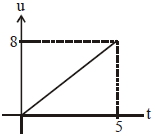
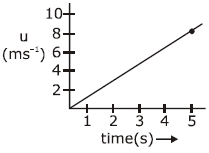
Distance \(=\int v\, dt\)Area under graph \(=\frac{1}{2} \times 5 \times 8=20\)
-
- (A) \(12\)
- (B) \(\frac{49}{4} m\)
- (C) \(11\)
- (D) \(\frac{37}{3} m\)
Show answer and solution
Correct Answer: (D)
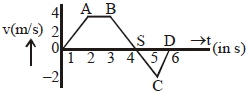
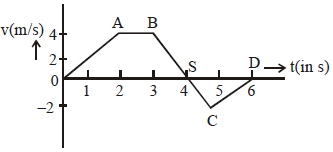
\(OS =4+\frac{1}{3}=\frac{13}{3}\)\(SD =2-\frac{1}{3}=\frac{5}{3}\)
Area of \(OABS\) is \(A _{1}\)
Area of \(SCD\) is \(A _{2}\)
Distance \(=\left| A _{1}\right|+\left| A _{2}\right|\)
\(A _{1}=\frac{1}{2}\left[\frac{13}{3}+1\right] 4=\frac{32}{3}\)
\(A _{2}=\frac{1}{2} \times \frac{5}{3} \times 2=\frac{5}{3}\)
Distance \(=\left|A_{1}\right|+\left|A_{2}\right|\)
\(=\frac{32}{3}+\frac{5}{3}\)
\(=\frac{37}{3}\)
-
- (A) \(30.5\)
- (B) \(29.5\)
- (C) \(31.5\)
- (D) \(28.5\)
Show answer and solution
Correct Answer: (B)
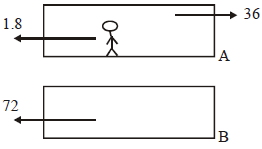
Velocity of man with respect to ground\(\overrightarrow{ V }_{m / g}=\overrightarrow{ V }_{ m / A }+\overrightarrow{ V }_{ A }=-1.8+36\)
Velocity of man w.r.t. \(B\)
\(\overrightarrow{ V }_{ m / s }=\overrightarrow{ V }_{ m }-\overrightarrow{ V }_{ B }\)
\(=-1.8+36-(-72)\)
\(=106.2 km / hr\)
\(=29.5 m / s\)
-
- (A) \(33\)
- (B) \(35\)
- (C) \(31\)
- (D) \(28\)
Show answer and solution
Correct Answer: (A)
\(\frac{50-40}{300}=\beta\left(\frac{50+40}{2}-20\right)\)\(\frac{40-T}{300}=\beta\left(\frac{40+T}{2}-20\right)\)
\(\therefore \quad T=\frac{100}{3}\)
-
- (A) \(K _{1}: K _{3}=2: 3 ; K _{2}: K _{3}=2: 5\)
- (B) \(K _{1}< K _{2}< K _{3}\)
- (C) \(K _{1}: K _{2}=5: 2 ; K _{1}: K _{3}=3: 5\)
- (D) \(K _{1}> K _{2}> K _{3}\)
Show answer and solution
Correct Answer: (A)
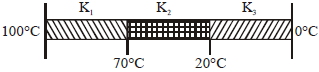
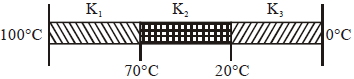
Rods are identical have same length ( \(\ell\) ) and area of cross-section \((A)\)Combination are in series, so heat current is same for all Rods
\(\left(\frac{\Delta Q }{\Delta t }\right)_{ AB }=\left(\frac{\Delta Q }{\Delta t }\right)_{ BC }=\left(\frac{\Delta Q }{\Delta t }\right)_{ CD }=\) Heat current
\(\frac{(100-70) K _{1} A }{\ell}=\frac{(70-20) K _{2} A }{\ell}=\frac{(20-0) K _{3} A }{\ell}\)
\(30 K _{1}=50 K _{2}=20 K _{3}\)
\(3 K _{1}=2 K _{3}\)
\(\frac{K_{1}}{K_{3}}=\frac{2}{3}=2: 3\)
\(5 K _{2}=2 K _{3}\)
\(\frac{ K _{2}}{ K _{3}}=\frac{2}{5}=2: 5\)
No questions on this page match these filters.