


JEE Mains · Physics · STD 12 - 13. Nuclei
Given the masses of various atomic particles \(m _{ p }=1.0072 u , m _{ n }=1.0087 u\) \(m _{ e }=0.000548 u , m _{ v }=0, m _{ d }=2.0141 u\) where \(p \equiv\) proton, \(n \equiv\) neutron, \(e \equiv\) electron, \(\overline{ v } \equiv\) antineutrino and \(d \equiv\) deuteron. Which of the following process is allowed by momentum and energy conservation \(?\)
- A \(n+p \rightarrow d+\gamma\)
- B \(e ^{+}+ e ^{-} \rightarrow \gamma\)
- C \(n + n \rightarrow\) deuterium atom (electron bound to the nucleus)
- D \(p \rightarrow n+e^{+}+\bar{v}\)
Answer & Solution
Correct Answer
(A) \(n+p \rightarrow d+\gamma\)
Step-by-step Solution
Detailed explanation
Only in \(case-I,\) \(M _{ LHS }> M _{ RHS }\) i.e. total mass on reactant side is greater then that on the product side. Hence it will only be allowed.
See the Complete Solution
Get step-by-step explanations for this and 2.5 Lakh+ more JEE, NEET & CET questions.
- Unlock all solutions
- Practice the full chapter
- Track accuracy across PYQs
4.8 rated on Google Play · 14,000+ reviews
More questions from Physics
- The period of oscillation of a simple pendulum is \(T=2\pi \sqrt {\frac{l}{g}} \). Measured value of \(L\) is \(20.0\; cm\) known to \(1\; mm\) accuracy and time for \(100\) oscillations of the pendulum is found to be \(90\ s\) using a wrist watch of \(1\; s\) resolution. The accuracy in the determination of \(g\) is ........ \(\%\)JEE Mains 2015 Easy
- As shown in the figure, a plane mirror is fixed at a height of \(50\,cm\) from the bottom of tank containing water \(\left(\mu=\frac{4}{3}\right)\). The height of water in the tank is \(8\,cm\). A small bulb is placed at the bottom of the water tank. The distance of image of the bulb formed by mirror from the bottom of the tank is \(......cm\)
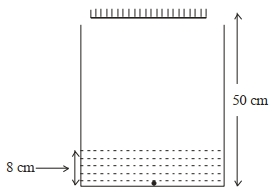 JEE Mains 2023 Hard
 - A copper block of mass \(5.0\, kg\) is heated to a temperature of \(500^{\circ} C\) and is placed on a large ice block. What is the maximum amount of ice (ઇન \(kg\)) that can melt? [Specific heat of copper: \(0.39\, Jg ^{-1 \circ} C ^{-1}\) and latent heat of fusion of water : \(335 \,J g ^{-1}\) ]JEE Mains 2022 Medium
- Particle \(A\) of mass \(m _{1}\) moving with velocity \((\sqrt{3} \hat{i}+\hat{j})\, ms ^{-1}\) collides with another particle \(B\) of mass \(m _{2}\) which is at rest initially. Let \(\overrightarrow{ V }_{1}\) and \(\overrightarrow{ V }_{2}\) be the velocities of particles \(A\) and \(B\) after collision respectively. If \(m _{1}=2\, m _{2}\) and after collision \(\overrightarrow{ V }_{1}=(\hat{ i }+\sqrt{3} \hat{ j })\, ms ^{-1},\) the angle between \(\overrightarrow{ V }_{1}\) and \(\overrightarrow{ V }_{2}\) is\(......^o\)JEE Mains 2020 Hard
- A solid sphere of radius \(r\) made of a soft material of bulk modulus \(K\) is surrounded by a liquid in a cylindrical container. A massless piston of area \(a\) floats on the surface of the liquid, covering entire crosssection of cylindrical container. When a mass \(m\) is placed on the surface of the piston to compress the liquid, the fractional decrement in the radius of the sphere, \(\left( {\frac{{dr}}{r}} \right)\) isJEE Mains 2018 Medium
- A body projected vertically upwards with a certain speed from the top of a tower reaches the ground in \(t_1\). If it is projected vertically downwards from the same point with the same speed, it reaches the ground in \(t_2\). Time required to reach the ground, if it is dropped from the top of the tower, is _______.JEE Mains 2024 Hard
More PYQs from JEE Mains
- The current flowing through the \(1 \Omega\) resistor is \(\frac{\mathrm{n}}{10} \ A.\) The value of \(n\) is _______.
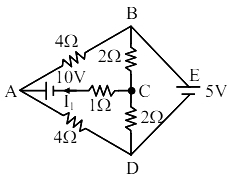 JEE Mains 2024 Hard
 - A body of mass \(m\) is taken from the surface of earth to a height equal to twice the radius of earth (\(R_e\)). The increase in potential energy will be _______.
(\(g\) is acceleration due to gravity at the surface of earth)JEE Mains 2026 Medium - If \(\left| {\begin{array}{*{20}{c}}{x - 4}&{2x}&{2x}\\{2x}&{x - 4}&{2x}\\{2x}&{2x}&{x - 4}\end{array}} \right| = \left( {A + Bx} \right){\left( {x - A} \right)^2},\) then the ordered pair \(\left( {A,B} \right) = \). . . . .JEE Mains 2018 Medium
- \(B _{ X }\) and \(B _{ Y }\) are the magnetic field at the centre of two coils of two coils \(X\) and \(Y\) respectively, each carrying equal current. If coil \(X\) has \(200\) turns and \(20 cm\) radius and coil \(Y\) has \(400\) turns and \(20 cm\) radius, the ratio of \(B _{ X }\) and \(B _{ Y }\) isJEE Mains 2022 Medium
- Let \(y = y _1( x )\) and \(y = y _2( x )\) be the solution curves of the differential equation \(\frac{d y}{d x}=y+7\) with initial conditions \(y_1(0)=0, y_2(0)=1\) respectively. Then the curves \(y=y_1(x)\) and \(y=y_2(x)\) intersect atJEE Mains 2023 Hard
- The source that illuminates the double - slit in 'double - slit interference experiment' emits two distinct monochromatic waves of wavelength \(500\,nm\) and \(600\, nm\), each of them producing its own pattern on the screen. At the central point of the pattern when path difference is zero, maxima of both the patterns coincide and the resulting interference pattern is most distinct at the region of zero path difference. But as one moves out of this central region, the two fringe systems are gradually out of step such that maximum due to on wavelength coincides with the minimum due to the other and the combined fringe system becomes completely indistinct. This may happen when path difference in \(nm\) isJEE Mains 2013 Hard