


All JEE Mains 2018 Physics questions
29 chaptersShowing 101–111 of 111 questions
-
- (A) \(\frac{1}{8}\,m{a^4}{t^2}\)
- (B) \(4\,m{a^4}{t^2}\)
- (C) \(8\,m{a^4}{t^2}\)
- (D) \(\frac{1}{4}\,m{a^4}{t^2}\)
Show answer and solution
Correct Answer: (A)
From qusestion, \(v = a\sqrt s = \frac{{ds}}{{dt}}\)or, \(\begin{gathered}
2\sqrt s \,\,\, = at \Rightarrow s = \frac{{{a^2}{t^2}}}{4} \hfill \\
\,\,\,\,\,\,\,\,\,\,\,\,\,\,F = m \times \frac{{{a^2}}}{2} \hfill \\
\end{gathered} \)Work done \(=\frac{{m{a^2}}}{2} \times \frac{{{a^2}{t^2}}}{4} = \frac{1}{8}m{a^4}{t^2}\)
- 102. A particle is moving in a circular path of radius a under the action of an attractive potential \(U = - \frac{k}{{2{r^2}}}\) Its total energy is 2018 Medium
- (A) \(\;\frac{k}{{2{a^2}}}\)
- (B) Zero
- (C) \( - \frac{3}{2}\;\frac{k}{{{a^2}}}\)
- (D) \( - \frac{k}{{4{a^2}}}\)
Show answer and solution
Correct Answer: (B)
\(F = \frac{{\partial u}}{{\partial r}}\,\hat r = \frac{K}{{{r^3}}}\,\hat r\)Since particle is moving in circular path
\(\begin{gathered}
F = \frac{{m{v^2}}}{r} = \frac{K}{{{r^3}}} \Rightarrow m{v^2} = \frac{K}{{{r^2}}} \hfill \\
\therefore \,K.E. = \frac{1}{2}m{v^2} = \frac{K}{{2{r^2}}} \hfill \\
\end{gathered} \)Total enerygy \(= P.E. + K.E.\)
\( = - \frac{K}{{2{r^2}}} + \frac{K}{{2{r^2}}} = zero\,\,\left( {\because \,P.E. = \frac{K}{{2{r^2}}}given} \right)\)
-
- (A) \(\frac{m}{{\sqrt 3 }}\)
- (B) \(\frac{m}{2}\)
- (C) \(2m\)
- (D) \(m\)
Show answer and solution
Correct Answer: (D)
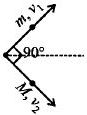
Apply principle of conservation of momentum along \(x-direction,\)\(mu=mv_1\) \(\cos {45^ \circ } + M{v_2}\cos {45^ \circ }\)
\(mu = \frac{1}{{\sqrt 2 }}\left( {m{v_1} + M{v_2}} \right)\,\,\,\,\,\,\,\,\,\,\,\,\,\,\,\,\,\,\,...\left( i \right)\)
Along \(y-direction,\)
\(0 = m{v_1}\sin {45^ \circ } - M{v_2}\sin {45^ \circ }\)
\(0 = \left( {m{v_1} - M{v_2}} \right)\frac{1}{{\sqrt 2 }}\,\,\,\,\,\,\,\,\,\,\,\,\,\,\,\,\,\,\,\,...\left( {ii} \right)\)
\(m,{u_1} = u\,\,\,\,\,\,M,{u_2} = 0\)
proton Unknown mass After collision
Beforce collision
Coefficient of restution \(e = 1\)
\(\begin{gathered}
= {v_2} - {v_1}\,\cos 90 \hfill \\
\,\,\,\,\,u\,\cos \,45 \hfill \\
\end{gathered} \)(\(\because \) coillsion is elastic)
\(\begin{gathered}
\Rightarrow \,\frac{{{v_2}}}{{\frac{u}{{\sqrt 2 }}}} = 1 \hfill \\
\Rightarrow \,u = \sqrt 2 {v_{2\,}}\,\,\,\,\,\,\,\,\,\,\,\,\,\,\,\,\,\,\,\,\,\,\,\,\,\,\,\,\,\,\,\,...\left( {iii} \right) \hfill \\
\end{gathered} \)Solving eqn\( (i) ,(ii) \& (iii),\) we get mass of unknown patricle, \(M=m\)
-
- (A) \(\sqrt 2 \;{v_0}\)
- (B) \(\frac{{{v_0}}}{2}\)
- (C) \(\;\frac{{{v_0}}}{{\sqrt 2 }}\)
- (D) \(\frac{{{v_0}}}{4}\)
Show answer and solution
Correct Answer: (A)
Before collision after collision\(\begin{gathered}
\frac{1}{2}mv_1^2 + \frac{1}{2}mv_2^2 = \frac{3}{2}\left( {\frac{1}{2}mv_0^2} \right) \hfill \\
\Rightarrow \,v_1^2 + v_2^2 = \frac{3}{2}v_0^2\,\,\,\,\,\,\,\,\,\,\,\,\,\,\,\,\,\,\,\,\,\,\,\,\,\,\,....\left( i \right) \hfill \\
\end{gathered} \)From momentum conservation
\(m{v_0} = m\left( {{v_1} + {v_2}} \right)\,\,\,\,\,\,\,\,\,\,\,\,\,\,\,\,\,\,\,\,\,\,\,\,\,....\left( {ii} \right)\)
Squarring both sides,
\(\begin{gathered}
{\left( {{v_1} + {v_2}} \right)^2} = v_0^2 \hfill \\
\Rightarrow \,v_1^2 + v_2^2 + 2{v_1}{v_2} = v_0^2 \hfill \\
\,\,\,\,\,\,2{v_1}{v_2} = \frac{{v_0^2}}{2} \hfill \\
{\left( {{v_1} - {v_2}} \right)^2} = v_1^2 + v_2^2 - 2{v_1}{v_2} = \frac{3}{2}v_0^2 + \frac{{v_0^2}}{2} \hfill \\
\end{gathered} \)Solving we get relative velocity between the two particles
\({v_1} - {v_2} = \sqrt 2 {v_0}\)

-
- (A) \((0.28,0.89)\)
- (B) \((0,0)\)
- (C) \((0,1)\)
- (D) \((0.89,0.28)\)
Show answer and solution
Correct Answer: (D)
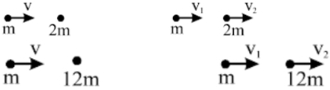
For collision of a nenutron with deuterium \(:\)Applying conservation of momentum\(:\)
\(m v+0=m v_{1}+2 m v_{2} \dots(i)\)
\(v_{2}-v_{1}=v \ldots(ii)\)
Therefore, Collision is elastic, \(e=1\)
From equ \((i)\) and equ \((ii)\) \(v_{1}=-v / 3\)
\(P_{d}=\frac{\frac{1}{2} m v^{2}-\frac{1}{2} m v_{1}^{2}}{\frac{1}{2} m v^{2}}=\frac{8}{9}=0.89\)
Now, for the collision of neutron with carbon nucleus
Applying conservation of momentum
\(m v+0=m v_{1}+12 m v_{2} \ldots\) \((iii)\)
\(v=v_{2}-v_{1}\) \(...(iv)\)
\(v_{1}=-\frac{11}{13} v\)
\(P_{0}=\frac{\frac{1}{2} m v^{2}-\frac{1}{2} m\left(\frac{11}{13} v\right)^{2}}{\frac{1}{2} m v^{2}}=\frac{48}{169} \approx 0.28\)
-
- (A) \(10^{-1}\)
- (B) \(6 \times {10^{-2}}\)
- (C) \(6 \times {10^2}\)
- (D) \(3 \times {10^{-3}}\)
Show answer and solution
Correct Answer: (B)
As the particles moving in circular orbits, So\(\frac{{m{v^2}}}{r} = \frac{{16}}{r} + {r^3}\)
Kinetic energy, \(K{E_0} = \frac{1}{2}m{v^2} = \frac{1}{2}\left[ {16 + {r^4}} \right]\)
For fist particle, \(r = 1,\) \({K_1} = \frac{1}{2}\left( {16 + 1} \right)\)
Similarly, for second particle, \(r = 4,\)
\({K_2} = \frac{1}{2}\left( {16 + 256} \right)\)
\(\therefore \,\frac{{{K_1}}}{{{K_2}}} = \frac{{\frac{{16 + 1}}{2}}}{{\frac{{16 + 256}}{2}}} = \frac{{17}}{{272}} \simeq 6 \times {10^{ - 2}}\)
-
- (A) \(\frac{d}{{\sqrt 3 }}\)
- (B) \(\frac{d}{2}\)
- (C) \(\frac{d}{{\sqrt 2 }}\)
- (D) \(d\)
Show answer and solution
Correct Answer: (A)
\(\begin{array}{l}
Let\,the\,car\,turn\,of\,the\,highway\,at\,a\,{\rm{distance }}\\
'x'\,from\,the\,{\rm{point}}\,M.\,So,\,RM = x\\
And\,if\,speed\,of\,car\,in\,field\,is\,v,\,then\,time\,\\
taken\,by\,the\,car\,to\,{\rm{cover}}\,{\rm{the}}\,{\rm{distance}}\,{\rm{QR = }}\\
{\rm{QM}}\, - {\rm{x}}\,{\rm{on}}\,the\,highway,\\
\,\,\,\,\,\,\,\,\,\,\,\,\,{t_1} = \frac{{QM - x}}{{2v}}\,\,\,\,\,\,\,\,\,\,\,\,\,\,\,\,\,\,\,\,\,\,\,\,\,\,\,\,\,\,\,\,\,\,\,\,\,\,\,\,\,\,\,\,...\left( i \right)\\
Time\,taken\,to\,travel\,the\,{\rm{distance}}\,'R\,P'\,in\,the\\
filed\\
\,\,\,\,\,\,\,\,\,\,\,\,\,{t_2} = \frac{{\sqrt {{d^2} + {x^2}} }}{v}\,\,\,\,\,\,\,\,\,\,\,\,\,\,\,\,\,\,\,\,\,\,\,\,\,\,\,\,\,\,\,\,\,\,\,\,\,\,....\left( {ii} \right)
\end{array}\)\(\begin{array}{l}
Total\,time\,elapsed\,to\,move\,the\,car\,form\,Q\\
to\,P\\
t = {t_1} + {t_2} = \frac{{QM - x}}{{2v}} + \frac{{\sqrt {{d^2} + {x^2}} }}{v}\,\,\,\,\,\\
For't'\,to\,be\,mimimum\,\frac{{dt}}{{dx}} = 0\\
\frac{1}{v}\left[ { - \frac{1}{2} + \frac{x}{{\sqrt {{d^2} + {x^2}} }}} \right] = 0\\
\,\,\,\,\,\,\,\,\,\,\,or\,x = \frac{d}{{\sqrt {{2^2} - 1} }} = \frac{d}{{\sqrt 3 }}
\end{array}\)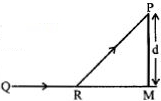
-
- (A) \(75\)
- (B) \(160\)
- (C) \(100\)
- (D) \(150\)
Show answer and solution
Correct Answer: (B)
\(\begin{array}{l}
According\,to\,question,\,{u_1} = 40\,km/h,\,{v_1} = 0\\
and\,{s_1} = 40\,m\\
{\rm{using}}\,{{\rm{v}}^2} - {u^2} = 2as;\,{0^2} - {40^2} = 2a \times 40\,\,\,\,\,\,...\left( i \right)\\
Again,\,{0^2} - {80^2} = 2as\,\,\,\,\,\,\,\,\,\,\,\,\,\,\,\,\,\,\,\,\,\,\,\,\,\,\,\,\,\,\,\,\,\,\,\,\,\,\,...\left( {ii} \right)\\
From\,eqn.\left( i \right)\,and\,\left( {ii} \right)\,\\
Stopping\,{\rm{ distance}},\,s = 160\,m\,\,
\end{array}\) -
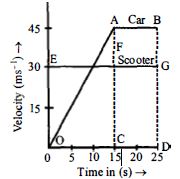
- (A) \(337.5\,m\) and \(25\,s\)
- (B) \(225.5\,m\) and \(10\,s\)
- (C) \(112.5\,m\) and \(22.5\,s\)
- (D) \(112.5\,m\) and \(15\,s\)
Show answer and solution
Correct Answer: (C)
Using equation, \(a=\frac{v-u}{t}\) and
\(s=u t+\frac{1}{2} a t^2\)
Distance travelled by car in 15 sec
\(=\frac{1}{2} \frac{(45)}{15}(15)^2\)
\(=\frac{675}{2} m\)
Distance traveled by scooter in 15 seconds
\(=30 \times 15=450 (\text {distance}=\text {speed} \text { × } \text {time})\)
Difference between distance travelled by car and scooter in 15 sec ,
\(450-337.5=112.5 m\)
Let car catches scooter in time \(t\);
\(\frac{675}{2}+45(t-15)=30 t\)
\(337.5+45 t-675=30 t\)
\(\Rightarrow 15 t=337.5\)
\(\Rightarrow t=22.5 sec\) -
- (A) \(43\)
- (B) \(47\)
- (C) \(41\)
- (D) \(45\)
Show answer and solution
Correct Answer: (A)
According to \(Newton's\) law of coolling,\(\left( {\frac{{{\theta _1} - {\theta _2}}}{t}} \right) = K\left( {\frac{{{\theta _1} + {\theta _2}}}{2} - {\theta _0}} \right)\)
\(\left( {\frac{{60 - 50}}{{10}}} \right) = K\left( {\frac{{60 + 50}}{2} - 25} \right)\,\,\,\,\,\,\,\,\,...\left( i \right)\)
\(and,\left( {\frac{{50 - \theta }}{{10}}} \right) = K\left( {\frac{{50 + \theta }}{2} - 25} \right)\,\,\,\,\,\,\,\,\,\,\,...\left( {ii} \right)\)
Dividing eq. \((i)\) by \((ii)\),
\(\frac{{10}}{{\left( {50 - \theta } \right)}} = \frac{{60}}{\theta } \Rightarrow \theta = {42.85^ \circ }C \cong {43^ \circ }C\)
-
- (A) \(\sqrt {\frac{5}{9}} \)
- (B) \(\sqrt {\frac{10}{9}} \)
- (C) \(\sqrt {\frac{20}{9}} \)
- (D) \(\sqrt {\frac{9}{12}} \)
Show answer and solution
Correct Answer: (A)
\(\begin{array}{l}
If\,\vec C = a\hat i + b\hat j\,then\,\vec A.\vec C = \vec A.\vec B\\
a + b = 1\,\,\,\,\,\,\,\,\,\,\,\,\,\,\,\,\,\,\,\,\,\,\,\,\,\,\,\,\,\,\,\,\,\,\,\,\,\,\,\,\,\,\,\,\,\,\,\,\,\,\,\,\,\,\,...\left( i \right)\\
\vec B.\vec C = \vec A.\vec B\\
2a - b = 1\,\,\,\,\,\,\,\,\,\,\,\,\,\,\,\,\,\,\,\,\,\,\,\,\,\,\,\,\,\,\,\,\,\,\,\,\,\,\,\,\,\,\,\,\,\,\,\,\,\,\,...\left( {ii} \right)\\
Solving\,equation\,\left( i \right)\,and\,\left( {ii} \right)\,\,we\,get\\
a = \frac{1}{3},\,b = \frac{2}{3}\\
Magnitude\,of\,coplanar\,vector,\\
\left| {\vec C} \right| = \sqrt {\frac{1}{9} + \frac{4}{9}} = \sqrt {\frac{5}{9}}
\end{array}\)
No questions on this page match these filters.