


Questions
4 questionsShowing 1–4 of 4 questions
-
- (A) \(\beta \frac{{{R_L}}}{{{R_{BE}}}},\frac{{\Delta {I_E}}}{{\Delta {I_B}}},{\beta ^2}\frac{{{R_L}}}{{{R_{BE}}}}\)
- (B) \({\beta ^2}\frac{{{R_L}}}{{{R_{BE}}}},\frac{{\Delta {I_C}}}{{\Delta {I_B}}},\beta \frac{{{R_L}}}{{{R_{BE}}}}\)
- (C) \({\beta ^2}\frac{{{R_L}}}{{{R_{BE}}}},\frac{{\Delta {I_C}}}{{\Delta {I_E}}},{\beta ^2}\frac{{{R_L}}}{{{R_{BE}}}}\)
- (D) \(\beta \frac{{{R_L}}}{{{R_{BE}}}},\frac{{\Delta {I_C}}}{{\Delta {I_B}}},{\beta ^2}\frac{{{R_L}}}{{{R_{BE}}}}\)
Show answer and solution
Correct Answer: (D)
Curent gain \(\beta=\frac{\Delta I_{C}}{I_{B}}\)Voltage gain \(\mathrm{A}_{\mathrm{v}}=\) Current gain \(\times\) Resistance
\(\operatorname{gain}=\beta \frac{R_{L}}{R_{B E}}\)
Power gain \(A_{p}=(\text { Current gain })^{2} \times\) Resistance gain
\(=\beta^{2} \frac{R_{L}}{R_{B E}}\)
-
- (A) \(2.5\)
- (B) \(3.3\)
- (C) \(5.5\)
- (D) \(6.7\)
Show answer and solution
Correct Answer: (B)
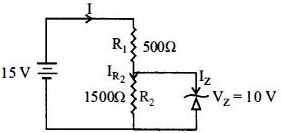
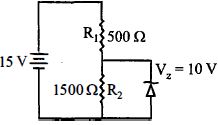
The voltage drop across \(\mathrm{R}_{2}\) is \(\mathrm{V}_{\mathrm{R}_{2}}\) \(=\mathrm{V}_{\mathrm{Z}}=10 \mathrm{V}\)The current through \(\mathrm{R}_{2}\) is
\(\mathrm{I}_{\mathrm{R}_{2}}=\) \(\frac{\mathrm{V}_{\mathrm{R}_{2}}}{\mathrm{R}_{2}}\) \(=\frac{10 \mathrm{V}}{1500 \Omega}\) \(=0.667 \times 10^{-2} \mathrm{A}\)
\(=6.67 \times 10^{-3} \mathrm{A}=6.67 \mathrm{mA}\)
The voltage drop across \(R_{1}\) is
\(\mathrm{V}_{\mathrm{R}_{1}}=15 \mathrm{V}-\mathrm{V}_{\mathrm{R}_{2}}\) \(=15 \mathrm{V}-10 \mathrm{V}=5 \mathrm{V}\)
The current through \(\mathrm{R}_{1}\) is
\(\mathrm{I}_{\mathrm{R}_{1}}=\frac{\mathrm{V}_{\mathrm{R}_{1}}}{\mathrm{R}_{1}}=\frac{5 \mathrm{V}}{500 \Omega}=10^{-2} \mathrm{A}=10 \times 10^{-3} \mathrm{A}=10 \mathrm{mA}\)
The current through the zener diode is
\(\mathrm{I}_{\mathrm{Z}}=\mathrm{I}_{\mathrm{R}_{1}}-\mathrm{I}_{\mathrm{R}_{2}}\) \(=(10-6.67) \mathrm{mA}=3.3 \mathrm{mA}\)
-
- (A) \(15\)
- (B) \(13.5 \)
- (C) \(11.5\)
- (D) \(0\)
Show answer and solution
Correct Answer: (C)
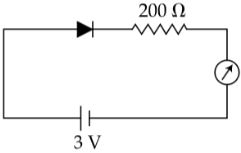
Clearly from fig. given in question, Silicon diode is in forward bias.\(\therefore\) Potential barrier across diode
\(\Delta \mathrm{V}=0.7 \mathrm{volts}\)
Current, \(I=\frac{V-\Delta V}{R}=\frac{3-0.7}{200}\) \(=\frac{2.3}{200}=11.5 \mathrm{mA}\)
-
- (A)
\(x\) \(y\) \(z\) \(0\) \(0\) \(1\) \(0\) \(1\) \(1\) \(1\) \(0\) \(1\) \(1\) \(1\) \(0\) - (B)
\(x\) \(y\) \(z\) \(0\) \(0\) \(0\) \(0\) \(1\) \(0\) \(1\) \(0\) \(0\) \(1\) \(1\) \(1\) - (C)
\(x\) \(y\) \(z\) \(0\) \(0\) \(1\) \(0\) \(1\) \(1\) \(1\) \(0\) \(1\) \(1\) \(1\) \(1\) - (D)
\(x\) \(y\) \(z\) \(0\) \(0\) \(0\) \(0\) \(1\) \(1\) \(1\) \(0\) \(1\) \(1\) \(1\) \(1\)
Show answer and solution
Correct Answer: (C)
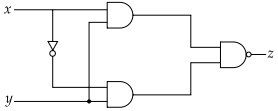
Truth table of the circuit is as follows\(x\) \(y\) \(\bar x\) \(a= x.y\) \(b=\bar x.y\) \(z=\bar {a.b}\) \(0\) \(0\) \(1\) \(0\) \(0\) \(1\) \(0\) \(1\) \(1\) \(0\) \(1\) \(1\) \(1\) \(0\) \(0\) \(0\) \(0\) \(1\) \(1\) \(1\) \(0\) \(1\) \(0\) \(1\) - (A)
No questions on this page match these filters.