


Questions
5 questionsShowing 1–5 of 5 questions
-
- (A) \(195\)
- (B) \(251\)
- (C) \(150\)
- (D) \(300\)
Show answer and solution
Correct Answer: (A)
Probable frequencies of tuning fork be \(n \pm5\)Frequency of sonometer wire, \(n \propto \frac{1}{l}\)
\(\therefore \frac{n+5}{n-5}=\frac{100}{95} \Rightarrow 95(n+5)=100(n-5)\)
or, \(95 n+475=100 n-500\)
or, \(5 n=975\)
or, \(n=\frac{975}{5}=195 \mathrm{Hz}\)
-
- (A) \(2.5\)
- (B) \(10\)
- (C) \(7.5\)
- (D) \(5\)
Show answer and solution
Correct Answer: (D)
In solids, Velocity of wave \(V=\sqrt{\frac{Y}{\rho}}=\sqrt{\frac{9.27 \times 10^{10}}{2.7 \times 10^{3}}}\)\(\mathrm{v}=5.85 \times 10^{3} \mathrm{m} / \mathrm{sec}\)
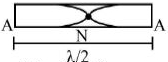
since rod is clamped at middle fundamental wave shape is as follow
\(\frac{\lambda}{2}=\mathrm{L} \Rightarrow \lambda=2 \mathrm{L}\)
\(\lambda=1.2 \mathrm{m}(\because \mathrm{L}=60 \mathrm{cm}=0.6 \mathrm{m}(\mathrm{given})\)
Using \(v=f \lambda\)
\(\Rightarrow \quad f=\frac{v}{\lambda}=\frac{5.85 \times 10^{3}}{1.2}\)
\(=4.88 \times 10^{3} \mathrm{Hz}=5 \mathrm{KHz}\)
-
- (A) \(190\)
- (B) \(180\)
- (C) \(220\)
- (D) \(200\)
Show answer and solution
Correct Answer: (D)
According to question, tuning fork gives \(1\, beat/second\) with \((N)\, 3^{rd}\) normal mode. Therefore, organ pipe will have frequency \(\left( {256 \pm 1} \right)\,Hz\). In open organ pipe, frequency\(\mathrm{n}=\frac{\mathrm{NV}}{2 \ell}\)
or, \(255=\frac{3 \times 340}{2 \times \ell} \Rightarrow \ell=2 \mathrm{m}=200 \mathrm{cm}\)
-
- (A) \(32\)
- (B) \(40\)
- (C) \(28\)
- (D) \(36\)
Show answer and solution
Correct Answer: (A)
For first resonance, \(\frac{\lambda}{4}=\ell_{1}+\mathrm{e}=11 \mathrm{cm}\)\((\because \text { end correction } \mathrm{e}=1 \mathrm{cm} \text { given })\)
For second resonance, \(\frac{3 \lambda}{4}=\ell_{2}+\mathrm{e}\)
\(\Rightarrow \ell_{2}=3 \times 11-1=32 \mathrm{cm}\)
-
- (A) \(430\)
- (B) \(428\)
- (C) \(422\)
- (D) \(420\)
Show answer and solution
Correct Answer: (D)
\(\mathrm{n}_{\mathrm{A}}=425 \mathrm{Hz}, \mathrm{n}_{\mathrm{B}}=?\)Beat frequency \(x=5\) \(Hz\) which is decreasing \((5 \rightarrow 3)\) after increasing the tension of the string \(B\).
Also tension of string \(\mathrm{B}\) increasing so
\(\mathrm{n}_{\mathrm{B}} \uparrow(\because \mathrm{n} \propto \sqrt{\mathrm{T}})\)
Hence \(\quad \mathrm{n}_{\mathrm{A}}-\mathrm{n}_{\mathrm{B}} \uparrow=x \downarrow \longrightarrow\) correct
\(\mathrm{n}_{\mathrm{B}} \uparrow-\mathrm{n}_{\mathrm{A}}=\mathrm{x} \downarrow \longrightarrow \text { incorrect }\)
\(\therefore \mathrm{n}_{\mathrm{B}}=\mathrm{n}_{\mathrm{A}}-\mathrm{x}=425-5=420 \mathrm{Hz}\)
No questions on this page match these filters.