


Questions
4 questionsShowing 1–4 of 4 questions
-
- (A) The total energy of the system is \(\frac{1}{2}m{\omega ^2}{A^2} + \frac{1}{2}\frac{{{q^2}{E^2}}}{k}\)
- (B) The new equilibrium position is at a distance: \(\frac{{2qE}}{k}\) from \(x = 0\)
- (C) The new equilibrium position is at a distance: \(\frac{{qE}}{{2k}}\) from \(x = 0\)
- (D) The total energy of the system is \(\frac{1}{2}m{\omega ^2}{A^2} - \frac{1}{2}\frac{{{q^2}{E^2}}}{k}\)
Show answer and solution
Correct Answer: (A)
Equilibrium position will shifto point where resultant force \(=0\)\(k{x_{eq}} = {\text{qE}} \Rightarrow {{\text{x}}_{{\text{eq}}}} = \frac{{{\text{qE}}}}{{\text{k}}}\)
Total energy \(=\frac{1}{2} \mathrm{m} \omega^{2} \mathrm{A}^{2}+\frac{1}{2} \mathrm{k} \mathrm{x}_{\mathrm{eq}}^{2}\)
Total energy \(=\frac{1}{2} \mathrm{m} \omega^{2} \mathrm{A}^{2}+\frac{1}{2} \frac{\mathrm{q}^{2} \mathrm{E}^{2}}{\mathrm{k}}\)
-
- (A) \(\frac{Q}{{3{\varepsilon _0}}}\)
- (B) \(\frac{Q}{{6{\varepsilon _0}}}\)
- (C) \(\frac{Q}{{2{\varepsilon _0}}}\)
- (D) \(\frac{Q}{{{\varepsilon _0}}}\)
Show answer and solution
Correct Answer: (B)
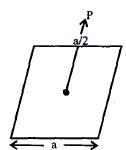
When cube is of side a and point charge \(Q\) is at the center of the cube then the total electric flux due to this charge will pass evenly through the six faces of the cube.So, the electric flux through one face will be equalto \(1 / 6\) of the total electric flux due to this charge.
Flux through \(6\) faces \(=\frac{Q}{\epsilon_{0}}\)
\(\therefore\) Flux through \(1\) face, \(=\frac{Q}{6 \in_{0}}\)
-
- (A) \(\frac{{{\rho _0}{R^3}}}{{{\varepsilon _0}{r^2}}}\)
- (B) \(\frac{{{4\rho _0}{R^3}}}{{{3\varepsilon _0}{r^2}}}\)
- (C) \(\frac{{{3\rho _0}{R^3}}}{{{4\varepsilon _0}{r^2}}}\)
- (D) \(\frac{{{\rho _0}{R^3}}}{{{12\varepsilon _0}{r^2}}}\)
Show answer and solution
Correct Answer: (D)
\(\text { Charge density, } \rho=\rho_{0}\left(1-\frac{r}{R}\right)\)\(d q=\rho d v\)
\(q_{i n}=\int d q=\rho d v\)
\(=\rho_{0}\left(1-\frac{r}{R}\right) 4 \pi r^{2} d r \quad\left(\because d v=4 \pi \mathrm{r}^{2} \mathrm{dr}\right)\)
\(=4 \pi p_{0} \int_{0}^{R}\left(1-\frac{r}{R}\right) r^{2} d r\)
\(=4 \pi \rho_{0} \int_{0}^{R} r^{2} d r-\frac{r^{2}}{R} d r\)
\(=4 \pi \rho_{0}\left[\left[\frac{r^{3}}{3}\right]_{0}^{R}-\left[\frac{r^{4}}{4 R}\right]_{0}^{R}\right]\)
\({=4 \pi \rho_{0}\left[\frac{R^{3}}{3}-\frac{R^{4}}{4 R}\right]}\)
\({=4 \pi \rho_{0}\left[\frac{R^{3}}{3}-\frac{R^{3}}{4}\right]=4 \pi \rho_{0}\left[\frac{R^{3}}{12}\right]}\)
\({q=\frac{\pi \rho_{0} R^{3}}{3}}\)
\(E .4 \pi r^{2}=\left(\frac{\pi \rho_{0} R^{3}}{3 \epsilon_{0}}\right)\)
Electric field outside the ball, \(E=\frac{\rho_{0} R^{3}}{12 \epsilon_{0} r^{2}}\)
-
- (A) \(\frac{{3F}}{4}\)
- (B) \(\frac{{F}}{2}\)
- (C) \(F\)
- (D) \(\frac{{3F}}{8}\)
Show answer and solution
Correct Answer: (D)
Spheres \(A\) and \(B\) carry equal charge say \('q\)\(\therefore \) Force between them, \(\mathrm{F}=\frac{\mathrm{k} \mathrm{qq}}{\mathrm{r}^{2}}\)
When \(A\) and \(C\) are touched, charge on both
\(\mathrm{q}_{\mathrm{A}}=\mathrm{q}_{\mathrm{C}}=\frac{\mathrm{q}}{2}\)
Then when \(\mathrm{B}\) and \(\mathrm{C}\) are touched, charge or \(B\)
\(\mathrm{q}_{\mathrm{B}}=\frac{\frac{\mathrm{q}}{2}+\mathrm{q}}{2}=\frac{3 \mathrm{q}}{4}\)
Now, the force between charge \(q_{A}\) and \(q_{B}\)
\(\mathrm{F}^{\prime}=\frac{\mathrm{k} \mathrm{q}_{\mathrm{A}} \mathrm{q}_{\mathrm{B}}}{\mathrm{r}^{2}}=\frac{\mathrm{k} \times \frac{\mathrm{q}}{2} \times \frac{3 \mathrm{q}}{4}}{\mathrm{r}^{2}}=\frac{3 \mathrm{kq}^{2}}{8} \mathrm{r}^{2}=\frac{3}{8}\, \mathrm{F}\)
No questions on this page match these filters.