


enEnglishhiहिन्दी
JEE Mains · Physics · STD 12 - 11. Dual nature of radiation and matter
Two electrons are moving with non-relativistic speeds perpendicular to each other. If corresponding de Broglie wavelengths are \({\lambda _1}\) and \({\lambda _2}\), their de Broglie wavelength in the frame of reference attached to their centre of mass is
- A \({\lambda _{CM}} = {\lambda _1} = {\lambda _2}\)
- B \(\frac{1}{{{\lambda _1}}} = \frac{1}{{{\lambda _1}}} + \frac{1}{{{\lambda _2}}}\)
- C \({\lambda _{CM}} = \frac{{2{\lambda _1}{\lambda _2}}}{{\sqrt {\lambda _1^2 + \lambda _2^2} }}\)
- D \({\lambda _{CM}} = \left( {\frac{{{\lambda _1} + {\lambda _2}}}{2}} \right)\)
Answer & Solution
Correct Answer
(C) \({\lambda _{CM}} = \frac{{2{\lambda _1}{\lambda _2}}}{{\sqrt {\lambda _1^2 + \lambda _2^2} }}\)
Step-by-step Solution
Detailed explanation
Momentum \((p)\) of each electron \(\frac{\mathrm{h}}{\lambda_{1}} \hat{\mathrm{i}}\) and \(\frac{\mathrm{h}}{\lambda_{2}} \hat{\mathrm{j}}\) Velocity of centre of mass \({{\text{V}}_{{\text{cm}}}} = \frac{{\text{h}}}{{2{\text{m}}{\lambda _1}}}\widehat {\text{i}} + \)…
See the Complete Solution
Get step-by-step explanations for this and 2.5 Lakh+ more JEE, NEET & CET questions.
- Unlock all solutions
- Practice the full chapter
- Track accuracy across PYQs
4.8 rated on Google Play · 14,000+ reviews
More questions from Physics
- A one metre long (both ends open) organ pipe is kept in a gas that has double the density of air at \(STP\). Assuming the speed of sound in air at \(STP\) is \(300\; \mathrm{m} / \mathrm{s}\), the frequency difference between the fundamental and second harmonic of this pipe is ___ \(\mathrm{Hz}\)JEE Mains 2020 Hard
- A compound microscope is designed with two symmetric biconvex lenses. The objective lens is cut vertically, creating two identical plano-convex lenses. One of them is used in place of original objective lens. To retain same magnification keeping the object distance unchanged, the tube length has to beJEE Mains 2026 Hard
- The characteristic distance at which quantum gravitational effects are significant, the Planck length, can be determined from a suitable combination of the fundamental physical constants \(G, h\) and \(c\) . Which of the following correctly gives the Planck length?JEE Mains 2018 Hard
- Two beams of light having intensities \(I\) and \(4\,I\) interfere to produce a fringe pattern on a screen. The phase difference between the two beams are \(\pi / 2\) and \(\pi / 3\) at points \(A\) and \(B\) respectively. The difference between the resultant intensities at the two points is \(x I\). The value of \(x\) will be.JEE Mains 2022 Medium
- A body is moving with constant speed, in a circle of radius \(10 m\). The body completes one revolution in \(4 s\). At the end of \(3 rd\) second, the displacement of body (in \(m\) ) from its starting point is:JEE Mains 2023 Medium
- Two simple pendulums having lengths \(l_1\) and \(l_2\) with negligible string mass undergo angular displacements \(\theta_1\) and \(\theta_2\), from their mean positions, respectively. If the angular accelerations of both pendulums are same, then which expression is correct?JEE Mains 2025 Medium
More PYQs from JEE Mains
- The absolute difference of the coefficients of \(x^{10}\) and \(x^7\) in the expansion of \(\left(2 x^2+\frac{1}{2 x}\right)^{11}\) is equal toJEE Mains 2023 Hard
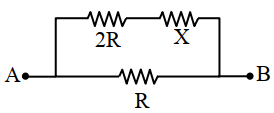
- Two known resistance of \(R \Omega\) and \(2 R \Omega\) and and one unknown resistance \(X \Omega\) are connected in a circuit as shown in the figure. If the equivalent resistance between points A and B in the circuit is \(X \Omega\), then the value of X is _________ \(\Omega\).
 JEE Mains 2026 Hard
 - Let \(A\) be the region enclosed by the parabola \(y^2=2 x\) and the line \(x=24\). Then the maximum area of the rectangle inscribed in the region \(\mathrm{A}\) is ...........JEE Mains 2024 Hard
- If \(z\) is a complex number such that \(\frac{z-i}{z-1}\) is purely imaginary, then the minimum value of \(\mid \mathrm{z}-(3+3 \mathrm{i}) \mid\) is :JEE Mains 2021 Hard
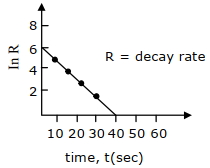
- For a certain radioactive process the graph between \(In\, {R}\) and \({t}\,({sec})\) is obtained as shown in the figure. Then the value of half life for the unknown radioactive material is approximately \(....\,{sec}.\)
 JEE Mains 2021 Medium
 - One vertex of a rectangular parallelopiped is at the origin \(O\) and the lengths of its edges along \(x , y\) and \(Z\) axes are \(3,4\) and \(5\) units respectively. Let \(P\) be the vertex \((3,4,5)\). Then the shortest distance between the diagonal \(OP\) and an edge parallel to \(Z\) axis, not passing through \(O\) or \(P\) is:JEE Mains 2023 Hard