


- JEE Mains 2018
- Hard
- MCQ
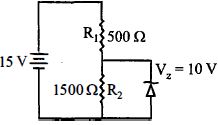
In the given circuit, the current through zener diode is......\(mA\)
Answer & Solution
(B) \(3.3\)
Step-by-step Solution
Detailed explanation
The current through \(\mathrm{R}_{2}\) is
\(\mathrm{I}_{\mathrm{R}_{2}}=\) \(\frac{\mathrm{V}_{\mathrm{R}_{2}}}{\mathrm{R}_{2}}\) \(=\frac{10 \mathrm{V}}{1500 \Omega}\) \(=0.667 \times 10^{-2} \mathrm{A}\)
\(=6.67 \times 10^{-3} \mathrm{A}=6.67 \mathrm{mA}\)
The voltage drop across \(R_{1}\) is
\(\mathrm{V}_{\mathrm{R}_{1}}=15 \mathrm{V}-\mathrm{V}_{\mathrm{R}_{2}}\) \(=15 \mathrm{V}-10 \mathrm{V}=5 \mathrm{V}\)
The current through \(\mathrm{R}_{1}\) is
\(\mathrm{I}_{\mathrm{R}_{1}}=\frac{\mathrm{V}_{\mathrm{R}_{1}}}{\mathrm{R}_{1}}=\frac{5 \mathrm{V}}{500 \Omega}=10^{-2} \mathrm{A}=10 \times 10^{-3} \mathrm{A}=10 \mathrm{mA}\)
The current through the zener diode is
\(\mathrm{I}_{\mathrm{Z}}=\mathrm{I}_{\mathrm{R}_{1}}-\mathrm{I}_{\mathrm{R}_{2}}\) \(=(10-6.67) \mathrm{mA}=3.3 \mathrm{mA}\)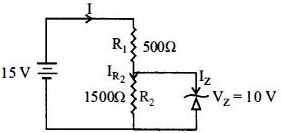
More questions from Physics
- A sample of radioactive material \(A\), that has an activity of \(10\, mCi\, (1\, Ci = 3.7 \times 10^{10}\, decays/s)\), has twice the number of nuclei as another sample of different radioactive material \(B\) which has an activity of \(20\, mCi\). The correct choices for half-lives of \(A\) and \(B\) would then be respectivelyJEE Mains 2019 Hard
- The typical transfer characteristic of a transistor in \(CE\) configuration is shown in figure. A load resistor of \(2\,k\Omega\) is connected in the collector branch of the circuit used. The input resistance of the transistor is \(0.50\,k \Omega\). The voltage gain of the transistor is.
 JEE Mains 2022 Hard
- The equivalent resistance between \(A\) and \(B\) as shown in figure is \(........\,k\Omega\)
 JEE Mains 2023 Easy
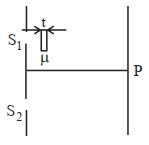
- As shown in the figure, in Young's double slit experiment, a thin plate of thickness \(t =10\,\mu m\) and refractive index \(\mu _{1}=1.2\) is inserted infront of slit \(S _1\). The experiment is conducted in air \((\mu=1)\) and uses a monochromatic light of wavelength \(\lambda=500\,nm\). Due to the insertion of the plate, central maxima is shifted by a distance of \(x \beta_0 . \beta_0\) is the fringe-width before the insertion of the plate.The value of the \(x\) is \(.............\)
 JEE Mains 2023 Medium
- If velocity \([V],\) time \([T]\) and force \([F]\) are chosen as the base quantities, the dimensions of the mass will beJEE Mains 2021 Medium
- An inductor of \(0.5 \,mH\), a capacitor of \(200 \,\mu F\) and a resistor of \(2 \,\Omega\) are connected in series with a \(220 \,V\) ac source. If the current is in phase with the emf, the frequency of ac source will be ................ \(\times 10^{2} \,Hz\)JEE Mains 2022 Hard
More PYQs from JEE Mains
- A point charge +q is placed at the origin. A second point charge +9 q is placed at \((\mathrm{d}, 0,0)\) in Cartesian coordinate system. The point in between them where the electric field vanishes is :JEE Mains 2025 Easy
- The ratio of de-Broglie wavelength of an \(\alpha\)-particle and a proton accelerated from rest by the same potential is \(\frac{1}{\sqrt{ m }}\), the value of \(m\) is \(........\)JEE Mains 2023 Easy
- The average mass of rain drops is \(3.0\times10^{-5}\, kg\) and their avarage terminal velocity is \(9\, m/s\). Calculate the energy transferred by rain to each square metre of the surface at a place which receives \(100\, cm\) of rain in a yearJEE Mains 2014 Medium
- A particle is moving with uniform speed along the circumference of a circle of radius \(R\) under the action of a central fictitious force \(F\) which is inversely proportional to \(R ^{3}\). Its time period of revolution will be given byJEE Mains 2021 Hard
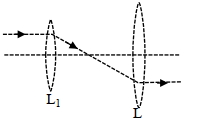
- move in opposite direction with speed ratio \(1: 2\). The following figure represents two biconvex lenses \(L_1\) and \(L_2\) having focal length \(10 \mathrm{~cm}\) and \(15 \mathrm{~cm}\) respectively. The distance between \(\mathrm{L}_1 \& \mathrm{~L}_2\) is _______.
 JEE Mains 2024 Hard
- The time period of revolution of electron in its ground state orbit in a hydrogen atom is \(1.6 \times 10^{-16} \;\mathrm{s}\). The frequency of revolution of the electron in its first excited state (in \(s^{-1}\) ) is:JEE Mains 2020 Hard