


Questions
8 questionsShowing 1–8 of 8 questions
-
- (A) Increased \(8\) times
- (B) Doubled
- (C) Halved
- (D) Unchanged
Show answer and solution
Correct Answer: (A)
Rate of heat i.e., Power developed in thewire \(=P=\frac{V^{2}}{R}\)
Resistance of the wire of length, \(L\)
\(R_{1}=\frac{\rho L}{A}=\frac{\rho L}{\pi r^{2}}\)
\(\therefore\) Power, \(P_{1}=\frac{V^{2}}{R_{1}}\)
Resistance of the wire when length is halved
i.e., \(L / 2\)
\(R_{2}=\frac{\rho \frac{L}{2}}{\pi(2 r)^{2}}=\frac{\rho L}{\pi 8 r^{2}}=\frac{R_{1}}{8}\)
\(\therefore\) Power, \(P_{2}=\frac{V}{\frac{R_{1}}{8}}=\frac{8 V}{R_{1}}\)
or, \(\mathrm{P}_{2}=8 \mathrm{P}_{1}\) i.e., power increased \(8\) times of previous or original wire.
-
- (A) \(\frac{{2\rho dA}}{{IT}}\)
- (B) \(\frac{{2\rho dA}}{{I}}\)
- (C) \(\frac{{\rho dA}}{{I}}\)
- (D) \(\frac{{\rho dA}}{{IT}}\)
Show answer and solution
Correct Answer: (C)
Charge density\(\rho=\frac{\text { charge }}{\text { volume }}=\frac{q}{A d} \Rightarrow q=\rho A d\)
Also, \(q=I T \Rightarrow T=\frac{q}{I}=\frac{\rho A d}{I}\)
-
- (A) \(1\, \times \,{10^{ - {4}}}\,\,{^oC^{ - 1}}\)
- (B) \(5\, \times \,{10^{ - {4}}}\,\,{^oC^{ - 1}}\)
- (C) \(2\, \times \,{10^{ - {4}}}\,\,{^oC^{ - 1}}\)
- (D) \(0.5\, \times \,{10^{ - {4}}}\,\,{^oC^{ - 1}}\)
Show answer and solution
Correct Answer: (C)
Resistance after temperature increases by \(500\,{\,^o}C\,\,i.e.,\,{R_t}\, = \,\frac{V}{I}\, = \frac{{220}}{2}\, = 110\,\Omega \) \(R_0 = 100\) (given) temperature coefficient of resistance, \(\alpha = ?\)using \(R_t = R_0( 1 + \alpha t)\)
\(110 = 100 (1 + \alpha 500)\)
\(\alpha \, = \,\frac{{10}}{{100 \times 500}}\) or, \(\alpha \, = \,2 \times {10^{ - 4}}\,\,{^o C^{ - 1}}\)
-
- (A) \(19.15\,\Omega \) and \(39.5\,cm\)
- (B) \(8.16\,\Omega \) and \(60.5\,cm\)
- (C) \(19.15\,\Omega \) and \(60.5\,cm\)
- (D) \(8.16\,\Omega \) and \(39.5\,cm\)
Show answer and solution
Correct Answer: (B)
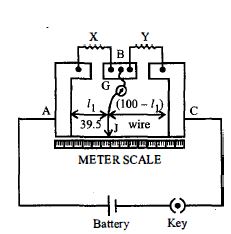
For a balanced meter bridge,\(\frac{X}{39.5}=\frac{Y}{(100-39.5)}\)
\(\Rightarrow Y=39.5=X \times(100-39.5)\)
or, \(\quad {\rm{X}} = \frac{{12.5 \times 39.5}}{{60.5}} = 8.16\,\Omega \)
\({\text { When } X \text { and } Y \text { are interchanged } l_{1} \text { and }(100} \)
\({\left.-l_{1}\right) \text { will also interchange so, } l_{2}=60.5\, \mathrm{cm}}\)
-
- (A) \(1.5\)
- (B) \(2 \)
- (C) \(2.5 \)
- (D) \(1\)
Show answer and solution
Correct Answer: (A)
Using formula, internal resistance,\(r=\left(\frac{l_{1}-l_{2}}{l_{2}}\right) s=\left(\frac{52-40}{40}\right) \times 5=1.5 \Omega\)
-
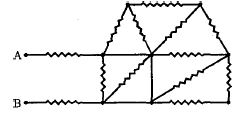
- (A) \(2R\)
- (B) \(\frac{{5R}}{2}\)
- (C) \(\frac{{5R}}{3}\)
- (D) \(3R\)
Show answer and solution
Correct Answer: (A)
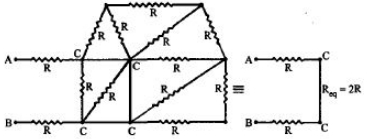
\({\mathrm{R}_{\text {scries }}=\mathrm{R}_{1}+\mathrm{R}_{2}+\ldots \ldots+\mathrm{R}_{\mathrm{n}}} \)\({\frac{1}{\mathrm{R}_{\mathrm{parallel}}}=\frac{1}{\mathrm{R}_{1}}+\frac{1}{\mathrm{R}_{2}}+\ldots \ldots+\frac{1}{\mathrm{R}_{\mathrm{n}}}}\)
-
- (A) \(505 \)
- (B) \(550\)
- (C) \(910\)
- (D) \(990\)
Show answer and solution
Correct Answer: (B)
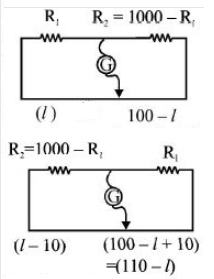
\(\mathrm{R}_{1}+\mathrm{R}_{2}=1000\)\(\Rightarrow \mathrm{R}_{2}=1000-\mathrm{R}_{1}\)
On balancing condition
\(\mathrm{R}_{1}(100-I)=\left(1000-\mathrm{R}_{1}\right) l\) ...\((i)\)
On Interchaanging resistance balance point shifts left by \(10 \,cm\)
On balancing condition \(\left(1000-R_{1}\right)(110-l)=R_{1}(l-10)\)
or, \(\mathrm{R}_{1}(l-10)=\left(1000-\mathrm{R}_{1}\right)(110-l) \ldots(\mathrm{ii})\)
Dividing eqn \((i)\) by \((ii)\)
\(\frac{100-l}{l-10}=\frac{l}{110-l}\)
\(\Rightarrow \quad(100-l)(110-l)=l(l-10)\)
\( \Rightarrow 11000 - 100l - 110l + {l^2} = {l^2} - 10l\)
\(\Rightarrow 11000=200 l\)
or, \(l=55\)
Putting the value of \('l'{\rm{in}}\,{\rm{eqn}}(i)\)
\(\mathrm{R}_{1}(100-55)=\left(1000-\mathrm{R}_{1}\right) 55\)
\(\Rightarrow \mathrm{R}_{1}(45)=\left(1000-\mathrm{R}_{1}\right) 55\)
\(\Rightarrow \mathrm{R}_{1}(9)=\left(1000-\mathrm{R}_{1}\right) 11\)
\(\Rightarrow 20 \mathrm{R}_{1}=11000\)
\(\therefore \quad \mathrm{R}_{1}=550\, \mathrm{K\Omega}\)
-
- (A) \(11.5\) \( V\) and \(11.6\) \( V\)
- (B) \(11.4\) \( V\) and \(11.5\) \( V\)
- (C) \(11.7\) \(V\) and \(11.8\) \( V\)
- (D) \(\;\) \(11.6\) \( V\) and \(11.7\) \( V\)
Show answer and solution
Correct Answer: (A)
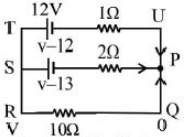
Using Kirchhoff's law at \(P\) we get\(\frac{V-12}{1}+\frac{V-13}{2}+\frac{V-0}{10}=0\)
[Let potential at \(\mathrm{P}, \mathrm{Q}, \mathrm{U}=0\) and at \(\mathrm{R}=\mathrm{V}\)
\(\Rightarrow \frac{\mathrm{V}}{1}+\frac{\mathrm{V}}{2}+\frac{\mathrm{V}}{10}=\frac{12}{1}+\frac{13}{2}+\frac{0}{10}\)
\(\Rightarrow \frac{10+5+1}{10} \mathrm{V}=\frac{24+13}{2}\)
\(\Rightarrow \mathrm{V}\left(\frac{16}{10}\right)=\frac{37}{2}\)
\(\Rightarrow \mathrm{V}=\frac{37 \times 10}{16 \times 2}=\frac{370}{32}=11.56\, \mathrm{volt}\)
No questions on this page match these filters.