


Questions
12 questionsShowing 1–12 of 12 questions
-
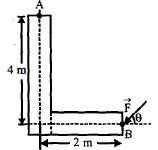
- (A) \(\tan \theta = \frac{1}{4}\)
- (B) \(\tan \theta = 2\)
- (C) \(\tan \theta = \frac{1}{2}\)
- (D) \(\tan \theta = 4\)
Show answer and solution
Correct Answer: (C)
To produce maximum moment of force line of action of force must be perpendicular to line \(AB\).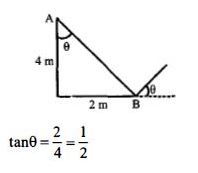
-
- (A) \(\tan \theta = \frac{1}{4}\)
- (B) \(\tan \theta = 2\)
- (C) \(\tan \theta = \frac{1}{2}\)
- (D) \(\tan \theta = 4\)
Show answer and solution
Correct Answer: (C)
To produce maximum moment of force line of action of force must be perpendicular to line \(AB\). -
- (A) \(1:2\)
- (B) \(1:4\)
- (C) \(1:3\)
- (D) \(1:5\)
Show answer and solution
Correct Answer: (C)
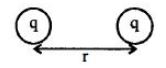
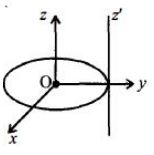
As we know, moment of inertia of a disc about an axis passing through \(C.G.\) and perpendicular to its plane, \({I_z}\, = \frac{{m{R^2}}}{2}\) Moment of inertia of a disc about a tangential axis perpendicular to its own plane,\({I_z}'\, = \frac{3}{{20}}m{R^2}\)
\({I_z}/{I_z}'\, = \frac{{m{R^2}}}{2}/\frac{{3m{R^2}}}{2}\, = 1/3\)
-
- (A) \(1:2\)
- (B) \(1:4\)
- (C) \(1:3\)
- (D) \(1:5\)
Show answer and solution
Correct Answer: (C)
As we know, moment of inertia of a disc about an axis passing through \(C.G.\) and perpendicular to its plane, \({I_z}\, = \frac{{m{R^2}}}{2}\) Moment of inertia of a disc about a tangential axis perpendicular to its own plane,\({I_z}'\, = \frac{3}{{20}}m{R^2}\)
\({I_z}/{I_z}'\, = \frac{{m{R^2}}}{2}/\frac{{3m{R^2}}}{2}\, = 1/3\)
-
- (A) \(\sqrt {\cos \alpha } \)
- (B) \(\cos \alpha \)
- (C) \(\sin \alpha \)
- (D) \(\sqrt {\sin \alpha } \)
Show answer and solution
Correct Answer: (A)
When the rod makes an angle \(\alpha \)Displacement of center of mass \( = \frac{1}{2}\cos \,\alpha \)
\(mg\frac{1}{2}\cos \alpha = \frac{l}{2}I{\omega ^2}\,\)
\(mg\frac{1}{2}\cos \alpha = \frac{{m{l^2}}}{6}{\omega ^2}\) (M.I. of thin uniform rod about an axis passing through its center of mass and perpendicular to the rod \(I = \frac{{m{l^2}}}{{12}}\))
\( \Rightarrow \omega = \sqrt {\frac{{3g\cos \alpha }}{l}} \)
speed of end \( = \omega \times l = \sqrt {3g\cos \alpha l} \)
i.e., Speed of end, \(\omega \, \propto \,\sqrt {\cos \alpha } \)
-
- (A) \(\frac{v}{{6L}}\)
- (B) \(\frac{6v}{{5L}}\)
- (C) \(\frac{3v}{{5L}}\)
- (D) \(\frac{v}{{5L}}\)
Show answer and solution
Correct Answer: (A)
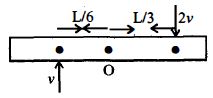
Linear momentum is conserved\(2 m v-2 m v=(2 m+m+M) V_{c m}\)
\(\Rightarrow V_{c m}=0\)
Angular momentum is conserve
\(2 m v \frac{L}{6}+2 m v \times \frac{L}{3}+0=I w\) \(...(i)\)
\(I=\mathrm{M.I.}\) of rod \(+\mathrm{M.I.}\) of mass \(2 \mathrm{m}+\mathrm{M.I}\) of mass \(\mathrm{m}\)
\(=\frac{8 m L^{2}}{12}+2 m\left(\frac{L}{6}\right)^{2}+m\left(\frac{L}{3}\right)^{2}\)
\(=m L^{2}\left(\frac{2}{3}+\frac{1}{18}+\frac{1}{9}\right)=\frac{5}{6} m L^{2}\)
eqn \((1)\) becomes
\(\left(\frac{m v L}{3}+\frac{2}{3} m v L\right)=\frac{5}{6} m L^{2} w\)
\(\frac{m L}{3}(V+2 v)=\frac{5}{6} m L^{2} w\)
\(\frac{6 V}{5 L}=w\)
-
- (A) \(m,\frac{1}{x}\)
- (B) \(m,\frac{1}{x^2}\)
- (C) \(m,x\)
- (D) \(m,x^2\)
Show answer and solution
Correct Answer: (A)
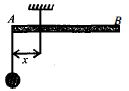
Balancing torque w.r.t point of suspension\(\begin{array}{l}
mg\,x\, = Mg\left( {\frac{{.\ell }}{2} - x} \right)\\
\Rightarrow mx = M\frac{\ell }{2} - Mx\\
m = \left( {M\frac{\ell }{2}} \right)\frac{1}{x} - M\\
y = \alpha \frac{1}{x} - C,\,\,\,\,\,\,\,\,\, straight\,\, line\,\, equation.
\end{array}\)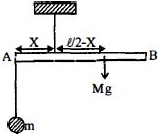
-
- (A) \(m,\frac{1}{x}\)
- (B) \(m,\frac{1}{x^2}\)
- (C) \(m,x\)
- (D) \(m,x^2\)
Show answer and solution
Correct Answer: (A)
Balancing torque w.r.t point of suspension\(\begin{array}{l}
mg\,x\, = Mg\left( {\frac{{.\ell }}{2} - x} \right)\\
\Rightarrow mx = M\frac{\ell }{2} - Mx\\
m = \left( {M\frac{\ell }{2}} \right)\frac{1}{x} - M\\
y = \alpha \frac{1}{x} - C,\,\,\,\,\,\,\,\,\, straight\,\, line\,\, equation.
\end{array}\) -
- (A) \(\frac{{55}}{2}M{R^2}\)
- (B) \(\frac{{73}}{2}M{R^2}\)
- (C) \(\frac{{181}}{2}M{R^2}\)
- (D) \(\;\frac{{19}}{2}M{R^2}\)
Show answer and solution
Correct Answer: (C)
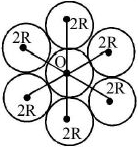
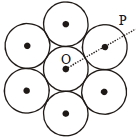
Using parallel axes theorem, moment of inertia about \('O'\)\(\begin{array}{l}
{I_0} = {I_{cm}} + m{d^2}\\
\,\,\,\,\,\,\,\,\,\,\,\,\,\,\,\, = \frac{{7M{R^2}}}{2} + 6\left( {M \times {{\left( {2R} \right)}^2}} \right) = \frac{{55M{R^2}}}{2}
\end{array}\)Again, moment of inertia about point P,\({I_P} = {I_0} + m{d^2}\)
\( = \frac{{55M{R^2}}}{2} + 7M{\left( {3R} \right)^2} = \frac{{181}}{2}M{R^2}\)
-
- (A) \(\frac{{55}}{2}M{R^2}\)
- (B) \(\frac{{73}}{2}M{R^2}\)
- (C) \(\frac{{181}}{2}M{R^2}\)
- (D) \(\;\frac{{19}}{2}M{R^2}\)
Show answer and solution
Correct Answer: (C)
Using parallel axes theorem, moment of inertia about \('O'\)\(\begin{array}{l}
{I_0} = {I_{cm}} + m{d^2}\\
\,\,\,\,\,\,\,\,\,\,\,\,\,\,\,\, = \frac{{7M{R^2}}}{2} + 6\left( {M \times {{\left( {2R} \right)}^2}} \right) = \frac{{55M{R^2}}}{2}
\end{array}\)Again, moment of inertia about point P,\({I_P} = {I_0} + m{d^2}\)
\( = \frac{{55M{R^2}}}{2} + 7M{\left( {3R} \right)^2} = \frac{{181}}{2}M{R^2}\)

No questions on this page match these filters.