


All JEE Mains 2018 Physics questions
29 chaptersShowing 51–100 of 111 questions
-
- (A) \(55\)
- (B) \(110\)
- (C) \(220\)
- (D) \(550\)
Show answer and solution
Correct Answer: (B)
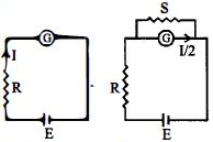
Figure of merit of a galvanometer is the current required to produce a deflection of one division in the galvancmeter i.e., figure of merit \(=\frac{\mathrm{I}}{\theta}\)\(\mathrm{I}=\frac{\varepsilon}{\mathrm{R}+\mathrm{G}} \quad \mathrm{G}=\frac{1}{9}\, \mathrm{K}\, \Omega\)
\(\frac{1}{2}=\frac{\varepsilon}{R+\frac{G S}{G+\bar{S}}} \times \frac{S}{S+G} \Rightarrow \frac{1}{2}=\frac{\varepsilon S}{R(S+G)+G S}\)
\(S=\frac{R G \times \frac{1}{2}}{\varepsilon-\frac{(R+G) I}{2}}\)
\(S=\frac{11 \times 10^{3} \times \frac{1}{2} \times 10^{2} \times 270 \times 10^{-6}}{6-\left(\frac{6}{2}\right)}=110\, \Omega\)
-
- (A) \(\sqrt 3 \)
- (B) \(\sqrt 2 \)
- (C) \(\frac{1}{{\sqrt 2 }}\)
- (D) \(2\)
Show answer and solution
Correct Answer: (B)
Magnetic field at the centre of \(\operatorname{loop}, B_{1}=\frac{\mu_{0} I}{2 R}\)Dipole moment of circular loop is \(m=I A\)
\(\mathrm{m}_{1}=\mathrm{I} \cdot \mathrm{A}=\mathrm{I} \pi \mathrm{R}^{2} \quad\{\mathrm{R}=\text { Radius of the loop }\}\)
If moment is doubled (keeping current constant) \(R\) becomes \(\sqrt{2 \mathrm{R}}\)
\({{\text{m}}_2} = {\text{L}}\pi {(\sqrt 2 {\text{R}})^2} = 2.{\text{I}}\pi {{\text{R}}^2} = 2{{\text{m}}_1}\)
\(B_{2}=\frac{\mu_{0} I}{2(\sqrt{2} R)}\)
-
- (A) \(nBA\omega \)
- (B) \(\frac{3}{2}\,nBA\omega \)
- (C) \(3\,nBA\omega \)
- (D) \(\frac{1}{2}\,nBA\omega \)
Show answer and solution
Correct Answer: (A)
Induced emf in a coil,\(e\, = \, - \frac{{d\phi }}{{dt}}\, = \,NBA\,\omega \,\sin \,\,\omega t\)
Also, \(e = e_0\,\,sin\,\omega t\)
\(\therefore \) Maximum \(emf\) induced, \(e_0 = nBA\omega \)
-
- (A) \(\frac{{mgR\cos \,\theta }}{{{B^2}{l^2}}}\)
- (B) \(\frac{{mgR\sin \,\theta }}{{{B^2}{l^2}}}\)
- (C) \(\frac{{mgR\tan \,\theta }}{{{B^2}{l^2}}}\)
- (D) \(\frac{{mgR\cot \,\theta }}{{{B^2}{l^2}}}\)
Show answer and solution
Correct Answer: (B)
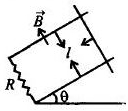
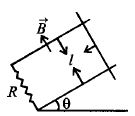
From Faraday's law of electomagnetic induction,\(e=\frac{d \phi}{d t}=\frac{d(B A)}{l t}=\frac{d(B l l)}{d t}\)
\( = \frac{{Bdl \times l}}{{dt}} = BVl\)
Also, \(F=i l B=\left(\frac{B V}{R}\right)\left(l^{2} B\right)=\frac{B^{2} l^{2} V}{R}\)
At equilibrium
\(m g \sin \theta=\frac{B^{2} I V}{R} \Rightarrow V=\frac{m g R \sin \theta}{B^{2} l^{2}}\)
-
- (A) \(0.17\)
- (B) \(0.15\)
- (C) \(0.34\)
- (D) \(0.25\)
Show answer and solution
Correct Answer: (A)
Given: Capacitance, \(C=0.2\, \mu \mathrm{F}=0.2 \times 10^{-6}\,F\)Inductance \(\mathrm{L}=0.5\, \mathrm{mH}=0.5 \times 10^{-3}\, \mathrm{H}\)
Current \(I=?\)
Using energy conservation
\(\frac{1}{2} C V^{2}=\frac{1}{2} C V_{1}^{2}+\frac{1}{2} L I^{2}\)
\(\frac{1}{2} \times 0.2 \times 10^{-6} \times 10^{2}+0\)
\(=\frac{1}{2} \times 0.2 \times 10^{-6} \times 5^{2}+\frac{1}{2} \times 0.5 \times 10^{-3} I^{2}\)
\(\therefore \quad I=\sqrt{3} \times 10^{-1}\, \mathrm{A}=0.17\, \mathrm{A}\)
-
- (A) \(\frac{{{\mu _0}I}}{{2R}}\,\omega {r^2}\,\sin \,\omega t\)
- (B) \(\frac{{{\mu _0}I}}{{4R}}\,\omega \pi {r^2}\,\sin \,\omega t\)
- (C) \(\frac{{{\mu _0}I}}{{2R}}\,\omega \pi {r^2}\,\sin \,\omega t\)
- (D) \(\frac{{{\mu _0}I}}{{4R}}\,\omega {r^2}\,\sin \,\omega t\)
Show answer and solution
Correct Answer: (C)
According to Faraday's law of electromagnetic induction,\(e=-\frac{d \phi}{d t} \text { and } \phi=B A \cos \omega t=B \pi r^{2} \cos \omega t\)
\(\Rightarrow \quad e=-\frac{d}{d t}\left(\pi r^{2} B \cos \omega t\right)=\pi r^{2} B \sin \omega t(\omega)\)
\(\therefore e=\frac{\mu_{0} I}{2 R} \pi \omega r^{2} \sin \omega t\left(\because B=\frac{\mu_{0} I}{2 R}\right)\)
-
- (A) \(2\,mA\)
- (B) \(1\,mA\)
- (C) \(40\,\mu A\)
- (D) \(20\,\mu A\)
Show answer and solution
Correct Answer: (B)
Given Number of turns,\(\mathrm{n}=1000\) \(turns/\)\(\mathrm{cm}=1000 \times 100\) \(turns\) \(/ \mathrm{m}\)
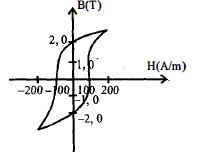
Coercivity of ferromagnet. \(\mathrm{H}=100 \,\mathrm{A} / \mathrm{m}\)
Current to demagnetise the ferromagnet, \(I=?\)
Using, \(H=n I\)
or, \(\quad 100=10^{5} \times I\)
\(\therefore \mathrm{I}=\frac{100}{10^{5}}=1\, \mathrm{mA}\)
-
- (A) Increased \(8\) times
- (B) Doubled
- (C) Halved
- (D) Unchanged
Show answer and solution
Correct Answer: (A)
Rate of heat i.e., Power developed in thewire \(=P=\frac{V^{2}}{R}\)
Resistance of the wire of length, \(L\)
\(R_{1}=\frac{\rho L}{A}=\frac{\rho L}{\pi r^{2}}\)
\(\therefore\) Power, \(P_{1}=\frac{V^{2}}{R_{1}}\)
Resistance of the wire when length is halved
i.e., \(L / 2\)
\(R_{2}=\frac{\rho \frac{L}{2}}{\pi(2 r)^{2}}=\frac{\rho L}{\pi 8 r^{2}}=\frac{R_{1}}{8}\)
\(\therefore\) Power, \(P_{2}=\frac{V}{\frac{R_{1}}{8}}=\frac{8 V}{R_{1}}\)
or, \(\mathrm{P}_{2}=8 \mathrm{P}_{1}\) i.e., power increased \(8\) times of previous or original wire.
-
- (A) \(\frac{{2\rho dA}}{{IT}}\)
- (B) \(\frac{{2\rho dA}}{{I}}\)
- (C) \(\frac{{\rho dA}}{{I}}\)
- (D) \(\frac{{\rho dA}}{{IT}}\)
Show answer and solution
Correct Answer: (C)
Charge density\(\rho=\frac{\text { charge }}{\text { volume }}=\frac{q}{A d} \Rightarrow q=\rho A d\)
Also, \(q=I T \Rightarrow T=\frac{q}{I}=\frac{\rho A d}{I}\)
-
- (A) \(1\, \times \,{10^{ - {4}}}\,\,{^oC^{ - 1}}\)
- (B) \(5\, \times \,{10^{ - {4}}}\,\,{^oC^{ - 1}}\)
- (C) \(2\, \times \,{10^{ - {4}}}\,\,{^oC^{ - 1}}\)
- (D) \(0.5\, \times \,{10^{ - {4}}}\,\,{^oC^{ - 1}}\)
Show answer and solution
Correct Answer: (C)
Resistance after temperature increases by \(500\,{\,^o}C\,\,i.e.,\,{R_t}\, = \,\frac{V}{I}\, = \frac{{220}}{2}\, = 110\,\Omega \) \(R_0 = 100\) (given) temperature coefficient of resistance, \(\alpha = ?\)using \(R_t = R_0( 1 + \alpha t)\)
\(110 = 100 (1 + \alpha 500)\)
\(\alpha \, = \,\frac{{10}}{{100 \times 500}}\) or, \(\alpha \, = \,2 \times {10^{ - 4}}\,\,{^o C^{ - 1}}\)
-
- (A) \(19.15\,\Omega \) and \(39.5\,cm\)
- (B) \(8.16\,\Omega \) and \(60.5\,cm\)
- (C) \(19.15\,\Omega \) and \(60.5\,cm\)
- (D) \(8.16\,\Omega \) and \(39.5\,cm\)
Show answer and solution
Correct Answer: (B)
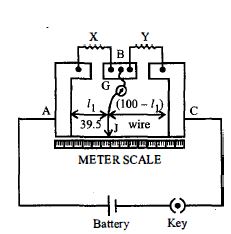
For a balanced meter bridge,\(\frac{X}{39.5}=\frac{Y}{(100-39.5)}\)
\(\Rightarrow Y=39.5=X \times(100-39.5)\)
or, \(\quad {\rm{X}} = \frac{{12.5 \times 39.5}}{{60.5}} = 8.16\,\Omega \)
\({\text { When } X \text { and } Y \text { are interchanged } l_{1} \text { and }(100} \)
\({\left.-l_{1}\right) \text { will also interchange so, } l_{2}=60.5\, \mathrm{cm}}\)
-
- (A) \(1.5\)
- (B) \(2 \)
- (C) \(2.5 \)
- (D) \(1\)
Show answer and solution
Correct Answer: (A)
Using formula, internal resistance,\(r=\left(\frac{l_{1}-l_{2}}{l_{2}}\right) s=\left(\frac{52-40}{40}\right) \times 5=1.5 \Omega\)
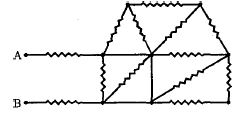
- 63. In the given circuit all resistances are of value \(R\,ohm\) each. The equivalent resistance between \(A\) and \(B\) is
 2018 Hard
- (A) \(2R\)
- (B) \(\frac{{5R}}{2}\)
- (C) \(\frac{{5R}}{3}\)
- (D) \(3R\)
Show answer and solution
Correct Answer: (A)
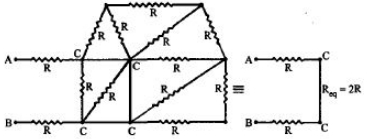
\({\mathrm{R}_{\text {scries }}=\mathrm{R}_{1}+\mathrm{R}_{2}+\ldots \ldots+\mathrm{R}_{\mathrm{n}}} \)\({\frac{1}{\mathrm{R}_{\mathrm{parallel}}}=\frac{1}{\mathrm{R}_{1}}+\frac{1}{\mathrm{R}_{2}}+\ldots \ldots+\frac{1}{\mathrm{R}_{\mathrm{n}}}}\)
-
- (A) \(505 \)
- (B) \(550\)
- (C) \(910\)
- (D) \(990\)
Show answer and solution
Correct Answer: (B)
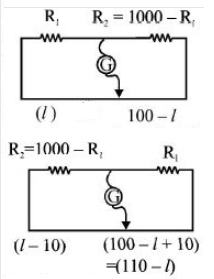
\(\mathrm{R}_{1}+\mathrm{R}_{2}=1000\)\(\Rightarrow \mathrm{R}_{2}=1000-\mathrm{R}_{1}\)
On balancing condition
\(\mathrm{R}_{1}(100-I)=\left(1000-\mathrm{R}_{1}\right) l\) ...\((i)\)
On Interchaanging resistance balance point shifts left by \(10 \,cm\)
On balancing condition \(\left(1000-R_{1}\right)(110-l)=R_{1}(l-10)\)
or, \(\mathrm{R}_{1}(l-10)=\left(1000-\mathrm{R}_{1}\right)(110-l) \ldots(\mathrm{ii})\)
Dividing eqn \((i)\) by \((ii)\)
\(\frac{100-l}{l-10}=\frac{l}{110-l}\)
\(\Rightarrow \quad(100-l)(110-l)=l(l-10)\)
\( \Rightarrow 11000 - 100l - 110l + {l^2} = {l^2} - 10l\)
\(\Rightarrow 11000=200 l\)
or, \(l=55\)
Putting the value of \('l'{\rm{in}}\,{\rm{eqn}}(i)\)
\(\mathrm{R}_{1}(100-55)=\left(1000-\mathrm{R}_{1}\right) 55\)
\(\Rightarrow \mathrm{R}_{1}(45)=\left(1000-\mathrm{R}_{1}\right) 55\)
\(\Rightarrow \mathrm{R}_{1}(9)=\left(1000-\mathrm{R}_{1}\right) 11\)
\(\Rightarrow 20 \mathrm{R}_{1}=11000\)
\(\therefore \quad \mathrm{R}_{1}=550\, \mathrm{K\Omega}\)
-
- (A) \(11.5\) \( V\) and \(11.6\) \( V\)
- (B) \(11.4\) \( V\) and \(11.5\) \( V\)
- (C) \(11.7\) \(V\) and \(11.8\) \( V\)
- (D) \(\;\) \(11.6\) \( V\) and \(11.7\) \( V\)
Show answer and solution
Correct Answer: (A)
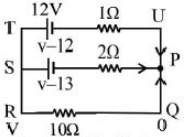
Using Kirchhoff's law at \(P\) we get\(\frac{V-12}{1}+\frac{V-13}{2}+\frac{V-0}{10}=0\)
[Let potential at \(\mathrm{P}, \mathrm{Q}, \mathrm{U}=0\) and at \(\mathrm{R}=\mathrm{V}\)
\(\Rightarrow \frac{\mathrm{V}}{1}+\frac{\mathrm{V}}{2}+\frac{\mathrm{V}}{10}=\frac{12}{1}+\frac{13}{2}+\frac{0}{10}\)
\(\Rightarrow \frac{10+5+1}{10} \mathrm{V}=\frac{24+13}{2}\)
\(\Rightarrow \mathrm{V}\left(\frac{16}{10}\right)=\frac{37}{2}\)
\(\Rightarrow \mathrm{V}=\frac{37 \times 10}{16 \times 2}=\frac{370}{32}=11.56\, \mathrm{volt}\)
-
- (A) \(0.3\)
- (B) \(2.4\)
- (C) \(0.9\)
- (D) \(1.2\)
Show answer and solution
Correct Answer: (D)
Charge on Capacitor, \(\mathrm{Q}_{i}=\mathrm{CV}\)After inserting dielectric of dielectric constant = \(\mathrm{K}\)
\(\mathrm{Q}_{\mathrm{f}}=(\mathrm{k} \mathrm{C}) \mathrm{V}\)
Induced charges on dielectric
\( \mathrm{Q}_{\mathrm{ind}} =\mathrm{Q}_{\mathrm{f}}-\mathrm{Q}_{\mathrm{i}}=\mathrm{KCV}-\mathrm{CV} \)
\(=(\mathrm{K}-1) \mathrm{CV}=\left(\frac{5}{3}-1\right) \times 90 \,\mathrm{pF} \times 2\, \mathrm{V}=1.2\, \mathrm{nc} \)
-
- (A) \(150\)
- (B) \(100\)
- (C) \(250\)
- (D) \(300\)
Show answer and solution
Correct Answer: (C)
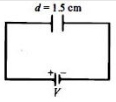
Given area of Parallel plate capacitor, \(A=\) \(200\, \mathrm{cm}^{2}\)Separation between the plates, \(d=1.5\, \mathrm{cm}\) Force of attraction between the plates, \(F=\) \(25 \times 10^{-6}\, \mathrm{N}\)
\(F=Q E\)
\(F=\frac{Q^{2}}{2 A \epsilon_{0}} \quad\) (\(E\) due to parallel plate
\(=\frac{\sigma}{2 \epsilon_{0}}=\frac{Q}{A 2 \epsilon_{0}})\)
But \(Q=C V=\frac{\epsilon_{0} A(V)}{d}\)
\(\therefore \,F = \,\frac{{({\epsilon_0}A{V^2})}}{{{{\text{d}}^2} \times 2{\text{A}}{\epsilon_0}}}\)
\( = \frac{{{{\left( {{\epsilon_0}A} \right)}^2} \times {V^2}}}{{{d^2} \times 2 \times \left( {A{\epsilon_0}} \right)}} = \frac{{\left( {{\epsilon_0}A} \right) \times {V^2}}}{{{d^2} \times 2}}\)
or, \(25 \times {10^{ - 6}} = \frac{{\left( {8.85 \times {{10}^{ - 12}}} \right) \times \left( {200 \times {{10}^{ - 4}}} \right) \times {V^2}}}{{2.25 \times {{10}^{ - 4}} \times 2}}\)
\( \Rightarrow V\, = \frac{{25 \times {{10}^{ - 6}} \times 2.25 \times {{10}^{ - 4}} \times 2}}{{8.85 \times {{10}^{ - 12}} \times 200 \times {{10}^{ - 4}}}}\) \( \approx 250\,V\)
-
- (A) \({C_{eq}}E\,[1 - \exp ( - t/R{C_{eq}})]\)
- (B) \({C_1}E\,[1 - \exp ( - tR/{C_1})]\)
- (C) \({C_2}E\,[1 - \exp ( - t/R{C_2})]\)
- (D) \({C_{eq}}E\,\exp ( - t/R{C_{eq}})\)
Show answer and solution
Correct Answer: (A)
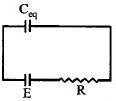
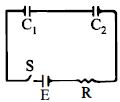
During charging charge on the capacitor increases with time. Charge on the capacitor\(\mathrm{C}_{1}\) as a function of time, \(\mathrm{Q}=\mathrm{Q}_{0}\left(1-\mathrm{e}^{-t / \mathrm{R} C}\right)\)
\(\mathrm{Q}=\mathrm{C}_{\mathrm{eq}} \mathrm{E}\left[1-\mathrm{e}^{-t / \mathrm{RC}_{\mathrm{eq}}}\right]\)
\(\left(\because Q_{0}=C_{e q} E\right)\)
Both capacitor will have charge as they are connected in series
- 69. The equivalent capacitance between \(A\) and \(B\) in the circuit given below is.....\(μF\)
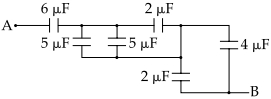 2018 Hard
- (A) \(4.9\)
- (B) \(3.6\)
- (C) \(5.4\)
- (D) \(2.4\)
Show answer and solution
Correct Answer: (D)
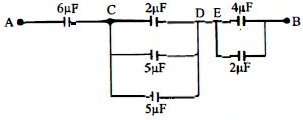
The simplified circuit of the circuit given in question as follows:The equivalent capacitance between \(C \& D\) capacitors of \(2\, \mu \mathrm{F}, 5\, \mu \mathrm{F}\) and \(5\, \mu \mathrm{F}\) are in parallel.
\(\therefore \mathrm{C}_{\mathrm{CD}}=2+5+5=12 \,\mu \mathrm{F}\)
(\(\because\) In parallel grouping \(C_{e q}=C_{1}+C_{2}+\ldots .+C_{n})\)
Similarly equivalent capacitance between \(\mathrm{E}\) \(\& \mathrm{BC}_{\mathrm{EB}}\)
\(=4+2=6\, \mu \mathrm{F}\)
Now equivalent capacitance between \(A \& B\)
\(\frac{1}{C_{e q}}=\frac{1}{6}+\frac{1}{12}+\frac{1}{6}=\frac{5}{12}\)
\(\Rightarrow \mathrm{C}_{\mathrm{eq}}=\frac{12}{5}=24\, \mu \mathrm{F}\)
(\(\because \) In series group-ing, \(\frac{1}{{{C_{eq}}}} = \frac{1}{{{C_1}}} + \frac{1}{{{C_2}}} + \ldots \ldots + \frac{1}{{{C_n}}}\)
-
- (A) \(\frac{\sigma}{\epsilon_0} \left[ {\frac{a^2-b^2}{b}+c} \right ]\)
- (B) \(\frac{\sigma}{\epsilon_0} \left[ {\frac{b^2-c^2}{b}+a} \right ]\)
- (C) \(\frac{\sigma}{\epsilon_0} \left[ {\frac{b^2-c^2}{c}+a} \right ]\)
- (D) \(\frac{\sigma}{\epsilon_0} \left[ {\frac{a^2-b^2}{a}+c} \right ]\)
Show answer and solution
Correct Answer: (A)
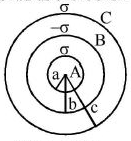
Potential outside the shell, \(V_{outside}\) \(=\frac{\mathrm{KQ}}{\mathrm{r}}\)where \(\mathrm{r}\) is distance of point from the centre of shel Potential inside the shell, \(V_{\text {inside }}=\frac{K Q}{R}\)
where \('R"\) is radius of the shell
\(\mathrm{V}_{\mathrm{B}}=\frac{\mathrm{Kq}_{\mathrm{A}}}{\mathrm{r}_{\mathrm{b}}}+\frac{\mathrm{Kq}_{\mathrm{B}}}{\mathrm{r}_{\mathrm{b}}}+\frac{\mathrm{Kq}_{\mathrm{C}}}{\mathrm{r}_{\mathrm{c}}}\)
\(\mathrm{V}_{\mathrm{B}}=\frac{1}{4 \pi \epsilon_{0}}\left[\frac{\sigma 4 \pi \mathrm{a}^{2}}{\mathrm{b}}-\frac{\sigma 4 \pi \mathrm{b}^{2}}{\mathrm{b}}+\frac{\sigma 4 \pi \mathrm{c}^{2}}{\mathrm{c}}\right]\)
\(V_{B}=\frac{\sigma}{\epsilon_{0}}\left[\frac{a^{2}-b^{2}}{b}+c\right]\)
-
- (A) The total energy of the system is \(\frac{1}{2}m{\omega ^2}{A^2} + \frac{1}{2}\frac{{{q^2}{E^2}}}{k}\)
- (B) The new equilibrium position is at a distance: \(\frac{{2qE}}{k}\) from \(x = 0\)
- (C) The new equilibrium position is at a distance: \(\frac{{qE}}{{2k}}\) from \(x = 0\)
- (D) The total energy of the system is \(\frac{1}{2}m{\omega ^2}{A^2} - \frac{1}{2}\frac{{{q^2}{E^2}}}{k}\)
Show answer and solution
Correct Answer: (A)
Equilibrium position will shifto point where resultant force \(=0\)\(k{x_{eq}} = {\text{qE}} \Rightarrow {{\text{x}}_{{\text{eq}}}} = \frac{{{\text{qE}}}}{{\text{k}}}\)
Total energy \(=\frac{1}{2} \mathrm{m} \omega^{2} \mathrm{A}^{2}+\frac{1}{2} \mathrm{k} \mathrm{x}_{\mathrm{eq}}^{2}\)
Total energy \(=\frac{1}{2} \mathrm{m} \omega^{2} \mathrm{A}^{2}+\frac{1}{2} \frac{\mathrm{q}^{2} \mathrm{E}^{2}}{\mathrm{k}}\)
-
- (A) \(\frac{Q}{{3{\varepsilon _0}}}\)
- (B) \(\frac{Q}{{6{\varepsilon _0}}}\)
- (C) \(\frac{Q}{{2{\varepsilon _0}}}\)
- (D) \(\frac{Q}{{{\varepsilon _0}}}\)
Show answer and solution
Correct Answer: (B)
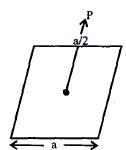
When cube is of side a and point charge \(Q\) is at the center of the cube then the total electric flux due to this charge will pass evenly through the six faces of the cube.So, the electric flux through one face will be equalto \(1 / 6\) of the total electric flux due to this charge.
Flux through \(6\) faces \(=\frac{Q}{\epsilon_{0}}\)
\(\therefore\) Flux through \(1\) face, \(=\frac{Q}{6 \in_{0}}\)
-
- (A) \(\frac{{{\rho _0}{R^3}}}{{{\varepsilon _0}{r^2}}}\)
- (B) \(\frac{{{4\rho _0}{R^3}}}{{{3\varepsilon _0}{r^2}}}\)
- (C) \(\frac{{{3\rho _0}{R^3}}}{{{4\varepsilon _0}{r^2}}}\)
- (D) \(\frac{{{\rho _0}{R^3}}}{{{12\varepsilon _0}{r^2}}}\)
Show answer and solution
Correct Answer: (D)
\(\text { Charge density, } \rho=\rho_{0}\left(1-\frac{r}{R}\right)\)\(d q=\rho d v\)
\(q_{i n}=\int d q=\rho d v\)
\(=\rho_{0}\left(1-\frac{r}{R}\right) 4 \pi r^{2} d r \quad\left(\because d v=4 \pi \mathrm{r}^{2} \mathrm{dr}\right)\)
\(=4 \pi p_{0} \int_{0}^{R}\left(1-\frac{r}{R}\right) r^{2} d r\)
\(=4 \pi \rho_{0} \int_{0}^{R} r^{2} d r-\frac{r^{2}}{R} d r\)
\(=4 \pi \rho_{0}\left[\left[\frac{r^{3}}{3}\right]_{0}^{R}-\left[\frac{r^{4}}{4 R}\right]_{0}^{R}\right]\)
\({=4 \pi \rho_{0}\left[\frac{R^{3}}{3}-\frac{R^{4}}{4 R}\right]}\)
\({=4 \pi \rho_{0}\left[\frac{R^{3}}{3}-\frac{R^{3}}{4}\right]=4 \pi \rho_{0}\left[\frac{R^{3}}{12}\right]}\)
\({q=\frac{\pi \rho_{0} R^{3}}{3}}\)
\(E .4 \pi r^{2}=\left(\frac{\pi \rho_{0} R^{3}}{3 \epsilon_{0}}\right)\)
Electric field outside the ball, \(E=\frac{\rho_{0} R^{3}}{12 \epsilon_{0} r^{2}}\)
-
- (A) \(\frac{{3F}}{4}\)
- (B) \(\frac{{F}}{2}\)
- (C) \(F\)
- (D) \(\frac{{3F}}{8}\)
Show answer and solution
Correct Answer: (D)
Spheres \(A\) and \(B\) carry equal charge say \('q\)\(\therefore \) Force between them, \(\mathrm{F}=\frac{\mathrm{k} \mathrm{qq}}{\mathrm{r}^{2}}\)
When \(A\) and \(C\) are touched, charge on both
\(\mathrm{q}_{\mathrm{A}}=\mathrm{q}_{\mathrm{C}}=\frac{\mathrm{q}}{2}\)
Then when \(\mathrm{B}\) and \(\mathrm{C}\) are touched, charge or \(B\)
\(\mathrm{q}_{\mathrm{B}}=\frac{\frac{\mathrm{q}}{2}+\mathrm{q}}{2}=\frac{3 \mathrm{q}}{4}\)
Now, the force between charge \(q_{A}\) and \(q_{B}\)
\(\mathrm{F}^{\prime}=\frac{\mathrm{k} \mathrm{q}_{\mathrm{A}} \mathrm{q}_{\mathrm{B}}}{\mathrm{r}^{2}}=\frac{\mathrm{k} \times \frac{\mathrm{q}}{2} \times \frac{3 \mathrm{q}}{4}}{\mathrm{r}^{2}}=\frac{3 \mathrm{kq}^{2}}{8} \mathrm{r}^{2}=\frac{3}{8}\, \mathrm{F}\)
-
- (A) \(195\)
- (B) \(251\)
- (C) \(150\)
- (D) \(300\)
Show answer and solution
Correct Answer: (A)
Probable frequencies of tuning fork be \(n \pm5\)Frequency of sonometer wire, \(n \propto \frac{1}{l}\)
\(\therefore \frac{n+5}{n-5}=\frac{100}{95} \Rightarrow 95(n+5)=100(n-5)\)
or, \(95 n+475=100 n-500\)
or, \(5 n=975\)
or, \(n=\frac{975}{5}=195 \mathrm{Hz}\)
-
- (A) \(2.5\)
- (B) \(10\)
- (C) \(7.5\)
- (D) \(5\)
Show answer and solution
Correct Answer: (D)
In solids, Velocity of wave \(V=\sqrt{\frac{Y}{\rho}}=\sqrt{\frac{9.27 \times 10^{10}}{2.7 \times 10^{3}}}\)\(\mathrm{v}=5.85 \times 10^{3} \mathrm{m} / \mathrm{sec}\)
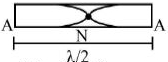
since rod is clamped at middle fundamental wave shape is as follow
\(\frac{\lambda}{2}=\mathrm{L} \Rightarrow \lambda=2 \mathrm{L}\)
\(\lambda=1.2 \mathrm{m}(\because \mathrm{L}=60 \mathrm{cm}=0.6 \mathrm{m}(\mathrm{given})\)
Using \(v=f \lambda\)
\(\Rightarrow \quad f=\frac{v}{\lambda}=\frac{5.85 \times 10^{3}}{1.2}\)
\(=4.88 \times 10^{3} \mathrm{Hz}=5 \mathrm{KHz}\)
-
- (A) \(190\)
- (B) \(180\)
- (C) \(220\)
- (D) \(200\)
Show answer and solution
Correct Answer: (D)
According to question, tuning fork gives \(1\, beat/second\) with \((N)\, 3^{rd}\) normal mode. Therefore, organ pipe will have frequency \(\left( {256 \pm 1} \right)\,Hz\). In open organ pipe, frequency\(\mathrm{n}=\frac{\mathrm{NV}}{2 \ell}\)
or, \(255=\frac{3 \times 340}{2 \times \ell} \Rightarrow \ell=2 \mathrm{m}=200 \mathrm{cm}\)
-
- (A) \(32\)
- (B) \(40\)
- (C) \(28\)
- (D) \(36\)
Show answer and solution
Correct Answer: (A)
For first resonance, \(\frac{\lambda}{4}=\ell_{1}+\mathrm{e}=11 \mathrm{cm}\)\((\because \text { end correction } \mathrm{e}=1 \mathrm{cm} \text { given })\)
For second resonance, \(\frac{3 \lambda}{4}=\ell_{2}+\mathrm{e}\)
\(\Rightarrow \ell_{2}=3 \times 11-1=32 \mathrm{cm}\)
-
- (A) \(430\)
- (B) \(428\)
- (C) \(422\)
- (D) \(420\)
Show answer and solution
Correct Answer: (D)
\(\mathrm{n}_{\mathrm{A}}=425 \mathrm{Hz}, \mathrm{n}_{\mathrm{B}}=?\)Beat frequency \(x=5\) \(Hz\) which is decreasing \((5 \rightarrow 3)\) after increasing the tension of the string \(B\).
Also tension of string \(\mathrm{B}\) increasing so
\(\mathrm{n}_{\mathrm{B}} \uparrow(\because \mathrm{n} \propto \sqrt{\mathrm{T}})\)
Hence \(\quad \mathrm{n}_{\mathrm{A}}-\mathrm{n}_{\mathrm{B}} \uparrow=x \downarrow \longrightarrow\) correct
\(\mathrm{n}_{\mathrm{B}} \uparrow-\mathrm{n}_{\mathrm{A}}=\mathrm{x} \downarrow \longrightarrow \text { incorrect }\)
\(\therefore \mathrm{n}_{\mathrm{B}}=\mathrm{n}_{\mathrm{A}}-\mathrm{x}=425-5=420 \mathrm{Hz}\)
-
- (A) \(\frac{1}{{2\pi {t_0}}}\cos {\,^{ - 1}}\left( {\frac{{a + b}}{{2c}}} \right)\)
- (B) \(\frac{1}{{2\pi {t_0}}}\cos {\,^{ - 1}}\left( {\frac{{a + b}}{{3c}}} \right)\)
- (C) \(\frac{1}{{2\pi {t_0}}}\cos {\,^{ - 1}}\left( {\frac{{2a + 3c}}{{b}}} \right)\)
- (D) \(\frac{1}{{2\pi {t_0}}}\cos {\,^{ - 1}}\left( {\frac{{a + c}}{{2b}}} \right)\)
Show answer and solution
Correct Answer: (D)
Using \(\mathrm{y}=\mathrm{A} \sin \omega \mathrm{t}\)\(\mathrm{a}=\mathrm{A} \sin \omega \mathrm{t}_{0}\)
\(b=A \sin 2 \omega t_{0}\)
\(c=A \sin 3 \omega t_{0}\)
\(\mathrm{a}+\mathrm{c}=\mathrm{A}\left[\sin \omega \mathrm{t}_{0}+\sin 3 \omega t_{0}\right]\)\(=2 \mathrm{A} \sin 2 \omega \mathrm{t}_{0}\cos \omega t_{0}\)
\(\frac{a+c}{b}=2 \cos \omega t_{0}\)
\(\Rightarrow \omega=\frac{1}{t_{0}} \cdot \cos ^{-1}\left(\frac{a+c}{2 b}\right)\)
\( \Rightarrow f=\frac{1}{2 \pi t_{0}} \cos ^{-1}\left(\frac{a+c}{2 b}\right)\)
-
- (A) \(\frac {1}{2}\)
- (B) \(\frac {1}{\sqrt 3}\)
- (C) \(\frac {2}{3}\)
- (D) \(\sqrt {\frac {3}{5}}\)
Show answer and solution
Correct Answer: (B)
In first collision \(mu\) momentum will be imparted to system, in second collision when momentum of \((\mathrm{M}+\mathrm{m})\) is in opposite direction \(mu\) momentum of particle will make its momentum zero.On \(13^{\text {th }}\) collision,
\(\mathrm{m} \rightarrow {\mathrm{M}+12} ; \quad \mathrm{M}+13 \mathrm{m} \rightarrow \mathrm{V}\)
\(\mathrm{mu}=(\mathrm{M}+13 \mathrm{m}) \mathrm{v} \Rightarrow \mathrm{v}=\frac{\mathrm{mu}}{\mathrm{M}+13 \mathrm{m}}=\frac{\mathrm{u}}{15}\)
\(v=\omega A \Rightarrow \frac{u}{15}=\sqrt{\frac{K}{M-13 m}} \times A\)
Putting value of \(M, m, u\) and \(K\) we get amplitude
\(A=\frac{1}{15} \sqrt{\frac{75}{1}}=\frac{1}{\sqrt{3}}\)
-
- (A) \(7.1\)
- (B) \(2.2 \)
- (C) \(5.5 \)
- (D) \(6.4 \)
Show answer and solution
Correct Answer: (A)
As we know, frequency in \(SHM\)\(\mathrm{f}=\frac{1}{2 \pi} \sqrt{\frac{\mathrm{k}}{\mathrm{m}}}=10^{12}\) where \(\mathrm{m}=\mathrm{mass}\) of one atom
Mass of one atom of silver, \(=\frac{108}{\left(6.02 \times 10^{23}\right)} \times 10^{-3} \mathrm{kg}\)
\(\frac{1}{2 \pi} \sqrt{\frac{\mathrm{k}}{108 \times 10^{-3}} \times 6.02 \times 10^{23}}=10^{12}\)
Solving we get, spring constant, \(\mathrm{K}=7.1 \mathrm{N} / \mathrm{m}\)
-
- (A) Parameters: \(A\, = B\), \(a\, = 2b\); \(\delta = \frac{\pi }{2}\); Curve : Circle
- (B) Parameters: \(A\,= B\), \(a\, = b\); \(\delta = \frac{\pi }{2}\) ; Curve : Line
- (C) Parameters: \(A \ne B\), \(a\, = b\); \(\delta = \frac{\pi }{2}\); Curve : Ellipse
- (D) Parameters: \(A \ne B\), \(a\, = b\); \(\delta\, = 0\); Curve : Parabola
Show answer and solution
Correct Answer: (C)
From the two mutually perpendicular \(S.H.M. 's\), the general equation of Lissajous figure\(\frac{{{x^2}}}{{{A^2}}} + \frac{{{y^2}}}{{{B^2}}} - \frac{{2xy}}{{AB}}\cos \,\delta = {\sin ^2}\,\delta\)
\(x = A\,\sin \,\left( {at + \delta } \right)\)
\(y = B\,\sin \,\left( {bt + r} \right)\)
Clearly \(A\ne B\) hence ellipse
-
- (A) \(1.3\times10^4\)
- (B) \(1.3\times10^5\)
- (C) \(1.3\times10^2\)
- (D) \(1.3\times10^3\)
Show answer and solution
Correct Answer: (D)
\(v = \sqrt {3{k_B}T/{m_{He}}} = \sqrt {\frac{{3 \times 1.4 \times {{10}^{ - 23}} \times 300}}{{7 \times {{10}^{ - 27}}}}} = 1.34 \times {10^3}\,m/s\) -
- (A) \(1.5\)
- (B) \(2\)
- (C) \(1\)
- (D) \(3\)
Show answer and solution
Correct Answer: (B)
Using formula,\({\gamma _{mixture}} = {\left( {\frac{{{C_p}}}{{{C_V}}}} \right)_{mix}} = \frac{{\frac{{{n_1}{\gamma _1}}}{{{\gamma _1} - 1}} + \frac{{{n_2}{\gamma _2}}}{{{\gamma _2} - 1}}}}{{\frac{{{n_1}}}{{{\gamma _1} - 1}} + \frac{{{n_2}}}{{{\gamma _2} - 1}}}}\)
Putting the value of \({n_1} = 2,{n_2} = n.\)
\({\left( {\frac{{{C_p}}}{{{C_v}}}} \right)_{mix }} = \frac{3}{2}\)
\({\gamma _1} = \frac{5}{3},{\gamma _2} = \frac{7}{5}\) and solving we get, \(n=2\)
-
- (A) \(420\)
- (B) \(2100\)
- (C) \(772\)
- (D) \(2520\)
Show answer and solution
Correct Answer: (A)
Given: Temperature of cold body, \(T_2= 250\,K\) temperature of hot body; \(T_1 = 300\, K\) Heat received, \(Q_2= 500\, cal\) work done, \(W =\) ?Effociency\( = 1 - \frac{{{T_2}}}{{{T_1}}} = \frac{W}{{{Q_2} + W}}\)
\( \Rightarrow 1 - \frac{{250}}{{300}} = \frac{W}{{{Q_2} + W}}\)
\(W = \frac{{{Q_2}}}{5} = \frac{{500 \times 4.2}}{5}\,\,J = 420\,J\)
-
- (A) \(300R\,ln\,6\)
- (B) \(300R\)
- (C) \(300R\,ln\,7\)
- (D) \(300R\,ln\,2\)
Show answer and solution
Correct Answer: (D)
\(Work\,done\,on\,gas = nRT\,\ell n\left( {\frac{{{p_f}}}{{{p_l}}}} \right)\)\( = R\left( {300} \right)\ell n\left( 2 \right)\left( {\frac{{{p_f}}}{{{p_i}}} = 2\,given} \right)\)
-
- (A) \(\frac{{25}}{8}\,\frac{{{P_0}{V_0}}}{R}\)
- (B) \(\frac{{25}}{4}\,\frac{{{P_0}{V_0}}}{R}\)
- (C) \(\frac{{25}}{16}\,\frac{{{P_0}{V_0}}}{R}\)
- (D) \(\frac{{5}}{8}\,\frac{{{P_0}{V_0}}}{R}\)
Show answer and solution
Correct Answer: (A)
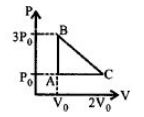
Equation of the \(BC\)\(p = {p_0} - \frac{{2{P_0}}}{{{V_0}}}\left( {V - 2{V_0}} \right)\)
using=\(PV=nRT\)
Temperature,\(T = \frac{{{P_0}V - \frac{{2{P_0}{V^2}}}{{{V_0}}} + 4{P_0}V}}{{1 \times R}}\)
\(\left( {n = 1\,mole\,given} \right)\)
\(T = \frac{{{P_0}}}{R}\left[ {5V - \frac{{2{V^2}}}{{{V_0}}}} \right]\)
\(\frac{{dT}}{{dV}} = 0 \Rightarrow 5 - \frac{{4V}}{{{V_0}}} = 0 \Rightarrow V = \frac{5}{4}{V_0}\)
\(T = \frac{{{P_0}}}{R}\left[ {5 \times \frac{{5{V_0}}}{4} - \frac{2}{{{V_0}}} \times \frac{{25}}{{16}}V_0^2} \right] = \frac{{25}}{8}\frac{{{P_0}{V_0}.}}{R}\)
-
- (A) \(\frac{{12}}{7}\)
- (B) \(\frac{{12}}{5}\)
- (C) \(\frac{{5}}{12}\)
- (D) \(\frac{{7}}{12}\)
Show answer and solution
Correct Answer: (D)
Efficiency of engine \(A,{n_A} = \frac{{{T_1} - {T_2}}}{{{T_1}}}\)and \({n_B} = \frac{{{T_2} - {T_3}}}{{{T_2}}};{T_2} = \frac{{{T_1} + {T_3}}}{2} = 350\,K\)
\(or\frac{{{n_A}}}{{{n_B}}} = \frac{{\frac{{600 - 350}}{{600}}}}{{\frac{{350 - 100}}{{350}}}} = \frac{7}{{12}}\)
-
- (A) \((a)\) \(195 \) \(K\) \((b)\) \(-2.7\) \(kJ\)
- (B) \((a)\) \(189\) \(K\) \((b)\) \(-2.7\) \(kJ\)
- (C) \((a)\) \(195\) \(K\) \((b)\) \(2.7\) \(kJ\)
- (D) \((a)\) \(189\) \( K\) \((b)\) \(2.7\) \(kJ\)
Show answer and solution
Correct Answer: (B)
In an adiabatic process\(T{V^{\gamma - 1}}=constant\) or \({T_1}{V_1}^{\gamma - 1} = {T_2}{V_2}^{\gamma - 1}\)
For monoatomic gas \(\gamma = \frac{5}{3}\)
\(\left( {300} \right){V^{2/3}} = {T_2}{\left( {2V} \right)^{2/3}} \Rightarrow {T_2} = \frac{{300}}{{{{\left( 2 \right)}^{2/3}}}}\)
\({T_2} = 189\,K\,\left( {final\,temperature} \right)\)
Change in internal energy \(\Delta U = n\frac{f}{2}R\,\Delta T\)
\( = 2\left( {\frac{3}{2}} \right)\left( {\frac{{25}}{3}} \right)\left( { - 111} \right) = - 2.7\,kJ\)
-
- (A) \(\frac{{Ka}}{{3mg}}\)
- (B) \(\frac{{mg}}{{3Ka}}\)
- (C) \(\frac{{mg}}{{ka}}\)
- (D) \(\frac{{Ka}}{{mg}}\)
Show answer and solution
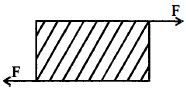
Correct Answer: (B)
\(\Delta P = \frac{{mg}}{a}\)\(k = - \frac{{\frac{{mg}}{A}}}{{\frac{{4\pi {r^2}dr}}{{\frac{4}{3}\pi {r^3}}}}}\)
\(\frac{{dr}}{r} = - \frac{{mg}}{{3KA}}\)
-
- (A) \(1.00\)
- (B) \(0.25\)
- (C) \(0.37\)
- (D) \(0.75\)
Show answer and solution
Correct Answer: (B)
For same material teh ratio of stress to strain is sameFor first cube
\(Stres{s_1} = \frac{{force}}{{force}} = \frac{{{{10}^5}}}{{\left( {{{0.1}^2}} \right)}}\)
\(Strai{n_1} = \frac{{change\,in\,lengt{h_1}}}{{original\,lengt{h_1}}} = \frac{{0.5 \times {{10}^{ - 2}}}}{{0.1}}\)
For second block,
\(Stres{s_2} = \frac{{forc{e_2}}}{{are{a_2}}} = \frac{{{{10}^5}}}{{\left( {{{0.2}^2}} \right)}}\)
\(Strai{n_2} = \frac{{change\,in\,lengt{h_2}}}{{original\,lengt{h_2}}} = \frac{x}{{0.2}}\)
\(x\) is the displacement for second block.
\(For\,same\,material,\frac{{Stress_1}}{{Strai{n_1}}} = \frac{{Stress_2}}{{Strai{n_2}}}\)
\(or,\frac{{\frac{{10.5}}{{{{\left( {0.1} \right)}^2}}}}}{{\frac{{0.5 \times {{10}^{ - 2}}}}{{0.1}}}} = \frac{{\frac{{{{10}^5}}}{{{{\left( {0.2} \right)}^2}}}}}{{\frac{x}{{0.2}}}}\)
\(Solving\,we\,get,\,x = 0.25\,cm\)
-
- (A) \(6\)
- (B) \(12\)
- (C) \(4.8\)
- (D) \(2.4\)
Show answer and solution
Correct Answer: (D)
Clearly from figure,\({P_2} = {P_0} + \frac{{4T}}{6} + \frac{{4t}}{4}\)
\(or,\,\,\,{P_2} - {P_0} = \frac{{4T}}{6} + \frac{{4T}}{4}\) \(...\left( i \right)\)
Let \(r\) be the radius of bubble with pressure difference
\({P_2} - {P_0}\,so,\)
\({P_2} - {P_0} = \frac{{4T}}{r}\) \(...(ii)\)
\(From\,e{q^n}\,\left( i \right)\,and\,\left( {ii} \right),\)
\(\frac{{4T}}{r} = \frac{{4T}}{6} + \frac{{4T}}{4}\)
\(\frac{1}{r} = \frac{1}{6} + \frac{1}{4} \Rightarrow r = 2.4\,cm\)

-
- (A) \(10.5\)
- (B) \(8.7\)
- (C) \(11.2\)
- (D) \(9.5\)
Show answer and solution
Correct Answer: (D)
Using\({P_1}{V_1} = {P_2}{V_2}\)\(\left( {{P_1}} \right)\frac{4}{3}\pi {r^3} = \left( {{P_2}} \right)\frac{4}{3}\pi \frac{{125{r^3}}}{{64}}\)
\(\frac{{\rho g\left( {10} \right) + \rho gh}}{{\rho g\left( {10} \right)}} = \frac{{125}}{{64}}\)
\(640 + 64\,h = 1250\)
\(On\,solving\,we\,get\,h = 9.5\,m\)
-
- (A) \(\theta = {\tan ^{ - 1}}\left[ {\frac{\pi }{2}\left( {\frac{{{\rho _1} - {\rho _2}}}{{{\rho _1} + {\rho _2}}}} \right)} \right]\)
- (B) \(\theta = {\tan ^{ - 1}}\frac{\pi }{2}\left( {\frac{{{\rho _1} + {\rho _2}}}{{{\rho _1} - {\rho _2}}}} \right)\)
- (C) \(\theta = {\tan ^{ - 1}}\pi \left( {\frac{{{\rho _1}}}{{{\rho _2}}}} \right)\)
- (D) \(\theta = {\tan ^{ - 1}}\frac{\pi }{2}\left( {\frac{{{\rho _2}}}{{{\rho _1}}}} \right)\)
Show answer and solution
Correct Answer: (A)
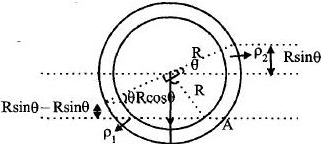
Pressure at interface \(A\) must be same from both the sides to be in equilibrium.\(\therefore \left( {R\cos \theta + R\sin \theta } \right){\rho _2}g\)
\( = \left( {R\cos \theta - R\sin \theta } \right){\rho _1}g\)
\( \Rightarrow \frac{{{\rho _1}}}{{{\rho _2}}} = \frac{{\cos \theta + \sin \theta }}{{\cos \theta - \sin \theta }} = \frac{{1 + \tan \theta }}{{1 - \tan \theta }}\)
\( \Rightarrow {\rho _1} - {\rho _1}\,\tan \,\theta = {\rho _2} + {\rho _2}\,\tan \,\theta \)
\( \Rightarrow \left( {{\rho _1} + {\rho _2}} \right)\tan \theta = {\rho _1} - {\rho _2}\)
\(\therefore \theta = {\tan ^{ - 1}}\left( {\frac{{{\rho _1} - {\rho _2}}}{{{\rho _1} + {\rho _2}}}} \right),so\,closest\,answer\,is\left( a \right)\)
-
- (A) \(4.70 \times 10^3\) \(N/m^2\)
- (B) \(2.35 \times 10^2 \) \(N/m^2\)
- (C) \(4.70 \times 10^ 2\) \( N/m^2\)
- (D) \(2.35 \times 10^3\) \( N/m^2\)
Show answer and solution
Correct Answer: (D)
\(\begin{array}{l}
Change\,in\,momentum\\
\Delta P = \frac{P}{{\sqrt 2 }}\hat j + \frac{P}{{\sqrt 2 }}\hat j + \frac{P}{{\sqrt 2 }}\hat i - \frac{P}{{\sqrt 2 }}\hat i\\
\Delta P = \frac{{2P}}{{\sqrt 2 }}\hat j = {I_H}\,molecule\\
\Rightarrow \,{I_{wall}} = - \frac{{2P}}{{\sqrt 2 }}\hat j
\end{array}\)\(\begin{array}{l}
pressure,P\\
= \frac{F}{A} = \frac{{\sqrt 2 P}}{A}n\,\,\,\,\,\left( {\,n = no.of\,particles} \right)\\
= \frac{{\sqrt 2 \times 3.32 \times {{10}^{ - 27}} \times {{10}^3} \times {{10}^{23}}}}{{2 \times {{10}^{ - 4}}}}\\
= 2.35 \times {10^3}N/{m^2}
\end{array}\)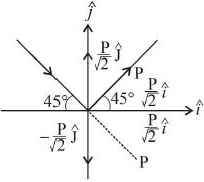
-
- (A) \( - \frac{{GMm}}{{2R}}\)
- (B) \( + \frac{{GMm}}{{6R}}\)
- (C) \( - \frac{{GMm}}{{6R}}\)
- (D) \( \frac{{GMm}}{{2R}}\)
Show answer and solution
Correct Answer: (C)
Initial gravitational potential energy,\({E_i} = - \frac{{GMm}}{{2R}}\)
Final gravitational potential energy,
\({E_f} = - \frac{{GMm/2}}{{2\left( {\frac{R}{2}} \right)}}\frac{{GMm/2}}{{2\left( {\frac{{3R}}{2}} \right)}}\)
\( = - \frac{{GMm}}{{2R}} - \frac{{GMm}}{{6R}}\)
\( = - \frac{{4GMm}}{{6R}} = - \frac{{2GMm}}{{3R}}\)
\(\therefore \) Difference between initial and final energy,
\({E_f} - {E_i} = \frac{{GMm}}{R}\left( { - \frac{2}{3} + \frac{1}{2}} \right) = - \frac{{GMm}}{{6R}}\)
- 98. Suppose that the angular velocity of rotation of earth is increased. Then, as a consequence. 2018 Medium
- (A) There will be no change in weight anywhere on the earth
- (B) Weight of the object, everywhere on the earth, wild decrease
- (C) Weight of the object, everywhere on the earth, will increase
- (D) Except at poles, weight of the object on the earth will decrease
Show answer and solution
Correct Answer: (D)
With rotation of earth or latitude, acceleration due to gravity vary as \(g' = g - {\omega ^2}R\,\,{\cos ^2}\,\phi \) Where \(\phi \) is latitude, there will be no change in gravity at poles as \(\phi = 90^o\) At all other points as \(\omega \) increases \(g'\) will decreases hence, weight, \(W = mg\) decreases. -
- (A) \(2\)
- (B) \(6\)
- (C) \(10^{-2}\)
- (D) \(0.6\)
Show answer and solution
Correct Answer: (A)
As we know, Gravitational force of attraction,\(F = \frac{{GMm}}{{{R^2}}}\)
\({F_1} = \frac{{G{M_e}m}}{{r_1^2}}\,and\,{F_2} = \frac{{G{m_e}{M_s}}}{{r_2^2}}\)
\(\Delta {F_1} = \frac{{2G{M_e}m}}{{r_1^3}}\Delta {r_1}\,and\,\Delta {F_2} = \frac{{G{M_e}{M_s}}}{{r_2^3}}\Delta {r_2}\)
\(\frac{{\Delta {F_1}}}{{\Delta {F_2}}} = \frac{{m\Delta {r_1}}}{{r_1^3}}\frac{{r_2^3}}{{{M_s}\Delta {r_2}}} = \left( {\frac{m}{{{M_s}}}} \right)\left( {\frac{{r_2^3}}{{r_1^3}}} \right)\left( {\frac{{\Delta {r_1}}}{{\Delta {r_2}}}} \right)\)
Using \(\Delta {r_1} = \Delta {r_2} = 2{R_{earth}};m = 8 \times {10^{22}}\,kg;\)
\({M_s} = 2 \times {10^{30\,}}kg\)
\({r_1} = 0.4 \times {10^6}km\,and\,{r_2} = 150 \times {10^6}\,km\)
\(\frac{{\Delta {F_1}}}{{\Delta {F_2}}} = \left( {\frac{{8 \times {{10}^{22}}}}{{2 \times {{10}^{30}}}}} \right){\left( {\frac{{150 \times {{10}^6}}}{{0.4 \times {{10}^6}}}} \right)^3} \times 1 \cong 2\)
-
- (A) \(3\times 10^{-2}\)
- (B) \(10^{-2}\)
- (C) \(2\times 10^{-2}\)
- (D) \(6\times 10^{-2}\)
Show answer and solution
Correct Answer: (C)
From Kepler's law, time period of a satellite,\(T = 2\pi \sqrt {\frac{{{r^3}}}{{Gm}}} \,\,\,\,\,\,\,{T^2} = \frac{{4{\pi ^2}}}{{GM}}{r^3}\)
\(M = \frac{4\pi^2 r^3}{GT^2}\)
\(\frac{\Delta M}{M} = 3 \frac{\Delta r}{r} + 2 \frac{\Delta T}{T}\)
\(\frac{\Delta M}{M} = 3(0) + 2(10^{-2})\)
\(\frac{\Delta M}{M} = 2 \times 10^{-2}\)
No questions on this page match these filters.