


Questions
5 questionsShowing 1–5 of 5 questions
-
- (A) \(0.3\)
- (B) \(2.4\)
- (C) \(0.9\)
- (D) \(1.2\)
Show answer and solution
Correct Answer: (D)
Charge on Capacitor, \(\mathrm{Q}_{i}=\mathrm{CV}\)After inserting dielectric of dielectric constant = \(\mathrm{K}\)
\(\mathrm{Q}_{\mathrm{f}}=(\mathrm{k} \mathrm{C}) \mathrm{V}\)
Induced charges on dielectric
\( \mathrm{Q}_{\mathrm{ind}} =\mathrm{Q}_{\mathrm{f}}-\mathrm{Q}_{\mathrm{i}}=\mathrm{KCV}-\mathrm{CV} \)
\(=(\mathrm{K}-1) \mathrm{CV}=\left(\frac{5}{3}-1\right) \times 90 \,\mathrm{pF} \times 2\, \mathrm{V}=1.2\, \mathrm{nc} \)
-
- (A) \(150\)
- (B) \(100\)
- (C) \(250\)
- (D) \(300\)
Show answer and solution
Correct Answer: (C)
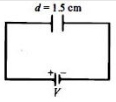
Given area of Parallel plate capacitor, \(A=\) \(200\, \mathrm{cm}^{2}\)Separation between the plates, \(d=1.5\, \mathrm{cm}\) Force of attraction between the plates, \(F=\) \(25 \times 10^{-6}\, \mathrm{N}\)
\(F=Q E\)
\(F=\frac{Q^{2}}{2 A \epsilon_{0}} \quad\) (\(E\) due to parallel plate
\(=\frac{\sigma}{2 \epsilon_{0}}=\frac{Q}{A 2 \epsilon_{0}})\)
But \(Q=C V=\frac{\epsilon_{0} A(V)}{d}\)
\(\therefore \,F = \,\frac{{({\epsilon_0}A{V^2})}}{{{{\text{d}}^2} \times 2{\text{A}}{\epsilon_0}}}\)
\( = \frac{{{{\left( {{\epsilon_0}A} \right)}^2} \times {V^2}}}{{{d^2} \times 2 \times \left( {A{\epsilon_0}} \right)}} = \frac{{\left( {{\epsilon_0}A} \right) \times {V^2}}}{{{d^2} \times 2}}\)
or, \(25 \times {10^{ - 6}} = \frac{{\left( {8.85 \times {{10}^{ - 12}}} \right) \times \left( {200 \times {{10}^{ - 4}}} \right) \times {V^2}}}{{2.25 \times {{10}^{ - 4}} \times 2}}\)
\( \Rightarrow V\, = \frac{{25 \times {{10}^{ - 6}} \times 2.25 \times {{10}^{ - 4}} \times 2}}{{8.85 \times {{10}^{ - 12}} \times 200 \times {{10}^{ - 4}}}}\) \( \approx 250\,V\)
-
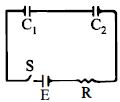
- (A) \({C_{eq}}E\,[1 - \exp ( - t/R{C_{eq}})]\)
- (B) \({C_1}E\,[1 - \exp ( - tR/{C_1})]\)
- (C) \({C_2}E\,[1 - \exp ( - t/R{C_2})]\)
- (D) \({C_{eq}}E\,\exp ( - t/R{C_{eq}})\)
Show answer and solution
Correct Answer: (A)
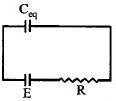
During charging charge on the capacitor increases with time. Charge on the capacitor\(\mathrm{C}_{1}\) as a function of time, \(\mathrm{Q}=\mathrm{Q}_{0}\left(1-\mathrm{e}^{-t / \mathrm{R} C}\right)\)
\(\mathrm{Q}=\mathrm{C}_{\mathrm{eq}} \mathrm{E}\left[1-\mathrm{e}^{-t / \mathrm{RC}_{\mathrm{eq}}}\right]\)
\(\left(\because Q_{0}=C_{e q} E\right)\)
Both capacitor will have charge as they are connected in series
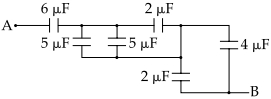
- 4. The equivalent capacitance between \(A\) and \(B\) in the circuit given below is.....\(μF\)
 2018 Hard
- (A) \(4.9\)
- (B) \(3.6\)
- (C) \(5.4\)
- (D) \(2.4\)
Show answer and solution
Correct Answer: (D)
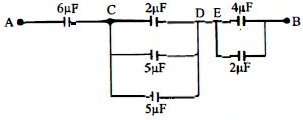
The simplified circuit of the circuit given in question as follows:The equivalent capacitance between \(C \& D\) capacitors of \(2\, \mu \mathrm{F}, 5\, \mu \mathrm{F}\) and \(5\, \mu \mathrm{F}\) are in parallel.
\(\therefore \mathrm{C}_{\mathrm{CD}}=2+5+5=12 \,\mu \mathrm{F}\)
(\(\because\) In parallel grouping \(C_{e q}=C_{1}+C_{2}+\ldots .+C_{n})\)
Similarly equivalent capacitance between \(\mathrm{E}\) \(\& \mathrm{BC}_{\mathrm{EB}}\)
\(=4+2=6\, \mu \mathrm{F}\)
Now equivalent capacitance between \(A \& B\)
\(\frac{1}{C_{e q}}=\frac{1}{6}+\frac{1}{12}+\frac{1}{6}=\frac{5}{12}\)
\(\Rightarrow \mathrm{C}_{\mathrm{eq}}=\frac{12}{5}=24\, \mu \mathrm{F}\)
(\(\because \) In series group-ing, \(\frac{1}{{{C_{eq}}}} = \frac{1}{{{C_1}}} + \frac{1}{{{C_2}}} + \ldots \ldots + \frac{1}{{{C_n}}}\)
-
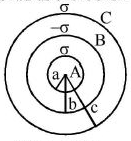
- (A) \(\frac{\sigma}{\epsilon_0} \left[ {\frac{a^2-b^2}{b}+c} \right ]\)
- (B) \(\frac{\sigma}{\epsilon_0} \left[ {\frac{b^2-c^2}{b}+a} \right ]\)
- (C) \(\frac{\sigma}{\epsilon_0} \left[ {\frac{b^2-c^2}{c}+a} \right ]\)
- (D) \(\frac{\sigma}{\epsilon_0} \left[ {\frac{a^2-b^2}{a}+c} \right ]\)
Show answer and solution
Correct Answer: (A)
Potential outside the shell, \(V_{outside}\) \(=\frac{\mathrm{KQ}}{\mathrm{r}}\)where \(\mathrm{r}\) is distance of point from the centre of shel Potential inside the shell, \(V_{\text {inside }}=\frac{K Q}{R}\)
where \('R"\) is radius of the shell
\(\mathrm{V}_{\mathrm{B}}=\frac{\mathrm{Kq}_{\mathrm{A}}}{\mathrm{r}_{\mathrm{b}}}+\frac{\mathrm{Kq}_{\mathrm{B}}}{\mathrm{r}_{\mathrm{b}}}+\frac{\mathrm{Kq}_{\mathrm{C}}}{\mathrm{r}_{\mathrm{c}}}\)
\(\mathrm{V}_{\mathrm{B}}=\frac{1}{4 \pi \epsilon_{0}}\left[\frac{\sigma 4 \pi \mathrm{a}^{2}}{\mathrm{b}}-\frac{\sigma 4 \pi \mathrm{b}^{2}}{\mathrm{b}}+\frac{\sigma 4 \pi \mathrm{c}^{2}}{\mathrm{c}}\right]\)
\(V_{B}=\frac{\sigma}{\epsilon_{0}}\left[\frac{a^{2}-b^{2}}{b}+c\right]\)
No questions on this page match these filters.