


Questions
14 questionsShowing 1–14 of 14 questions
-
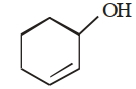
- (A) Cyclohex-\(1\)-en-\(2\)-ol
- (B) \(1\)-Hydroxyhex-\(2\)-ene
- (C) Cyclohex-\(1\)-en-\(3\)-ol
- (D) Cyclohex-\(2\)-en-\(1\)-ol
Show answer and solution
Correct Answer: (D)
Cyclohex-\(2\)-en-\(1\)-ol -
- (A) Benzenoid aromatic
- (B) Benzenoid non-aromatic
- (C) Acyclic
- (D) Alicyclic
Show answer and solution
Correct Answer: (D)
is Alicyclic
-
- (A) \(\mathrm{SO}_4 \mathrm{H}\)
- (B) \(\mathrm{SO}_3 \mathrm{H}\)
- (D) \(-\mathrm{SO}_2\)
Show answer and solution
Correct Answer: (B)
Group present in sulphonic acids
-
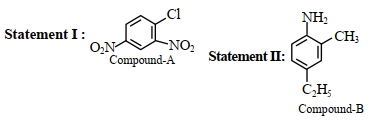
- (A) Both Statement \(I\) and Statement \(II\) are correct
- (B) Statement \(I\) is incorrect but Statement \(II\) is correct
- (C) Statement \(I\) is correct but Statement \(II\) is incorrect
- (D) Both Statement \(I\) and Statement \(II\) are incorrect
Show answer and solution
Correct Answer: (B)
\(IUPAC\) name
\(\Rightarrow \)\(1\)-chloro-\(2, 4-\)dinitrobenzene
\(\Rightarrow \)statement-\(I\) is incorrect
\(\Rightarrow\)\(4\)-ethy\(l-2\)-methylaniline
\(\Rightarrow\)statement-\(II\) is correct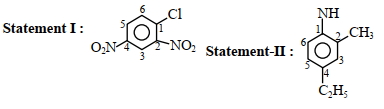
-
- (A) Statement \(I\) is correct but Statement \(II\) is incorrect.
- (B) Both Statement \(I\) and Statement \(II\) are incorrect.
- (C) Both Statement \(I\) and Statement \(II\) are correct.
- (D) Statement \(I\) is incorrect but Statement \(II\) is correct.
Show answer and solution
Correct Answer: (A)
\(7\)-Hydroxyheptan-\(2\)-one is correct \(IUPAC\) name. -
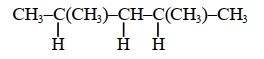
- (A) Three
- (B) One
- (C) Two
- (D) Four
Show answer and solution
Correct Answer: (B)
only one \(2^{\circ}\) carbon is present in this compound.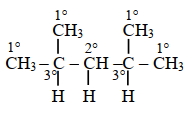
-
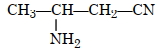
- (A) \(2\)-Aminopentanenitrile
- (B) \(2\)-Aminobutanenitrile
- (C) \(3\)-Aminobutanenitrile
- (D) \(3\)-Aminopropanenitrile
Show answer and solution
Correct Answer: (C)
\(3\)-Aminobutanenitrile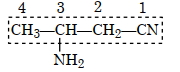
-
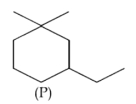
- (A) \(1-\)Ethyl\(-5,\) \(5-\)dimethylcyclohexane
- (B) \(3-\)Ethyl\(-1\),\(1-\)dimethylcyclohexane
- (C) \(1-\)Ethyl\(-3\), \(3-\)dimethylcyclohexane
- (D) \(1\),\(1-\)Dimethyl\(-3-\)ethylcyclohexane
Show answer and solution
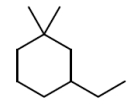
Correct Answer: (B)
\(image\)\(3-\) \(1,\) dimenthylcyclohexane
-
- (A) \(2\)-Ethyl-\(3,6\)-dimethylheptane
- (B) \(2\)-Ethyl-\(2,6\)-diethylheptane
- (C) \(2,5,6\)-Trimethyloctane
- (D) \(3,4,7\)-Trimethyloctane
Show answer and solution
Correct Answer: (C)
\(2,5,6-\) trimethyloctane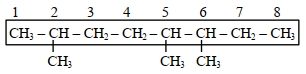
- 10. Number of \(\sigma\) and \(\pi\) bonds present in ethylene molecule is respectively _______. 2024 Medium
- (A) \(3\) and \(1\)
- (B) \(5\) and \(2\)
- (C) \(4\) and \(1\)
- (D) \(5\) and \(1\)
Show answer and solution
Correct Answer: (D)
\(1 \pi\) bond.
-
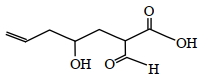
- (A) \(2\)-carboxy-\(4\)-hydroxyhept-\(6\)-enal
- (B) \(2\)-carboxy-\(4\)-hydroxyhept-\(7\)-enal
- (C) \(2\)-formy\(l-4\)-hydroxyhept-\(6\)-enoic acid
- (D) \(2\)-formy\(l-4\)-hydroxyhept-\(7\)-enoic acid
Show answer and solution
Correct Answer: (C)
\(2\)-formly-\(4\)-hydroxyhept-\(6\)-enoic acid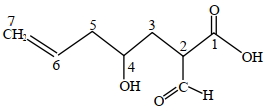
-
- (A) The \(\mathrm{C}-\mathrm{C}\) bonds in ethyne is shorter than that in ethene
- (B) Both carbons are sp hybridised
- (C) Ethyne is linear
- (D) The carbon-carbon bonds in ethyne is weaker than that in ethene
Show answer and solution
Correct Answer: (D)
Explanation:
Let us analyze each statement regarding ethyne (\( \text{H}-\text{C}\equiv\text{C}-\text{H} \)) to identify the incorrect one based on standard chemical bonding principles:
1. Bond Length (Statement A): Ethyne contains a carbon-carbon triple bond (\( \text{C}\equiv\text{C} \)) with a bond length of approximately 120 pm, whereas ethene (\( \text{CH}_2=\text{CH}_2 \)) contains a carbon-carbon double bond (\( \text{C}=\text{C} \)) with a bond length of approximately 134 pm. Since a triple bond is shorter than a double bond, this statement is factually correct.
2. Hybridization (Statement B): Each carbon atom in ethyne forms two sigma bonds and two pi bonds, which corresponds to \( \text{sp} \) hybridization. This statement is factually correct.
3. Geometry (Statement C): Due to the \( \text{sp} \) hybridization of both carbon atoms, the bond angle is \( 180^\circ \), giving ethyne a linear molecular geometry. This statement is factually correct.
4. Bond Strength (Statement D): A carbon-carbon triple bond consists of one sigma bond and two pi bonds, making it significantly stronger (bond dissociation enthalpy of \( 839\text{ kJ/mol} \)) than the carbon-carbon double bond in ethene (bond dissociation enthalpy of \( 614\text{ kJ/mol} \)). Therefore, stating that the bond in ethyne is weaker is factually incorrect.
Since the question specifically asks for the incorrect statement, Option D is the correct choice. - 13. The molecular formula of second homologue in the homologous series of mono carboxylic acids is___________. 2024 Hard
- (A) \(\mathrm{C}_3 \mathrm{H}_6 \mathrm{O}_2\)
- (B) \(\mathrm{C}_2 \mathrm{H}_4 \mathrm{O}_2\)
- (C) \(\mathrm{CH}_2 \mathrm{O}\)
- (D) \(\mathrm{C}_2 \mathrm{H}_2 \mathrm{O}_2\)
Show answer and solution
Correct Answer: (B)
\(\mathrm{HCOOH}, \mathrm{CH}_3 \mathrm{COOH}\)\(\uparrow\)
Second homologue
-
- (A) \(1\)
- (B) \(10\)
- (C) \(18\)
- (D) \(20\)
Show answer and solution
Correct Answer: (C)
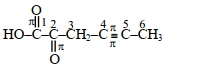
\(2\)-Oxohex-\(4\)-ynoic acid\(\text { Number of } \sigma \text {-bonds }=14\)
\(\text { Number of } \pi \text {-bonds }=4\)
\(=18\)


No questions on this page match these filters.