


JEE Mains · Chemistry · STD 12 - 4. d and f- block elements
Given below are two statements : Statement \(I\) : The higher oxidation states are more stable down the group among transition elements unlike p-block elements. Statement \(II\) : Copper can not liberate hydrogen from weak acids. In the light of the above statements, choose the correct answer from the options given below :
- A Both Statement \(I\) and Statement \(II\) are false
- B Statement \(I\) is false but Statement \(II\) is true
- C Both Statement \(I\) and Statement \(II\) are true
- D Statement \(I\) is true but Statement \(II\) is false
Answer & Solution
Correct Answer
(C) Both Statement \(I\) and Statement \(II\) are true
Step-by-step Solution
Detailed explanation
On moving down the group in transition elements, stability of higher oxidation state increases, due to increase in effective nuclear charge. \( \Rightarrow \mathrm{E}_{\mathrm{Cu}^{+2} / \mathrm{Cu}}^{\circ}=0.34 \mathrm{~V} \)…
See the Complete Solution
Get step-by-step explanations for this and 2.5 Lakh+ more JEE, NEET & CET questions.
- Unlock all solutions
- Practice the full chapter
- Track accuracy across PYQs
4.8 rated on Google Play · 14,000+ reviews
More questions from Chemistry
- Arrange the following conformational isomers of \(n-\)butane in order of their increasing potential energy :
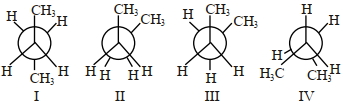 JEE Mains 2021 Easy
 - Which of the following statements are correct about \(\mathrm{Zn}, \mathrm{Cd}\) and \(\mathrm{Hg}\) ? \(A\). They exhibit high enthalpy of atomization as the d-subshell is full. \(B\). \(\mathrm{Zn}\) and \(\mathrm{Cd}\) do not show variable oxidation state while \(\mathrm{Hg}\) shows \(+\mathrm{I}\) and + \(II.\) \(C\). Compounds of \(\mathrm{Zn}, \mathrm{Cd}\) and \(\mathrm{Hg}\) are paramagnetic in nature. \(D\). \(\mathrm{Zn}, \mathrm{Cd}\) and \(\mathrm{Hg}\) are called soft metals. Choose the most appropriate from the options given below:JEE Mains 2024 Hard
- Given below are two statements :
Statement (I) : A spectral line will be observed for a \(2 \mathrm{p}_x \rightarrow 2 \mathrm{p}_y\) transition.
Statement (II) : \(2 P_x\) and \(2 p_y\) are degenerate orbitals.
In the light of the above statements, choose the correct answer from the options given below :JEE Mains 2025 Easy - The increasing order of the reactivity of the following with \(LiAlH_4\) is
 JEE Mains 2019 Hard
 - Match List-I with List-II
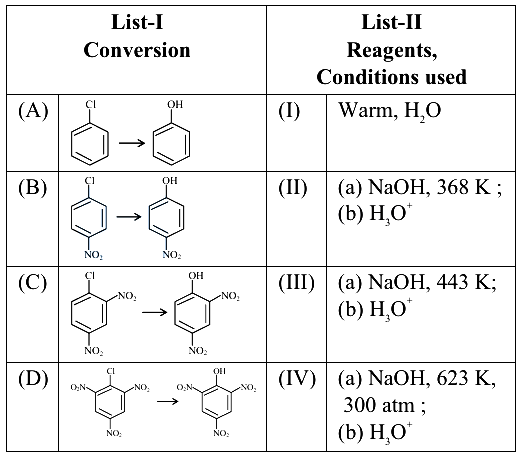
Choose the correct answer from the options given below :JEE Mains 2025 Medium - The number of stereoisomers possible for \(1,2-\) dimethyl cyclopropane is :JEE Mains 2021 Easy
More PYQs from JEE Mains
- 80 mL of a hydrocarbon on mixing with 264 mL of oxygen in a closed U-tube undergoes complete combustion. The residual gases after cooling to 273 K occupy 224 mL. When the system is treated with KOH solution, the volume decreases to 64 mL. The formula of the hydrocarbon is:JEE Mains 2026 Medium
- If the point on the curve \(y^{2}=6 x\), nearest to the point \(\left(3, \frac{3}{2}\right)\) is \((\alpha, \beta)\), then \(2(\alpha+\beta)\) is equal to \(.....\)JEE Mains 2021 Hard
- Let \(f: R-\left\{\frac{\alpha}{6}\right\} \rightarrow R\) be defined by \(f(x)=\frac{5 x+3}{6 x-\alpha} .\) Then the value of \(\alpha\) for which \((fof)(x)=x\), for all \(x \in R-\left\{\frac{\alpha}{6}\right\}\), is:JEE Mains 2021 Medium
- Match List \(I\) with List \(II\)
Choose the correct answer from the options given below :-List \(I\) (Spectral Series for Hyddrogen) List \(II\) (Spectral Region/Higher Energy State) \(A\). Lyman \(I\). Infrared region \(B\). Balmer \(II\). \(UV\) region \(C\). Paschen \(III\). Infrared region \(D\). Pfund \(IV\). Visible region JEE Mains 2024 Hard - In the following reactions, \(ZnO\) is respectively acting as a/an : \((A)\,ZnO + Na_2O\rightarrow Na_2ZnO_2\) \((B)\,ZnO + CO_2\rightarrow ZnCO_3\)JEE Mains 2017 Easy
- In \(CH _{2} = C = C H - C H _{3}\) \(\quad 1\quad \quad 2\quad \quad 3\quad \quad \quad 4\) molecule, the hybridization of carbon \(1,2,3\) and \(4\) respectively are :JEE Mains 2021 Medium