


Questions
20 questionsShowing 1–20 of 20 questions
-
- (A) \(5\)
- (B) \(7\)
- (C) \(9\)
- (D) \(10\)
Show answer and solution
Correct Answer: (A)
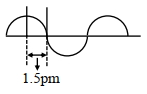
\(\lambda=1.5 \times 4 \mathrm{pm}\)\(=6 \times 10^{-12} \text { meter }\)
\(\lambda v=\mathrm{C}\)
\(6 \times 10^{-12} \times v=3 \times 10^8\)
\(v=5 \times 10^{19} \mathrm{~Hz}\)
-
- (A) \(12\)
- (B) \(65\)
- (C) \(58\)
- (D) \(20\)
Show answer and solution
Correct Answer: (C)
\( \mathrm{m} \Delta \mathrm{V} \cdot \Delta \mathrm{x}=\frac{\mathrm{h}}{4 \pi} \)\(\Delta \mathrm{V} \)\( =\frac{6.626 \times 10^{-34}}{9.1 \times 10^{-31} \times 10^{-15} \times 4 \times 3.14} \)
\( =57.97 \times 10^{+9} \mathrm{~m} / \mathrm{sec}\)
-
- (A) \((\mathrm{B})>(\mathrm{A})>(\mathrm{C})>\text { (E) }>\text { (D) }\)
- (B) \((\mathrm{E})>(\mathrm{C})<\text { (D) }<\text { (A) }<\text { (B) }\)
- (C) \({ (E) }>\text { (C) }>\text { (A) }>\text { (D) }>\text { (B) }\)
- (D) \((\mathrm{C})<\text { (E) }<\text { (D) }<\text { (A) }<\text { (B) }\)
Show answer and solution
Correct Answer: (D)
Energy level can be determined by comparing ( \(\mathrm{n}+\ell\) ) values\((A)\) \(\mathrm{n}=4, \ell=1 \Rightarrow(\mathrm{n}+\ell)=5\)
\((B)\) \(\mathrm{n}=4, \ell=2 \Rightarrow(\mathrm{n}+\ell)=6\)
\((C)\) \(\mathrm{n}=3, \ell=1 \Rightarrow(\mathrm{n}+\ell)=4\)
\((D\)) \(\mathrm{n}=3, \ell=2 \Rightarrow(\mathrm{n}+\ell)=5\)
\((E)\) \(\mathrm{n}=4, \ell=0 \Rightarrow(\mathrm{n}+\ell)=4\)
For same value of \((n+\ell)\), orbital having higher value of \(n\), will have more energy.
\((B) \)>\( (A) \)>\( (D) \)>\( (E) \)>\( (C)\)
-
- (A) \(34\)
- (B) \(40\)
- (C) \(45\)
- (D) \(50\)
Show answer and solution
Correct Answer: (A)
\(34\) -
- (A) \(600\)
- (B) \(657\)
- (C) \(661\)
- (D) \(668\)
Show answer and solution
Correct Answer: (C)
\(\lambda=\frac{\mathrm{h}}{\mathrm{mv}}\)\(\lambda=\frac{\mathrm{hv}}{\mathrm{mv}^2}\)
\(\frac{\mathrm{mv}^2}{\mathrm{~h}}=\frac{\mathrm{v}}{\lambda}=\mathrm{v} \text { (frequency) }\)
\(\text { Given } \frac{1}{2} \mathrm{mv}^2=2.18 \times 10^{-18} \mathrm{~J}\)
\(\mathrm{~h}=6.6 \times 10^{-34}\)
\(\mathrm{v}=\frac{4.36 \times 10^{-18}}{6.6 \times 10^{-34}}=660.60 \times 10^{13} \mathrm{~Hz}\)
\(\approx 661 \times 10^{13} \mathrm{~Hz}\)
-
- (A) Statement-\(I\) is true but Statement-\(II\) is false
- (B) Both Statement-\(I\) and Statement-\(II\) are true.
- (C) Both Statement-\(I\) and Statement-\(II\) are false
- (D) Statement-\(I\) is false but Statement-\(II\) is true
Show answer and solution
Correct Answer: (A)
For single electron species the energy depends upon principal quantum number ' \(n\) ' only. So, statement \(II\) is false.
Statement \(I\) is correct definition of degenerate orbitals. -
- (A) \(4\)
- (B) \(7\)
- (C) \(8\)
- (D) \(6\)
Show answer and solution
Correct Answer: (D)
\(\mathrm{n}=4\)l \(\quad \mathrm{m}_{\ell}\)
\(0 \quad 0\)
\(1-1,0,+1\)
\(2-2,-1,0,+1,+2,+3\)
So number of orbital associated with
\(\mathrm{n}=4,\left|\mathrm{~m}_{\mathrm{l}}\right|=1\) are \(6\)
Now each orbital contain one \(e^{-}\)with \(\mathrm{m}_x=-\frac{1}{2}\)
-
- (A) \(A-IV, B-III, C-II, D-I\)
- (B) \(A-III, B-II, C-I, D-IV\)
- (C) \(A-I, B-IV, C-III, D-II\)
- (D) \(A-II, B-I, C-IV, D-III\)
Show answer and solution
Correct Answer: (B)
(\(A\)) \({ }_7 \mathrm{~N}:[\mathrm{He}] 2 \mathrm{~s}^2 2 \mathrm{p}^3\)(\(B\)) \({ }_{16} \mathrm{~S}:[\mathrm{Ne}] 2 \mathrm{~s}^2 3 \mathrm{p}^4\)
(\(C\)) \({ }_{35} \mathrm{Br}:[\mathrm{Ar}] 3 \mathrm{~d}^{10} 4 \mathrm{~s}^2 4 \mathrm{p}^5\)
(\(D\)) \({ }_{36} \mathrm{Kr}:[\mathrm{Ar}] 3 \mathrm{~d}^{10} 4 \mathrm{~s}^2 4 \mathrm{p}^6\)
-
- (A) \(A-II\), \(B-III\), \(C-I\), \(D-IV\)
- (B) \(A-I\), \(B-III\), \(C-II\), \(D-IV\)
- (C) \(A-II\), \(B-IV\), \(C-III\), \(D-I\)
- (D) \(A-I\), \(B-II\), \(C-III\), \(D-IV\)
Show answer and solution
Correct Answer: (C)
\(A - II\), \(B - IV\), \(C - III\), \(D - I\)Fact based.
-
- (A) \(11\)
- (B) \(10\)
- (C) \(12\)
- (D) \(13\)
Show answer and solution
Correct Answer: (B)
\(5^{\text {th }} \text { excited state } \Rightarrow n_1=6\)\(1^{\text {st }} \text { excited state } \Rightarrow n_2=2\)
\(\Delta n=n_1-n_2=6-2=4\)
Maximum number of spectral lines
\(=\frac{\Delta \mathrm{n}(\Delta \mathrm{n}+1)}{2}=\frac{4(4+1)}{2}=10\)
-
- (A) \(540\) and \(\frac{1}{683}\)
- (B) \(540\) and \(683\)
- (C) \(450\) and \(\frac{1}{683}\)
- (D) \(450\) and \(683\)
Show answer and solution
Correct Answer: (B)
The candela is the luminous intensity of a source that emits monochromatic radiation of frequency radiation of frequency \(540 \times 10^{12} \mathrm{~Hz}\) and has a radiant intensity in that direction of \(\frac{1}{683} \mathrm{w} / \mathrm{sr}\). It is unit of Candela. - 12. The correct set of four quantum numbers for the valence electron of rubidium atom \((Z=37)\) is _______. 2024 Hard
- (A) \(5,0,0,+\frac{1}{2}\)
- (B) \(5,0,1,+\frac{1}{2}\)
- (C) \(5,1,0,+\frac{1}{2}\)
- (D) \(5,1,1,+\frac{1}{2}\)
Show answer and solution
Correct Answer: (A)
\( \mathrm{Rb}=[\mathrm{Kr}] 5 \mathrm{~s}^1 \)\( \mathrm{n}=5 \)
\( l=0 \)
\( \mathrm{~m}=0 \)
\( \mathrm{~s}=+1 / 2 \text { or }-1 / 2\)
- 13. The de-Broglie's wavelength of an electron in the \(4^{\text {th }}\) orbit is _______. \(\pi a_0 .\left(a_0=\right.\) Bohr's radius) 2024 Medium
- (A) \(5\)
- (B) \(4\)
- (C) \(7\)
- (D) \(8\)
Show answer and solution
Correct Answer: (D)
\(2 \pi \mathrm{r}_{\mathrm{u}}=\mathrm{n} \lambda_{\mathrm{d}}\)\(2 \pi \mathrm{a}_0 \frac{\mathrm{n}^2}{\mathrm{z}}=\mathrm{n} \lambda_{\mathrm{d}}\)
\(2 \pi \mathrm{a}_0 \frac{4^2}{1}=4 \lambda_{\mathrm{d}}\)
\(\lambda_{\mathrm{d}}=8 \pi \mathrm{a}_0\)
- 14. The four quantum numbers for the electron in the outer most orbital of potassium (atomic no. \(19\)) are _______. 2024 Hard
- (A) \(\mathrm{n}=4, l=2, \mathrm{~m}=-1, s=+\frac{1}{2}\)
- (B) \(\mathrm{n}=4, l=0, \mathrm{~m}=0, s=+\frac{1}{2}\)
- (C) \(\mathrm{n}=3, l=0, \mathrm{~m}=1, s=+\frac{1}{2}\)
- (D) \(\mathrm{n}=2, l=0, \mathrm{~m}=0, s=+\frac{1}{2}\)
Show answer and solution
Correct Answer: (B)
\({ }_{19} \mathrm{K} \quad 1 \mathrm{~s}^2, 2 \mathrm{~s}^2, 2 \mathrm{p}^6, 3 \mathrm{~s}^2, 3 \mathrm{p}^6, 4 \mathrm{~s}^1 \text {. }\)Outermost orbital of potassium is \(4 \mathrm{~s}\) orbital
\(\mathrm{n}=4, \mathrm{l}=0, \mathrm{~m}_1=0, \mathrm{~s}= \pm \frac{1}{2}\)
-
- (A) \(494\)
- (B) \(490\)
- (C) \(499\)
- (D) \(445\)
Show answer and solution
Correct Answer: (A)
\(\mathrm{E}=\frac{1240}{\lambda(\mathrm{nm})} \mathrm{eV}\)\(=\frac{1240}{242} \mathrm{eV}\)
\(=5.12 \mathrm{eV}\)
\(=5.12 \times 1.6 \times 10^{-19}\)
\(=8.198 \times 10^{-19} \mathrm{~J} / \text { atom }\)
\(=494 \mathrm{~kJ} / \mathrm{mol}\)
-
- (A) \(14\)
- (B) \(35\)
- (C) \(18\)
- (D) \(16\)
Show answer and solution
Correct Answer: (D)
\(n=4\) can have,
So, Ans.\(16\)\(4\text s\) \(4\text q\) \(4\text d\) \(4\text f\) Total \(\text e^{-}\) \(2\) \(6\) \(10\) \(14\) Total \(\text e ^{-}\)with \(\text S =+\frac{1}{2}\) \(1\) \(3\) \(5\) \(7\) -
- (A) \(1\)
- (B) \(4\)
- (C) \(2\)
- (D) \(3\)
Show answer and solution
Correct Answer: (A)
For \(3 \mathrm{p}: \mathrm{n}=3, \ell=1\)Number of radial node \(=n-\ell-1\)
\(=3-1-1=1\)
-
- (A) \(22\)
- (B) \(25\)
- (C) \(30\)
- (D) \(35\)
Show answer and solution
Correct Answer: (A)
\(\mathrm{V}=2.18 \times 10^6 \times \frac{\mathrm{Z}}{\mathrm{n}}\)\(=21.8 \times 10^5 \times \frac{1}{1} \approx 22 \times 10^5 \text { (nearest) }\)
-
- (A) \(2\)
- (B) \(7\)
- (C) \(9\)
- (D) \(11\)
Show answer and solution
Correct Answer: (A)
\( \text { Noble gas configuration }=\mathrm{ns}^2 \mathrm{np}^6 \)\( {\left[\mathrm{Sr}^{2+}\right]=[\mathrm{Kr}\rfloor} \)
\( {\left[\mathrm{Cs}^{+}\right]=[\mathrm{Xe}]} \)
\( {\left[\mathrm{Yb}^{2+}\right]=[\mathrm{Xe}] 4 \mathrm{f}^{14}}\)
\( {\left[\mathrm{La}^{2+}\right]=[\mathrm{Xe}] 5 \mathrm{~d}^1} \)
\( {\left[\mathrm{~Pb}^{2+}\right]=[\mathrm{Xe}] 4 \mathrm{f}^{14} 5 \mathrm{~d}^{10} 6 \mathrm{~s}^2} \)
\( {\left[\mathrm{Fe}^{2+}\right]=[\mathrm{Ar}] 3 \mathrm{~d}^6}\)
- 20. Wavenumber for a radiation having \(5800 \mathring A\) wavelength is \(x \times 10 \mathrm{~cm}^{-1}\). The value of \(x\) is _______. 2024 Medium
- (A) \(1724\)
- (B) \(1725\)
- (C) \(1727\)
- (D) \(1730\)
Show answer and solution
Correct Answer: (A)
\(\bar{v} \text { (wave no.) }=\frac{1}{\lambda}=\frac{1}{5800 \times 10^{-8} \mathrm{~cm}}=17241\)OR
\(1724 \times 10 \mathrm{~cm}^{-1} \Rightarrow \mathrm{x}=1724\)
No questions on this page match these filters.