


Questions
16 questionsShowing 1–16 of 16 questions
-
- (A) \(4\)
- (B) \(3\)
- (C) \(8\)
- (D) \(7\)
Show answer and solution
Correct Answer: (C)
\( \mathrm{PbS}+4 \mathrm{O}_3 \rightarrow \mathrm{PbSO}_4+4 \mathrm{O}_2 \)\( \mathrm{x}=4, \mathrm{y}=4\)
-
- (A) \(8\)
- (B) \(7\)
- (C) \(6\)
- (D) \(9\)
Show answer and solution
Correct Answer: (A)
Reduction Half Oxidation Half\(2 \mathrm{MnO}_4^{-} \rightarrow 2 \mathrm{MnO}_2\) \(2 \mathrm{I}^{-} \rightarrow \mathrm{I}_2+2 \mathrm{e}^{-}\)
\(2 \mathrm{MnO}_4^{-}+4 \mathrm{H}_2 \mathrm{O}+6 \mathrm{e}^{-} \rightarrow 2 \mathrm{MnO}_2+8 \mathrm{OH}^{-}\) \(6 \mathrm{I}^{-} \rightarrow 3 \mathrm{I}_2+6 \mathrm{e}^{-}\)
Adding oxidation half and reduction half, net reaction is
\(2 \mathrm{MnO}_4^{-}+6 \mathrm{I}^{-}+4 \mathrm{H}_2 \mathrm{O} \rightarrow 3 \mathrm{I}_2+2 \mathrm{MnO}_2+8 \mathrm{OH}^{-}\)
\({z}=8\)
\({ Ans. }8\)
-
- (A) \(1\), \(2\), \(1\) and \(1\)
- (B) \(2\), \(2\), \(1\) and \(3\)
- (C) \(3\),\(4\),\(4\) and \(2\)
- (D) \(2\), \(4\), \(1\) and \(3\)
Show answer and solution
Correct Answer: (A)
\(\Rightarrow \mathrm{Cl}_2+2 \overline{\mathrm{O}} \mathrm{H} \longrightarrow \mathrm{Cl}^{-}+\mathrm{ClO}^{-}+\mathrm{H}_2 \mathrm{O}\)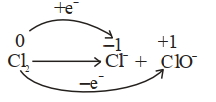
-
- (A) Bromine
- (B) Iodine
- (C) Chlorine
- (D) Fluorine
Show answer and solution
Correct Answer: (D)
Fluorine does not show variable oxidation state. -
- (A) \(2\)
- (B) \(3\)
- (C) \(9\)
- (D) \(11\)
Show answer and solution
Correct Answer: (B)
Compounds \(\mathrm{SO}_3\) \(\mathrm{H}_2 \mathrm{SO}_3\) \(\mathrm{SOCl}_2\) \(\mathrm{SF}_4\) \(\mathrm{BaSO}_4\) \(\mathrm{H}_2 \mathrm{~S}_2 \mathrm{O}_7\) \(O.S.\) of sulphur \(+6\) \(+4\) \(+4\) \(+4\) \(+6\) \(+6\) -
- (A) Statement \(I\) is correct but statement \(II\) is incorrect.
- (B) Statement \(I\) is incorrect but statement \(II\) is correct
- (C) Both statement \(I\) and statement \(II\) are incorrect
- (D) Both statement \(I\) and statement \(II\) are correct
Show answer and solution
Correct Answer: (A)
\(\mathrm{S}_1: \mathrm{S}_{\mathrm{8}}+12 \mathrm{OH}^{\ominus} \rightarrow 4 \mathrm{~S}^{2-}+2 \mathrm{~S}_2 \mathrm{O}_3^{2-}+6 \mathrm{H}_2 \mathrm{O}\)\(\mathrm{S}_2: \mathrm{ClO}_4^{\ominus}\) cannot undergo disproportionation reaction as chlorine is present in it's highest oxidation state.
-
- (A) \(8, 6, 4\) and \(\mathrm{Cr}_2 \mathrm{O}_3\)
- (B) \(14,7,6\) and \(\mathrm{Cr}^{3+}\)
- (C) \(8,4,6\) and \(\mathrm{Cr}_2 \mathrm{O}_3\)
- (D) \(14,6,7\) and \(\mathrm{Cr}^{3+}\)
Show answer and solution
Correct Answer: (D)
The balanced reaction is,\(\mathrm{Cr}_2 \mathrm{O}_7^{2-}+14 \mathrm{H}^{+}+6 \mathrm{e}^{-} \rightarrow 2 \mathrm{Cr}^{3+}+7 \mathrm{H}_2 \mathrm{O}\)
\(\mathrm{X}=14\), \(\mathrm{Y}=6\), \(\mathrm{~Z}=7\), \(\mathrm{A}=\mathrm{Cr}^{3+}\)
-
- (A) \((A)-(I), (B)-(II), (C)-(III), (D)-(IV)\)
- (B) \((A)-(III), (B)-(II), (C)-(I), (D)-(IV)\)
- (C) \((A)-(II), (B)-(III), (C)-(IV), (D)-(I)\)
- (D) \((A)-(IV), (B)-(I), (C)-(II), (D)-(III)\)
Show answer and solution
Correct Answer: (D)
\(\mathrm{A} \rightarrow \text { (IV) }\)
\(\mathrm{B} \rightarrow(\mathrm{I})\)
\(\mathrm{C} \rightarrow \text { (II) }\)
\(\mathrm{D} \rightarrow \text { (III) }\) -
- (A) \(8\)
- (B) \(10\)
- (C) \(15\)
- (D) \(20\)
Show answer and solution
Correct Answer: (A)
\(2 \mathrm{MnO}_4^{-}+5 \mathrm{C}_2 \mathrm{O}_4^{2-}+16 \mathrm{H}^{+} \longrightarrow 2 \mathrm{Mn}^{2+}+10 \mathrm{CO}_2+8 \mathrm{H}_2 \mathrm{O}\)\(\therefore\) Number of moles of \(\mathrm{H}^{+}\)ions required by 1 mole of \(\mathrm{MnO}_4^{-}\)to oxidise oxalate ion to \(\mathrm{CO}_2\) is 8.
- 10. On reaction of Lead Sulphide with dilute nitric acid which of the following is not formed? 2024 Medium
- (A) Nitric oxide
- (B) Nitrous oxide
- (C) Lead nitrate
- (D) Sulphur
Show answer and solution
Correct Answer: (B)
\(PbS + HNO _3 \rightarrow Pb\left( NO _3\right)_2+ NO + S + H _2 O\) Nitrous oxide \(\left( N _2 O \right)\) is not formed during the reaction. -
- (A) 8
- (B) 6
- (C) 5
- (D) 10
Show answer and solution
Correct Answer: (A)
\(\text { eq. }\left(\mathrm{KMnO}_4\right)=\text { eq. }\left(\mathrm{H}_2 \mathrm{C}_2 \mathrm{O}_4\right)\)\(\mathrm{M} \times 2 \times 5=2 \times 20 \times 2\)
\(\mathrm{M}=8 \mathrm{M}\)
-
- (A) Bromine undergoes oxidation and iodine undergoes reduction by iodine in these reactions
- (B) Thiosulphate undergoes oxidation by bromine and reduction by iodine in these reaction
- (C) Bromine is a stronger oxidant than iodine
- (D) Bromine is a weaker oxidant than iodine
Show answer and solution
Correct Answer: (C)
In the reaction of \(\mathrm{S}_2 \mathrm{O}_3{ }^{2-}\) with \(\mathrm{I}_2\), oxidation state of sulphur changes to +\(2\) to +\(2.5\)In the reaction of \(\mathrm{S}_2 \mathrm{O}_3{ }^{2-}\) with \(\mathrm{Br}_2\), oxidation state of sulphur changes from +\(2\) to +\(6\) .
\(\therefore\) Both \(\mathrm{I}_2\) and \(\mathrm{Br}_2\) are oxidant (oxidising agent) and \(\mathrm{Br}_2\) is stronger oxidant than \(\mathrm{I}_2\).
-
- (A) \(4\)
- (B) \(5\)
- (C) \(6\)
- (D) \(7\)
Show answer and solution
Correct Answer: (C)
Intermediate oxidation state of element can undergo disproportionation.\(\mathrm{H}_2 \mathrm{O}_2, \mathrm{ClO}_3^{-}, \mathrm{P}_4, \mathrm{Cl}_2, \mathrm{Cu}^{+1}, \mathrm{NO}_2\)
-
- (A) \(\mathrm{N}^{3-}\)
- (B) \(\mathrm{SO}_4^{2-}\)
- (C) \(\mathrm{BrO}_3^{-}\)
- (D) \(\mathrm{MnO}_4^{-}\)
Show answer and solution
Correct Answer: (A)
In \(\mathrm{N}^{3-}\) ion ' \(\mathrm{N}\) ' is present in its lowest possible oxidation state, hence it cannot be reduced further because of which it cannot act as an oxidizing agent. -
- (A) \((A), (B)\)
- (B) \((B), (C), (D)\)
- (C) \((A), (B), (C)\)
- (D) \((A),(D)\)
Show answer and solution
Correct Answer: (A)
When a particular oxidation state becomes less stable relative to other oxidation state, one lower, one higher, it is said to undergo disproportionation.\(\mathrm{Cu}^{+} \rightarrow \mathrm{Cu}^{2+}+\mathrm{Cu}\)
\(3 \mathrm{MnO}_4^{2-}+4 \mathrm{H}^{+} \rightarrow 2 \mathrm{MnO}_4^{-}+\mathrm{MnO}_2+2 \mathrm{H}_2 \mathrm{O}\)
-
- (A) prevent the hydrolysis of ferrous sulphate
- (B) prevent the hydrolysis of ammonium sulphate
- (C) make the medium strongly acidic
- (D) increase the rate of formation of crystals
Show answer and solution
Correct Answer: (A)
\(Fe ^{+2}\) ions undergoes hydrolysis, therefore while preparing aqueous solution of ferrous sulphate and ammonium sulphate in water dilute sulphuric acid is added to prevent hydrolysis of ferrous sulphate.
No questions on this page match these filters.