


Questions
10 questionsShowing 1–10 of 10 questions
-
- (A) Both \((A)\) and \((R)\) are true but \((R)\) is NOT the correct explanation of \((A)\)
- (B) \((A)\) is true but \((R)\) is false
- (C) Both (\(A\)) and \((R)\) are true and \((R)\) is the correct explanation of\((A)\)
- (D) \((A)\) is false but \((R)\) is true
Show answer and solution
Correct Answer: (C)
Dipole moment is a vector quantity and for compound net dipole moment is the vector sum of all dipoles hence dipole moment of cis form is greater than trans form.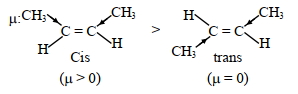
-
- (A) \(3\)
- (B) \(4\)
- (C) \(5\)
- (D) \(6\)
Show answer and solution
Correct Answer: (B)
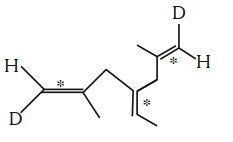
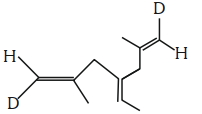
\(3\) stereocenteres, symmetricalTotal Geometrical isomers \(\rightarrow 4\). \(EE, ZZ, EZ\) (two isomers)
-
- (A) 4
- (B) 6
- (C) 8
- (D) 10
Show answer and solution
Correct Answer: (A)
All the following metal ions will respond to flame test.
\(Sr ^{2+}, Ba ^{2+}, Ca ^{2+}, Cu ^{2+}\) -
- (A) \(2\)
- (B) \(4\)
- (C) \(6\)
- (D) \(8\)
Show answer and solution
Correct Answer: (A)
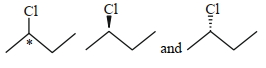
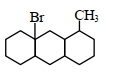
There is one chiral centre present in given compound.So, Total optical isomers \(=2\)
-
- (A) Ethane has infinite number of conformations
- (B) The dihedral angle in staggered conformation is \(60^{\circ}\)
- (C) Eclipsed conformation is the most stable conformation.
- (D) The conformations of ethane are interconvertible to one-another.
Show answer and solution
Correct Answer: (C)
Eclipsed conformation is the least stable conformation of ethane. - 6. The incorrect statement regarding the geometrical isomers of \(2\)-butene is _______. 2024 Medium
- (A) cis-\(2\)-butene and trans-\(2\)-butene are not interconvertible at room temperature.
- (B) cis-\(2\)-butene has less dipole moment than trans-\(2\)-butene.
- (C) trans-\(2\)-butene is more stable than cis-\(2\)-butene.
- (D) cis-\(2\)-butene and trans-\(2\)-butene are stereoisomers.
Show answer and solution
Correct Answer: (B)
Cis-but-\(2\)-ene has higher Dipole moment than trans-but-\(2\)-ene.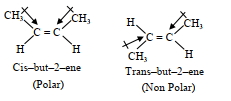
-
- (A) \(30\)
- (B) \(35\)
- (C) \(36\)
- (D) \(32\)
Show answer and solution
Correct Answer: (D)
Total chiral centre \(=5\)No. of optical isomers \(=2^5=32\).
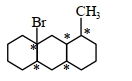
-
- (A) \(6\)
- (B) \(5\)
- (C) \(7\)
- (D) \(75\)
Show answer and solution
Correct Answer: (B)
Explanation:
A carbon atom is considered chiral if it is sp3 hybridized and directly bonded to four different atoms or groups. Let us analyze each compound:
1. Compound I: \( \text{CH}_3-\text{CH}_2-\text{CH}^*(\text{NO}_2)-\text{COOH} \) is chiral. The C-2 carbon is bonded to four distinct groups: \( -\text{H} \), \( -\text{NO}_2 \), \( -\text{COOH} \), and \( -\text{CH}_2\text{CH}_3 \).
2. Compound II: \( \text{CH}_3-\text{CH}_2-\text{CHBr}-\text{CH}_2-\text{CH}_3 \) is achiral. The C-3 carbon is attached to two identical ethyl groups, so it lacks a chiral center.
3. Compound III: \( \text{CH}_3-\text{CH}^*(\text{I})-\text{CH}_2-\text{NO}_2 \) is chiral. The C-2 carbon is bonded to four distinct groups: \( -\text{H} \), \( -\text{I} \), \( -\text{CH}_3 \), and \( -\text{CH}_2\text{NO}_2 \).
4. Compound IV: \( \text{CH}_3-\text{CH}_2-\text{CH}^*(\text{OH})-\text{CH}_2\text{OH} \) is chiral. The C-2 carbon is bonded to four distinct groups: \( -\text{H} \), \( -\text{OH} \), \( -\text{CH}_2\text{CH}_3 \), and \( -\text{CH}_2\text{OH} \).
5. Compound V: \( \text{CH}_3-\text{CH}^*(\text{I})-\text{CH}^*(\text{I})-\text{C}_2\text{H}_5 \) (corrected from the incomplete print) is chiral. Both C-2 and C-3 carbons are bonded to four different groups, creating two chiral centers.
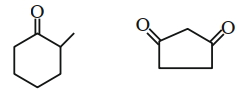
6. Compound VI: 2-Methylcyclohexanone is chiral. The ring carbon bearing the methyl group is attached to four asymmetric paths/groups.
7. Compound VII: Cyclopentane-1,3-dione is achiral due to its internal plane of symmetry and lack of an asymmetric carbon center.
Counting the chiral structures (I, III, IV, V, and VI), we find a total of 5 chiral compounds.
Hence, Option B is the correct choice. -
- (A) \(5\)
- (B) \(8\)
- (C) \(1\)
- (D) \(9\)
Show answer and solution
Correct Answer: (C)
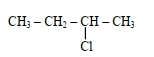
Explanation:
This question requires identifying the number of optically active compounds by analyzing their molecular structures for chiral centers and internal elements of symmetry:
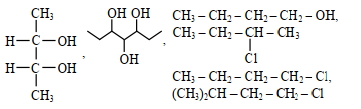
1. Fischer Projection (Butane-2,3-diol):
This structure contains two chiral carbon centers. However, there is a clear horizontal plane of symmetry running through the middle of the molecule that divides it into two mirror-image halves. Due to this internal symmetry, the optical rotation of one half cancels out the other (internal compensation). Therefore, it is a meso compound and is optically inactive.
2. Skeletal Structure (Heptane-3,4,5-triol variant):
This molecule is constitutionally symmetrical from left to right. In the planar zigzag conformation shown, the middle carbon has its \( -\text{OH} \) group pointing downwards, while the two flanking chiral carbons have their \( -\text{OH} \) groups pointing upwards. A vertical plane of symmetry passes directly through the central carbon and its \( -\text{OH} \) group, mirroring the left half perfectly onto the right half. Because of this internal plane of symmetry, it is a meso form and is optically inactive.
3. Analyzing the Condensed Molecular Formulas:
- \( \text{CH}_3-\text{CH}_2-\text{CH}_2-\text{CH}_2-\text{OH} \) (Butan-1-ol): This molecule does not possess any chiral carbon atom (a carbon bonded to four different groups). Thus, it is optically inactive.
- \( \text{CH}_3-\text{CH}_2-\text{CH}(\text{Cl})-\text{CH}_3 \) (2-chlorobutane): The second carbon atom is asymmetric because it is bonded to four completely different groups: \( -\text{H} \), \( -\text{Cl} \), \( -\text{CH}_3 \), and an ethyl group (\( -\text{CH}_2\text{CH}_3 \)). Since it contains a chiral center and lacks any internal symmetry, it is optically active.
- \( \text{CH}_3-\text{CH}_2-\text{CH}_2-\text{CH}_2-\text{Cl} \) (1-chlorobutane): It contains no asymmetric carbon atom, making it optically inactive.
- \( (\text{CH}_3)_2\text{CH}-\text{CH}_2-\text{CH}_2-\text{Cl} \) (1-chloro-3-methylbutane): It contains no asymmetric carbon atom, making it optically inactive.
4. Conclusion:
Out of all the given configurations, only 2-chlorobutane is chiral and lacks internal symmetry elements. Therefore, the total count of optically active compounds is exactly 1.
Hence, Option C is the correct choice. -
- (A) \(8\)
- (B) \(2\)
- (C) \(4\)
- (D) \(3\)
Show answer and solution
Correct Answer: (A)
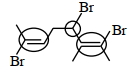
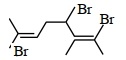
There are three stereo center So No of stereoisomer \(=2^3=8\)
No questions on this page match these filters.