


All JEE Mains 2024 Chemistry questions
26 chaptersShowing 401–450 of 490 questions
-
- (A) \(A\) only
- (B) \(A\), \(B\) and \(D\) only
- (C) \(A\) and \(B\) only
- (D) \(B\), \(C\) and \(D\) only
Show answer and solution
Correct Answer: (B)
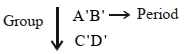
In general along the period from left to right, size decreases and metallic character decrease.In general down the group, size increases and metallic character increases.\(\mathrm{B}^{\prime}<\mathrm{A}^{\prime}(\text { size }) \quad \mathrm{C}^{\prime}>\mathrm{A}^{\prime}(\text { size })\)
\(\mathrm{D}^{\prime}<\mathrm{C}^{\prime}(\text { size }) \quad \mathrm{D}^{\prime}>\mathrm{B}^{\prime}(\text { size })\)
\(\mathrm{B}^{\prime}<\mathrm{A}^{\prime}(\text { metallic character })\)
\(\mathrm{D}^{\prime}<\mathrm{C}^{\prime}(\text { metallic character })\)
\(\mathrm{B}^{\prime+}<\mathrm{A}^{\prime+}(\text { size })\)
\(\mathrm{D}^{\prime+}<\mathrm{C}^{\prime+}(\text { size })\)
\(\therefore \mathrm{C}\) statement is incorrect.
-
- (A) Both \(\mathrm{A}\) and \(\mathrm{R}\) are true and \(\mathrm{R}\) is the correct explanation of \(A\)
- (B) \(A\) is true but \(R\) is false
- (C) \(A\) is false but \(R\) is true
- (D) Both \(\mathrm{A}\) and \(\mathrm{R}\) are true but \(\mathrm{R}\) is \(NOT\) the correct explanation of \(\mathrm{A}\)
Show answer and solution
Correct Answer: (C)
First ionisation energy increases along the period. Along the period \(\mathrm{Z}\) increases which outweighs the shielding effect. -
- (A) Both statement \(I\) and Statement \(II\) are true.
- (B) Statement \(I\) is true but Statement \(II\) is False.
- (C) Statement \(I\) is false but Statement \(II\) is true.
- (D) Both Statement \(I\) and Statement \(II\) is false.
Show answer and solution
Correct Answer: (C)
Chemical reactivity of elements decreases along the period therefore statement \(-\mathrm{I}\) is false.\(Group -1\) elements from basic nature oxides while group - \(17\) elements form acidic oxides therefore statement \(-\mathrm{II}\) is true.
-
- (A) Both Statement \(I\) and Statement \(II\) are false
- (B) Statement \(I\) is false but Statement \(II\) is true
- (C) Statement \(I\) is true but Statement \(VII\) is false
- (D) Both Statement \(I\) and Statement \(II\) are true
Show answer and solution
Correct Answer: (B)
\(I\). In \(p-\)Block both metals and non metals are present but in \(d\)-Block only metals are present.\(II\). \(EN\) and \(IE\) of non metals are greater than that of metals
\(I\) - False, \(II\)-True
-
- (A) Both Statement \(I\) and Statement \(II\) are true
- (B) Statement \(I\) is true but Statement \(II\) is false
- (C) Both Statement \(I\) and Statement \(II\) are false
- (D) Statement \(I\) is false but Statement \(II\) is true
Show answer and solution
Correct Answer: (D)
Explanation:
Let us evaluate both statements according to the periodic trends of electron gain enthalpy:
1. Analysis of Statement I: In Group 17 (halogens), electron gain enthalpy generally becomes less negative down the group. However, Fluorine (\( \text{F} \)) has an exceptionally small atomic size and high electron density in its compact \( 2p \) subshell. This creates significant inter-electronic repulsion when an extra electron is added. Consequently, Chlorine (\( \text{Cl} \)) releases more energy and has a more negative electron gain enthalpy (\( -349\text{ kJ/mol} \)) than Fluorine (\( -328\text{ kJ/mol} \)). Thus, Chlorine has the most negative electron gain enthalpy in its group, making Statement I false.
2. Analysis of Statement II: In Group 16 (chalcogens), due to the very compact size of the Oxygen (\( \text{O} \)) atom, an incoming electron experiences severe repulsion from the valence electrons already present in the \( 2p \) subshell. Therefore, less energy is released upon electron addition compared to its heavier congeners. The electron gain enthalpy values across the group are: \( \text{O} = -141\text{ kJ/mol} \), \( \text{S} = -200\text{ kJ/mol} \), \( \text{Se} = -195\text{ kJ/mol} \), \( \text{Te} = -190\text{ kJ/mol} \), and \( \text{Po} = -174\text{ kJ/mol} \). Since \( -141\text{ kJ/mol} \) represents the smallest absolute magnitude of energy released, Oxygen has the least negative electron gain enthalpy in its group, making Statement II true.
Hence, Option D is the correct choice. -
- (A) Both Statement \(I\) and Statement \(II\) are incorrect
- (B) Statement \(I\) is correct but Statement \(II\) is incorrect
- (C) Both Statement \(I\) and Statement \(II\) are correct
- (D) Statement \(I\) is incorrect but Statement \(II\) is correct
Show answer and solution
Correct Answer: (D)
Oxidation state of an element in a particular compound is defined by the charge acquired by its atom on the basis of electronegativity consideration from other atoms in molecule. -
- (A) Statement \(I\) is false but Statement \(II\) is true
- (B) Both Statement \(I\) and Statement \(II\) are true
- (C) Statement \(I\) is true but Statement \(II\) is false
- (D) Both Statement \(I\) and Statement \(II\) are false
Show answer and solution
Correct Answer: (C)
s-block elements are highly reactive and found in combined state. -
- (A) Statement \(I\) is correct but Statement \(II\) is false
- (B) Both Statement \(I\) and Statement \(II\) are true
- (C) Both Statement \(I\) and Statement \(II\) are false
- (D) Statement \(I\) is incorrect but Statement \(II\) is true
Show answer and solution
Correct Answer: (A)
\(\mathrm{r}_{\mathrm{Na}}>\mathrm{r}_{\mathrm{Na}^{+}}\)So, Statement \((I)\) is correct but size of anions are greater than size of neutral atoms.
So, statement \((II)\) is incorrect.
-
- (A) \((D)\) and \((E)\) only
- (B) \((A)\) and \((C)\) only
- (C) \((B)\) and \((E)\) only
- (D) \((B)\) and \((D)\) only
Show answer and solution
Correct Answer: (B)
As electronegativity increases non-metallic nature increases.Along the period ionisation energy increases.
High electronegativity difference results in ionic bond formation.
Oxides of metals are generally basic and that of non-metals are acidic in nature.
- 410. If \(IUPAC \) name of an element is \("unununium"\) then correct statement regarding element is 2024 Hard
- (A) It is a inner transition element
- (B) It belongs to \(8^{th}\) period in periodic table
- (C) It is transition element
- (D) It is a non-transition element
Show answer and solution
Correct Answer: (C)
\((c)\) \("Unununium"\) : At number \(= 111\)
It is a transition element. Period number \(= 7^{th}\); Group number \(= 11\) - 411. If IUPAC name of an element is "Unununnium" then the element belongs to nth group of periodic table. The value of n is _______. 2024 Medium
- (A) 11
- (B) 22
- (C) 33
- (D) 44
Show answer and solution
Correct Answer: (A)
111 belongs to \(11^{\text {th }}\) group - 412. In case of isoelectronic species the size of \(\mathrm{F}^{-}, \mathrm{Ne}\) and \(\mathrm{Na}^{+}\)is affected by _______. 2024 Hard
- (A) Principal quantum number \((n)\)
- (B) None of the factors because their size is the same
- (C) Electron-electron interaction in the outer orbitals
- (D) Nuclear charge \((z)\)
Show answer and solution
Correct Answer: (D)
In \(\mathrm{F}^{-}, \mathrm{Ne}, \mathrm{Na}^{+}\)all have \(1 \mathrm{~s}^2, 2 \mathrm{~s}^2, 2 \mathrm{p}^0\) configuration. They have different size due to the difference in nuclear charge. -
- (A) \(A-II, B-III, C-IV, D-I\)
- (B) \(A-III, B-II, C-I, D-IV\)
- (C) \(A-IV, B-III, C-II, D-I\)
- (D) \(A-II, B-I, C-IV, D-III\)
Show answer and solution
Correct Answer: (C)
Elements with highest electronegativity \(\rightarrow \mathrm{F}, \mathrm{O}\)Elements with largest atomic size \(\rightarrow \mathrm{Fr}, \mathrm{Ra}\)
Elements which shows properties of both metal and non-metals i.e. metalloids \(\rightarrow \mathrm{Ge}\), As
Elements with highest negative electron gain enthalpy \(\rightarrow \mathrm{Cl}, \mathrm{S}\)
-
- (A) (A)-(II), (B)-(IV), (C)-(III), (D)-(I)
- (B) (A)-(I), (B)-(IV), (C)-(III), (D)-(II)
- (C) (A)-(IV), (B)-(II), (C)-(I), (D)-(III)
- (D) (A)-(III), (B)-(I), (C)-(IV), (D)-(II)
Show answer and solution
Correct Answer: (D)
(A)-(III), (B)-(I), (C)-(IV), (D)-(II) -
- (A) \(7\)
- (B) \(5\)
- (C) \(6\)
- (D) \(3\)
Show answer and solution
Correct Answer: (D)
Explanation:
The ability of an element to exhibit a valency equal to its group valency depends on its electronic configuration and the availability of valence orbitals:
1. Concept of Group Valency: The maximum group valency traditionally corresponds to the number of valence electrons present in the outermost shell of the atoms in that group (Group 13 = 3, Group 14 = 4, Group 15 = 5, Group 16 = 6, Group 17 = 7).
2. Anomalous Behavior of Second Period Elements: Elements belonging to the second period, specifically Nitrogen (\( \text{N} \)), Oxygen (\( \text{O} \)), and Fluorine (\( \text{F} \)), possess only \( 2s \) and \( 2p \) valence orbitals. Since there are no vacant \( 2d \) orbitals available in the second principle shell, their maximum covalency is strictly restricted to 4. Consequently, they cannot expand their octet to form stable compounds matching their group valencies of 5, 6, and 7 respectively.
3. Behavior of Other Given Elements:
- Boron (\( \text{B} \)) forms \( \text{BF}_3 \) matching its group valency of 3.
- Carbon (\( \text{C} \)) forms \( \text{CH}_4 \) matching its group valency of 4.
- Sulfur (\( \text{S} \)) and Phosphorus (\( \text{P} \)) belong to the third period and can utilize vacant \( 3d \) orbitals to expand their octets, forming stable compounds like \( \text{SF}_6 \) (valency = 6) and \( \text{PCl}_5 \) (valency = 5).
- Aluminum (\( \text{Al} \)) and Silicon (\( \text{Si} \)) also easily form stable compounds matching their group valencies of 3 and 4.
Therefore, exactly 3 elements (\( \text{N, O, F} \)) cannot form compounds that match their group valencies.
Hence, Option D is the correct choice. -
- (A) \(B \)<\( D \)<\( C \)<\( E \)<\( A\)
- (B) \(E \)<\( C \)<\( A \)<\( B \)<\( D\)
- (C) \(C \)<\( E \)<\( A \)<\( B \)<\( D\)
- (D) \(A \)<\( B \)<\( D \)<\( C \)<\( E\)
Show answer and solution
Correct Answer: (B)
Correct order of \(\mathrm{I}^{\mathrm{st}} \mathrm{IE}\)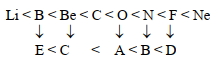
-
- (A) \(\mathrm{Al}>\mathrm{Ga}>\mathrm{Tl}\)
- (B) \(\mathrm{Ga}>\mathrm{Al}>\mathrm{B}\)
- (C) \(\mathrm{B}>\mathrm{Al}>\mathrm{Ga}\)
- (D) \(\mathrm{Tl}>\mathrm{Ga}>\mathrm{Al}\)
Show answer and solution
Correct Answer: (D)
(\(i\)) due to lanthanide contraction \(\mathrm{T} \ell\) has more \(I.E\). as compared to \(\mathrm{Ga}\) and \(\mathrm{A} \ell\)(\(ii\)) due to scandide contraction Ga has more \(I.E\). as compared to \(\mathrm{A} \ell\)
-
- (A) \(C \) > \( B \) > \( D \) > \( A\)
- (B) \(A \) > \( D \) > \( B \) > \( C\)
- (C) \(A \) > \( D \) > \( C \) > \( B\)
- (D) \(D \) > \( C \) > \( B \) > \( A\)
Show answer and solution
Correct Answer: (B)
Element ΔegH (kJ/mol) F −333 S −200 Br −325 Ar +96 -
- (A) \(D\) and \(E\) only
- (B) \(A\), B, \(D\) and E only
- (C) \(A\) and \(D\) only
- (D) \(A\), \(B\) and \(C\) only
Show answer and solution
Correct Answer: (D)
\((A)\) \(\mathrm{Be}+\mathrm{e}^{-} \rightarrow \mathrm{Be}^{-}, \quad\) E.A \(=\)-ive\((B)\) \(\mathrm{N}+\mathrm{e}^{-} \rightarrow \mathrm{N}^{-} \quad\) E.A \(=-\) ive
\((C)\) \(\mathrm{O}+\mathrm{e}^{-} \rightarrow \mathrm{O}^{-}\)
\(\mathrm{O}^{-}+\mathrm{e}^{-} \rightarrow \mathrm{O}^{-2} \quad\) E.A \(=-\) ive
\((D)\) \(\mathrm{Na}+\mathrm{e}^{-} \rightarrow \mathrm{Na}^{-} \quad\) E.A \(=+\) ive
\((E)\) \(\mathrm{A} \ell+\mathrm{e}^{-} \rightarrow \mathrm{A} \ell^{-} \quad\) E.A \(=+\) ive
Ans. \(A,B\) and \(C\) only
-
- (A) \(\mathrm{Si}\)
- (B) \(\mathrm{Al}\)
- (C) \(\mathrm{N}\)
- (D) \(\mathrm{C}\)
Show answer and solution
Correct Answer: (C)
\(\mathrm{Al}<\mathrm{Si}<\mathrm{C}<\mathrm{N} ; \mathrm{IE}_1\) order. -
- (A) \((B), (C)\) and \((D)\) only
- (B) \((A), (B), (C)\) and \((D)\)
- (C) \((C)\) and \((D)\) only
- (D) \((A), (C)\) and \((D)\) only
Show answer and solution
Correct Answer: (D)
\(\mathrm{O}^{-2} \mathrm{~F}^{-} \mathrm{Na}^{+} \mathrm{Mg}^{+2}\)\(\text { (No. of } \mathrm{e}^{-} \text {) } \ 10 \ 10 \ 10 \ 10\)
\(\text { (Ionic radius) } \mathrm{O}^{-2}>\mathrm{F}^{-}>\mathrm{Na}^{+}>\mathrm{Mg}^{+2}\)
\(\text { Zeff } \mathrm{O}^{-2}<\mathrm{F}^{-}<\mathrm{Na}^{+}<\mathrm{Mg}^{-2}\)
-
- (A) \(K_P=\frac{\alpha^{1 /_2} P^{1 / 2}}{(2+\alpha)^{1 /_2}}\)
- (B) \(K_P=\frac{\alpha^{3 /_2} P^{1 / 2}}{(2+\alpha)^{1 / 2}(1-\alpha)}\)
- (C) \(K_P=\frac{\alpha^{1 /_2} P^{3 / 2}}{(2+\alpha)^{3 /_2}}\)
- (D) \(K_P=\frac{\alpha^{1 /_2} P^{1 / 2}}{(2+\alpha)^{3 /_2}}\)
Show answer and solution
Correct Answer: (B)
Sol:-\(A_{(g)} \rightleftharpoons B_{(g)}+\frac{C}{2}(g)\)
\(t=t_{e q}(1-\alpha) \quad \alpha \quad \frac{\alpha}{2}\)
\(\mathrm{P}_{\mathrm{B}}=\frac{\alpha}{\left(1+\frac{\alpha}{2}\right)} . \mathrm{P}, \mathrm{P}_{\mathrm{A}}=\frac{(1-\alpha)}{\left(1+\frac{\alpha}{2}\right)} \cdot \mathrm{P}, \mathrm{P}_{\mathrm{C}}=\frac{\frac{\alpha}{2}}{\left(1+\frac{\alpha}{2}\right)} \cdot \mathrm{P}\)
\(K_P=\frac{P_B \cdot P_C^{\frac{1}{2}}}{P_A}\)
\(=\frac{(\alpha)^{\frac{3}{2}}(P)^{\frac{1}{2}}}{(1-\alpha)(2+\alpha)^{\frac{1}{2}}}\)
-
- (A) \(2\)
- (B) \(1\)
- (C) \(10\)
- (D) \(0.01\)
Show answer and solution
Correct Answer: (C)
\(\Delta \mathrm{n}_{\mathrm{g}}=0 \mathrm{~K}_{\mathrm{p}}=\frac{\left(\mathrm{n}_{\mathrm{HI}}\right)^2}{\mathrm{n}_{\mathrm{H}_2} \mathrm{n}_{\mathrm{I}_2}}\left(\frac{\mathrm{P}_{\mathrm{T}}}{\mathrm{n}_{\mathrm{T}}}\right)^{\Delta \mathrm{ng}_{\mathrm{g}}}\)\(\mathrm{n}_{\mathrm{HI}}=\mathrm{n}_{\mathrm{H}_2}=\mathrm{n}_{\mathrm{I}_2} \text { so } \mathrm{K}_{\mathrm{P}}=1\)
\(1=\mathrm{x} \times 10^{-1} \mathrm{x}=10\)
-
- (A) \(150\)
- (B) \(165\)
- (C) \(160\)
- (D) \(163\)
Show answer and solution
Correct Answer: (D)
\(\frac{3}{2} \mathrm{O}_{2(\mathrm{~g})} \rightleftharpoons \mathrm{O}_{3(\mathrm{~g})} \cdot \mathrm{K}_{\mathrm{P}}=2.47 \times 10^{-29}\)\(\Delta_{\mathrm{r}} \mathrm{G}^{\ominus}=-\mathrm{RT} \ln \mathrm{K}_{\mathrm{P}}\)
\(=-8.314 \times 10^{-3} \times 298 \times \ln \left(2.47 \times 10^{-29}\right)\)
\(=-8.314 \times 10^{-3} \times 298 \times(-65.87)\)
\(=163.19 \mathrm{~kJ}\)
-
- (A) \(70\)
- (B) \(60\)
- (C) \(80\)
- (D) \(57\)
Show answer and solution
Correct Answer: (D)
\(\Delta \mathrm{G}^{\circ}=-\mathrm{RT}(\mathrm{n} \mathrm{K}\)\(=-8.314 \times 300 \ell \mathrm{n}(10)\)
\(=5744.14 \mathrm{~J} / \mathrm{mole}\)
\(=57.44 \times 10^{-1} \mathrm{~kJ} / \mathrm{mole}\)
-
- (A) \(6.0\)
- (B) \(12.0\)
- (C) \(8.0\)
- (D) \(7.0\)
Show answer and solution
Correct Answer: (C)
\(\mathrm{X} \rightleftharpoons \mathrm{Y} \mathrm{k}_1=1\)\(\mathrm{Y} \rightleftharpoons \mathrm{Z} \mathrm{k}_2=2\)
\(\mathrm{Z} \rightleftharpoons \omega \mathrm{k}_3=4\)
\(\mathrm{X} \rightleftharpoons \omega \mathrm{k}_1 \cdot \mathrm{k}_2 \cdot \mathrm{k}_3\)
\(\mathrm{k}=1 \times 2 \times 4\)
\(\mathrm{k}=8\)
-
- (A) \(\mathrm{K}_{\mathrm{C}}=\frac{\left[\mathrm{FeSCN}^{2+}\right]}{\left[\mathrm{Fe}^{3+}\right]\left[\mathrm{SCN}^{-}\right]}\)
- (B) \(\mathrm{K}_{\mathrm{C}}=\frac{\left[\mathrm{Fe}^{3+}\right]\left[\mathrm{SCN}^{-}\right]}{\left[\mathrm{FeSCN}^{2+}\right]}\)
- (C) \(\mathrm{K}_{\mathrm{C}}=\frac{\left[\mathrm{FeSCN}^{2+}\right]}{\left[\mathrm{Fe}^{3+}\right]^2\left[\mathrm{SCN}^{-}\right]^2}\)
- (D) \(\mathrm{K}_{\mathrm{C}}=\frac{\left[\mathrm{FeSCN}^{2+}\right]^2}{\left[\mathrm{Fe}^{3+}\right]\left[\mathrm{SCN}^{-}\right]}\)
Show answer and solution
Correct Answer: (A)
\(\mathrm{K}_{\mathrm{C}}=\frac{\text { Products ion conc. }}{\text { Reactants ion conc. }}\)\(\mathrm{K}_{\mathrm{C}}=\frac{\left[\mathrm{FeSCN}^{2+}\right]}{\left[\mathrm{Fe}^{3+}\right]\left[\mathrm{SCN}^{-}\right]}\)
-
- (A) \(1\)
- (B) \(4\)
- (C) \(3\)
- (D) \(2\)
Show answer and solution
Correct Answer: (D)
\( \mathrm{K}_{\mathrm{P}}=\mathrm{K}_{\mathrm{C}} \cdot(\mathrm{RT})^{\Delta \mathrm{n}_{\mathrm{g}}} \)\( \Delta \mathrm{n}_{\mathrm{g}}=1 \)
\( \Rightarrow \mathrm{K}_{\mathrm{c}}=\frac{\mathrm{K}_{\mathrm{P}}}{\mathrm{RT}}=\frac{0.492}{0.082 \times 300}=2 \times 10^{-2}\)
- 429. If 50 mL of 0.5 M oxalic acid is required to neutralise 25 mL of NaOH solution, the amount of NaOH in 50 mL of given NaOH solution is __________ g. 2024 Medium
- (A) 40
- (B) 50
- (C) 60
- (D) 70
Show answer and solution
Correct Answer: (A)
The reaction takes place as follows,
\(H _2 C _2 O _4+2 NaOH \rightarrow Na _2 C _2 O _4+2 H _2 O\)
Molarity \(=\frac{\text { Number of moles }}{\text { Volume of solution (in } L \text { ) }}\)
Calculation:
Now, 50 mL of \(0.5 M H _2 C _2 O _4\) is needed to neutralize 25 mL of NaOH
\(\therefore M _{\text {eq }}\) of \(H _2 C _2 O _4= M _{\text {eq }}\) of NaOH
\(50 \times 0.5 \times 2=25 \times M _{ NaOH } \times 1\)
\(M _{ NaOH }=2 M\)
Now, molarity \(=\frac{\text { Number of moles }}{\text { Volume of solution (in } L \text { ) }}\)
\(=\frac{\text { weight/molecular mass }}{\text { Volume of solution (in } L \text { ) }}\)
\(2=\frac{w_{ NaOH }}{40} \times \frac{1000}{50}\)
\(w _{ NaOH }=\frac{2 \times 40 \times 50}{1000}=4 g\). -
- (A) \(4.9\)
- (B) \(41.6\)
- (C) \(49\)
- (D) \(416\)
Show answer and solution
Correct Answer: (D)
\(\mathrm{K}_{\mathrm{C}}^{\prime}=\left(\frac{1}{\mathrm{~K}_{\mathrm{C}}}\right)^2=\left(\frac{1}{4.9 \times 10^{-2}}\right)^2\)\(\mathrm{~K}_{\mathrm{C}}^{\prime}=416.49\)
-
- (A) \(419\)
- (B) \(418\)
- (C) \(417\)
- (D) \(455\)
Show answer and solution
Correct Answer: (C)
\( \mathrm{K}_{\mathrm{C}}=\frac{\left[\mathrm{NH}_3\right]^2}{\left[\mathrm{~N}_2\right]\left[\mathrm{H}_2\right]^3} \)\( \mathrm{~K}_{\mathrm{C}}=\frac{\left(1.5 \times 10^{-2}\right)^2}{\left(2 \times 10^{-2}\right) \times\left(3 \times 10^{-2}\right)^3} \)
\( \mathrm{~K}_{\mathrm{C}}=417\)
-
- (A) Addition of \(\mathrm{Fe}_2 \mathrm{O}_3\)
- (B) Addition of \(\mathrm{CO}_2\)
- (C) Removal of \(\mathrm{CO}\)
- (D) Removal of \(\mathrm{CO}_2\)
Show answer and solution
Correct Answer: (A)
When solid added no effect on equilibrium. - 433. The ratio \(\frac{K_P}{K_C}\) for the reaction : \(CO _{( g )}+\frac{1}{2} O _{2(g)} \rightleftharpoons CO _{2(g)}\) is _______. 2024 Medium
- (A) \(\frac{1}{\sqrt{ RT }}\)
- (B) \(( RT )^{1 / 2}\)
- (C) RT
- (D) 1
Show answer and solution
Correct Answer: (A)
\(\Delta n_g = n_{products, g} - n_{reactants, g}\)
\(\Delta n_g = 1 - (1 + \frac{1}{2})\)
\(\Delta n_g = 1 - 1.5 = -0.5\)
\(\frac{K_P}{K_C} = (RT)^{\Delta n_g}\)
\(\frac{K_P}{K_C} = (RT)^{-0.5}\)
\(\frac{K_P}{K_C} = \frac{1}{\sqrt{RT}}\)
-
- (A) \(273\)
- (B) \(274\)
- (C) \(277\)
- (D) \(280\)
Show answer and solution
Correct Answer: (B)
\(\Delta \mathrm{U}=\mathrm{q}+\mathrm{w}(\mathrm{q}=0)\)\(\mathrm{nC}_{\mathrm{V}} \Delta \mathrm{T}=-\mathrm{P}_{\mathrm{ext}}\left(\mathrm{V}_2-\mathrm{V}_1\right)\)
\(\mathrm{V}_2=2 \mathrm{~V}_1\)
\(\frac{\mathrm{nRT}_2}{\mathrm{P}_2}=\frac{2 \mathrm{nRT}_1}{\mathrm{P}_1}\)
\(\mathrm{P}_1=5, \mathrm{~T}_1=298\)
\(\mathrm{P}_2=\frac{5 \mathrm{~T}_2}{2 \times 298}\)
\(\mathrm{n} \frac{5}{2} \mathrm{R}\left(\mathrm{T}_2-\mathrm{T}_1\right)=-1\left(\frac{\mathrm{nRT}_2}{\mathrm{P}_1}-\frac{\mathrm{nRT}_1}{\mathrm{P}_1}\right)\)
\(\mathrm{T}_1=298\)
\(\text { and } \mathrm{P}_2=\frac{5 \mathrm{~T}_2}{2 \times 298}\)
Solve and we get \(T_2=274.16 \mathrm{~K}\)
\(\mathrm{T}_2 \approx 274 \mathrm{~K}\)
-
- (A) \(100\)
- (B) \(150\)
- (C) \(200\)
- (D) \(250\)
Show answer and solution
Correct Answer: (C)
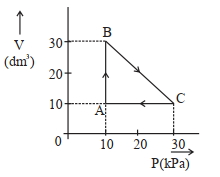
Work done is given by area enclosed in the \(\mathrm{P}\) vs \(\mathrm{V}\) cyclic graph or \(V\) vs \(P\) cyclic graph.Sign of work is positive for clockwise cyclic process for \(\mathrm{V}\) vs \(\mathrm{P}\) graph.
\(\mathrm{W}=\frac{1}{2} \times(30-10) \times(30-10)=200 \mathrm{kPa}-\mathrm{dm}^3\)
\(=200 \times 1000 \mathrm{~Pa}-\mathrm{L}=2 \mathrm{~L}-\mathrm{bar}=200 \mathrm{~J}\)
- 436. Choose the correct option for free expansion of an ideal gas under adiabatic condition from the following : 2024 Hard
- (A) \(\mathrm{q}=0, \Delta \mathrm{T} \neq 0, \mathrm{w}=0\)
- (B) \(\mathrm{q}=0, \Delta \mathrm{T}<0, \mathrm{w} \neq 0\)
- (C) \(q \neq 0, \Delta T=0, w=0\)
- (D) \(q=0, \Delta T=0, w=0\)
Show answer and solution
Correct Answer: (D)
During free expansion of an ideal gas under adiabatic condition \(\mathrm{q}=0, \Delta \mathrm{T}=0, \mathrm{w}=0\). -
- (A) \(6535\)
- (B) \(6540\)
- (C) \(6545\)
- (D) \(6550\)
Show answer and solution
Correct Answer: (A)
\(6 \mathrm{C} \text { (graphite) }+3 \mathrm{H}_2(\mathrm{~g}) \rightarrow \mathrm{C}_6 \mathrm{H}_6(\ell) ; \Delta \mathrm{H}=48.5 \mathrm{~kJ} / \mathrm{mol}\)\(\mathrm{C} \text { (graphite) }+\mathrm{O}_2(\mathrm{~g}) \rightarrow \mathrm{CO}_2(\mathrm{~g}) ; \Delta \mathrm{H}=-393.5 \mathrm{~kJ} / \mathrm{mol}\)
\(\mathrm{H}_2^{(\mathrm{g})}+\frac{1}{2}(\mathrm{~g}) \longrightarrow \mathrm{H}_2 \mathrm{O}(\ell) ; \Delta \mathrm{H}=-286 \mathrm{~kJ} / \mathrm{mol}\)
\(\text { equation }-(1) \times 1+(2) \times 6+(3) \times 3\)
\(-48.5-6 \times 393.5-3 \times 286\)
\(=-3267.5 \mathrm{~kJ} \text { for } 1 \mathrm{~mol}\)
\(=-6535 \mathrm{~kJ} \text { for } 2 \mathrm{~mol}\)
Ans. \(6535 \mathrm{~kJ}\)
-
- (A) \(50\)
- (B) \(55\)
- (C) \(60\)
- (D) \(65\)
Show answer and solution
Correct Answer: (B)
\(\omega=-\mathrm{nRT} \ln \left(\frac{\mathrm{V}_2}{\mathrm{~V}_1}\right)\)\(=-1 \times .08206 \times 291.15 \ln \left(\frac{100}{10}\right)\)
\(=-55.0128\)
Work done by system \(\approx 55 \mathrm{~atm}\) lit.
-
- (A) \(37\)
- (B) \(38\)
- (C) \(39\)
- (D) \(40\)
Show answer and solution
Correct Answer: (A)
\( \Delta \mathrm{G}^{\circ}=\Delta \mathrm{H}^{\circ}-\mathrm{T} \Delta \mathrm{S}^{\circ} \)\( =77.2 \times 10^3-400 \times 122=28400 \mathrm{~J} \)
\( \Delta \mathrm{G}^{\circ}=-2.303 \mathrm{RT} \log \mathrm{K} \)
\( \Rightarrow 28400=-2.303 \times 8.314 \times 400 \log \mathrm{K} \)
\( \Rightarrow \log \mathrm{K}=-3.708=-37.08 \times 10^{-1}\)
-
- (A) \(1000\)
- (B) \(2000\)
- (C) \(100\)
- (D) \(200\)
Show answer and solution
Correct Answer: (B)
\(\Delta \mathrm{G}=0\)\(\mathrm{~T}=\frac{\Delta \mathrm{H}}{\Delta \mathrm{S}}=\frac{400}{0.2}=2000 \mathrm{~K}\)
-
- (A) (\(A\)) is true but (\(R\)) is false
- (B) Both (\(A\)) and (\(R\)) are true and (\(R\)) is the correct explanation of (\(A\))
- (C) (\(A\)) is false but (\(R\)) is true
- (D) Both (\(A\)) and (\(R\)) are true but (\(R\)) is not the correct explanation of (\(A\))
Show answer and solution
Correct Answer: (B)
Enthalpy of neutralization of \(SA \)& \(SB\) is always \(-57 \mathrm{~kJ} / \mathrm{mol}\) because strong monoacid gives one mole of \(\mathrm{H}^{+}\)and strong mono base gives one mole of \(\mathrm{OH}^{-}\)which form one mole of water. -
- (A) \(28719\)
- (B) \(28721\)
- (C) \(28722\)
- (D) \(28725\)
Show answer and solution
Correct Answer: (B)
It is isothermal reversible expansion, so work done negative\(\mathrm{W}=-2.303 \mathrm{nRT} \log \left(\frac{\mathrm{V}_2}{\mathrm{~V}_1}\right)\)
\(=-2.303 \times 5 \times 8.314 \times 300 \log \left(\frac{100}{10}\right)\)
\(=-28720.713 \mathrm{~J}\)
\(\equiv-28721 \mathrm{~J}\)
-
- (A) \(1100\)
- (B) \(3200\)
- (C) \(4700\)
- (D) \(1200\)
Show answer and solution
Correct Answer: (D)
Using, first law of thermodynamics,\( \Delta \mathrm{U}=\mathrm{Q}+\mathrm{W}, \)
\( \Delta \mathrm{U}=0: \text { Process is isothermal } \)
\( \mathrm{Q}=-\mathrm{W} \)
\( \mathrm{W}=-\mathrm{P}_{\text {ext }} \Delta \mathrm{V}: \text { Irreversible } \)
\( =-80 \times 10^3(45-30) \times 10^{-3} \)
\( =-1200 \mathrm{~J}\)
-
- (A) \(78\)
- (B) \(12\)
- (C) \(46\)
- (D) \(56\)
Show answer and solution
Correct Answer: (D)
\( \Delta \mathrm{H}_{\text {vap }}^0 \mathrm{CCl}_4=30.5 \mathrm{~kJ} / \mathrm{mol} \)\( \text { Mass of } \mathrm{CCl}_4=284 \mathrm{gm} \)
\( \text { Molar mass of } \mathrm{CCl}_4=154 \mathrm{~g} / \mathrm{mol} \)
\( \text { Moles of } \mathrm{CCl}_4=\frac{284}{154}=1.844 \mathrm{~mol} \)
\( \Delta \mathrm{H}_{\text {vap }}{ }^{\circ} \text { for } 1 \mathrm{~mole}=30.5 \mathrm{~kJ} / \mathrm{mol} \)
\( \Delta \mathrm{H}_{\text {vap }}{ }^{\circ} \text { for } 1.844 \mathrm{~mol}=30.5 \times 1.844 \)
\( \quad=56.242 \mathrm{~kJ}\)
-
- (A) \(125\)
- (B) \(128\)
- (C) \(130\)
- (D) \(135\)
Show answer and solution
Correct Answer: (A)
\(\mathrm{C}_2 \mathrm{H}_4(\mathrm{~g})+\mathrm{H}_2(\mathrm{~g}) \rightarrow \mathrm{C}_2 \mathrm{H}_6(\mathrm{~g})\)\(\Delta \mathrm{H}=\mathrm{BE}(\mathrm{C}=\mathrm{C})+4 \mathrm{BE}(\mathrm{C}-\mathrm{H})+\mathrm{BE}(\mathrm{H}-\mathrm{H})\)
\(-\mathrm{BE}(\mathrm{C}-\mathrm{C})-6 \mathrm{BE}(\mathrm{C}-\mathrm{H})\)
\(\Delta \mathrm{H}=\mathrm{BE}(\mathrm{C}=\mathrm{C})+\mathrm{BE}(\mathrm{H}-\mathrm{H})-\mathrm{BE}(\mathrm{C}-\mathrm{C})\)
\(-2 \mathrm{BE}(\mathrm{C}-\mathrm{H})\)
\(=615+435-347-2 \times 414\)
\(=-125 \mathrm{~kJ}\)
-
- (A) \(100\)
- (B) \(120\)
- (C) \(150\)
- (D) \(160\)
Show answer and solution
Correct Answer: (C)
\(\mathrm{C}_6 \mathrm{H}_5 \mathrm{COOH}(\mathrm{S})+\frac{15}{2} \mathrm{O}_2(\mathrm{~g}) \rightarrow 7 \mathrm{CO}_2(\mathrm{~g})+3 \mathrm{H}_2 \mathrm{O}(\ell)\)\(\Delta \mathrm{H}=\Delta \mathrm{U}+\Delta \mathrm{n}_g \mathrm{RT}\)
\(=-321.30-\frac{1}{2} \frac{\mathrm{R}}{100} \times 300\)
\(=(-321.30-150 \mathrm{R}) \mathrm{kJ}\)
-
- (A) \(82\)
- (B) \(85\)
- (C) \(89\)
- (D) \(90\)
Show answer and solution
Correct Answer: (A)
\(\text {from (1) (2) }\)
\(-70=x+12\)
\(x=-82\)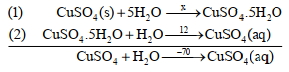
-
- (A) \(199\)
- (B) \(100\)
- (C) \(200\)
- (D) \(300\)
Show answer and solution
Correct Answer: (C)
As isothermal \(\Delta \mathrm{U}=0\)and process is irreversible
\(\mathrm{Q}=-\mathrm{W}=-\left[-\mathrm{P}_{\mathrm{ext}}\left(\mathrm{V}_2-\mathrm{V}_1\right)\right]\)
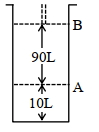
\(\mathrm{Q}=5(20-60)=-200 \mathrm{~atm}-\mathrm{L}\)
-
- (A) \(470\)
- (B) \(495\)
- (C) \(492\)
- (D) \(499\)
Show answer and solution
Correct Answer: (C)
\(2\mathrm{Fe}_{(\mathrm{s})}+\frac{3}{2} \mathrm{O}_{2(\mathrm{~g})} \rightarrow \mathrm{Fe}_2 \mathrm{O}_{3(\mathrm{~s})}, \Delta \mathrm{H}^{\mathrm{o}}=-822 \mathrm{~kJ} / \mathrm{mol}\) \(......(1)\)\(\mathrm{C}_{(\mathrm{s})}+\frac{1}{2} \mathrm{O}_{2(\mathrm{~g})} \rightarrow \mathrm{CO}_{(\mathrm{g})}, \Delta \mathrm{H}^{\mathrm{o}}=-110 \mathrm{~kJ} / \mathrm{mol}\) \(.......(2)\)
\(3\mathrm{C}_{(\mathrm{s})}+\mathrm{Fe}_2 \mathrm{O}_{3(\mathrm{~s})} \rightarrow 2 \mathrm{Fe}_{(\mathrm{s})}+3 \mathrm{CO}_{(\mathrm{g})}, \Delta \mathrm{H}_3=\text { ? }\)
\(\text { (3) }=3 \times(2)-(1)\)
\(\Delta \mathrm{H}_3=3 \times \Delta \mathrm{H}_2-\Delta \mathrm{H}_1\)
\(=3(-110)+822\)
\(=492 \mathrm{~kJ} / \mathrm{mole}\)+
-
- (A) \(38\)
- (B) \(39\)
- (C) \(40\)
- (D) \(45\)
Show answer and solution
Correct Answer: (A)
\(\mathrm{H}_2 \mathrm{O}(\ell) \rightleftharpoons \mathrm{H}_2 \mathrm{O}(\mathrm{g}) \quad \Delta \mathrm{H}_{\text {ap }}^0=40.79 \mathrm{~kJ} / \mathrm{mole}\)\(\Delta \mathrm{H}_{\text {vap }}^0=\Delta \mathrm{U}_{\text {vap }}^0+\Delta \mathrm{n}_{\mathrm{g}} \mathrm{RT}\)
\(40.79=\Delta \mathrm{U}_{\text {vap }}^0+\frac{1 \times 8.3 \times 373.15}{1000}\)
\(\Delta \mathrm{U}_{\text {Tap }}^0=40.79-3.0971\)
\(=37.6929\)
\(\Delta \mathrm{U}_{T \mathrm{ap}}^0 \simeq 38\)
No questions on this page match these filters.