


Questions
31 questionsShowing 1–31 of 31 questions
-
- (A) \(7\)
- (B) \(9\)
- (C) \(10\)
- (D) \(11\)
Show answer and solution
Correct Answer: (D)
Volume of silver coating =\(0.05 \times 0.05 \times 10000\)\(=25 \mathrm{~cm}^3\)
Mass of silver deposited=\(25 \times 7.9 \mathrm{~g}\)
Moles of silver atoms =\(\frac{25 \times 7.9}{108}\)
Number of silver atoms =\(\frac{25 \times 7.9}{108} \times 6.023 \times 10^{23}\)
\(=11.01 \times 10^{23}\)
Ans. \(11\)
-
- (A) increasing concentration of \(\mathrm{T1}^{+}\)ions
- (B) increasing concentration of both \(\mathrm{T1}^{+}\)and \(\mathrm{Cu}^{2+}\) ions
- (C) decreasing concentration of both \(\mathrm{T1}^{+}\)and \(\mathrm{Cu}^{2+}\) ions
- (D) increasing concentration of \(\mathrm{Cu}^{2+}\) ions
Show answer and solution
Correct Answer: (D)
\(\mathrm{E}_{\text {cell }}\) increases by increasing concentration of \(\left[\mathrm{Cu}^{+2}\right]\) ions.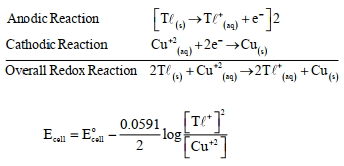
-
- (A) increase sharply
- (B) remain same or can not be measured accurately
- (C) decrease sharply
- (D) depend upon type of electrolyte
Show answer and solution
Correct Answer: (B)
Solution is already infinitely dilute, hence no change in molar conductivity upon addition of water -
- (A) \(2\)
- (B) \(3\)
- (C) \(4\)
- (D) \(5\)
Show answer and solution
Correct Answer: (A)
\(\frac{\mathrm{W}}{\mathrm{E}}=\frac{\text { ch arge }}{1 \mathrm{~F}} \)\(\frac{1.314}{\frac{197}{3}}=\frac{\mathrm{Q}}{1 \mathrm{~F}}\)
\(\mathrm{Q}=2 \times 10^{-2} \mathrm{~F}\)
-
- (A) \(339\)
- (B) \(350\)
- (C) \(390\)
- (D) \(340\)
Show answer and solution
Correct Answer: (A)
Cell \(\mathrm{Rx}^{\mathrm{n}} ; \mathrm{MnO}_4^{-}+\mathrm{H}_2 \mathrm{C}_2 \mathrm{O}_4 \rightarrow \mathrm{Mn}^{2+}+\mathrm{CO}_2\)\(\mathrm{E}_{\text {coll }}^{\mathrm{c}}=\mathrm{E}_{\mathrm{op}}^{\circ} \text { of anode }+\mathrm{E}_{\mathrm{RP}}^{\circ} \text { of cathode }\)
\(=0.49+1.51=2.00 \mathrm{~V}\)
At equilibrium
\(\mathrm{E}_{\text {cell }}=0,\)
\(\mathrm{E}_{\text {cell }}^{\circ}=\frac{0.059}{\mathrm{n}} \log \mathrm{K}\)
\(\text { (As per NCERT } \frac{\mathrm{RT}}{\mathrm{F}}=0.059 \text { But } \frac{\mathrm{RT}}{\mathrm{F}}=0.0591\)can also be taken.)
\(2=\frac{0.059}{10} \log \mathrm{K}\)
\(\log \mathrm{K}=338.98\)
- 6. find out the quantity of silver deposited when one coulomb charge is passed through \(\mathrm{AgNO}_3\) solution. 2024 Medium
- (A) \(0.1 \mathrm{~g}\) atom of silver
- (B) \(1\) chemical equivalent of silver
- (C) \(1 \mathrm{~g}\) of silver
- (D) \(1\) electrochemical equivalent of silver
Show answer and solution
Correct Answer: (D)
\(\mathrm{W}=\mathrm{ZIt}\)\(\mathrm{W}=\mathrm{ZQ}\)
\(\mathrm{Q}=\frac{\mathrm{W}}{\mathrm{Z}}\)
\(\mathrm{W}=\mathrm{ZQ}=\text { (electrochemical equivalent) }\)
-
- (A) \(\mathrm{S} \mathrm{cm}^2 \mathrm{~mol}^{-3 / 2} \mathrm{~L}^{1 / 2}\)
- (B) \(\mathrm{S} \mathrm{cm}^2 \mathrm{~mol}^{-1} \mathrm{~L}^{1 / 2}\)
- (C) \(\mathrm{S} \mathrm{cm}^2 \mathrm{~mol}^{-3 / 2} \mathrm{~L}\)
- (D) \(\mathrm{S} \mathrm{cm}^2 \mathrm{~mol}^{-3 / 2} \mathrm{~L}^{-1 / 2}\)
Show answer and solution
Correct Answer: (A)
\(\Lambda_{\mathrm{m}}=\Lambda_{\mathrm{m}}^{\circ}-\mathrm{A} \sqrt{\mathrm{C}}\)Units of \(\mathrm{A} \sqrt{\mathrm{C}}=\mathrm{S} \mathrm{cm}^2 \mathrm{~mole}^{-1}\)
Uits of \(\mathrm{A}=\mathrm{S} \mathrm{cm}^2 \mathrm{~mole}^{-3 / 2} \mathrm{~L}^{1 / 2}\)
-
- (A) \(\mathrm{E}_{\text {cell }}=-0.80 \mathrm{~V}\)
- (B) \(\mathrm{M}+\mathrm{X} \rightarrow \mathrm{M}^2+\mathrm{X}^2\) is a spontaneous reaction
- (C) \(\mathrm{M}^{2+}+\mathrm{X}^{2-} \rightarrow \mathrm{M}+\mathrm{X}\) is a spontaneous reaction
- (D) \(\mathrm{E}_{\text {eell }}=0.80 \mathrm{~V}\)
Show answer and solution
Correct Answer: (C)
\(\mathrm{M} \mid \mathrm{M}^{+2} \| \mathrm{X} / \mathrm{X}^{2-}\)\(\mathrm{E}_{\text {cell }}^{\circ}=\mathrm{E}_{\mathrm{M} / \mathrm{M}^{+2}}^{\circ}+\mathrm{E}_{\mathrm{X} / \mathrm{X}^{-2}}^{\circ}\)
\(=-0.46+0.34=-0.12 \mathrm{~V}\)
As \(\mathrm{E}_{\text {cell }}^{\circ}\) is negative so anode becomes cathode and cathode become anode. Spontaneous reaction will be
\(\mathrm{M}^{+2}+\mathrm{X}^{2-} \longrightarrow \mathrm{M}+\mathrm{X}\)
-
- (A) \(A,B,C\) only
- (B) \(A,B,D\) only
- (C) \(A, B, D, E\) only
- (D) \(A,D,E\) only
Show answer and solution
Correct Answer: (D)
Fuel cell is used in spaceship and it is type of galvanic cell. -
- (A) Applying an external opposite potential greater than \(\mathrm{E}_{\text {cell }}^0\)
- (B) Reversing the flow of ions in salt bridge.
- (C) Applying an external opposite potential lower than \(\mathrm{E}_{\text {cell }}^0\).
- (D) Exchanging the electrodes at anode and cathode.
Show answer and solution
Correct Answer: (A)
Applied external potential should be greater than \(\mathrm{E}_{\text {cell }}^0\) in opposite direction. - 11. Identify the factor from the following that does not affect electrolytic conductance of a solution. 2024 Hard
- (A) The nature of the electrolyte added.
- (B) The nature of the electrode used.
- (C) Concentration of the electrolyte.
- (D) The nature of solvent used.
Show answer and solution
Correct Answer: (B)
Conductivity of electrolytic cell is affected by concentration of electrolyte, nature of electrolyte and nature of solvent. -
- (A) \(A-I, B-II, C-III, D-IV\)
- (B) \(A-III, B-I, C-IV, D-II\)
- (C) \(A-IV, B-III, C-I, D-II\)
- (D) \(A-II, B-III, C-IV, D-I\)
Show answer and solution
Correct Answer: (C)
\(A-IV, B-III, C-I, D-II\) -
- (A) \(65 \mathrm{~S} \mathrm{~cm}^2 \mathrm{~mol}^{-1}\)
- (B) \(130 \mathrm{~s} \mathrm{~cm}^2 \mathrm{~mol}^{-1}\)
- (C) \(187 \mathrm{~S} \mathrm{~cm}^2 \mathrm{~mol}^{-1}\)
- (D) \(260 \mathrm{~s} \mathrm{~cm}^2 \mathrm{~mol}^{-1}\)
Show answer and solution
Correct Answer: (B)
\(\Lambda_{\mathrm{C}}^{+2}=57 \mathrm{Scm}^2 \mathrm{~mol}^{-1}\)\(\Lambda_{\mathrm{A}}^{+2}=73 \mathrm{Scm}^2 \mathrm{~mol}^{-1}\)
\(\Lambda_{\text {Solution }}=\lambda_{\mathrm{C}}^{+2}+\Lambda_{\mathrm{A}}^{-2}\)
\(=57+73=130\)
-
- (A) \(4\)
- (B) \(5\)
- (C) \(6\)
- (D) \(7\)
Show answer and solution
Correct Answer: (B)
\(\mathrm{Cu}^{2+}+2 \mathrm{e}^{-} \rightarrow \mathrm{Cu}\)\(2 \text { Faraday } \rightarrow 1 \mathrm{~mol} \mathrm{Cu}\)
\(1 \text { Faraday } \rightarrow 0.5 \mathrm{~mol} \mathrm{Cu} \text { deposit }\)
\(0.5 \mathrm{~mol}=0.5 \mathrm{~g} \text { atom }=5 \times 10^{-1}\)
\(\mathrm{x}=5\)
- 15. One of the commonly used electrode is calomel electrode. Under which of the following categories calomel electrode comes? 2024 Medium
- (A) Metal - Insoluble Salt - Anion electrodes
- (B) Oxidation - Reduction electrodes
- (C) Gas - Ion electrodes
- (D) Metal ion-Metal electrodes
Show answer and solution
Correct Answer: (A)
Theory based -
- (A) \(\mathrm{ClO}_4^{-}>\mathrm{IO}_4^{-}>\mathrm{BrO}_4^{-}\)
- (B) \(\mathrm{BrO}_4^{-}>\mathrm{IO}_4^{-}>\mathrm{ClO}_4^{-}\)
- (C) \(\mathrm{BrO}_4^{-}>\mathrm{ClO}_4^{-}>\mathrm{IO}_4^{-}\)
- (D) \(\mathrm{IO}_4^{-}>\mathrm{BrO}_4^{-}>\mathrm{ClO}_4^{-}\)
Show answer and solution
Correct Answer: (B)
Higher the value of \(\oplus\) ve \(SRP\) (Std. reduction potential) more is tendency to undergo reduction, so better is oxidising power of reactant.\(Hence, ox. Power:- \mathrm{BrO}_4^{-}>\mathrm{IO}_4^{-}>\mathrm{ClO}_4^{-}\)
-
- (A) \(5\)
- (B) \(8\)
- (C) \(7\)
- (D) \(2\)
Show answer and solution
Correct Answer: (D)
\(2 \mathrm{H}_2 \mathrm{O} \rightarrow \mathrm{O}_2+4 \mathrm{H}^{+}+4 \mathrm{e}^{-}\)\(\frac{\mathrm{W}}{\mathrm{E}}=\frac{\mathrm{Q}}{96500}\)
\(\text { mole } \times \text { n-factor }=\frac{\mathrm{Q}}{96500}\)
\(1 \times 2=\frac{\mathrm{Q}}{96500}\)
\(\mathrm{Q}=2 \times 96500 \mathrm{C}\)
\(=1.93 \times 10^5 \mathrm{C}\)
-
- (A) \(30\)
- (B) \(75\)
- (C) \(45\)
- (D) \(18\)
Show answer and solution
Correct Answer: (D)
\( 2 \mathrm{H}_{\text {(aq.) }}^{+}+2 \mathrm{e}^{-} \rightarrow \mathrm{H}_2(\mathrm{~g}) \)\( \mathrm{E}_{\text {cell }}=\mathrm{E}_{\text {cell }}^0-\frac{0.059}{2} \log \frac{\mathrm{P}_{\mathrm{H}_2}}{\left[\mathrm{H}^{+}\right]^2} \)
\( =0-0.059 \times 3=-0.177 \text { volts. }=-17.7 \times 10^{-2} \mathrm{~V} .\)
-
- (A) \(108\)
- (B) \(159\)
- (C) \(189\)
- (D) \(148\)
Show answer and solution
Correct Answer: (A)
Eq. of \(\mathrm{Ag}=\) Eq. of \(\mathrm{O}_2\)Let \(\mathrm{x}\) gm silver displaced,
\(\frac{\mathrm{x} \times 1}{108}=\frac{5.6}{22.7} \times 4\)
(Molar volume of gas at STP \(=22.7\) lit)
\(\mathrm{x}=106.57 \mathrm{gm}\)
Ans. \(107\)
OR,
as per old STP data, molar volume \(=22.4\) lit
\(\frac{\mathrm{x} \times 1}{108}=\frac{5.6}{22.4} \times 4, \mathrm{x}=108 \mathrm{gm} \text {. }\)
Ans. \(108\)
-
- (A) \(47\)
- (B) \(46\)
- (C) \(49\)
- (D) \(41\)
Show answer and solution
Correct Answer: (B)
\( \mathrm{Zn}^{+2}+2 \mathrm{e}^{-} \longrightarrow \mathrm{Zn} \)\( \mathrm{W}=\mathrm{Z} \times \mathrm{i} \times \mathrm{t} \)
\( =\frac{65.4}{2 \times 96500} \times 0.015 \times 15 \times 60 \)
\( =45.75 \times 10^{-4} \mathrm{gm}\)
-
- (A) \(B\), \(C\) and \(E\) only
- (B) \(A\), \(B\), \(C\), \(D\) and \(E\)
- (C) \(A\), \(B\), \(C\) and \(D\) only
- (D) \(B\), \(D\) and \(E\) only
Show answer and solution
Correct Answer: (A)
\(\mathrm{Mn}, \mathrm{Ni}\) and \(\mathrm{Cd}\) metals used in battery industries. -
- (A) Weak electrolyte weak electrolyte
- (B) Strong electrolyte strong electrolyte
- (C) Weak electrolyte strong electrolyte
- (D) Strong electrolyte weak electrolyte
Show answer and solution
Correct Answer: (C)
\(\mathrm{A} \rightarrow\) Weak electrolyte\(B\) \(\rightarrow\) Strong electrolyte
-
- (A) 2
- (B) 3
- (C) 1
- (D) 0
Show answer and solution
Correct Answer: (B)
The ions \(Ti ^{+2}, V^{+2}, Cr ^{+2}\) are strong reducing agents and will liberate hydrogen from a dilute acid,
eg. \(2 Cr _{(\text {aq. })}^{+2}+2 H _{(\text {aq. })}^{+} \rightarrow 2 Cr _{(\text {aq. })}^{+3}+ H _2(g)\) -
- (A) \(0\)
- (B) \(1\)
- (C) \(3\)
- (D) \(4\)
Show answer and solution
Correct Answer: (B)
\(E=E_{\mathrm{H}^{+} / \mathrm{H}_2}^0-\frac{0.06}{2} \log \frac{\mathrm{P}_{\mathrm{H}_2}}{\left[\mathrm{H}^{+}\right]^2}\)\(\mathrm{E}=0.00-\frac{0.06}{2} \log \frac{2}{[1]^2}\)
\(E=-0.03 \times 0.3=-0.9 \times 10^{-2} \mathrm{~V}\)
-
- (A) reduction of \(\mathrm{Mn}\) from \(+4 to +3\)
- (B) oxidation of \(\mathrm{Mn}\) from \(+3 to +4\)
- (C) reduction of \(\mathrm{Mn}\) from \(+7 to +2\)
- (D) oxidation of \(\mathrm{Mn}\) from \(+2 to +7\)
Show answer and solution
Correct Answer: (A)
In the cathode reaction manganese \((\mathrm{Mn})\) is reduced from the \(+4\) oxidation state to the \(+3\) state. -
- (A) \(\mathrm{Pt}\left|\mathrm{H}_{2(\mathrm{~g})}\right| \mathrm{HCl}_{(\text {soln.) }}\left|\mathrm{AgCl}_{(\mathrm{s})}\right| \mathrm{Ag}\)
- (B) \(\mathrm{Pt}\left|\mathrm{H}_{2(\mathrm{~g})}\right| \mathrm{HCl}_{\text {(solm) }}\left|\mathrm{AgNO}_{3(2 \mathrm{~g})}\right| \mathrm{Ag}\)
- (C) \(\mathrm{Pt}\left|\mathrm{H}_{2(\mathrm{~g})}\right| \mathrm{KCl}_{\text {(solm. } .)}\left|\mathrm{AgCl}_{(\mathrm{s})}\right| \mathrm{Ag}\)
- (D) \(\mathrm{Ag}\left|\mathrm{AgCl}_{(5)}\right| \mathrm{KCl}_{(50 \mathrm{~m} .)}\left|\mathrm{AgNO}_{3(\mathrm{mq} .)}\right| \mathrm{Ag}\)
Show answer and solution
Correct Answer: (A)
The given cell reaction is:
\( \frac{1}{2}\text{H}_{2(g)} + \text{AgCl}_{(s)} \rightarrow \text{H}^{+}_{(aq)} + \text{Cl}^{-}_{(aq)} + \text{Ag}_{(s)} \)
Let us break this down into the two half-cell reactions:
1. Anodic half-cell reaction (Oxidation at Pt electrode):
\( \frac{1}{2}\text{H}_{2(g)} \rightarrow \text{H}^{+}_{(aq)} + e^{-} \)
This represents a hydrogen gas electrode, where \( \text{H}^{+} \) ions are released into the solution.
2. Cathodic half-cell reaction (Reduction at Ag electrode):
\( \text{AgCl}_{(s)} + e^{-} \rightarrow \text{Ag}_{(s)} + \text{Cl}^{-}_{(aq)} \)
This represents a metal-insoluble salt anion electrode, where \( \text{Cl}^{-} \) ions are released into the solution.
Combining both reactions, the net products in the solution are \( \text{H}^{+}_{(aq)} \) and \( \text{Cl}^{-}_{(aq)} \), which together form hydrochloric acid (\( \text{HCl} \)). Therefore, the common electrolyte solution must be \( \text{HCl}_{(soln.)} \), not \( \text{KCl}_{(soln.)} \).
The standard cell representation for this cell without a liquid junction is:
\( \text{Pt} \mid \text{H}_{2(g)} \mid \text{HCl}_{(soln.)} \mid \text{AgCl}_{(s)} \mid \text{Ag} \)
Hence, the correct option is (A). -
- (A) \(5\)
- (B) \(6\)
- (C) \(2\)
- (D) \(3\)
Show answer and solution
Correct Answer: (D)
\(\mathrm{Fe}, \mathrm{Ni}, \mathrm{Ag}\) will be oxidized due to lower \(S.R.P\). -
- (A) \(1\)
- (B) \(2\)
- (C) \(3\)
- (D) \(4\)
Show answer and solution
Correct Answer: (D)
Conductivity \(\left(\mathrm{S} \mathrm{m}^{-1}\right)\)\(2.1\times10^3\)
\(1.2 \times 10\)
\(3.91\) conductors at \(298.15 \mathrm{~K}\)
\(1 \times 10^3\)
\(1 \times 10^{-16}\) Insulator at \(298.15 {~K}\)
\(l1.5 \times 10^{-2}\)
\(110^{-7}\) Semiconductor at \(298.15 \mathrm{~K}\)
Therefore number of conductors is \(4\).
- 29. What pressure (bar) of \(\mathrm{H}_2\) would be required to make emf of hydrogen electrode zero in pure water at \(25^{\circ} \mathrm{C}\) ? 2024 Medium
- (A) \(10^{-14}\)
- (B) \(10^{-7}\)
- (C) \(1\)
- (D) \(0.5\)
Show answer and solution
Correct Answer: (A)
\(2 \mathrm{e}^{-}+2 \mathrm{H}^{+}(\mathrm{aq}) \rightarrow \mathrm{H}_2(\mathrm{~g})\)\(\mathrm{E}=\mathrm{E}^0-\frac{0.059}{\mathrm{n}} \log \frac{\mathrm{P}_{\mathrm{H}_2}}{\left[\mathrm{H}^{+}\right]^2}\)
\(0=0-\frac{0.059}{2} \log \frac{\mathrm{P}_{\mathrm{H}_2}}{\left(10^{-7}\right)^2}\)
\(\log \frac{\mathrm{P}_{\mathrm{H}_2}}{\left(10^{-7}\right)^2}=0\)
\(\frac{\mathrm{P}_{\mathrm{H}_2}}{10^{-14}}=1\)
\(\mathrm{P}_{\mathrm{H}_2}=10^{-14} \text { bar }\)
-
- (A) Coating of iron surface by tin prevents rusting, even if the tin coating is peeling off.
- (B) When \(\mathrm{pH}\) lies above \(9\) or \(10\) , rusting of iron does not take place.
- (C) Dissolved acidic oxides \(\mathrm{SO}_2, \mathrm{NO}_2\) in water act as catalyst in the process of rusting.
- (D) Rusting of iron is envisaged as setting up of electrochemical cell on the surface of iron object.
Show answer and solution
Correct Answer: (A)
As tin coating is peeled off, then iron is exposed to atmosphere. -
- (A) \(\Lambda_{\mathrm{m}}^2 \mathrm{C}-\mathrm{K}_{\mathrm{a}} \Lambda_{\mathrm{m}}^{\circ 2}+\mathrm{K}_{\mathrm{a}} \Lambda_{\mathrm{m}} \Lambda_{\mathrm{m}}^{\circ}=0\)
- (B) \(\Lambda_{\mathrm{m}}-\Lambda_{\mathrm{m}}^{\circ}+\mathrm{AC}^{\frac{1}{2}}=0\)
- (C) \(\Lambda_{\mathrm{m}}-\Lambda_{\mathrm{m}}^{\circ}-\mathrm{AC}^{\frac{1}{2}}=0\)
- (D) \(\Lambda_{\mathrm{m}}^2 \mathrm{C}+\mathrm{K}_{\mathrm{a}} \Lambda_{\mathrm{m}}^{\circ 2}-\mathrm{K}_{\mathrm{a}} \Lambda_{\mathrm{m}} \Lambda_{\mathrm{m}}^{\circ}=0\)
Show answer and solution
Correct Answer: (A)
\( \mathrm{HA}(\mathrm{aq}) \rightleftharpoons \mathrm{H}^{+}(\mathrm{aq})+\mathrm{A}^{-}(\mathrm{aq}) \)\( \mathrm{K}_{\mathrm{a}}=\frac{\alpha^2 \mathrm{C}}{1-\alpha} \)
\( \alpha^2 \mathrm{C}+\mathrm{K}_{\mathrm{a}} \alpha-\mathrm{K}_{\mathrm{a}}=0 \)
\( \left(\frac{\lambda_{\mathrm{m}}}{\lambda_{\mathrm{m}}^{\infty}}\right)^2 \mathrm{C}+\mathrm{K}_{\mathrm{a}} \frac{\lambda_{\mathrm{m}}}{\lambda_{\mathrm{m}}^{\infty}}-\mathrm{K}_{\mathrm{a}}=0 \)
\( \lambda_{\mathrm{m}}^2 \mathrm{C}+\mathrm{K}_{\mathrm{a}} \lambda_{\mathrm{m}} \lambda_{\mathrm{m}}^{\infty}-\mathrm{K}_{\mathrm{a}}\left(\lambda_{\mathrm{m}}^{\infty}\right)^2=0\)


No questions on this page match these filters.