


Questions
17 questionsShowing 1–17 of 17 questions
-
- (A) Green colour formation observed on side \(Y\).
- (B) Green colour formation observed on side \(\mathrm{X}\).
- (C) Molarity of \(\mathrm{K}_2 \mathrm{Cr}_2 \mathrm{O}_7\) solution is lowered.
- (D) Molarity of \(\mathrm{CuSO}_4\) solution is lowered.
Show answer and solution
Correct Answer: (D)
Only solvent Molecules are allowed to pass through the \(SPM\).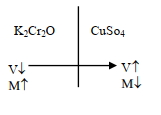
-
- (A) \(702\)
- (B) \(704\)
- (C) \(705\)
- (D) \(707\)
Show answer and solution
Correct Answer: (D)
\( 2=0.52 \times \mathrm{m}\)\(\mathrm{m}=\frac{2}{0.52}\)
According to question, solution is much diluted
\(\text { so } \frac{\Delta \mathrm{P}}{\mathrm{P}^{\circ}}=\frac{\mathrm{n}_{\text {solate }}}{\mathrm{n}_{\text {soltron: }}}\)
\(\frac{\Delta \mathrm{P}}{\mathrm{P}^{\circ}}=\frac{\mathrm{m}}{1000} \times \mathrm{M}_{\text {solvent }}\)
\(\Delta \mathrm{P}=\mathrm{P}^{\circ} \times \frac{\mathrm{m}}{1000} \times \mathrm{M}_{\text {sohtwat }}\)
\(=760 \times \frac{\frac{2}{0.52}}{1000} \times 18=52.615\)
\(P_5=760-52.615=707.385 \mathrm{~mm} \text { of } \mathrm{Hg}\)
-
- (A) \(31\)
- (B) \(35\)
- (C) \(37\)
- (D) \(40\)
Show answer and solution
Correct Answer: (A)
As moles of water \(>\) moles of \(\mathrm{CH}_3 \mathrm{COOH}\) water is solvent.\(\mathrm{T}_{\mathrm{F}}^{\circ}-\left(\mathrm{T}_{\mathrm{F}}\right)_{\mathrm{S}}=\mathrm{K}_{\mathrm{F}} \times \mathrm{M}\)
\(0-\left(\mathrm{T}_{\mathrm{F}}\right)_{\mathrm{S}}=1.86 \times \frac{2700 / 60}{2700 / 1000}\)
\(\left(\mathrm{~T}_{\mathrm{F}}\right)_{\mathrm{S}}=-31^{\circ} \mathrm{C}.\)
-
- (A) \(3\)
- (B) \(5\)
- (C) \(6\)
- (D) \(8\)
Show answer and solution
Correct Answer: (B)
\(\mathrm{AB}_2 \rightarrow \mathrm{A}^{+2}+2 \mathrm{~B}^{\ominus}\)\(\mathrm{i}=1+(3-1) \alpha\)
\(\mathrm{i}=1+2 \alpha\)
\(\Delta \mathrm{T}_{\mathrm{b}}=\mathrm{k}_{\mathrm{b}} \mathrm{im}\)
\(0.52=0.52(1+2 \alpha) \frac{\frac{10}{200}}{\frac{100}{1000}}\)
\(1=(1+2 \alpha) \frac{10}{20}\)
\(2=1+2 \alpha\)
\(\alpha=0.5\)
Ans. \(\alpha=5 \times 10^{-1}\)
- 5. A solution of two miscible liquids showing negative deviation from Raoult's law will have : 2024 Hard
- (A) increased vapour pressure, increased boiling point
- (B) increased vapour pressure, decreased boiling point
- (C) decreased vapour pressure, decreased boiling point
- (D) decreased vapour pressure, increased boiling point
Show answer and solution
Correct Answer: (D)
Solution with negative deviation has
\( \mathrm{P}_{\mathrm{T}}<\mathrm{P}_{\mathrm{A}^0} \mathrm{X}_{\mathrm{A}} +\mathrm{P}_{\mathrm{B}^0} \mathrm{X}_{\mathrm{B}} \)
\( \mathrm{P}_{\mathrm{A}}<\mathrm{P}_{\mathrm{A}^0} \mathrm{X}_{\mathrm{A}} \)
\( \mathrm{P}_{\mathrm{B}}<\mathrm{P}_{\mathrm{B}^0} \mathrm{X}_{\mathrm{B}} \)
If vapour pressure decreases so boiling point increases. -
- (A) \(10\)
- (B) \(20\)
- (C) \(25\)
- (D) \(30\)
Show answer and solution
Correct Answer: (C)
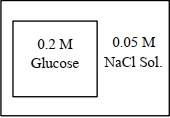
\(\mathrm{NaCl} \longrightarrow \mathrm{Na}^{+}+\mathrm{Cl}^{-}\)\(0.05 \mathrm{M} \quad 0.05 \mathrm{M} \quad 0.05 \mathrm{M}\)
\(\text { Total } \mathrm{C}_1=0.05+0.05=0.1 \mathrm{M}(\mathrm{NaCl})\)
\(\mathrm{C}_2=0.2 \mathrm{M}(\text { glucose })\)
\(\pi=\left(\mathrm{C}_2-\mathrm{C}_1\right) \mathrm{RT}\)
\(=(0.2-0.1) \times 0.083 \times 300\)
\(=2.49 \text { bar }\)
\(=24.9 \times 10^{-1} \text { bar }\)
-
- (A) \(76\)
- (B) \(77\)
- (C) \(79\)
- (D) \(80\)
Show answer and solution
Correct Answer: (A)
\(\mathrm{HX} \rightleftharpoons \mathrm{H}^{+}+\mathrm{X}^{-} \quad \mathrm{K}_{\mathrm{a}}=1.2 \times 10^{-5}\)\(0.03 \mathrm{M}\)
\(0.03-\mathrm{x} \quad \mathrm{x} \quad \mathrm{x}\)
\(\mathrm{K}_{\mathrm{a}}=1.2 \times 10^{-5}=\frac{\mathrm{x}^2}{0.03-\mathrm{x}}\)
\(0.03-\mathrm{x} \approx 0.03\left(\mathrm{~K}_{\mathrm{a}}\right. \text { is very small) }\)
\(\frac{\mathrm{x}^2}{0.03}=1.2 \times 10^{-5}\)
\(\mathrm{x}=6 \times 10^{-4}\)
\(\text { Final solution }: 0.03-\mathrm{x}+\mathrm{x}+\mathrm{x}\)
\(=0.03+\mathrm{x}=0.03+6 \times 10^{-4}\)
\(\Pi=\left(0.03+\left(6 \times 10^{-4}\right)\right) \times 0.083 \times 300\)
\(=76.19 \times 10^{-2} \approx 76 \times 10^{-2}\)
-
- (A) \(19\)
- (B) \(20\)
- (C) \(25\)
- (D) \(30\)
Show answer and solution
Correct Answer: (A)
\(\text { Mass of } \mathrm{CH}_3 \mathrm{COOH}=\mathrm{V} \times \mathrm{d}\)\(=5 \mathrm{ml} \times 1.2 \mathrm{~g} / \mathrm{ml}\)
\(=6 \mathrm{gm}\)
\(\mathrm{n}_{\mathrm{CH}_3 \mathrm{COOH}}=\frac{6}{60}=0.1 \mathrm{~mol}\)
\(\mathrm{~m}_{\mathrm{CH}_3 \mathrm{COOH}} \approx \mathrm{M}_{\mathrm{CH}_3 \mathrm{COOH}}=\frac{0.1}{1}=0.1 \mathrm{M}\)
\(\mathrm{CH}_3 \mathrm{COOH} \rightleftharpoons \mathrm{CH}_3 \mathrm{COO}^{-}+\mathrm{H}^{+}\)
\(\mathrm{C}\)
\(\mathrm{C}-\mathrm{C} \alpha\)
\(\mathrm{K}_{\mathrm{a}}=\frac{\mathrm{C} \alpha^2}{1-\alpha}\)
\(1-\alpha \approx 1 \Rightarrow \mathrm{K}_{\mathrm{a}}=\mathrm{C}^2\)
\(\alpha=\sqrt{\frac{\mathrm{Ka}^2}{\mathrm{C}}}=\sqrt{\frac{6.25 \times 10^{-5}}{0.1}}=25 \times 10^{-3}\)
\(\mathrm{~V} . \mathrm{f} .(\mathrm{i})=1+\alpha(\mathrm{n}-1)=1+\alpha(2-1)=1+\alpha\)
\(=1+25 \times 10^{-3}=1.025\)
\(\Delta \mathrm{T}_{\mathrm{r}}=i \mathrm{~K} \mathrm{~m}\)
\(=(1.025)(1.86)(0.1)\)
\(=0.19\)
\(=19 \times 10^{-2}\)
-
- (A) (A) and (B) only
- (B) (C) and (E) only
- (C) (B) and (E) only
- (D) (C) and (D) only
Show answer and solution
Correct Answer: (B)
\(KMnO _4 \& NaOH \rightarrow\) Secondary standard.
Primary standard should not be Hygroscopic. -
- (A) \(\left(\mathrm{CH}_3\right)_2 \mathrm{CO}+\mathrm{C}_6 \mathrm{H}_5 \mathrm{NH}_2\)
- (B) \(\mathrm{CHCl}_3+\mathrm{C}_6 \mathrm{H}_6\)
- (C) \(\mathrm{CHCl}_3+\left(\mathrm{CH}_3\right)_2 \mathrm{CO}\)
- (D) \(\left(\mathrm{CH}_3\right)_2 \mathrm{CO}+\mathrm{CS}_2\)
Show answer and solution
Correct Answer: (D)
\(\left(\mathrm{CH}_3\right)_2 \mathrm{CO}+\mathrm{CS}_2\) Exibits positive deviations from Raoult's Law. -
- (A) \(15\)
- (B) \(10\)
- (C) \(9\)
- (D) \(8\)
Show answer and solution
Correct Answer: (A)
\(\Delta \mathrm{T}_{\mathrm{f}}=\mathrm{i} \mathrm{K}_{\mathrm{f}} \times \text { molality }\)\(24=(1) \times 1.86 \times \frac{\mathrm{W}}{62 \times 18.6}\)
\(\mathrm{~W}=14880 \mathrm{gm}\)
\(=14.880 \mathrm{~kg}\)
-
- (A) \(36\)
- (B) \(73\)
- (C) \(45\)
- (D) \(15\)
Show answer and solution
Correct Answer: (B)
\( \text { (72.56) or (73) } \)\( \pi=\text { CRT } \)
\( \Rightarrow \frac{\pi_1}{\pi_2}=\frac{\mathrm{T}_1}{\mathrm{~T}_2} \)
\( \Rightarrow \pi_2=\frac{\pi_1 \mathrm{~T}_2}{\mathrm{~T}_1}=\frac{7 \times 10^5 \times 283}{273} \)
\( =72.56 \times 10^4 \mathrm{Nm}^{-2}\)
- 13. The solution from the following with highest depression in freezing point/lowest freezing point is _______. 2024 Hard
- (A) \(180 \mathrm{~g}\) of acetic acid dissolved in water
- (B) \(180 \mathrm{~g}\) of acetic acid dissolved in benzene
- (C) \(180 \mathrm{~g}\) of benzoic acid dissolved in benzene
- (D) \(180 \mathrm{~g}\) of glucose dissolved in water
Show answer and solution
Correct Answer: (A)
\(\Delta \mathrm{T}_{\mathrm{f}}\) is maximum when \(\mathrm{i} \times \mathrm{m}\) is maximum.1) \(\mathrm{m}_1=\frac{180}{60}=3, \mathrm{i}=1+\alpha\)
Hence
\(\Delta \mathrm{T}_{\mathrm{f}}=(1+\alpha) \cdot \mathrm{k}_{\mathrm{f}}=3 \times 1.86=5.58^{\circ} \mathrm{C}(\alpha<<1)\)
\(2)\) \(\mathrm{m}_2=\frac{180}{60}=3, \mathrm{i}=0.5, \Delta \mathrm{T}_{\mathrm{f}}=\frac{3}{2} \times \mathrm{k}_{\mathrm{f}}{ }^{\prime}=7.68^{\circ} \mathrm{C}\)
3) \(\mathrm{m}_3=\frac{180}{122}=1.48, \mathrm{i}=0.5, \Delta \mathrm{T}_{\mathrm{f}}=\frac{1.48}{2} \times \mathrm{k}_{\mathrm{f}}^{\prime}=3.8^{\circ} \mathrm{C}\)
4) \(\mathrm{m}_4=\frac{180}{180}=1, \mathrm{i}=1, \Delta \mathrm{T}_{\mathrm{f}}=1 \cdot \mathrm{k}_{\mathrm{f}}^{\prime}=1.86^{\circ} \mathrm{C}\)
As per NCERT, \(\mathrm{k}_{\mathrm{f}}{ }^{\prime}\left(\mathrm{H}_2 \mathrm{O}\right)=1.86 \mathrm{k} \cdot \mathrm{kg} \mathrm{mol}^{-1}\)
\(\mathrm{k}_{\mathrm{f}}{ }^{\prime}(\) Benzene \()=5.12 \mathrm{k} \cdot \mathrm{kg} \mathrm{mol}^{-1}\)
-
- (A) \(20\)
- (B) \(25\)
- (C) \(23\)
- (D) \(30\)
Show answer and solution
Correct Answer: (C)
\(\mathrm{X}_{\text {methylbezzene }}=0.5\)\(\mathrm{Y}_{\text {mehylibenzene }}=\frac{\mathrm{P}_{\text {methylbenzene }}}{\mathrm{P}_{\text {total }}}\)
\(\mathrm{Y}_{\text {mehhylibenzene }}=\frac{0.5 \times 24}{0.5 \times 80+0.5 \times 24}\)
\(=\frac{12}{40+12}=0.23=23 \times 10^{-2}\)
-
- (A) \(i_A < i_B < i_C\)
- (B) \(i_A < i_C < i_B\)
- (C) \(i_A=i_B=i_C\)
- (D) \(i_A>i_B>i_C\)
Show answer and solution
Correct Answer: (A)
Salt Values of \(i\) (for different conc. of a Salt) \(0.1 M\) \(0.01 M\) \(0.001 M\) \(NaCl\) \(1.87\) \(1.94\) \(1.94\) \(i\) approach \(2\) as the solution become very dilute.
- 16. What happens to freezing point of benzene when small quantity of napthalene is added to benzene? 2024 Hard
- (A) Increases
- (B) Remains unchanged
- (C) First decreases and then increases
- (D) Decreases
Show answer and solution
Correct Answer: (D)
On addition of naphthalene to benzene there is depression in freezing point of benzene. -
- (A) \(540\)
- (B) \(542\)
- (C) \(543\)
- (D) \(550\)
Show answer and solution
Correct Answer: (C)
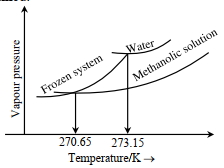
\(\Delta \mathrm{T}_{\mathrm{f}}=273.15-270.65=2.5 \mathrm{~K}\)\(\Delta \mathrm{T}_{\mathrm{f}}=\mathrm{K}_{\mathrm{f}} \mathrm{m} \Rightarrow 2.5=1.86 \times \frac{\mathrm{n}}{0.1}\)
\(\Rightarrow \mathrm{n}=0.1344 \text { moles }\)
\(\Rightarrow \mathrm{w}=0.1344 \times 32=4.3 \mathrm{~g}\)
\(\text { Volume }=\frac{4.3}{0.792}=5.43 \mathrm{ml}=543 \times 10^{-2} \mathrm{ml}\)
No questions on this page match these filters.