


All JEE Mains 2024 Chemistry questions
26 chaptersShowing 101–150 of 490 questions
-
- (A) Primary
- (B) Tertiary
- (C) Secondary
- (D) Quaternary
Show answer and solution
Correct Answer: (A)
Boiling an egg causes denaturation of its protein resulting in loss of its quarternary, tertiary and secondary structures. -
- (A) \(0.069 \times 10^{-12}\)
- (B) \(6.91 \times 10^{-12}\)
- (C) \(0.276 \times 10^{-12}\)
- (D) \(27.65 \times 10^{-12}\)
Show answer and solution
Correct Answer: (B)
\( \mathrm{AB}_{2(\mathrm{~s})} \rightleftharpoons \mathrm{A}_{(\mathrm{aq})}^{+2}+2 \mathrm{~B}_{(\mathrm{aq})}^{-} \)\( \mathrm{K}_{\mathrm{sp}}=\left[\mathrm{A}^{+2}\right]\left[\mathrm{B}^{-}\right]^2 \)
\(=1.2 \times 10^{-4} \times\left(2.4 \times 10^{-4}\right)^2 \)
\(=6.91 \times 10^{-12} \mathrm{M}^3\)
-
- (A) Statement \(I\) is false but Statement \(II\) is true
- (B) Both Statement \(I\) and Statement \(II\) is true
- (C) Both Statement \(I\) and Statement \(II\) is false
- (D) Statement \(I\) is true but Statement \(II\) is false
Show answer and solution
Correct Answer: (A)
Buffer solution is a mixture of either weak acid / weak base and its respective conjugate.Blood is a buffer solution of carbonic acid \(\mathrm{H}_2 \mathrm{CO}_3\) and bicarbonate \(\mathrm{HCO}_3^{-}\)
Statement \(1\) is false but Statement \(II\) is true.
-
- (A) Both Statement \(I\) and Statement \(II\) are correct
- (B) Statement \(I\) is correct but Statement \(II\) is incorrect
- (C) Both Statement \(I\) and Statement \(II\) are incorrect
- (D) Statement \(I\) is incorrect but Statement \(II\) is correct
Show answer and solution
Correct Answer: (A)
Aqueous solution of \(\left(\mathrm{NH}_4\right)_2 \mathrm{CO}_3\) is Basic
\(\mathrm{pH}\) of salt of weak acid and weak base depends on \(\mathrm{Ka}\) and \(\mathrm{Kb}\) value of acid and the base forming it -
- (A) Both Statement I and Statement II are correct
- (B) Statement I is correct but Statement II is incorrect
- (C) Both Statement I and Statement II are incorrect
- (D) Statement I is incorrect but Statement II is correct
Show answer and solution
Correct Answer: (B)
Statement I is correct but Statement II is incorrect
-
- (A) Both Statement I and Statement II are correct
- (B) Statement I is correct but Statement II is incorrect
- (C) Statement I is incorrect but Statement II is correct
- (D) Both Statement I and Statement II are incorrect
Show answer and solution
Correct Answer: (A)
Potassium hydrogen phthalate is used to standardize NaOH solutions.
Phenolphthalein is used as an indicator to detect completion of titrations -
- (A) \(5\)
- (B) \(7\)
- (C) \(8\)
- (D) \(10\)
Show answer and solution
Correct Answer: (B)
\(\mathrm{pH}=\frac{\mathrm{pK}_{\mathrm{w}}+\mathrm{pK}_{\mathrm{a}}-\mathrm{pK}_{\mathrm{b}}}{2}\)\(\mathrm{pK}_{\mathrm{a}}=\mathrm{pK}_{\mathrm{b}}\)
\(\Rightarrow \mathrm{pH}=\frac{\mathrm{pK}_{\mathrm{W}}}{2}=7\)
-
- (A) \(\text { A-IV, B-III, C-II, D-I }\)
- (B) \(\text { A-IV, B-III, C-I, D-II }\)
- (C) \(\text { A-III, B-IV, C-I, D-II }\)
- (D) \(\text { A-III, B-IV, C-II, D-I }\)
Show answer and solution
Correct Answer: (C)
Theory based question -
- (A) \(10^7\left(\frac{\mathrm{W}}{\mathrm{M}}\right)^3\)
- (B) \(10^7\left(\frac{\mathrm{W}}{\mathrm{M}}\right)^5\)
- (C) \(10^3\left(\frac{\mathrm{W}}{\mathrm{M}}\right)^5\)
- (D) \(10^5\left(\frac{\mathrm{W}}{\mathrm{M}}\right)^5\)
Show answer and solution
Correct Answer: (B)
\(\mathrm{S}=\frac{\mathrm{W} \times 10}{\mathrm{M}}\)\(\mathrm{Ca}_3\left(\mathrm{PO}_4\right)_2(\mathrm{~s}) \underset{3 \mathrm{~s}}{\rightleftharpoons} 3 \mathrm{Ca}^{2+}(\text { aq. })+2 \mathrm{PO}_4^{3-}(\text { aq. })\)
\(\mathrm{S}=\frac{\mathrm{W} \times 1000}{\mathrm{M} \times 100}=\frac{\mathrm{W} \times 10}{\mathrm{M}}\)
\(\mathrm{K}_{\mathrm{sp}}=(3 \mathrm{~s})^3(2 \mathrm{~s})^2\)
\(=108 \mathrm{~s}^5\)
\(=108 \times 10^5 \times\left(\frac{\mathrm{W}}{\mathrm{M}}\right)^{\mathrm{s}}\)
\(=1.08 \times 10^7\left(\frac{\mathrm{W}}{\mathrm{M}}\right)^5\)
-
- (A) \(08\)
- (B) \(09\)
- (C) \(10\)
- (D) \(11\)
Show answer and solution
Correct Answer: (B)
Precipitation when \(Q_{s p}=K_{s p}\)\({\left[\mathrm{Mg}^{2+}\right][\mathrm{OH}]^2=10^{-11}}\)
\(0.1 \times\left[\mathrm{OH}^{-}\right]^2=10^{-11} \Rightarrow\left[\mathrm{OH}^{-}\right]=10^{-5}\)
\(\Rightarrow \mathrm{pOH}=5 \quad \Rightarrow \mathrm{pH}=9\)
-
- (A) \(100\)
- (B) \(200\)
- (C) \(300\)
- (D) \(400\)
Show answer and solution
Correct Answer: (A)
\(\text { 1M Benzoic acid }+1 \mathrm{M} \text { Sodium Benzoate }\)\(\left(\mathrm{V}_{\mathrm{a}} \mathrm{ml}\right)\) \(\left(\mathrm{V}_{\mathrm{s}} \mathrm{ml}\right)\)
Millimole \(\mathrm{V}_{\mathrm{a}} \times 1\) \(\mathrm{~V}_{\mathrm{s}} \times1\)
\(\mathrm{pH}=4.5\)
\(\mathrm{pH}=\mathrm{pka}+\log \frac{[\text { salt }]}{[\text { acid }]}\)
\(4.5=4.2+\log \left(\frac{\mathrm{V}_{\mathrm{s}}}{\mathrm{V}_{\mathrm{a}}}\right)\)
\(\frac{\mathrm{V}_{\mathrm{s}}}{\mathrm{V}_{\mathrm{a}}}=2\) \(.....(1)\)
\(\mathrm{~V}_{\mathrm{s}}+\mathrm{V}_{\mathrm{a}}=300\) \(....(2)\)
\(\mathrm{~V}_{\mathrm{a}}=100 \mathrm{ml}\)
-
- (A) \(1\)
- (B) \(2\)
- (C) \(3\)
- (D) \(4\)
Show answer and solution
Correct Answer: (B)
Let, \(\mathrm{R}=\mathrm{k}[\mathrm{HI}]^{\mathrm{n}}\)
using any two of given data,
\( \frac{3 \times 10^{-3}}{7.5 \times 10^{-4}}=\left(\frac{0.01}{0.005}\right)^{\mathrm{n}} \)
\( \mathrm{n}=2\) -
- (A) \(3\)
- (B) \(5\)
- (C) \(8\)
- (D) \(9\)
Show answer and solution
Correct Answer: (A)
\(\mathrm{A}(\mathrm{g}) \rightarrow 2 \mathrm{~B}(\mathrm{~g})+\mathrm{C}(\mathrm{g})\)\(\mathrm{P}_{23}=\mathrm{P}_0+2 \mathrm{x}=200\)
\(\mathrm{P}_{\infty}=3 \mathrm{P}_0=300\)
\(\mathrm{A}(\mathrm{g}) \rightarrow 2 \mathrm{~B}(\mathrm{~g})+\mathrm{C}(\mathrm{g})\)
\(\mathrm{P}_{23}=\mathrm{P}_0+2 \mathrm{x}=200\)
\(\mathrm{P}_{\infty}=3 \mathrm{P}_0=300\)
\(\mathrm{A}(\mathrm{g}) \rightarrow 2 \mathrm{~B}(\mathrm{~g})+\mathrm{C}(\mathrm{g})\)
\(\mathrm{P}_{23}=\mathrm{P}_0+2 \mathrm{x}=200\)
\(\mathrm{P}_{\infty}=3 \mathrm{P}_0=300\)
\(\mathrm{P}_0=100\)
\(\mathrm{~K}=\frac{1}{\mathrm{t}} \ln \frac{\mathrm{P}_{\infty}-\mathrm{P}_0}{\mathrm{P}_{\infty}-\mathrm{P}_{\mathrm{t}}}\)
\(\mathrm{K}=\frac{2.3}{23} \log \frac{300-100}{300-200}\)
\(=\frac{2.3 \times 0.301}{23}=0.0301=3.01 \times 10^{-2} \mathrm{sec}^{-1}\)
\(\mathrm{P}_0=100\)
\(\mathrm{~K}=\frac{1}{\mathrm{t}} \ln \frac{\mathrm{P}_{\infty}-\mathrm{P}_0}{\mathrm{P}_{\infty}-\mathrm{P}_{\mathrm{t}}}\)
\(\mathrm{K}=\frac{2.3}{23} \log \frac{300-100}{300-200}\)
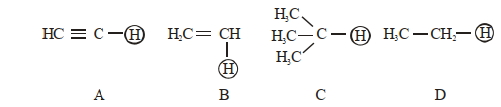
\(=\frac{2.3 \times 0.301}{23}=0.0301=3.01 \times 10^{-2} \mathrm{sec}^{-1}\)
\(\mathrm{P}_0=100\)
\(\mathrm{~K}=\frac{1}{\mathrm{t}} \ln \frac{\mathrm{P}_{\infty}-\mathrm{P}_0}{\mathrm{P}_{\infty}-\mathrm{P}_{\mathrm{t}}}\)
\(\mathrm{K}=\frac{2.3}{23} \log \frac{300-100}{300-200}\)
\(=\frac{2.3 \times 0.301}{23}=0.0301=3.01 \times 10^{-2} \mathrm{sec}^{-1}\)
-
- (A) \(5\)
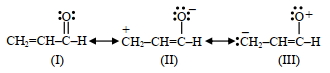
- (B) \(4\)
- (C) \(3\)
- (D) \(1\)
Show answer and solution
Correct Answer: (D)
For \(1^{\text {st }}\) order reaction\(75 \% \text { life }=2 \times 50 \% \text { life }\)
So order with respect to \(A\) will be first order.
So order with respect to \(B\) will be zero. Overall order of reaction \(=1+0=1\)
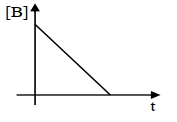
-
- (A) \(50\)
- (B) \(40\)
- (C) \(51\)
- (D) \(55\)
Show answer and solution
Correct Answer: (A)
\(\mathrm{K}=\frac{2.303}{\mathrm{t}} \log \frac{1}{0.1}\)\(4.6 \times 10^{-2}=\frac{2.303}{\mathrm{t}}\)
\(\mathrm{t}=50 \mathrm{sec}.\)
-
- (A) \(318\)
- (B) \(317\)
- (C) \(315\)
- (D) \(319\)
Show answer and solution
Correct Answer: (C)
\(2 \mathrm{~A}(\mathrm{~g})+\mathrm{B}(\mathrm{g}) \longrightarrow \mathrm{C}(\mathrm{g})\)\(\mathrm{r}_1 \quad 1.5 \mathrm{~atm} \quad 0.7 \mathrm{~atm}\)
\(\mathrm{r}_2 \quad 0.5 \mathrm{~atm} \quad 0.2 \mathrm{~atm} \quad 0.5 \mathrm{~atm}\)
\(\because \mathrm{r}=\mathrm{K}\left[\mathrm{P}_{\mathrm{A}}\right]^2\left[\mathrm{P}_{\mathrm{B}}\right]\)
\(\mathrm{r}_1=\mathrm{K}[1.5]^2[0.7]\)
\(\mathrm{r}_2=\mathrm{K}[0.5]^2[0.2]\)
\(\frac{\mathrm{r}_1}{\mathrm{r}_2}=9 \times \frac{7}{2}=31.5=315 \times 10^{-1}\)
Ans. \(315\)
-
- (A) \(70\)
- (B) \(98\)
- (C) \(100\)
- (D) \(90\)
Show answer and solution
Correct Answer: (C)
\(\mathrm{K}=\frac{\mathrm{K}_1 \mathrm{~K}_2}{\mathrm{~K}_3}\)\(A \mathrm{e}^{\frac{-\mathrm{E}_2}{\mathrm{RT}}}=\frac{\mathrm{A}_1 \mathrm{e}^{\frac{-\mathrm{E}_{\mathrm{a}_1}}{\mathrm{RT}}} \mathrm{A}_2 \mathrm{e}^{\frac{-\mathrm{E}_{2_2}}{\mathrm{RT}}}}{\mathrm{A}_3 \mathrm{e}^{\frac{-\mathrm{E}_{\mathrm{a}_1}}{\mathrm{RT}}}}\)
\(A \mathrm{e}^{\frac{-\mathrm{E}_2}{\mathrm{RT}}}=\frac{\mathrm{A}_1 \mathrm{~A}_2}{\mathrm{~A}_3} \mathrm{e}^{\frac{-\left(\mathrm{E}_{\mathrm{a}_2}+\mathrm{E}_{\mathrm{a}_2}-\mathrm{E}_{\mathrm{E}_3}\right)}{\mathrm{RT}}}\)
\(\mathrm{E}_{\mathrm{a}}=\mathrm{E}_{\mathrm{a}_1}+\mathrm{E}_{\mathrm{a}_2}-\mathrm{E}_{\mathrm{a}_3}\)
\(400=300+200-\mathrm{E}_{\mathrm{a}_3}\)
\(\mathrm{E}_{\mathrm{a}_3}=100 \mathrm{~kJ} / \mathrm{mole}\)
-
- (A) \(15\)
- (B) \(18\)
- (C) \(20\)
- (D) \(17\)
Show answer and solution
Correct Answer: (D)
\(\frac{\left(\mathrm{t}_{1 / 2}\right)_{\mathrm{I}}}{\left(\mathrm{t}_{1 / 2}\right)_{\mathrm{II}}}=\frac{\mathrm{K}_2}{\mathrm{~K}_1}=\frac{5}{2}\)\(\therefore \mathrm{K}_1 \mathrm{t}_1=\ln \frac{1}{1-\frac{2}{3}}=\ln 3\)
\(\mathrm{~K}_2 \mathrm{t}_2=\ln \frac{1}{1-\frac{4}{5}}=\ln 5\)
\(\Rightarrow \frac{\mathrm{K}_1}{\mathrm{~K}_2} \times \frac{\mathrm{t}_1}{\mathrm{t}_2}=\frac{0.477}{0.699}\)
\(\Rightarrow \frac{\mathrm{t}_1}{\mathrm{t}_2}=\frac{0.477}{0.699} \times \frac{5}{2}=1.7=17 \times 10^{-1}\)
-
- (A) \(2\)
- (B) \(3\)
- (C) \(4\)
- (D) \(5\)
Show answer and solution
Correct Answer: (B)
\(\mathrm{r}=\mathrm{K}[\mathrm{A}]^{\mathrm{x}}[\mathrm{B}]^{\mathrm{y}}\)\((I)\) \(6 \times 10^{-3}=\mathrm{K}[0.1]^{\mathrm{x}}[0.1]^{\mathrm{y}}\)
\((IV)\) \(2.4 \times 10^{-2}=\mathrm{K}[0.4]^{\mathrm{x}}[0.1]^{\mathrm{y}}\)
\((IV)/(I)\)
\(4=(4)^{\mathrm{x}}\)
\(\mathrm{x}=1\)
\(\mathrm{r}=\mathrm{K}[\mathrm{A}]^{\mathrm{x}}[\mathrm{B}]^{\mathrm{y}}\)
\((III)\) \(2.88 \times 10^{-1}=\mathrm{K}[0.3]^{\mathrm{x}}[0.4]^{\mathrm{y}}\)
\((II)\) \(7.2 \times 10^{-2}=\mathrm{K}[0.3]^{\mathrm{x}}[0.2]^{\mathrm{y}}\)
\((III)/(II)\)
\(4=2^y\)
\(y=2\)
Overall order \(=x+y=1+2=3\)
-
- (A) \(\mathrm{K}_1 \mathrm{~K}_2[\mathrm{~A}]\)
- (B) \(\left(\mathrm{K}_1-\mathrm{K}_2\right)[\mathrm{A}]\)
- (C) \(\left(\mathrm{K}_1+\mathrm{K}_2\right)[\mathrm{A}]\)
- (D) \(\left(\mathrm{K}_1 / \mathrm{K}_2\right)[\mathrm{A}]\)
Show answer and solution
Correct Answer: (D)
Rate of formation of \(B\) is\(\frac{\mathrm{d}[\mathrm{B}]}{\mathrm{dt}}=\mathrm{k}_1[\mathrm{~A}]-\mathrm{k}_2[\mathrm{~B}]\)
\(0=\mathrm{k}_1[\mathrm{~A}]-\mathrm{k}_2[\mathrm{~B}]\)
\(\left(\frac{\mathrm{k}_1}{\mathrm{k}_2}\right)[\mathrm{A}]=[\mathrm{B}]\)
-
- (A) \(20\)
- (B) \(10\)
- (C) \(30\)
- (D) \(45\)
Show answer and solution
Correct Answer: (C)
\( \mathrm{K}=\frac{\mathrm{K}_1 \cdot \mathrm{K}_2}{\mathrm{~K}_3}=\frac{\mathrm{A}_1 \cdot \mathrm{A}_2}{\mathrm{~A}_3} \cdot \mathrm{e}^{-\frac{\left(\mathrm{E}_{\mathrm{a}_1}+\mathrm{E}_{\mathrm{a}_2}-\mathrm{E}_{\mathrm{a}_3}\right)}{R T}} \)\( \mathrm{~A} \cdot \mathrm{e}^{-\mathrm{E}_{\mathrm{a}} / \mathrm{RT}}=\frac{\mathrm{A}_1 \mathrm{~A}_2}{\mathrm{~A}_3} \cdot \mathrm{e}^{-\frac{\left(\mathrm{E}_{\mathrm{a}_1}+\mathrm{E}_{\mathrm{a}_2}-\mathrm{E}_{\mathrm{a}_3}\right)}{R T}}\)
\(\mathrm{E}_{\mathrm{a}}=\mathrm{E}_{\mathrm{a}_1}+\mathrm{E}_{\mathrm{a}_2}-\mathrm{E}_{\mathrm{a}_3}=40+50-60=30 \mathrm{~kJ} / \mathrm{mole}\)
-
- (A) \(7\)
- (B) \(8\)
- (C) \(10\)
- (D) \(15\)
Show answer and solution
Correct Answer: (B)
\(\mathrm{r}=\mathrm{K}[\mathrm{A}]^2|\mathrm{~B}|\)if conc. are doubled
\(\mathrm{r}^{\prime}=\mathrm{K}[2 \mathrm{~A}]^2[2 \mathrm{~B}]^1\)
\(\mathrm{r}^{\prime}=8 \mathrm{r} \Rightarrow \mathrm{x}=8\)
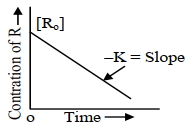
(Image)
\(\Rightarrow \text { Zero order, } y=0\)
\(x+y=8\)
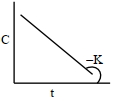
-
- (A) \(\mathrm{k}=\frac{2.303}{\mathrm{t}} \times \log \frac{\mathrm{P}_{\mathrm{i}}}{\left(2 \mathrm{P}_{\mathrm{i}}-\mathrm{P}_{\mathrm{t}}\right)}\)
- (B) \(k=\frac{2.303}{t} \times \log \frac{2 P_i}{\left(2 P_i-P_t\right)}\)
- (C) \(k=\frac{2.303}{t} \times \log \frac{\left(2 P_i-P_t\right)}{P_i}\)
- (D) \(\mathrm{k}=\frac{2.303}{\mathrm{t}} \times \frac{\mathrm{P}_{\mathrm{i}}}{\left(2 \mathrm{P}_{\mathrm{i}}-\mathrm{P}_{\mathrm{t}}\right)}\)
Show answer and solution
Correct Answer: (A)
\(\mathrm{A} \rightarrow\) \(\mathrm{B}+\) \(\mathrm{C}\) \(P_i\) \(0\) \(0\) \(P_i-\) \(x\) \(x\) \(\mathrm{P}_{\mathrm{t}}=\mathrm{P}_{\mathrm{i}}+\mathrm{x}\)
\(\mathrm{P}_{\mathrm{i}}-\mathrm{x}=\mathrm{P}_{\mathrm{i}}-\mathrm{P}_{\mathrm{t}}+\mathrm{P}_{\mathrm{i}}\)
\(=2 \mathrm{P}_{\mathrm{i}}-\mathrm{P}_{\mathrm{t}}\)
\(\mathrm{K}=\frac{2.303}{\mathrm{t}} \log \frac{\mathrm{P}_{\mathrm{i}}}{2 \mathrm{P}_{\mathrm{i}}-\mathrm{P}_{\mathrm{t}}}\)
-
- (A) B only
- (B) A only
- (C) B and C only
- (D) A and D only
Show answer and solution
Correct Answer: (D)
\(2 Fe ^{3+}+2 I ^{-} \rightarrow 2 Fe ^{2+}+ I _2\)
\(2 Fe ^{2+}+ S _2 O _8^{2-} \rightarrow 2 Fe ^{3+}+2 SO _4^{2-}\)
\(Fe ^{+3}\) oxidises \(I ^{-}\)to \(I _2\) and convert itself into \(Fe ^{+2}\).
This \(Fe ^{+2}\) reduces \(S _2 O _8{ }^{2-}\) to \(SO _4{ }^{2-}\) and converts itself into \(Fe ^{+3}\). -
- (A) \(16\)
- (B) \(17\)
- (C) \(18\)
- (D) \(19\)
Show answer and solution
Correct Answer: (B)
Rate of reaction (ROR)\(=-\frac{1}{2} \frac{\Delta\left[\mathrm{N}_2 \mathrm{O}_5\right]}{\Delta \mathrm{t}}=\frac{1}{4} \frac{\left[\mathrm{NO}_2\right]}{\Delta \mathrm{t}}=\frac{\Delta\left[\mathrm{O}_2\right]}{\Delta \mathrm{t}}\)
\(\mathrm{ROR}=-\frac{1}{2} \frac{\Delta\left[\mathrm{N}_2 \mathrm{O}_5\right]}{\Delta \mathrm{t}}=-\frac{1}{2} \frac{(2.75-3)}{30} \mathrm{molL}^{-1} \mathrm{~min}^{-1}\)
\(\mathrm{ROR}=-\frac{1}{2} \frac{(-0.25)}{30} \mathrm{molL}^{-1} \mathrm{~min}^{-1}\)
\(\text { ROR }=\frac{1}{240} \mathrm{molL}^{-1} \mathrm{~min}^{-1}\)
\(\text { Rate of formation of } \mathrm{NO}_2=\frac{\Delta\left[\mathrm{NO}_2\right]}{\Delta \mathrm{t}}=4 \times \mathrm{ROR}\)
\(=\frac{4}{240}=16.66 \times 10^{-3} \mathrm{molL}^{-1} \mathrm{~min}^{-1} \simeq 17 \times 10^{-3}\)
-
- (A) \(390\)
- (B) \(399\)
- (C) \(499\)
- (D) \(490\)
Show answer and solution
Correct Answer: (B)
\({r}=\mathrm{k}[\mathrm{A}]\)So, order of reaction \(=1\)
\({t}_{1 / 2}=120 \mathrm{~min}\)
For \(90 \%\) completion of reactio
\(\Rightarrow \mathrm{k}=\frac{2.303}{\mathrm{t}} \log \left(\frac{\mathrm{a}}{\mathrm{a}-\mathrm{x}}\right)\)
\(\Rightarrow \frac{0.693}{\mathrm{t}_{1 / 2}}=\frac{2.303}{\mathrm{t}} \log \frac{100}{10}\)
\(\therefore \mathrm{t}=399 \mathrm{~min} .\)
-
- (A) \(1\)
- (B) \(2\)
- (C) \(5\)
- (D) \(10\)
Show answer and solution
Correct Answer: (B)
\(\text { Sol. } \mathrm{A}(\mathrm{g}) \rightarrow 2 \mathrm{B}(\mathrm{g})+\mathrm{C}(\mathrm{g})\)\(\mathrm{t}=0 \quad 0.1\)
\(\mathrm{t}=115 \mathrm{sec} . \quad 0.1-\mathrm{x} \quad 2 \mathrm{x} \quad \mathrm{x}\)
\(0.1+2 \mathrm{x}=0.28\)
\(2 \mathrm{x}=0.18\)
\(x=0.09\)
\(\mathrm{~K}=\frac{1}{115} \ln \frac{0.1}{0.1-0.09}\)
\(=0.0200 \mathrm{sec}^{-1}\)
\(=2 \times 10^{-2} \sec ^{-1}\)
-
- (A) \(41\)
- (B) \(52\)
- (C) \(63\)
- (D) \(36\)
Show answer and solution
Correct Answer: (C)
Half life of bromine \(-82=36\) hours\( \mathrm{t}_{1 / 2}=\frac{0.693}{\mathrm{~K}} \)
\( \mathrm{~K}=\frac{0.693}{36}=0.01925 \mathrm{hr}^{-1} \)
\(1^{\text {st }}\) order rxn kinetic equation
\( t=\frac{2.303}{K} \log \frac{a}{a-x} \)
\( \log \frac{a}{a-x}=\frac{t \times K}{2.303} \quad(t=1 \text { day }=24 \mathrm{hr}) \)
\( \log \frac{\mathrm{a}}{\mathrm{a}-\mathrm{x}}=\frac{24 \mathrm{hr} \times 0.01925 \mathrm{hr}^{-1}}{2.303} \)
\( \log \frac{\mathrm{a}}{\mathrm{a}-\mathrm{x}}=0.2006 \)
\( \frac{\mathrm{a}}{\mathrm{a}-\mathrm{x}}=\operatorname{anti} \log (0.2006) \)
\( \frac{\mathrm{a}}{\mathrm{a}-\mathrm{x}}=1.587 \)
\( \text { If } \mathrm{a}=1 \)
\( \frac{1}{1-\mathrm{x}}=1.587 \Rightarrow 1-\mathrm{x}=0.6301=\text { Fraction remain } \) after one day
-
- (A) \(24\)
- (B) \(30\)
- (C) \(35\)
- (D) \(40\)
Show answer and solution
Correct Answer: (A)
\(0.04=\mathrm{k}[\mathrm{A}]_0 \mathrm{e}^{-\mathrm{k} \times 10 \times 60}\) \(...(1)\)\(0.03=\mathrm{k}[\mathrm{A}]_0 \mathrm{e}^{-\mathrm{k} \times 20 \times 60}\) \(...(2)\)
\((1) /(2)\)
\(\frac{4}{3}=\mathrm{e}^{600 \mathrm{k}(2-1)}\)
\(\frac{4}{3}=\mathrm{e}^{600 \mathrm{k}}\)
\(\ln \frac{4}{3}=600 \mathrm{k}\)
\(\ln \frac{4}{3}=600 \times \frac{\ln 2}{\mathrm{t}_{1 / 2}}\)
\(\mathrm{t}_{1 / 2}=600 \frac{\ln 2}{\ln \frac{4}{3}}\)sec
\(\mathrm{t}_{1 / 2}=600 \times \frac{\log 2}{\log 4-\log 3} \text { sec. }=10 \times \frac{0.3010}{0.6020-0.477} \mathrm{~min}\)
\(\mathrm{t}_{1 / 2}\)
Ans. \(24\)
-
- (A) \(17160\)
- (B) \(17170\)
- (C) \(17180\)
- (D) \(17190\)
Show answer and solution
Correct Answer: (D)
\(\lambda t=\ln \frac{\left({ }^{14} \mathrm{C} /{ }^{12} \mathrm{C}\right)_{\text {atmosphere }}}{\left({ }^{14} \mathrm{C} /{ }^{12} \mathrm{C}\right)_{\text {wood sample }}}\)As per the question,
\(\frac{\left({ }^{14} \mathrm{C} / 12 \mathrm{C}\right)_{\text {wood }}}{\left({ }^{14} \mathrm{C} /{ }^{12} \mathrm{C}\right)_{\text {atrmophere }}}=\frac{1}{8}\)
So, \(\lambda \mathrm{t}=\ln 8\)
\(\frac{\ln 2}{t_{1 / 2}} t=\ln 8\)
\(t=3 \times t_{1 / 2}=17190 \text { years }\)
-
- (A) \(5\)
- (B) \(4\)
- (C) \(3\)
- (D) \(8\)
Show answer and solution
Correct Answer: (C)
\(\mathrm{K}=\frac{1}{\mathrm{t}_{99.9 \%}} \ln \left(\frac{100}{0.1}\right)=\frac{1}{\mathrm{t}_{90 \%}} \ln \left(\frac{100}{10}\right)\)\(\mathrm{t}_{99.9 \%}=\mathrm{t}_{90 \%} \frac{\ln \left(10^3\right)}{\ln 10}\)
\(\mathrm{t}_{99.9 \%}=\mathrm{t}_{90 \%} \times 3\)
-
- (A) \(15\)
- (B) \(17\)
- (C) \(10\)
- (D) \(5\)
Show answer and solution
Correct Answer: (C)
\(\frac{t_{99.9 \%}}{t_{1 / 2}}=\frac{\frac{2.303}{k}\left(\frac{a}{a-x}\right)}{\frac{2.303}{k} \log 2}=\frac{\log \left(\frac{100}{100-99.9}\right)}{\log 2}=\frac{\log 10^3}{\log 2}=\frac{3}{0.3}=10\) -
- (A) \(3\)
- (B) \(2\)
- (C) \(4\)
- (D) \(1\)
Show answer and solution
Correct Answer: (C)
\(-\mathrm{NO}_2,-\mathrm{C} \equiv \mathrm{N},-\mathrm{COR},-\mathrm{COOH}\)are meta directing.
-
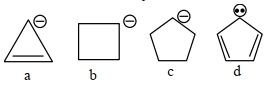
- (A) \(c>b>d>a\)
- (B) \(a>b>c>d\)
- (C) \(d>a>c>b\)
- (D) \(d>c>b>a\)
Show answer and solution
Correct Answer: (D)
As we know compound (\(d\)) is aromatic and the compound (\(a\)) is anti-aromatic. Hence compound(\(d\))is most stable and compound (\(a\)) is least stable among these in compound (\(b\)) and (\(c\)) carbon atom of that positive charge is \(\mathrm{sp}^3\) hybridised they on the basis of angle strain theory compound (\(c\)) is more stable than compound (\(b\)).
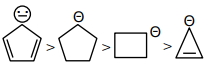
- 135. For the given compounds, the correct order of increasing \(\mathrm{pK}_{\mathrm{a}}\) value:
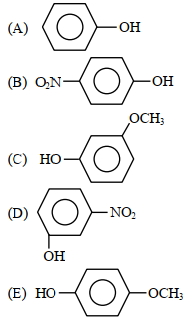 2024 Medium
- (A) (E) < (D) < (C) < (B) < (A)
- (B) (D) < (E) < (C) < (B) < (A)
- (C) (E) < (D) < (B) < (A) < (C)
- (D) (B) < (D) < (C) < (A) < (E)
Show answer and solution
Correct Answer: (D)
Acidic strength order :-\(\mathrm{B}>\mathrm{D}>\mathrm{C}>\mathrm{A}>\mathrm{E}\)
Correct \(\mathrm{pKa}\) Order :
\(\text { B }<\text { D }<\text { C }<\text { A }<\text { E }\)
-
- (A) \((A)\) only
- (B) \((C)\) only
- (C) \((B)\) only
- (D) \((D)\) and \((E)\) only
Show answer and solution
Correct Answer: (C)
Heterolytic cleavage of Bond lead to formation of ions. - 137. Number of carbocations from the following that are not stabilized by hyperconjugation is _______.
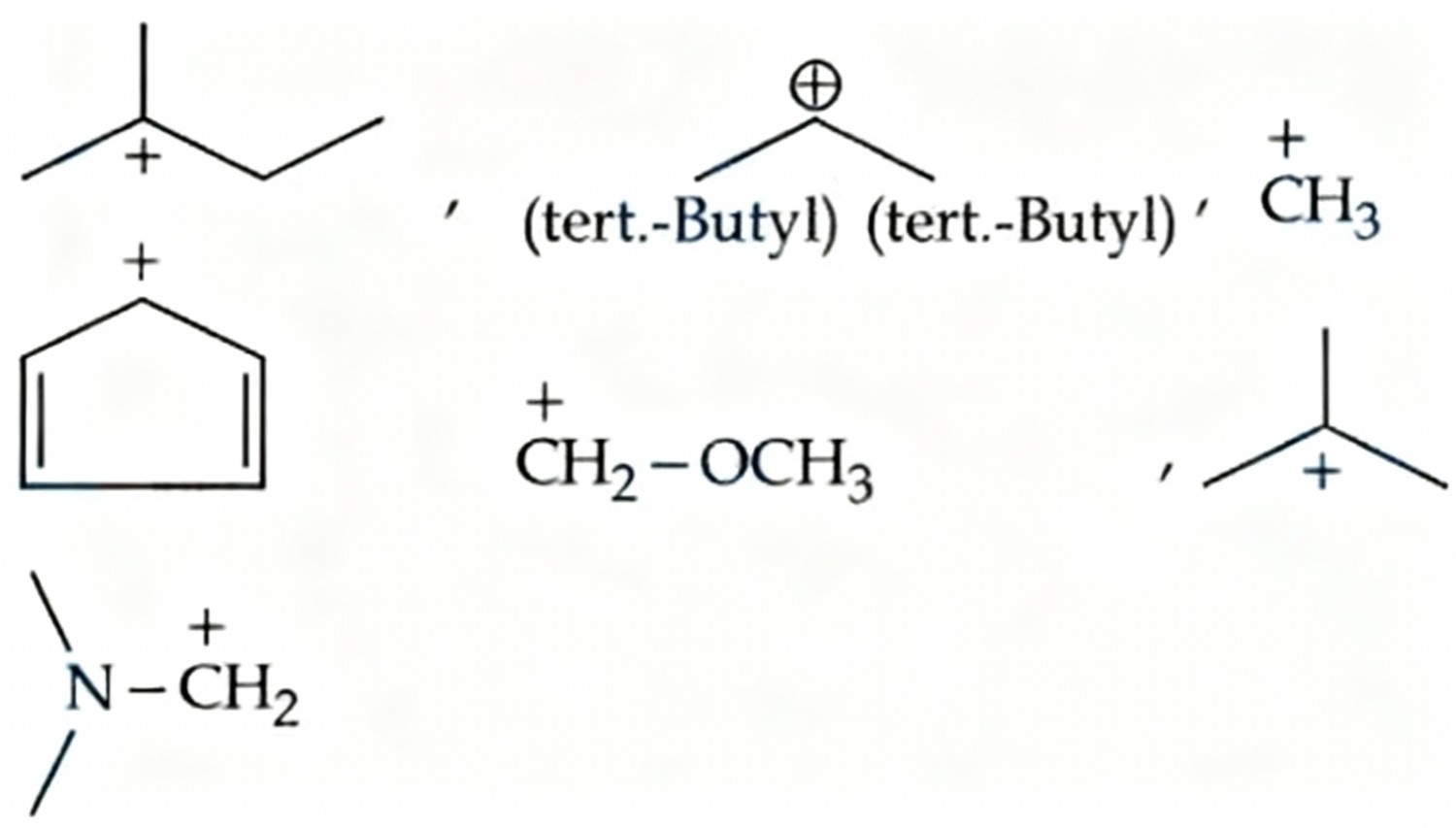 2024 Medium
- (A) 3
- (B) 5
- (C) 7
- (D) 9
Show answer and solution
Correct Answer: (A)
3 -
- (A) \((I) \)>\( (III) \)>\( (II)\)
- (B) \((I) \)>\( (II) \)>\( (III)\)
- (C) \((II) \)>\( (I) \)>\( (III)\)
- (D) \((III) \)>\( (II) \)>\( (I)\)
Show answer and solution
Correct Answer: (B)
\((1)\) Neutral structures are more stable than charged ones. Therefore \(I\) is more stable than \(II\) and \(III\).\((2)\) +ve charge on less electronegative atom is more stable i.e., \(\mathrm{C}^{\oplus}\) is more stable than \(\mathrm{O}^{\oplus}\)
\(\therefore\) Order is \(\mathrm{I}>\) II \(>\) \(III\)
-
- (A) \(C < D < B < A\)
- (B) \(A < B < C < D\)
- (C) \(A < B < D < C\)
- (D) \(D < C < B < A\)
Show answer and solution
Correct Answer: (A)
\(Image\)Stability of conjugate base \(\alpha\) acidic strength \(\mathrm{C}<\mathrm{D}<\mathrm{B}<\mathrm{A}\)

- 140. The correct order of reactivity in electrophilic substitution reaction of the following compounds is _______.
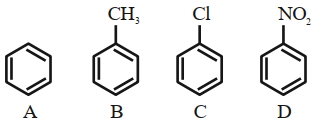 2024 Hard
- (A) \(\mathrm{B}>\mathrm{C}>\mathrm{A}>\mathrm{D}\)
- (B) \(\mathrm{D}>\mathrm{C}>\mathrm{B}>\mathrm{A}\)
- (C) \(\mathrm{A}>\mathrm{B}>\mathrm{C}>\mathrm{D}\)
- (D) \(B>A>C>D\)
Show answer and solution
Correct Answer: (D)
\(-\mathrm{CH}_3\) shows \(+\mathrm{M}\) and \(+\mathrm{I}\).\(-\mathrm{Cl}\) shows \(+\mathrm{M}\) and \(-\mathrm{I}\) but inductive effect dominates.
\(-\mathrm{NO}_2\) shows \(-\mathrm{M}\) and \(-\mathrm{I}\).
Electrophilic substitution \(\alpha \frac{1}{-\mathrm{M} \text { and }-\mathrm{I}}\)
\(\alpha+\mathrm{M} \text { and }+\mathrm{I}\)
Hence, order is \(\mathrm{B}>\mathrm{A}>\mathrm{C}>\mathrm{D}\).
-
- (A) \(\left(\mathrm{CH}_3\right)_3 \mathrm{C}^{+}>\mathrm{CH}_3-\stackrel{+}{\mathrm{C}} \mathrm{H}_2>\left(\mathrm{CH}_3\right)_2 \stackrel{+}{\mathrm{C}} \mathrm{H}>\stackrel{+}{\mathrm{C}} \mathrm{H}_3\)
- (B) \(\stackrel{+}{\mathrm{C}} \mathrm{H}_3>\left(\mathrm{CH}_3\right)_2 \stackrel{+}{\mathrm{C}} \mathrm{H}>\mathrm{CH}_3-\stackrel{+}{\mathrm{C}} \mathrm{H}_2>\left(\mathrm{CH}_3\right)_3 \stackrel{+}{\mathrm{C}}\)
- (C) \(\left(\mathrm{CH}_3\right)_3 \stackrel{+}{\mathrm{C}}>\left(\mathrm{CH}_3\right)_2 \stackrel{+}{\mathrm{C}} \mathrm{H}>\mathrm{CH}_3-\stackrel{+}{\mathrm{C}} \mathrm{H}_2>\stackrel{+}{\mathrm{C}} \mathrm{H}_3\)
- (D) \(\stackrel{+}{\mathrm{C}} \mathrm{H}_3>\mathrm{CH}_3-\stackrel{+}{\mathrm{C}} \mathrm{H}_2>\mathrm{CH}_3-\stackrel{+}{\mathrm{C}} \mathrm{H}>\left(\mathrm{CH}_3\right) \mathrm{C}^{+}\stackrel{+}{\mathrm{C}} \mathrm{H}_3\)
Show answer and solution
Correct Answer: (C)
More no. of hyperconjugable Hydrogens, more stable is the carbocations. - 142. The correct stability order of the following resonance structures of \(\mathrm{CH}_3-\mathrm{CH}=\mathrm{CH}-\mathrm{CHO}\) is _______.
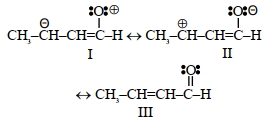 2024 Medium
- (A) \(II\) \(>\) \(III\) \(>\) \(I\)
- (B) \(III\) \(>\) \(II\) \(>\) \(I\)
- (C) \(I\) \(>\) \(II\) \(>\) \(III\)
- (D) \(II\) \(>\) \(I\) \(>\) \(III\)
Show answer and solution
Correct Answer: (B)
\(Image\)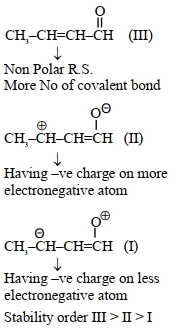
- 143. The difference in energy between the actual structure and the lowest energy resonance structure for the given compound is _______. 2024 Hard
- (A) electromeric energy
- (B) resonance energy
- (C) ionization energy
- (D) hyperconjugation energy
Show answer and solution
Correct Answer: (B)
The difference in energy between the actual structure and the lowest energy resonance structure for the given compound is known as resonance energy. - 144. The interaction between \(\pi\) bond and lone pair of electrons present on an adjacent atom is responsible for: 2024 Hard
- (A) Hyperconjugation
- (B) Inductive effect
- (C) Electromeric effect
- (D) Resonance effect
Show answer and solution
Correct Answer: (D)
It is a type of conjugation responsible for resonance. - 145. The order of relative stability of the contributing structure is: Choose the correct answer from the options given below:
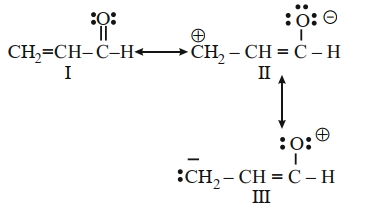 2024 Hard
- (A) \( I > II > III\)
- (B) \(II > I > III\)
- (C) \(\mathrm{I}=\mathrm{II}=\mathrm{III}\)
- (D) \(III > II > I\)
Show answer and solution
Correct Answer: (A)
\(I\) \(>\) \(II\) \(>\) \(III\), since neutral resonating structures are more stable than charged resonating structure. \(II\) \(>\) \(III\), since stability of structure with -ve charge on more electronegative atom is higher. -
- (A) \(-\mathrm{CN},-\mathrm{NH}_2,-\mathrm{NHR},-\mathrm{OCH}_3\)
- (B) \(-\mathrm{NO}_2,-\mathrm{NH}_2,-\mathrm{COOH},-\mathrm{COOR}\)
- (C) \(-\mathrm{NO}_2,-\mathrm{CHO},-\mathrm{SO}_3 \mathrm{H},-\mathrm{COR}\)
- (D) \(-\mathrm{CN},-\mathrm{CHO},-\mathrm{NHCOCH}_3,-\mathrm{COOR}\)
Show answer and solution
Correct Answer: (C)
All are \(-\mathrm{M}\), Hence meta directing groups.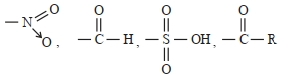
-
- (A) \(\mathrm{C} \overline{1}>\mathrm{OH}>\mathrm{R} \overline{\mathrm{O}}>\mathrm{CH}_3 \mathrm{CO} \overline{\mathrm{O}}\)
- (B) \(\mathrm{R} \overline{\mathrm{O}}>-\mathrm{OH}>\mathrm{CH}_3 \mathrm{CO} \overline{\mathrm{O}}>\mathrm{C} \overline{1}\)
- (C) \({ }^{-} \mathrm{OH}>\mathrm{R} \overline{\mathrm{O}}>\mathrm{CH}_3 \mathrm{CO} \overline{\mathrm{O}}>\mathrm{C} \overline{1}\)
- (D) \(\mathrm{C}_{\overline{1}}>\mathrm{R} \overline{\mathrm{O}}>-{ }^{-} \mathrm{OH}>\mathrm{CH}_3 \mathrm{CO} \overline{\mathrm{O}}\)
Show answer and solution
Correct Answer: (B)
Strong acid have weak conjugate base Acidic strength :\(\mathrm{H}-\mathrm{Cl}>\mathrm{CH}_3 \mathrm{COOH}>\mathrm{H}_2 \mathrm{O}>\mathrm{R}-\mathrm{OH}\)
Conjugate base strength :
\(\mathrm{Cl}^{-}<\mathrm{CH}_3 \mathrm{COO}^{-}<\overline{\mathrm{O}} \mathrm{H}<\mathrm{RO}^{-}\)
-
- (A) Electromeric effect dominates over inductive effect
- (B) The electromeric effect is, temporary effect
- (C) The organic compound shows electromeric effect in the presence of the reagent only
- (D) Hydrogen ion \(\left(\mathrm{H}^{+}\right)\)shows negative electromeric effect
Show answer and solution
Correct Answer: (D)
Hydrogen ion \(\left(\mathrm{H}^{+}\right)\)shows positive electromeric effect. -
- (A) \(135\)
- (B) \(136\)
- (C) \(132\)
- (D) \(147\)
Show answer and solution
Correct Answer: (A)
\( \mathrm{n}_{\text {Acetan ilide }}=\mathrm{n}_{\text {Aniline }} \)\( \Rightarrow \frac{\mathrm{m}}{135}=\frac{9.3}{93} \)
\( \Rightarrow \mathrm{m}=13.5 \mathrm{~g}\)

-
- (A) \(70\)
- (B) \(80\)
- (C) \(90\)
- (D) \(100\)
Show answer and solution
Correct Answer: (B)
\(93 \mathrm{~g}\) of aniline produces \(330 \mathrm{~g}\) of \(2,4,6-\) tribromoaniline. Hence \(9.3 \mathrm{~g}\) of aniline should produce \(33 \mathrm{~g}\) of \(2, 4, 6-\)tribromoaniline. Hence percentage yield \(\frac{26.4 \times 100}{33}=80 \%\)

No questions on this page match these filters.