


Questions
12 questionsShowing 1–12 of 12 questions
- 1. For the compounds :

The increasing order of boiling point is :
Choose the correct answer from the options given below : 2024 Medium- (A) \((\mathrm{A})<(\mathrm{B})<(\mathrm{C})<(\mathrm{D})\)
- (B) \((\mathrm{B})<(\mathrm{C})<(\mathrm{C})<(\mathrm{D})\)
- (C) \((\mathrm{D})<(\mathrm{C})<(\mathrm{A})<(\mathrm{B})\)
- (D) \((\mathrm{B})<(\mathrm{A})<(\mathrm{D})<(\mathrm{C})\)
Show answer and solution
Correct Answer: (B)
Compounds having same number of carbon atoms follow the boiling point order as:(Boiling point \()_{\text {Hydogen bending }}>\) (Boiling point \()_{\text {iigh polarity }}>\) \((\text { Boiling point })_{1 \text { or polarity }}>(\text { Boiling point })_{\text {nou polar }}\)
-
- (A) \(3\)
- (B) \(4\)
- (C) \(10\)
- (D) \(6\)
Show answer and solution
Correct Answer: (A)
Acetaldehyde \(\left(\mathrm{CH}_3 \mathrm{CHO}\right)\), Methanal \((\mathrm{HCHO})\), andcyclohexane carbaldehyde
-
- (A) Both Statement \(I\) and Statement \(II\) are correct.
- (B) Both Statement \(I\) and Statement \(II\) are incorrect.
- (C) Statement \(I\) is incorrect but Statement \(II\) is correct.
- (D) Statement \(I\) is correct but Statement \(II\) is incorrect.
Show answer and solution
Correct Answer: (D)
Aldehyde and ketones having acidic \(\alpha\)-hydrogen show aldol reaction
-
- (A) Stephen reaction
- (B) Etard reaction
- (C) Gatterman-koch reaction
- (D) Rosenmund reduction
Show answer and solution
Correct Answer: (C)
Gatterman-Koch reaction
- 5. In the above chemical reaction sequence " \(\mathrm{A}\) " and " \(\mathrm{B}\) " respectively are :
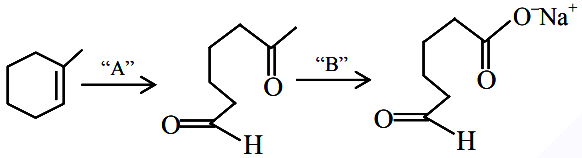 2024 Medium
- (A) \(\mathrm{O}_3, \mathrm{Zn} / \mathrm{H}_2 \mathrm{O}\) and \(\mathrm{NaOH}_{\text {(alc.). }} / \mathrm{I}_2\)
- (B) \(\mathrm{H}_2 \mathrm{O}, \mathrm{H}^{+}\)and \(\mathrm{NaOH}_{\text {(alc.) }} / \mathrm{I}_2\)
- (C) \(\mathrm{H}_2 \mathrm{O}, \mathrm{H}^{+}\)and \(\mathrm{KMnO}_4\)
- (D) \(\mathrm{O}_3, \mathrm{Zn} / \mathrm{H}_2 \mathrm{O}\) and \(\mathrm{KMnO}_4\)
Show answer and solution
Correct Answer: (A)
Explanation:
To determine the identity of reagents "A" and "B", we analyze each transformation step in the reaction pathway:
1. First Transformation (Identification of "A"):
The starting reactant is an unsymmetrical cyclic alkene, 1-methylcyclohexene. Under the action of reagent "A", the carbon-carbon double bond (\( \text{C}=\text{C} \)) undergoes oxidative cleavage to open the ring, generating a dicarbonyl product containing both a ketone group and an aldehyde group (6-oxoheptanal). This specific cleavage with a reductive workup that preserves aldehydes without further oxidation to carboxylic acids is known as reductive ozonolysis. Therefore, reagent "A" must be:
\( \text{O}_3 \text{ followed by } \text{Zn/H}_2\text{O} \)
2. Second Transformation (Identification of "B"):
The intermediate contains a methyl ketone group (\( -\text{COCH}_3 \)). Upon treatment with reagent "B" in the presence of iodine (\( \text{I}_2 \)), the methyl ketone group undergoes a haloform cleavage to form a bright yellow precipitate of iodoform (\( \text{CHI}_3 \)) alongside the corresponding sodium carboxylate salt. This confirmation test for methyl ketones requires a strong base. Therefore, reagent "B" is:
\( \text{NaOH} \)
Combining both components, "A" and "B" correspond perfectly to option A. -
- (A) \(317\)
- (B) \(318\)
- (C) \(320\)
- (D) \(325\)
Show answer and solution
Correct Answer: (B)
Claisen Schmidt reaction(Image)
\(\mathrm{mw}\) of benzaldehyde \(=106\)
\(106 \times 3=318 \mathrm{gm}\). Benzaldehyde is required to give \(1.5 \mathrm{~mole}\) (or \(351 \mathrm{gm}\) ) product

-
- (A) \(1\)
- (B) \(10\)
- (C) \(15\)
- (D) \(0\)
Show answer and solution
Correct Answer: (A)

Explanation:
To find the correct product P and the number of hydroxyl groups, we analyze the competitive reaction pathways of Grignard reagents:
1. Acid-Base vs. Nucleophilic Addition: The starting material is 4-hydroxybenzaldehyde, which contains two functional groups: a carbonyl group (\( -\text{CHO} \)) and a phenolic hydroxyl group (\( -\text{OH} \)). Grignard reagents (\( \text{PhMgBr} \)) are exceptionally strong nucleophiles, but they are also extremely strong bases. Because acid-base proton transfer reactions are kinetically much faster than nucleophilic addition reactions to carbonyl groups, the Grignard reagent will preferentially act as a base.
2. First Step (Deprotonation): Since only 1 equivalent of \( \text{PhMgBr} \) is added, it completely reacts with the highly acidic proton of the phenolic \( -\text{OH} \) group instead of attacking the aldehyde group:
\( \text{H-O-C}_6\text{H}_4\text{-CHO} + \text{PhMgBr} \rightarrow \text{BrMg-O-C}_6\text{H}_4\text{-CHO} + \text{Ph-H} \)
This step yields a magnesium phenoxide salt and leaves the carbonyl group (\( -\text{CHO} \)) completely untouched.
3. Second Step (Acidic Workup): The addition of aqueous ammonium chloride (\( \text{aq. NH}_4\text{Cl} \)) neutralizes the mixture and protonates the phenoxide salt back to its original form:
\( \text{BrMg-O-C}_6\text{H}_4\text{-CHO} + \text{NH}_4\text{Cl} \rightarrow \text{H-O-C}_6\text{H}_4\text{-CHO} + \text{Mg(OH)Br} + \text{NH}_3 \)
4. Hydroxyl Group Count: Consequently, the principal organic product P recovered after workup is the unaltered starting material, 4-hydroxybenzaldehyde. Looking at its chemical structure, it contains exactly 1 phenolic hydroxyl (\( -\text{OH} \)) group.
Hence, Option A is the correct choice. -
- (A) Rosenmund reduction
- (B) Wolff-Kishner reduction
- (C) Stephen reduction
- (D) Etard reduction
Show answer and solution
Correct Answer: (A)
It is known as rosenmund reduction that is the partial reduction of acid chloride to aldehyde.
- 9. The total number of 'sigma' (σ) and 'Pi' (π) bonds in 2-oxohex-4-ionic acid is ______. 2024 Medium
- (A) 12
- (B) 14
- (C) 16
- (D) 18
Show answer and solution
Correct Answer: (D)
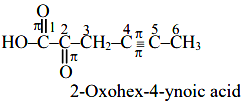
Number of \(\sigma\)-bonds \(=14\)
Number of \(\pi\)-bonds \(=4\)
Total number of bonds \(=18\) - 10. Vanillin compound obtained from vanilla beans, has total sum of oxygen atoms and \(\pi\) electrons is _______. 2024 Medium
- (A) \(10\)
- (B) \(11\)
- (C) \(15\)
- (D) \(20\)
Show answer and solution
Correct Answer: (B)
Vanillin compound is an organic compound molecular formula \(\mathrm{C}_3 \mathrm{H}_5 \mathrm{O}_3\). It is a phenolic aldehyde. Its functional compounds include aldehyde, hydroxyl and ether. It is the primary component of the extract of the vanilla beans.(Image)
Total sum of oxygen atoms and \(\pi\)-electrons is \(3+8=11\)
Total number of oxygen atoms \(=3\)
Total number of \(\pi\)-bonds \(=4\)
\(\therefore\) Total number of \(\pi\)-electrons \(=8\)

-
- (A) \(\mathrm{CH}_3 \mathrm{CH}_2 \mathrm{CH}_2 \mathrm{CH}_3\)
- (B) \(\mathrm{CH}_3 \mathrm{CH}_2 \mathrm{CH}_2 \mathrm{CH}_2-\mathrm{OH}\)
- (C) \(\mathrm{CH}_3 \mathrm{CH}_2 \mathrm{CH}_2 \mathrm{CHO}\)
- (D) \(\mathrm{H}_5 \mathrm{C}_2-\mathrm{O}-\mathrm{C}_2 \mathrm{H}_5\)
Show answer and solution
Correct Answer: (B)
Due to \(H\)-bonding boiling point of alcohol is High. -
- (A) \(C\) and \(D\) only
- (B) \(A\), \(B\) and \(C\) only
- (C) \(A\) only
- (D) \(B\) and \(C\) only
Show answer and solution
Correct Answer: (B)
Apart from aldehyde, Formic acid also gives silver mirror test with ammonical silver nitrate.


No questions on this page match these filters.