


All JEE Mains 2024 Chemistry questions
26 chaptersShowing 301–350 of 490 questions
-
- (A) \(1\)
- (B) \(2\)
- (C) \(3\)
- (D) \(4\)
Show answer and solution
Correct Answer: (D)
Conductivity \(\left(\mathrm{S} \mathrm{m}^{-1}\right)\)\(2.1\times10^3\)
\(1.2 \times 10\)
\(3.91\) conductors at \(298.15 \mathrm{~K}\)
\(1 \times 10^3\)
\(1 \times 10^{-16}\) Insulator at \(298.15 {~K}\)
\(l1.5 \times 10^{-2}\)
\(110^{-7}\) Semiconductor at \(298.15 \mathrm{~K}\)
Therefore number of conductors is \(4\).
- 302. What pressure (bar) of \(\mathrm{H}_2\) would be required to make emf of hydrogen electrode zero in pure water at \(25^{\circ} \mathrm{C}\) ? 2024 Medium
- (A) \(10^{-14}\)
- (B) \(10^{-7}\)
- (C) \(1\)
- (D) \(0.5\)
Show answer and solution
Correct Answer: (A)
\(2 \mathrm{e}^{-}+2 \mathrm{H}^{+}(\mathrm{aq}) \rightarrow \mathrm{H}_2(\mathrm{~g})\)\(\mathrm{E}=\mathrm{E}^0-\frac{0.059}{\mathrm{n}} \log \frac{\mathrm{P}_{\mathrm{H}_2}}{\left[\mathrm{H}^{+}\right]^2}\)
\(0=0-\frac{0.059}{2} \log \frac{\mathrm{P}_{\mathrm{H}_2}}{\left(10^{-7}\right)^2}\)
\(\log \frac{\mathrm{P}_{\mathrm{H}_2}}{\left(10^{-7}\right)^2}=0\)
\(\frac{\mathrm{P}_{\mathrm{H}_2}}{10^{-14}}=1\)
\(\mathrm{P}_{\mathrm{H}_2}=10^{-14} \text { bar }\)
-
- (A) Coating of iron surface by tin prevents rusting, even if the tin coating is peeling off.
- (B) When \(\mathrm{pH}\) lies above \(9\) or \(10\) , rusting of iron does not take place.
- (C) Dissolved acidic oxides \(\mathrm{SO}_2, \mathrm{NO}_2\) in water act as catalyst in the process of rusting.
- (D) Rusting of iron is envisaged as setting up of electrochemical cell on the surface of iron object.
Show answer and solution
Correct Answer: (A)
As tin coating is peeled off, then iron is exposed to atmosphere. -
- (A) \(\Lambda_{\mathrm{m}}^2 \mathrm{C}-\mathrm{K}_{\mathrm{a}} \Lambda_{\mathrm{m}}^{\circ 2}+\mathrm{K}_{\mathrm{a}} \Lambda_{\mathrm{m}} \Lambda_{\mathrm{m}}^{\circ}=0\)
- (B) \(\Lambda_{\mathrm{m}}-\Lambda_{\mathrm{m}}^{\circ}+\mathrm{AC}^{\frac{1}{2}}=0\)
- (C) \(\Lambda_{\mathrm{m}}-\Lambda_{\mathrm{m}}^{\circ}-\mathrm{AC}^{\frac{1}{2}}=0\)
- (D) \(\Lambda_{\mathrm{m}}^2 \mathrm{C}+\mathrm{K}_{\mathrm{a}} \Lambda_{\mathrm{m}}^{\circ 2}-\mathrm{K}_{\mathrm{a}} \Lambda_{\mathrm{m}} \Lambda_{\mathrm{m}}^{\circ}=0\)
Show answer and solution
Correct Answer: (A)
\( \mathrm{HA}(\mathrm{aq}) \rightleftharpoons \mathrm{H}^{+}(\mathrm{aq})+\mathrm{A}^{-}(\mathrm{aq}) \)\( \mathrm{K}_{\mathrm{a}}=\frac{\alpha^2 \mathrm{C}}{1-\alpha} \)
\( \alpha^2 \mathrm{C}+\mathrm{K}_{\mathrm{a}} \alpha-\mathrm{K}_{\mathrm{a}}=0 \)
\( \left(\frac{\lambda_{\mathrm{m}}}{\lambda_{\mathrm{m}}^{\infty}}\right)^2 \mathrm{C}+\mathrm{K}_{\mathrm{a}} \frac{\lambda_{\mathrm{m}}}{\lambda_{\mathrm{m}}^{\infty}}-\mathrm{K}_{\mathrm{a}}=0 \)
\( \lambda_{\mathrm{m}}^2 \mathrm{C}+\mathrm{K}_{\mathrm{a}} \lambda_{\mathrm{m}} \lambda_{\mathrm{m}}^{\infty}-\mathrm{K}_{\mathrm{a}}\left(\lambda_{\mathrm{m}}^{\infty}\right)^2=0\)
-
- (A) Green colour formation observed on side \(Y\).
- (B) Green colour formation observed on side \(\mathrm{X}\).
- (C) Molarity of \(\mathrm{K}_2 \mathrm{Cr}_2 \mathrm{O}_7\) solution is lowered.
- (D) Molarity of \(\mathrm{CuSO}_4\) solution is lowered.
Show answer and solution
Correct Answer: (D)
Only solvent Molecules are allowed to pass through the \(SPM\).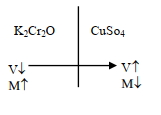
-
- (A) \(702\)
- (B) \(704\)
- (C) \(705\)
- (D) \(707\)
Show answer and solution
Correct Answer: (D)
\( 2=0.52 \times \mathrm{m}\)\(\mathrm{m}=\frac{2}{0.52}\)
According to question, solution is much diluted
\(\text { so } \frac{\Delta \mathrm{P}}{\mathrm{P}^{\circ}}=\frac{\mathrm{n}_{\text {solate }}}{\mathrm{n}_{\text {soltron: }}}\)
\(\frac{\Delta \mathrm{P}}{\mathrm{P}^{\circ}}=\frac{\mathrm{m}}{1000} \times \mathrm{M}_{\text {solvent }}\)
\(\Delta \mathrm{P}=\mathrm{P}^{\circ} \times \frac{\mathrm{m}}{1000} \times \mathrm{M}_{\text {sohtwat }}\)
\(=760 \times \frac{\frac{2}{0.52}}{1000} \times 18=52.615\)
\(P_5=760-52.615=707.385 \mathrm{~mm} \text { of } \mathrm{Hg}\)
-
- (A) \(31\)
- (B) \(35\)
- (C) \(37\)
- (D) \(40\)
Show answer and solution
Correct Answer: (A)
As moles of water \(>\) moles of \(\mathrm{CH}_3 \mathrm{COOH}\) water is solvent.\(\mathrm{T}_{\mathrm{F}}^{\circ}-\left(\mathrm{T}_{\mathrm{F}}\right)_{\mathrm{S}}=\mathrm{K}_{\mathrm{F}} \times \mathrm{M}\)
\(0-\left(\mathrm{T}_{\mathrm{F}}\right)_{\mathrm{S}}=1.86 \times \frac{2700 / 60}{2700 / 1000}\)
\(\left(\mathrm{~T}_{\mathrm{F}}\right)_{\mathrm{S}}=-31^{\circ} \mathrm{C}.\)
-
- (A) \(3\)
- (B) \(5\)
- (C) \(6\)
- (D) \(8\)
Show answer and solution
Correct Answer: (B)
\(\mathrm{AB}_2 \rightarrow \mathrm{A}^{+2}+2 \mathrm{~B}^{\ominus}\)\(\mathrm{i}=1+(3-1) \alpha\)
\(\mathrm{i}=1+2 \alpha\)
\(\Delta \mathrm{T}_{\mathrm{b}}=\mathrm{k}_{\mathrm{b}} \mathrm{im}\)
\(0.52=0.52(1+2 \alpha) \frac{\frac{10}{200}}{\frac{100}{1000}}\)
\(1=(1+2 \alpha) \frac{10}{20}\)
\(2=1+2 \alpha\)
\(\alpha=0.5\)
Ans. \(\alpha=5 \times 10^{-1}\)
- 309. A solution of two miscible liquids showing negative deviation from Raoult's law will have : 2024 Hard
- (A) increased vapour pressure, increased boiling point
- (B) increased vapour pressure, decreased boiling point
- (C) decreased vapour pressure, decreased boiling point
- (D) decreased vapour pressure, increased boiling point
Show answer and solution
Correct Answer: (D)
Solution with negative deviation has
\( \mathrm{P}_{\mathrm{T}}<\mathrm{P}_{\mathrm{A}^0} \mathrm{X}_{\mathrm{A}} +\mathrm{P}_{\mathrm{B}^0} \mathrm{X}_{\mathrm{B}} \)
\( \mathrm{P}_{\mathrm{A}}<\mathrm{P}_{\mathrm{A}^0} \mathrm{X}_{\mathrm{A}} \)
\( \mathrm{P}_{\mathrm{B}}<\mathrm{P}_{\mathrm{B}^0} \mathrm{X}_{\mathrm{B}} \)
If vapour pressure decreases so boiling point increases. -
- (A) \(10\)
- (B) \(20\)
- (C) \(25\)
- (D) \(30\)
Show answer and solution
Correct Answer: (C)
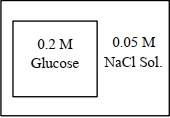
\(\mathrm{NaCl} \longrightarrow \mathrm{Na}^{+}+\mathrm{Cl}^{-}\)\(0.05 \mathrm{M} \quad 0.05 \mathrm{M} \quad 0.05 \mathrm{M}\)
\(\text { Total } \mathrm{C}_1=0.05+0.05=0.1 \mathrm{M}(\mathrm{NaCl})\)
\(\mathrm{C}_2=0.2 \mathrm{M}(\text { glucose })\)
\(\pi=\left(\mathrm{C}_2-\mathrm{C}_1\right) \mathrm{RT}\)
\(=(0.2-0.1) \times 0.083 \times 300\)
\(=2.49 \text { bar }\)
\(=24.9 \times 10^{-1} \text { bar }\)
-
- (A) \(76\)
- (B) \(77\)
- (C) \(79\)
- (D) \(80\)
Show answer and solution
Correct Answer: (A)
\(\mathrm{HX} \rightleftharpoons \mathrm{H}^{+}+\mathrm{X}^{-} \quad \mathrm{K}_{\mathrm{a}}=1.2 \times 10^{-5}\)\(0.03 \mathrm{M}\)
\(0.03-\mathrm{x} \quad \mathrm{x} \quad \mathrm{x}\)
\(\mathrm{K}_{\mathrm{a}}=1.2 \times 10^{-5}=\frac{\mathrm{x}^2}{0.03-\mathrm{x}}\)
\(0.03-\mathrm{x} \approx 0.03\left(\mathrm{~K}_{\mathrm{a}}\right. \text { is very small) }\)
\(\frac{\mathrm{x}^2}{0.03}=1.2 \times 10^{-5}\)
\(\mathrm{x}=6 \times 10^{-4}\)
\(\text { Final solution }: 0.03-\mathrm{x}+\mathrm{x}+\mathrm{x}\)
\(=0.03+\mathrm{x}=0.03+6 \times 10^{-4}\)
\(\Pi=\left(0.03+\left(6 \times 10^{-4}\right)\right) \times 0.083 \times 300\)
\(=76.19 \times 10^{-2} \approx 76 \times 10^{-2}\)
-
- (A) \(19\)
- (B) \(20\)
- (C) \(25\)
- (D) \(30\)
Show answer and solution
Correct Answer: (A)
\(\text { Mass of } \mathrm{CH}_3 \mathrm{COOH}=\mathrm{V} \times \mathrm{d}\)\(=5 \mathrm{ml} \times 1.2 \mathrm{~g} / \mathrm{ml}\)
\(=6 \mathrm{gm}\)
\(\mathrm{n}_{\mathrm{CH}_3 \mathrm{COOH}}=\frac{6}{60}=0.1 \mathrm{~mol}\)
\(\mathrm{~m}_{\mathrm{CH}_3 \mathrm{COOH}} \approx \mathrm{M}_{\mathrm{CH}_3 \mathrm{COOH}}=\frac{0.1}{1}=0.1 \mathrm{M}\)
\(\mathrm{CH}_3 \mathrm{COOH} \rightleftharpoons \mathrm{CH}_3 \mathrm{COO}^{-}+\mathrm{H}^{+}\)
\(\mathrm{C}\)
\(\mathrm{C}-\mathrm{C} \alpha\)
\(\mathrm{K}_{\mathrm{a}}=\frac{\mathrm{C} \alpha^2}{1-\alpha}\)
\(1-\alpha \approx 1 \Rightarrow \mathrm{K}_{\mathrm{a}}=\mathrm{C}^2\)
\(\alpha=\sqrt{\frac{\mathrm{Ka}^2}{\mathrm{C}}}=\sqrt{\frac{6.25 \times 10^{-5}}{0.1}}=25 \times 10^{-3}\)
\(\mathrm{~V} . \mathrm{f} .(\mathrm{i})=1+\alpha(\mathrm{n}-1)=1+\alpha(2-1)=1+\alpha\)
\(=1+25 \times 10^{-3}=1.025\)
\(\Delta \mathrm{T}_{\mathrm{r}}=i \mathrm{~K} \mathrm{~m}\)
\(=(1.025)(1.86)(0.1)\)
\(=0.19\)
\(=19 \times 10^{-2}\)
-
- (A) (A) and (B) only
- (B) (C) and (E) only
- (C) (B) and (E) only
- (D) (C) and (D) only
Show answer and solution
Correct Answer: (B)
\(KMnO _4 \& NaOH \rightarrow\) Secondary standard.
Primary standard should not be Hygroscopic. -
- (A) \(\left(\mathrm{CH}_3\right)_2 \mathrm{CO}+\mathrm{C}_6 \mathrm{H}_5 \mathrm{NH}_2\)
- (B) \(\mathrm{CHCl}_3+\mathrm{C}_6 \mathrm{H}_6\)
- (C) \(\mathrm{CHCl}_3+\left(\mathrm{CH}_3\right)_2 \mathrm{CO}\)
- (D) \(\left(\mathrm{CH}_3\right)_2 \mathrm{CO}+\mathrm{CS}_2\)
Show answer and solution
Correct Answer: (D)
\(\left(\mathrm{CH}_3\right)_2 \mathrm{CO}+\mathrm{CS}_2\) Exibits positive deviations from Raoult's Law. -
- (A) \(15\)
- (B) \(10\)
- (C) \(9\)
- (D) \(8\)
Show answer and solution
Correct Answer: (A)
\(\Delta \mathrm{T}_{\mathrm{f}}=\mathrm{i} \mathrm{K}_{\mathrm{f}} \times \text { molality }\)\(24=(1) \times 1.86 \times \frac{\mathrm{W}}{62 \times 18.6}\)
\(\mathrm{~W}=14880 \mathrm{gm}\)
\(=14.880 \mathrm{~kg}\)
-
- (A) \(36\)
- (B) \(73\)
- (C) \(45\)
- (D) \(15\)
Show answer and solution
Correct Answer: (B)
\( \text { (72.56) or (73) } \)\( \pi=\text { CRT } \)
\( \Rightarrow \frac{\pi_1}{\pi_2}=\frac{\mathrm{T}_1}{\mathrm{~T}_2} \)
\( \Rightarrow \pi_2=\frac{\pi_1 \mathrm{~T}_2}{\mathrm{~T}_1}=\frac{7 \times 10^5 \times 283}{273} \)
\( =72.56 \times 10^4 \mathrm{Nm}^{-2}\)
- 317. The solution from the following with highest depression in freezing point/lowest freezing point is _______. 2024 Hard
- (A) \(180 \mathrm{~g}\) of acetic acid dissolved in water
- (B) \(180 \mathrm{~g}\) of acetic acid dissolved in benzene
- (C) \(180 \mathrm{~g}\) of benzoic acid dissolved in benzene
- (D) \(180 \mathrm{~g}\) of glucose dissolved in water
Show answer and solution
Correct Answer: (A)
\(\Delta \mathrm{T}_{\mathrm{f}}\) is maximum when \(\mathrm{i} \times \mathrm{m}\) is maximum.1) \(\mathrm{m}_1=\frac{180}{60}=3, \mathrm{i}=1+\alpha\)
Hence
\(\Delta \mathrm{T}_{\mathrm{f}}=(1+\alpha) \cdot \mathrm{k}_{\mathrm{f}}=3 \times 1.86=5.58^{\circ} \mathrm{C}(\alpha<<1)\)
\(2)\) \(\mathrm{m}_2=\frac{180}{60}=3, \mathrm{i}=0.5, \Delta \mathrm{T}_{\mathrm{f}}=\frac{3}{2} \times \mathrm{k}_{\mathrm{f}}{ }^{\prime}=7.68^{\circ} \mathrm{C}\)
3) \(\mathrm{m}_3=\frac{180}{122}=1.48, \mathrm{i}=0.5, \Delta \mathrm{T}_{\mathrm{f}}=\frac{1.48}{2} \times \mathrm{k}_{\mathrm{f}}^{\prime}=3.8^{\circ} \mathrm{C}\)
4) \(\mathrm{m}_4=\frac{180}{180}=1, \mathrm{i}=1, \Delta \mathrm{T}_{\mathrm{f}}=1 \cdot \mathrm{k}_{\mathrm{f}}^{\prime}=1.86^{\circ} \mathrm{C}\)
As per NCERT, \(\mathrm{k}_{\mathrm{f}}{ }^{\prime}\left(\mathrm{H}_2 \mathrm{O}\right)=1.86 \mathrm{k} \cdot \mathrm{kg} \mathrm{mol}^{-1}\)
\(\mathrm{k}_{\mathrm{f}}{ }^{\prime}(\) Benzene \()=5.12 \mathrm{k} \cdot \mathrm{kg} \mathrm{mol}^{-1}\)
-
- (A) \(20\)
- (B) \(25\)
- (C) \(23\)
- (D) \(30\)
Show answer and solution
Correct Answer: (C)
\(\mathrm{X}_{\text {methylbezzene }}=0.5\)\(\mathrm{Y}_{\text {mehylibenzene }}=\frac{\mathrm{P}_{\text {methylbenzene }}}{\mathrm{P}_{\text {total }}}\)
\(\mathrm{Y}_{\text {mehhylibenzene }}=\frac{0.5 \times 24}{0.5 \times 80+0.5 \times 24}\)
\(=\frac{12}{40+12}=0.23=23 \times 10^{-2}\)
-
- (A) \(i_A < i_B < i_C\)
- (B) \(i_A < i_C < i_B\)
- (C) \(i_A=i_B=i_C\)
- (D) \(i_A>i_B>i_C\)
Show answer and solution
Correct Answer: (A)
Salt Values of \(i\) (for different conc. of a Salt) \(0.1 M\) \(0.01 M\) \(0.001 M\) \(NaCl\) \(1.87\) \(1.94\) \(1.94\) \(i\) approach \(2\) as the solution become very dilute.
- 320. What happens to freezing point of benzene when small quantity of napthalene is added to benzene? 2024 Hard
- (A) Increases
- (B) Remains unchanged
- (C) First decreases and then increases
- (D) Decreases
Show answer and solution
Correct Answer: (D)
On addition of naphthalene to benzene there is depression in freezing point of benzene. -
- (A) \(540\)
- (B) \(542\)
- (C) \(543\)
- (D) \(550\)
Show answer and solution
Correct Answer: (C)
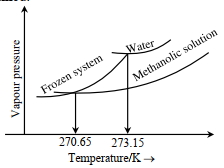
\(\Delta \mathrm{T}_{\mathrm{f}}=273.15-270.65=2.5 \mathrm{~K}\)\(\Delta \mathrm{T}_{\mathrm{f}}=\mathrm{K}_{\mathrm{f}} \mathrm{m} \Rightarrow 2.5=1.86 \times \frac{\mathrm{n}}{0.1}\)
\(\Rightarrow \mathrm{n}=0.1344 \text { moles }\)
\(\Rightarrow \mathrm{w}=0.1344 \times 32=4.3 \mathrm{~g}\)
\(\text { Volume }=\frac{4.3}{0.792}=5.43 \mathrm{ml}=543 \times 10^{-2} \mathrm{ml}\)
-
- (A) \(20\)
- (B) \(14\)
- (C) \(30\)
- (D) \(13\)
Show answer and solution
Correct Answer: (B)
\(\mathrm{CxHy}\) \((10 \mathrm{ml})\)\(+\mathrm{O}_2 \rightarrow \mathrm{CO}_2+\mathrm{H}_2 \mathrm{O}\)\(\mathrm{CxHy}+\left(\mathrm{x}+\frac{\mathrm{y}}{4}\right) \mathrm{O}_2 \rightarrow \mathrm{xCO}_2+\frac{\mathrm{y}}{2} \mathrm{H}_2 \mathrm{O}\)
\(\text { 10x } 5 \mathrm{y}\)
\(10 x=40\)
\(\mathrm{x}=4\)
\(5 y=50\)
\(\mathrm{y}=10\)
\(\mathrm{C}_4 \mathrm{H}_{10}\)
-
- (A) \(1.187 \mathrm{~g} \mathrm{CaCO}_3+1.023 \mathrm{~g} \mathrm{MgCO}_3\)
- (B) \(1.023 \mathrm{~g} \mathrm{CaCO}_3+1.023 \mathrm{~g} \mathrm{MgCO}_3\)
- (C) \(1.187 \mathrm{~g} \mathrm{CaCO}_3+1.187 \mathrm{~g} \mathrm{MgCO}_3\)
- (D) \(1.023 \mathrm{~g} \mathrm{CaCO}_3+1.187 \mathrm{~g} \mathrm{MgCO}_3\)
Show answer and solution
Correct Answer: (A)
\(\mathrm{CaCO}_3(\mathrm{~s}) \xrightarrow{\Delta} \mathrm{CaO}(\mathrm{s})+\mathrm{CO}_2(\mathrm{~g})\)\(\mathrm{MgCO}_3(\mathrm{~s}) \xrightarrow{\Delta} \mathrm{MgO}(\mathrm{s})+\mathrm{CO}_2(\mathrm{~g})\)
Let the weight of \(\mathrm{CaCO}_3\) be \(\mathrm{x} \mathrm{gm}\)
\(\therefore\)weight of \(\mathrm{MgCO}_3=(2.21-\mathrm{x}) \mathrm{gm}\)
Moles of \(\mathrm{CaCO}_3\) decomposed \(=\) moles of \(\mathrm{CaO}\) formed
\(\frac{\mathrm{x}}{100}=\) moles of \(\mathrm{CaO}\) formed
\(\therefore\) weight of \(\mathrm{CaO}\) formed \(=\frac{\mathrm{x}}{100} \times 56\)
Moles of \(\mathrm{MgCO}_3\) decomposed \(=\) moles of \(\mathrm{MgO}\) formed
\(\frac{(2.21-x)}{84}=\text { moles of } \mathrm{MgO} \text { formed }\)
\(\therefore \text { weight of } \mathrm{MgO} \text { formed }=\frac{2.21-\mathrm{x}}{84} \times 40\)
\(\Rightarrow \frac{2.21-\mathrm{x}}{84} \times 40+\frac{\mathrm{x}}{100} \times 56=1.152\)
\(\therefore \mathrm{x}=1.1886 \mathrm{~g}=\text { weight of } \mathrm{CaCO}_3\)
& weight of \(\mathrm{MgCO}_3=1.0214 \mathrm{~g}\)
-
- (A) \(20\)
- (B) \(22\)
- (C) \(30\)
- (D) \(35\)
Show answer and solution
Correct Answer: (B)
\(\text { Mass percent of Alcohol }\)\(=\frac{\text { Mass of ethyl alcohol }}{\text { Total mass of solution }} \times 100\)
\(=\frac{1 \times 46}{1 \times 46+9 \times 18} \times 100=\frac{4600}{208}\)
\(=22.11 \text { Or } 22\)
-
- (A) \(4\)
- (B) \(3\)
- (C) \(2\)
- (D) \(1\)
Show answer and solution
Correct Answer: (A)
\( \mathrm{M}=\frac{\mathrm{n}_{\text {solute }}}{\mathrm{V}} \times 1000 \)\( =\frac{\left(\frac{31.4}{98}\right)}{\left(\frac{100}{1.25}\right)} \times 1000 \)
\( =4.005 \approx 4\)
-
- (A) \(\mathrm{C}_{11} \mathrm{H}_{18} \mathrm{O}_{12}\)
- (B) \(\mathrm{C}_{12} \mathrm{H}_{20} \mathrm{O}_{12}\)
- (C) \(\mathrm{C}_{14} \mathrm{H}_{20} \mathrm{O}_{10}\)
- (D) \(\mathrm{C}_{12} \mathrm{H}_{22} \mathrm{O}_{11}\)
Show answer and solution
Correct Answer: (D)
Percentage of Oxygen = \( 100 - (42.1 + 6.4) = 51.5\% \)
Step 1: Calculate the number of moles of each element.
Moles of C = \( 42.1 / 12 = 3.51 \)
Moles of H = \( 6.4 / 1 = 6.4 \)
Moles of O = \( 51.5 / 16 = 3.22 \)
Step 2: Find the simple molar ratio by dividing by the smallest value (\(3.22\)).
C = \( 3.51 / 3.22 = 1.09 \)
H = \( 6.4 / 3.22 = 1.99 \approx 2 \)
O = \( 3.22 / 3.22 = 1 \)
Step 3: Convert to whole numbers. Multiplying by 11 gives:
C = \( 1.09 \times 11 \approx 12 \)
H = \( 2 \times 11 = 22 \)
O = \( 1 \times 11 = 11 \)
So, the empirical formula is \( C_{12}H_{22}O_{11} \).
Empirical formula mass = \( (12 \times 12) + (22 \times 1) + (11 \times 16) = 144 + 22 + 176 = 342 \).
Since Empirical formula mass = Molecular weight (\(342\)), the molecular formula is the same as the empirical formula: \( C_{12}H_{22}O_{11} \). -
- (A) Compounds are formed when atoms of different elements combine in any ratio
- (B) All the atoms of a given element have identical properties including identical mass
- (C) Matter consists of indivisible atoms
- (D) Chemical reactions involve recorganization of atoms
Show answer and solution
Correct Answer: (A)
In compound atoms of different elements combine in fixed ratio by mass. -
- (A) \(480\)
- (B) \(960\)
- (C) \(800\)
- (D) \(32\)
Show answer and solution
Correct Answer: (B)
Balanced equation: C6H12O6 + 6O2 → 6CO2 + 6H2O
Molar mass of glucose = (6×12 + 12×1 + 6×16) = 180 g
180 g glucose requires 6×32 = 192 g O2
900 g glucose = (900/180) = 5 moles
O2 required = 5×192 = 960 g
-
- (A) \(24\)
- (B) \(22\)
- (C) \(25\)
- (D) \(30\)
Show answer and solution
Correct Answer: (A)
Limiting Reagent is \(\mathrm{PbCl}_2\) \(\mathrm{mmol}\) of \(\mathrm{Pb}_5\left(\mathrm{PO}_4\right)_2\) formed\(=\frac{\mathrm{mmol} \text { of } \mathrm{PbCl}_2 \text { reacted }}{3}\)
\(=24 \mathrm{mmol}\)
-
- (A) \(\frac{n_C}{n_A \times n_B \times n_C}\)
- (B) \(\frac{n_C}{n_A+n_B+n_C}\)
- (C) \(\frac{n_C}{n_A-n_B-n_C}\)
- (D) \(\frac{n_B}{n_A+n_B}\)
Show answer and solution
Correct Answer: (B)
Mole fraction of \(C=\frac{n_C}{n_A+n_B+n_C}\) -
- (A) \(5\)
- (B) \(9\)
- (C) \(8\)
- (D) \(12\)
Show answer and solution
Correct Answer: (C)
\(\mathrm{CH}_4+2 \mathrm{O}_2 \rightarrow \mathrm{CO}_2+2 \mathrm{H}_2 \mathrm{O}\)Moles of \(\mathrm{CO}_2=\frac{22}{44}=0.5\)
So, required moles of \(\mathrm{CH}_4=0.5\)
\(\text { Mass }=0.5 \times 16=8 \mathrm{gm}\)
-
- (A) \(2.90 \mathrm{~m}\)
- (B) \(2.79 \mathrm{~m}\)
- (C) \(1.90 \mathrm{~m}\)
- (D) \(3.85 \mathrm{~m}\)
Show answer and solution
Correct Answer: (B)
\(3\) moles are present in \(1\) litre solution\(\text { molality }=\frac{3 \times 1000}{1.25 \times 1000-[3 \times 58.5]}=2.79 \mathrm{~m}\)
- 333. Molality of \(0.8 \ \mathrm{M} \mathrm{H}_2 \mathrm{SO}_4\) solution (density \(1.06 \mathrm{~g} \mathrm{~cm}^{-3}\) ) is _______ \(\times 10^{-3} m\). 2024 Medium
- (A) \(814\)
- (B) \(817\)
- (C) \(816\)
- (D) \(815\)
Show answer and solution
Correct Answer: (D)
\( \mathrm{m}=\frac{\mathrm{M} \times 1000}{\mathrm{~d}_{\text {sol }} \times 1000-\mathrm{M} \times \mathrm{Molar}^2 \text { mass }_{\text {solute }}} \)\( 815 \times 10^{-3} \mathrm{~m} \)
-
- (A) \(70\)
- (B) \(73\)
- (C) \(74\)
- (D) \(80\)
Show answer and solution
Correct Answer: (C)
Molality of urea is \(4.44 \mathrm{~m}\), that means \(4.44\) moles of urea present in \(1000 \mathrm{gm}\) of water.\(\therefore \mathrm{X}_{\text {urea }}=\frac{4.44}{4.44+\frac{1000}{18}}\)
\(=0.0740\)
\(74 \times 10^{-3}\)
\(\mathrm{X}=74\)
-
- (A) \(160\)
- (B) \(164\)
- (C) \(167\)
- (D) \(168\)
Show answer and solution
Correct Answer: (B)
\(\mathrm{M}_{\mathrm{rol}^{\mathrm{n}}}=\mathrm{v}_{\mathrm{sol}^{\mathrm{n}}} \times \mathrm{d}_{\mathrm{sol}^{\mathrm{n}}}\)\(=500 \times 1.25=625 \mathrm{~g}\)
\(\text { Mass of solute }(x)=0.2 \times 0.5 \times 159.5\)
\(=15.95\)
\(\mathrm{n}_{\text {solute }}=0.1 \text {, }\)
\(\text { Mass of solvent }=\text { Mass of solution }- \)\(\text { Mass of solute }\)
\(=625-15.95\)
\(=609.05\)
\(\mathrm{~m}=\frac{0.1}{\frac{609.05}{1000}}\)
\(\mathrm{~m}=0.164=164 \times 10^{-3}\)
-
- (A) \(30\)
- (B) \(40\)
- (C) \(50\)
- (D) \(60\)
Show answer and solution
Correct Answer: (C)
\(\mathrm{CH}_{4(\mathrm{~g})}+2 \mathrm{O}_{2(\mathrm{~g})} \rightarrow \mathrm{CO}_{2(\mathrm{~g})}+2 \mathrm{H}_2 \mathrm{O}_{(\ell)}\)\(\mathrm{n}_{\mathrm{CO}_2}=\frac{22}{44}=0.5 \mathrm{moles}\)
So moles of \(\mathrm{CH}_4\) required \(=0.5\) moles i.e. \(50 \times 10^{-2} \mathrm{~mole}\)
x = \(50\)
-
- (A) \(3.5\)
- (B) \(3.0\)
- (C) \(3.8\)
- (D) \(2.8\)
Show answer and solution
Correct Answer: (B)
\(\text { Molality }=\frac{1000 \times \mathrm{M}}{1000 \times \mathrm{d}-\mathrm{M} \times(\mathrm{Mw})_{\text {solute }}}\)\(3=\frac{1000 \times \mathrm{x}}{1000 \times 1.12-(\mathrm{x} \times 40)}\)
\(\mathrm{x}=3\)
-
- (A) \((B), (D), (E)\) only
- (B) \((A), (B), (D\)) only
- (C) \((C), (D), (E)\) only
- (D) \((B), (D)\) only
Show answer and solution
Correct Answer: (D)
\(B, D\) -
- (A) \(6\)
- (B) \(7\)
- (C) \(8\)
- (D) \(9\)
Show answer and solution
Correct Answer: (B)
\(\text { Moles }=\text { Molarity } \times \text { Volume in litres }\)\(=0.35 \times 0.25\)
\(\text { Mass }=\text { moles } \times \text { molar mass }\)
\(=0.35 \times 0.25 \times 82.02=7.18 \mathrm{~g}\)
Ans. 7
-
- (A) \(20\)
- (B) \(0.2\)
- (C) \(2\)
- (D) \(4\)
Show answer and solution
Correct Answer: (B)
\(\mathrm{M}=\frac{\mathrm{n}_{\mathrm{NaCl}}}{\mathrm{V}_{\mathrm{sol}}(\text { in } \mathrm{L})}\)\(\mathrm{M}=\frac{\frac{5.85}{58.5}}{0.5}=0.2 \mathrm{M}\)
-
- (A) 9
- (B) 10
- (C) 11
- (D) 12
Show answer and solution
Correct Answer: (C)
Specific gravity (density) \(=1.54 \mathrm{~g} / \mathrm{cc}\).Volume \(=1 \mathrm{~L}=1000 \mathrm{ml}\)
Mass of solution \(=1.54 \times 1000\)
\(=1540 \mathrm{~g}\)
\(\%\) purity of \(\mathrm{H}_2 \mathrm{SO}_4\) is \(70 \%\)
So weight of \(\mathrm{H}_3 \mathrm{PO}_4=0.7 \times 1540=1078 \mathrm{~g}\)
Mole of \(\mathrm{H}_3 \mathrm{PO}_4=\frac{1078}{98}=11\)
Molarity \(=\frac{11}{1 \mathrm{~L}}=11\)
-
- (A) \(0.75\)
- (B) \(0.25\)
- (C) \(0.35\)
- (D) \(0.5\)
Show answer and solution
Correct Answer: (B)
\(\mathrm{C}_{\mathrm{n}} \mathrm{H}_{2 \mathrm{an} 2}+\frac{3 \mathrm{n}+1}{2} \mathrm{O}_2 \longrightarrow \mathrm{nCO}_2+(\mathrm{n}+1) \mathrm{H}_2 \mathrm{O}\)\(\underset{4 \mathrm{gm}}{\mathrm{CH}_4+2 \mathrm{O}_2} \longrightarrow \underset{11 \mathrm{gm}}{\mathrm{CO}_2+2 \mathrm{H}_2 \mathrm{O}}\)
\(0.25 \text { mole } \quad 0.25 \text { mole }\)
\(\left.0.25 \text { mole } \mathrm{CH}_4 \text { gives } 0.25 \text { mole (or } 11 \mathrm{gm}\right) \mathrm{CO}_2\)
-
- (A) Molarity
- (B) Mass percentage
- (C) Molality
- (D) Mole fraction
Show answer and solution
Correct Answer: (A)
\(\text { Molarity }=\frac{\text { Moles of solute }}{\text { Volume of solution }}\)Since volume depends on temperature, molarity will change upon change in temperature.
-
- (A) \(8\)
- (B) \(7\)
- (C) \(9\)
- (D) \(10\)
Show answer and solution
Correct Answer: (B)
\(\mathrm{M}=\frac{\mathrm{n}_{\mathrm{NaOH}}}{\mathrm{V}_{\mathrm{sol}}(\text { in } \mathrm{L})} \Rightarrow 3=\frac{(84 / 40)}{\mathrm{V}} \Rightarrow \)\(\mathrm{V}=0.7 \mathrm{~L}=7 \times 10^{-1} \mathrm{~L}\) -
- (A) \(4\)
- (B) \(6\)
- (C) \(8\)
- (D) \(12\)
Show answer and solution
Correct Answer: (A)
\(2\) chiral centres
No. of stereoisomers \(=4\)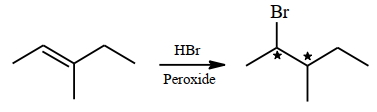
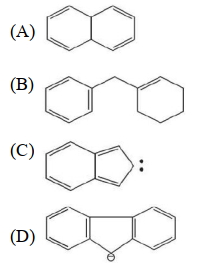
- 346. Among the given organic compounds, the total number of aromatic compounds is___________
 2024 Hard
- (A) \(1\)
- (B) \(3\)
- (C) \(4\)
- (D) \(2\)
Show answer and solution
Correct Answer: (B)
\(B\),\(C\) and \(D\) are Aromatic - 347. Consider the given reaction. The total number of oxygen atoms present per molecule of the product \((P)\) is _______.
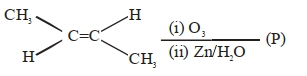 2024 Hard
- (A) \(2\)
- (B) \(1\)
- (C) \(7\)
- (D) \(5\)
Show answer and solution
Correct Answer: (B)
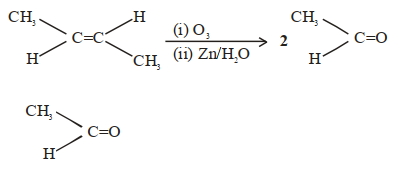
\(Image\)Hence total number of oxygen atom present per Molecule \(image\) is I.
-
- (A) Both Statement \(I\) and Statement \(II\) are incorrect
- (B) Statement \(I\) is correct but Statement \(II\) is incorrect
- (C) Both Statement \(I\) and Statement \(II\) are correct
- (D) Statement \(I\) is incorrect but Statement \(II\) is correct
Show answer and solution
Correct Answer: (B)
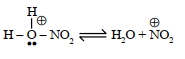
In nitration of benzene concentrated \(\mathrm{H}_2 \mathrm{SO}_4\) and \(\mathrm{HNO}_3\) is used as reagent which generates electrophile \(\mathrm{NO}_2\) in following steps: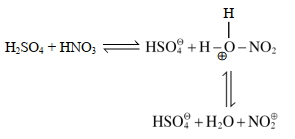
Lewis acids can promote the formation of electrophiles not Lewis base -
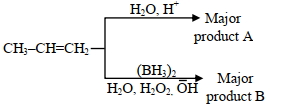
- (A) \(\mathrm{A}-\mathrm{CH}_3 \mathrm{CH}_2 \mathrm{CH}_2-\mathrm{OH}, \mathrm{B}-\mathrm{CH}_3 \mathrm{CH}_2 \mathrm{CH}_2-\mathrm{OH}\)
- (D) \(\mathrm{A}-\mathrm{CH}_3 \mathrm{CH}_2 \mathrm{CH}_3, \mathrm{~B}-\mathrm{CH}_3 \mathrm{CH}_2 \mathrm{CH}_3\)
Show answer and solution
Correct Answer: (C)
\((1)\) Hydration Reaction : (Image) \((2)\) Hydroboration Oxidation Reaction :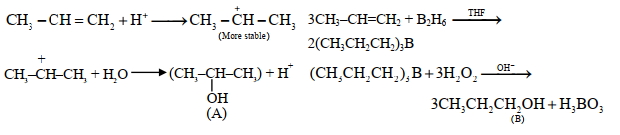
-
- (A) \(1\)
- (B) \(2\)
- (C) \(3\)
- (D) \(4\)
Show answer and solution
Correct Answer: (C)
\(\mathrm{CH}_3 \mathrm{COONa} \rightarrow \dot{\mathrm{CH}_3}\)\(\mathrm{C}_2 \mathrm{H}_5 \mathrm{COONa} \rightarrow \dot{\mathrm{C}}_2\mathrm{H}_5\)
\(2 \dot{\mathrm{C}}_2 \mathrm{H}_5 \rightarrow \mathrm{CH}_3-\mathrm{CH}_2-\mathrm{CH}_2-\mathrm{CH}_3\)
\(2 \dot{\mathrm{CH}}_3 \rightarrow \mathrm{CH}_3-\mathrm{CH}_3\)
\(\dot{\mathrm{C}} \mathrm{H}_3+\dot{\mathrm{C}}_2 \mathrm{H}_5 \rightarrow \mathrm{CH}_3-\mathrm{CH}_2-\mathrm{CH}_3\)
No questions on this page match these filters.