


Questions
20 questionsShowing 1–20 of 20 questions
-
- (A) \(273\)
- (B) \(274\)
- (C) \(277\)
- (D) \(280\)
Show answer and solution
Correct Answer: (B)
\(\Delta \mathrm{U}=\mathrm{q}+\mathrm{w}(\mathrm{q}=0)\)\(\mathrm{nC}_{\mathrm{V}} \Delta \mathrm{T}=-\mathrm{P}_{\mathrm{ext}}\left(\mathrm{V}_2-\mathrm{V}_1\right)\)
\(\mathrm{V}_2=2 \mathrm{~V}_1\)
\(\frac{\mathrm{nRT}_2}{\mathrm{P}_2}=\frac{2 \mathrm{nRT}_1}{\mathrm{P}_1}\)
\(\mathrm{P}_1=5, \mathrm{~T}_1=298\)
\(\mathrm{P}_2=\frac{5 \mathrm{~T}_2}{2 \times 298}\)
\(\mathrm{n} \frac{5}{2} \mathrm{R}\left(\mathrm{T}_2-\mathrm{T}_1\right)=-1\left(\frac{\mathrm{nRT}_2}{\mathrm{P}_1}-\frac{\mathrm{nRT}_1}{\mathrm{P}_1}\right)\)
\(\mathrm{T}_1=298\)
\(\text { and } \mathrm{P}_2=\frac{5 \mathrm{~T}_2}{2 \times 298}\)
Solve and we get \(T_2=274.16 \mathrm{~K}\)
\(\mathrm{T}_2 \approx 274 \mathrm{~K}\)
-
- (A) \(100\)
- (B) \(150\)
- (C) \(200\)
- (D) \(250\)
Show answer and solution
Correct Answer: (C)
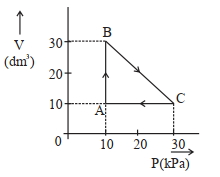
Work done is given by area enclosed in the \(\mathrm{P}\) vs \(\mathrm{V}\) cyclic graph or \(V\) vs \(P\) cyclic graph.Sign of work is positive for clockwise cyclic process for \(\mathrm{V}\) vs \(\mathrm{P}\) graph.
\(\mathrm{W}=\frac{1}{2} \times(30-10) \times(30-10)=200 \mathrm{kPa}-\mathrm{dm}^3\)
\(=200 \times 1000 \mathrm{~Pa}-\mathrm{L}=2 \mathrm{~L}-\mathrm{bar}=200 \mathrm{~J}\)
- 3. Choose the correct option for free expansion of an ideal gas under adiabatic condition from the following : 2024 Hard
- (A) \(\mathrm{q}=0, \Delta \mathrm{T} \neq 0, \mathrm{w}=0\)
- (B) \(\mathrm{q}=0, \Delta \mathrm{T}<0, \mathrm{w} \neq 0\)
- (C) \(q \neq 0, \Delta T=0, w=0\)
- (D) \(q=0, \Delta T=0, w=0\)
Show answer and solution
Correct Answer: (D)
During free expansion of an ideal gas under adiabatic condition \(\mathrm{q}=0, \Delta \mathrm{T}=0, \mathrm{w}=0\). -
- (A) \(6535\)
- (B) \(6540\)
- (C) \(6545\)
- (D) \(6550\)
Show answer and solution
Correct Answer: (A)
\(6 \mathrm{C} \text { (graphite) }+3 \mathrm{H}_2(\mathrm{~g}) \rightarrow \mathrm{C}_6 \mathrm{H}_6(\ell) ; \Delta \mathrm{H}=48.5 \mathrm{~kJ} / \mathrm{mol}\)\(\mathrm{C} \text { (graphite) }+\mathrm{O}_2(\mathrm{~g}) \rightarrow \mathrm{CO}_2(\mathrm{~g}) ; \Delta \mathrm{H}=-393.5 \mathrm{~kJ} / \mathrm{mol}\)
\(\mathrm{H}_2^{(\mathrm{g})}+\frac{1}{2}(\mathrm{~g}) \longrightarrow \mathrm{H}_2 \mathrm{O}(\ell) ; \Delta \mathrm{H}=-286 \mathrm{~kJ} / \mathrm{mol}\)
\(\text { equation }-(1) \times 1+(2) \times 6+(3) \times 3\)
\(-48.5-6 \times 393.5-3 \times 286\)
\(=-3267.5 \mathrm{~kJ} \text { for } 1 \mathrm{~mol}\)
\(=-6535 \mathrm{~kJ} \text { for } 2 \mathrm{~mol}\)
Ans. \(6535 \mathrm{~kJ}\)
-
- (A) \(50\)
- (B) \(55\)
- (C) \(60\)
- (D) \(65\)
Show answer and solution
Correct Answer: (B)
\(\omega=-\mathrm{nRT} \ln \left(\frac{\mathrm{V}_2}{\mathrm{~V}_1}\right)\)\(=-1 \times .08206 \times 291.15 \ln \left(\frac{100}{10}\right)\)
\(=-55.0128\)
Work done by system \(\approx 55 \mathrm{~atm}\) lit.
-
- (A) \(37\)
- (B) \(38\)
- (C) \(39\)
- (D) \(40\)
Show answer and solution
Correct Answer: (A)
\( \Delta \mathrm{G}^{\circ}=\Delta \mathrm{H}^{\circ}-\mathrm{T} \Delta \mathrm{S}^{\circ} \)\( =77.2 \times 10^3-400 \times 122=28400 \mathrm{~J} \)
\( \Delta \mathrm{G}^{\circ}=-2.303 \mathrm{RT} \log \mathrm{K} \)
\( \Rightarrow 28400=-2.303 \times 8.314 \times 400 \log \mathrm{K} \)
\( \Rightarrow \log \mathrm{K}=-3.708=-37.08 \times 10^{-1}\)
-
- (A) \(1000\)
- (B) \(2000\)
- (C) \(100\)
- (D) \(200\)
Show answer and solution
Correct Answer: (B)
\(\Delta \mathrm{G}=0\)\(\mathrm{~T}=\frac{\Delta \mathrm{H}}{\Delta \mathrm{S}}=\frac{400}{0.2}=2000 \mathrm{~K}\)
-
- (A) (\(A\)) is true but (\(R\)) is false
- (B) Both (\(A\)) and (\(R\)) are true and (\(R\)) is the correct explanation of (\(A\))
- (C) (\(A\)) is false but (\(R\)) is true
- (D) Both (\(A\)) and (\(R\)) are true but (\(R\)) is not the correct explanation of (\(A\))
Show answer and solution
Correct Answer: (B)
Enthalpy of neutralization of \(SA \)& \(SB\) is always \(-57 \mathrm{~kJ} / \mathrm{mol}\) because strong monoacid gives one mole of \(\mathrm{H}^{+}\)and strong mono base gives one mole of \(\mathrm{OH}^{-}\)which form one mole of water. -
- (A) \(28719\)
- (B) \(28721\)
- (C) \(28722\)
- (D) \(28725\)
Show answer and solution
Correct Answer: (B)
It is isothermal reversible expansion, so work done negative\(\mathrm{W}=-2.303 \mathrm{nRT} \log \left(\frac{\mathrm{V}_2}{\mathrm{~V}_1}\right)\)
\(=-2.303 \times 5 \times 8.314 \times 300 \log \left(\frac{100}{10}\right)\)
\(=-28720.713 \mathrm{~J}\)
\(\equiv-28721 \mathrm{~J}\)
-
- (A) \(1100\)
- (B) \(3200\)
- (C) \(4700\)
- (D) \(1200\)
Show answer and solution
Correct Answer: (D)
Using, first law of thermodynamics,\( \Delta \mathrm{U}=\mathrm{Q}+\mathrm{W}, \)
\( \Delta \mathrm{U}=0: \text { Process is isothermal } \)
\( \mathrm{Q}=-\mathrm{W} \)
\( \mathrm{W}=-\mathrm{P}_{\text {ext }} \Delta \mathrm{V}: \text { Irreversible } \)
\( =-80 \times 10^3(45-30) \times 10^{-3} \)
\( =-1200 \mathrm{~J}\)
-
- (A) \(78\)
- (B) \(12\)
- (C) \(46\)
- (D) \(56\)
Show answer and solution
Correct Answer: (D)
\( \Delta \mathrm{H}_{\text {vap }}^0 \mathrm{CCl}_4=30.5 \mathrm{~kJ} / \mathrm{mol} \)\( \text { Mass of } \mathrm{CCl}_4=284 \mathrm{gm} \)
\( \text { Molar mass of } \mathrm{CCl}_4=154 \mathrm{~g} / \mathrm{mol} \)
\( \text { Moles of } \mathrm{CCl}_4=\frac{284}{154}=1.844 \mathrm{~mol} \)
\( \Delta \mathrm{H}_{\text {vap }}{ }^{\circ} \text { for } 1 \mathrm{~mole}=30.5 \mathrm{~kJ} / \mathrm{mol} \)
\( \Delta \mathrm{H}_{\text {vap }}{ }^{\circ} \text { for } 1.844 \mathrm{~mol}=30.5 \times 1.844 \)
\( \quad=56.242 \mathrm{~kJ}\)
-
- (A) \(125\)
- (B) \(128\)
- (C) \(130\)
- (D) \(135\)
Show answer and solution
Correct Answer: (A)
\(\mathrm{C}_2 \mathrm{H}_4(\mathrm{~g})+\mathrm{H}_2(\mathrm{~g}) \rightarrow \mathrm{C}_2 \mathrm{H}_6(\mathrm{~g})\)\(\Delta \mathrm{H}=\mathrm{BE}(\mathrm{C}=\mathrm{C})+4 \mathrm{BE}(\mathrm{C}-\mathrm{H})+\mathrm{BE}(\mathrm{H}-\mathrm{H})\)
\(-\mathrm{BE}(\mathrm{C}-\mathrm{C})-6 \mathrm{BE}(\mathrm{C}-\mathrm{H})\)
\(\Delta \mathrm{H}=\mathrm{BE}(\mathrm{C}=\mathrm{C})+\mathrm{BE}(\mathrm{H}-\mathrm{H})-\mathrm{BE}(\mathrm{C}-\mathrm{C})\)
\(-2 \mathrm{BE}(\mathrm{C}-\mathrm{H})\)
\(=615+435-347-2 \times 414\)
\(=-125 \mathrm{~kJ}\)
-
- (A) \(100\)
- (B) \(120\)
- (C) \(150\)
- (D) \(160\)
Show answer and solution
Correct Answer: (C)
\(\mathrm{C}_6 \mathrm{H}_5 \mathrm{COOH}(\mathrm{S})+\frac{15}{2} \mathrm{O}_2(\mathrm{~g}) \rightarrow 7 \mathrm{CO}_2(\mathrm{~g})+3 \mathrm{H}_2 \mathrm{O}(\ell)\)\(\Delta \mathrm{H}=\Delta \mathrm{U}+\Delta \mathrm{n}_g \mathrm{RT}\)
\(=-321.30-\frac{1}{2} \frac{\mathrm{R}}{100} \times 300\)
\(=(-321.30-150 \mathrm{R}) \mathrm{kJ}\)
-
- (A) \(82\)
- (B) \(85\)
- (C) \(89\)
- (D) \(90\)
Show answer and solution
Correct Answer: (A)
\(\text {from (1) (2) }\)
\(-70=x+12\)
\(x=-82\)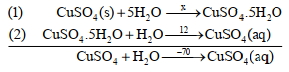
-
- (A) \(199\)
- (B) \(100\)
- (C) \(200\)
- (D) \(300\)
Show answer and solution
Correct Answer: (C)
As isothermal \(\Delta \mathrm{U}=0\)and process is irreversible
\(\mathrm{Q}=-\mathrm{W}=-\left[-\mathrm{P}_{\mathrm{ext}}\left(\mathrm{V}_2-\mathrm{V}_1\right)\right]\)
\(\mathrm{Q}=5(20-60)=-200 \mathrm{~atm}-\mathrm{L}\)
-
- (A) \(470\)
- (B) \(495\)
- (C) \(492\)
- (D) \(499\)
Show answer and solution
Correct Answer: (C)
\(2\mathrm{Fe}_{(\mathrm{s})}+\frac{3}{2} \mathrm{O}_{2(\mathrm{~g})} \rightarrow \mathrm{Fe}_2 \mathrm{O}_{3(\mathrm{~s})}, \Delta \mathrm{H}^{\mathrm{o}}=-822 \mathrm{~kJ} / \mathrm{mol}\) \(......(1)\)\(\mathrm{C}_{(\mathrm{s})}+\frac{1}{2} \mathrm{O}_{2(\mathrm{~g})} \rightarrow \mathrm{CO}_{(\mathrm{g})}, \Delta \mathrm{H}^{\mathrm{o}}=-110 \mathrm{~kJ} / \mathrm{mol}\) \(.......(2)\)
\(3\mathrm{C}_{(\mathrm{s})}+\mathrm{Fe}_2 \mathrm{O}_{3(\mathrm{~s})} \rightarrow 2 \mathrm{Fe}_{(\mathrm{s})}+3 \mathrm{CO}_{(\mathrm{g})}, \Delta \mathrm{H}_3=\text { ? }\)
\(\text { (3) }=3 \times(2)-(1)\)
\(\Delta \mathrm{H}_3=3 \times \Delta \mathrm{H}_2-\Delta \mathrm{H}_1\)
\(=3(-110)+822\)
\(=492 \mathrm{~kJ} / \mathrm{mole}\)+
-
- (A) \(38\)
- (B) \(39\)
- (C) \(40\)
- (D) \(45\)
Show answer and solution
Correct Answer: (A)
\(\mathrm{H}_2 \mathrm{O}(\ell) \rightleftharpoons \mathrm{H}_2 \mathrm{O}(\mathrm{g}) \quad \Delta \mathrm{H}_{\text {ap }}^0=40.79 \mathrm{~kJ} / \mathrm{mole}\)\(\Delta \mathrm{H}_{\text {vap }}^0=\Delta \mathrm{U}_{\text {vap }}^0+\Delta \mathrm{n}_{\mathrm{g}} \mathrm{RT}\)
\(40.79=\Delta \mathrm{U}_{\text {vap }}^0+\frac{1 \times 8.3 \times 373.15}{1000}\)
\(\Delta \mathrm{U}_{\text {Tap }}^0=40.79-3.0971\)
\(=37.6929\)
\(\Delta \mathrm{U}_{T \mathrm{ap}}^0 \simeq 38\)
-
- (A) \(2\)
- (B) \(5\)
- (C) \(8\)
- (D) \(9\)
Show answer and solution
Correct Answer: (A)
\(\mathrm{H}^{+}+\mathrm{OH} \rightarrow \mathrm{H}_2 \mathrm{O} \Rightarrow \mathrm{x}\)\(2 \mathrm{H}^{+}+2 \mathrm{OH} \rightarrow 2 \mathrm{H}_2 \mathrm{O} \Rightarrow 2 \mathrm{x}=\mathrm{y}\)
\(\mathrm{y} / \mathrm{x}=2\)
-
- (A) \(500\)
- (B) \(400\)
- (C) \(120\)
- (D) \(654\)
Show answer and solution
Correct Answer: (B)
At equilibrium \(\Delta \mathrm{G}_{\mathrm{PT}}=0\)\( \Delta \mathrm{H}_{\text {vap }}=\mathrm{T} \Delta \mathrm{S}_{\text {vap }} \)
\( 30 \times 1000=\mathrm{T} \times 75 \)
\( \mathrm{~T}=400 \mathrm{~K}\)
-
- (A) \(\Delta \mathrm{G}\) is negative for a spontaneous reaction
- (B) \(\Delta \mathrm{G}\) is positive for a spontaneous reaction
- (C) \(\Delta \mathrm{G}\) is zero for a reversible reaction
- (D) \(\Delta \mathrm{G}\) is positive for a non-spontaneous reaction
Show answer and solution
Correct Answer: (B)
\((\Delta \mathrm{G})_{\mathrm{P}, \mathrm{T}}=(+) \text { ve for non-spontaneous process }\)
No questions on this page match these filters.