


All JEE Mains 2024 Chemistry questions
26 chaptersShowing 201–250 of 490 questions
-
- (A) \((1) (A)-(I), (B), (II), (C)-(III), (D)-(IV)\)
- (B) \((2) (A)-(III), (B)-(I), (C)-(IV), (D)-( II)\)
- (C) \((A)-(IV), (B)-(III), (C)-(II), (D)-(I)\)
- (D) \((A)-( II), (B)-(III), (C)-(I), (D)-(IV)\)
Show answer and solution
Correct Answer: (B)
\(\mathrm{CCl}_4\) used in fire extinguisher. \(\mathrm{CH}_2 \mathrm{Cl}_2\) used as paint remover. Freons used in refrigerator and \(\mathrm{AC}\). \(DDT\) used as non Biodegradable insecticide. - 202. The correct statement regarding nucleophilic substitution reaction in a chiral alkyl halide is ; 2024 Hard
- (A) Retention occurs in \(\mathrm{S}_{\mathrm{N}} 1\) reaction and inversion occurs in \(\mathrm{S}_{\mathrm{N}} 2\) reaction.
- (B) Racemisation occurs in \(\mathrm{S}_{\mathrm{N}} \mathrm{l}\) reaction and retention occurs in \(\mathrm{S}_{\mathrm{N}} 2\) reaction.
- (C) Racemisation occurs in both \(\mathrm{S}_{\mathrm{N}} 1\) and \(\mathrm{S}_{\mathrm{N}} 2\) reactions.
- (D) Racemisation occurs in \(\mathrm{S}_{\mathrm{N}} 1\) reaction and inversion occurs in \(\mathrm{S}_{\mathrm{N}} 2\) reaction.
Show answer and solution
Correct Answer: (D)
\(\mathrm{SN}^1\) - Racemisation\(\mathrm{SN}^2\) - Inversion
- 203. The number of halobenzenes from the following that can be prepared by Sandmeyer's reaction is _______.
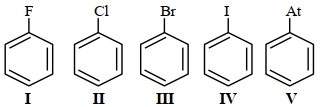 2024 Medium
- (A) \(8\)
- (B) \(3\)
- (C) \(7\)
- (D) \(2\)
Show answer and solution
Correct Answer: (D)
In Sandmayer reaction only bromobenzene & chlorobenzene are prepared. - 204. The total number of hydrogen atoms in product \(\mathrm{A}\) and product \(B\) is _______.
 2024 Hard
- (A) \(5\)
- (B) \(10\)
- (C) \(15\)
- (D) \(20\)
Show answer and solution
Correct Answer: (B)
Explanation:
This question involves understanding the dual behavior of hydroxide ions (\( \text{OH}^- \)) acting either as a strong base or as a nucleophile depending on the nature of the solvent:
1. Reaction in Ethanol Solvent (Product A):
When sodium hydroxide (\( \text{NaOH} \)) is dissolved in ethanol (\( \text{C}_2\text{H}_5\text{OH} \)), it forms an alcoholic solution. Hydroxide ions react with ethanol to form ethoxide ions (\( \text{C}_2\text{H}_5\text{O}^- \)), which act as a powerful strong base. This environment strongly favors \( \text{E}2 \) elimination (dehydrohalogenation) over substitution. The elimination of \( \text{HBr} \) from ethyl bromide (\( \text{CH}_3\text{CH}_2\text{Br} \)) yields ethene (\( \text{CH}_2=\text{CH}_2 \)) as the major product.
- Molecular formula of Product A (Ethene): \( \text{C}_2\text{H}_4 \)
- Number of hydrogen atoms in Product A = 4
2. Doubt Clearing regarding Ether Formation:
While nucleophilic substitution by ethoxide ions can technically form a small amount of diethyl ether (\( \text{C}_2\text{H}_5\text{OC}_2\text{H}_5 \)) as a side product at lower temperatures, standard textbook and competitive exam conventions treat \( \text{NaOH}/\text{C}_2\text{H}_5\text{OH} \) strictly as an elimination reagent that produces an alkene. Furthermore, if diethyl ether (10 hydrogen atoms) were assumed as Product A, the total number of hydrogens would be \( 10 + 6 = 16 \), which is completely absent from the given options (5, 10, 15, 20). This confirms that ethene is the intended product.
3. Reaction in Water Solvent (Product B):
When \( \text{NaOH} \) is dissolved in water (\( \text{H}_2\text{O} \)), it forms an aqueous solution. In this medium, hydroxide ions are highly stabilized by hydration, which minimizes their basicity while keeping them highly nucleophilic. Thus, the reaction proceeds via nucleophilic substitution (\( \text{S}_\text{N}2 \)), substituting the bromide ion to produce ethanol (\( \text{CH}_3\text{CH}_2\text{OH} \)) as the main product.
- Molecular formula of Product B (Ethanol): \( \text{C}_2\text{H}_5\text{OH} \)
- Number of hydrogen atoms in Product B = 6
4. Total Count of Hydrogen Atoms:
Summing up the hydrogen atoms contained in both major products:
\( \text{Total Hydrogen Atoms} = 4 \text{ (from ethene)} + 6 \text{ (from ethanol)} = 10 \)
Hence, Option B is the correct choice.
-
- (A) Both \((A)\) and \((R)\) are true but \((R)\) is NOT the correct explanation of \((A)\)
- (B) \((A)\) is true but \((R)\) is false
- (C) Both (\(A\)) and \((R)\) are true and \((R)\) is the correct explanation of\((A)\)
- (D) \((A)\) is false but \((R)\) is true
Show answer and solution
Correct Answer: (C)
Dipole moment is a vector quantity and for compound net dipole moment is the vector sum of all dipoles hence dipole moment of cis form is greater than trans form.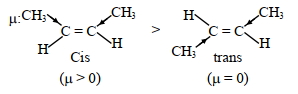
-
- (A) \(3\)
- (B) \(4\)
- (C) \(5\)
- (D) \(6\)
Show answer and solution
Correct Answer: (B)
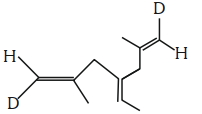
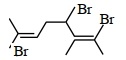
\(3\) stereocenteres, symmetricalTotal Geometrical isomers \(\rightarrow 4\). \(EE, ZZ, EZ\) (two isomers)
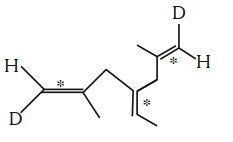
- 207. Number of metal ions characterized by flame test among the following is _______.
\(Sr ^{2+}, Ba ^{2+}, Ca ^{2+}, Cu ^{2+}, Zn ^{2+}, Co ^{2+}, Fe ^{2+}\) 2024 Medium- (A) 4
- (B) 6
- (C) 8
- (D) 10
Show answer and solution
Correct Answer: (A)
All the following metal ions will respond to flame test.
\(Sr ^{2+}, Ba ^{2+}, Ca ^{2+}, Cu ^{2+}\) -
- (A) \(2\)
- (B) \(4\)
- (C) \(6\)
- (D) \(8\)
Show answer and solution
Correct Answer: (A)
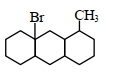
There is one chiral centre present in given compound.So, Total optical isomers \(=2\)
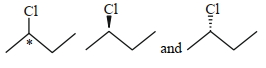
-
- (A) Ethane has infinite number of conformations
- (B) The dihedral angle in staggered conformation is \(60^{\circ}\)
- (C) Eclipsed conformation is the most stable conformation.
- (D) The conformations of ethane are interconvertible to one-another.
Show answer and solution
Correct Answer: (C)
Eclipsed conformation is the least stable conformation of ethane. - 210. The incorrect statement regarding the geometrical isomers of \(2\)-butene is _______. 2024 Medium
- (A) cis-\(2\)-butene and trans-\(2\)-butene are not interconvertible at room temperature.
- (B) cis-\(2\)-butene has less dipole moment than trans-\(2\)-butene.
- (C) trans-\(2\)-butene is more stable than cis-\(2\)-butene.
- (D) cis-\(2\)-butene and trans-\(2\)-butene are stereoisomers.
Show answer and solution
Correct Answer: (B)
Cis-but-\(2\)-ene has higher Dipole moment than trans-but-\(2\)-ene.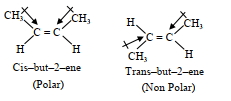
-
- (A) \(30\)
- (B) \(35\)
- (C) \(36\)
- (D) \(32\)
Show answer and solution
Correct Answer: (D)
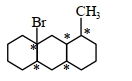
Total chiral centre \(=5\)No. of optical isomers \(=2^5=32\).
-
- (A) \(6\)
- (B) \(5\)
- (C) \(7\)
- (D) \(75\)
Show answer and solution
Correct Answer: (B)
Explanation:
A carbon atom is considered chiral if it is sp3 hybridized and directly bonded to four different atoms or groups. Let us analyze each compound:
1. Compound I: \( \text{CH}_3-\text{CH}_2-\text{CH}^*(\text{NO}_2)-\text{COOH} \) is chiral. The C-2 carbon is bonded to four distinct groups: \( -\text{H} \), \( -\text{NO}_2 \), \( -\text{COOH} \), and \( -\text{CH}_2\text{CH}_3 \).
2. Compound II: \( \text{CH}_3-\text{CH}_2-\text{CHBr}-\text{CH}_2-\text{CH}_3 \) is achiral. The C-3 carbon is attached to two identical ethyl groups, so it lacks a chiral center.
3. Compound III: \( \text{CH}_3-\text{CH}^*(\text{I})-\text{CH}_2-\text{NO}_2 \) is chiral. The C-2 carbon is bonded to four distinct groups: \( -\text{H} \), \( -\text{I} \), \( -\text{CH}_3 \), and \( -\text{CH}_2\text{NO}_2 \).
4. Compound IV: \( \text{CH}_3-\text{CH}_2-\text{CH}^*(\text{OH})-\text{CH}_2\text{OH} \) is chiral. The C-2 carbon is bonded to four distinct groups: \( -\text{H} \), \( -\text{OH} \), \( -\text{CH}_2\text{CH}_3 \), and \( -\text{CH}_2\text{OH} \).
5. Compound V: \( \text{CH}_3-\text{CH}^*(\text{I})-\text{CH}^*(\text{I})-\text{C}_2\text{H}_5 \) (corrected from the incomplete print) is chiral. Both C-2 and C-3 carbons are bonded to four different groups, creating two chiral centers.
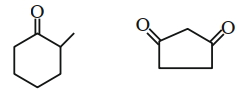
6. Compound VI: 2-Methylcyclohexanone is chiral. The ring carbon bearing the methyl group is attached to four asymmetric paths/groups.
7. Compound VII: Cyclopentane-1,3-dione is achiral due to its internal plane of symmetry and lack of an asymmetric carbon center.
Counting the chiral structures (I, III, IV, V, and VI), we find a total of 5 chiral compounds.
Hence, Option B is the correct choice. -
- (A) \(5\)
- (B) \(8\)
- (C) \(1\)
- (D) \(9\)
Show answer and solution
Correct Answer: (C)
Explanation:
This question requires identifying the number of optically active compounds by analyzing their molecular structures for chiral centers and internal elements of symmetry:
1. Fischer Projection (Butane-2,3-diol):
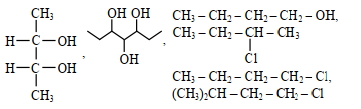
This structure contains two chiral carbon centers. However, there is a clear horizontal plane of symmetry running through the middle of the molecule that divides it into two mirror-image halves. Due to this internal symmetry, the optical rotation of one half cancels out the other (internal compensation). Therefore, it is a meso compound and is optically inactive.
2. Skeletal Structure (Heptane-3,4,5-triol variant):
This molecule is constitutionally symmetrical from left to right. In the planar zigzag conformation shown, the middle carbon has its \( -\text{OH} \) group pointing downwards, while the two flanking chiral carbons have their \( -\text{OH} \) groups pointing upwards. A vertical plane of symmetry passes directly through the central carbon and its \( -\text{OH} \) group, mirroring the left half perfectly onto the right half. Because of this internal plane of symmetry, it is a meso form and is optically inactive.
3. Analyzing the Condensed Molecular Formulas:
- \( \text{CH}_3-\text{CH}_2-\text{CH}_2-\text{CH}_2-\text{OH} \) (Butan-1-ol): This molecule does not possess any chiral carbon atom (a carbon bonded to four different groups). Thus, it is optically inactive.
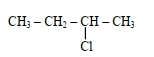
- \( \text{CH}_3-\text{CH}_2-\text{CH}(\text{Cl})-\text{CH}_3 \) (2-chlorobutane): The second carbon atom is asymmetric because it is bonded to four completely different groups: \( -\text{H} \), \( -\text{Cl} \), \( -\text{CH}_3 \), and an ethyl group (\( -\text{CH}_2\text{CH}_3 \)). Since it contains a chiral center and lacks any internal symmetry, it is optically active.
- \( \text{CH}_3-\text{CH}_2-\text{CH}_2-\text{CH}_2-\text{Cl} \) (1-chlorobutane): It contains no asymmetric carbon atom, making it optically inactive.
- \( (\text{CH}_3)_2\text{CH}-\text{CH}_2-\text{CH}_2-\text{Cl} \) (1-chloro-3-methylbutane): It contains no asymmetric carbon atom, making it optically inactive.
4. Conclusion:
Out of all the given configurations, only 2-chlorobutane is chiral and lacks internal symmetry elements. Therefore, the total count of optically active compounds is exactly 1.
Hence, Option C is the correct choice. -
- (A) \(8\)
- (B) \(2\)
- (C) \(4\)
- (D) \(3\)
Show answer and solution
Correct Answer: (A)
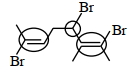
There are three stereo center So No of stereoisomer \(=2^3=8\)
- 215. A reagent which gives brilliant red precipitate with Nickel ions in basic medium is _______. 2024 Medium
- (A) sodium nitroprusside
- (B) neutral \(FeCl _3\)
- (C) meta-dinitrobenzene
- (D) dimethyl glyoxime
Show answer and solution
Correct Answer: (D)
\(Ni ^{2+}+2 dmg ^{-} \rightarrow\left[ Ni ( dmg )_2\right]\)
Rosy red/Bright Red precipitate -
- (A) \(3\)
- (B) \(6\)
- (C) \(8\)
- (D) \(5\)
Show answer and solution
Correct Answer: (C)
\(\left.\left[\stackrel{+3}{\mathrm{Co}}\left(\mathrm{NH}_3\right)_5 \mathrm{Cl}\right] \mathrm{Cl}_2+\text { excess } \mathrm{AgNO}_3 \longrightarrow 2 \text { moles }\right)\)\(\mathrm{x}+0-1-2=0\)
\(\mathrm{x}=+3\)
\(\mathrm{n}=5\)
\(\therefore \mathrm{x}+\mathrm{n}=8\)
-
- (A) \((B), (C), (E)\) only
- (B) \((C), (D), (E)\) only
- (C) \((A), (B), (C)\) only
- (D) \((A), (D), (E)\) only
Show answer and solution
Correct Answer: (C)
\(image\) Based on Hall-Heroults process\(\left[\mathrm{Rh}\left(\mathrm{PPh}_3\right)_3 \mathrm{Cl}\right]\) Wilkinson's catalyst
\({Ag}_2 \mathrm{~S}+\mathrm{NaCN} \stackrel{\text { Air }}{\rightleftharpoons} \mathrm{Na}\left[\mathrm{Ag}(\mathrm{CN})_2\right]+\mathrm{Na}_2 \mathrm{~S}\)
\({Ca}^{++}\)ion forms more stable complex with \(EDTA\)

-
- (A) Spin free Complex, Spin paired Complex
- (B) Spin paired Complex, Spin free Complex
- (C) Outer orbital Complex, Inner orbital Complex
- (D) Inner orbital Complex, Spin paired Complex
Show answer and solution
Correct Answer: (B)
\({\left[\mathrm{Co}\left(\mathrm{NH}_3\right)_6\right]^{3+}}\)\(\mathrm{Co}^{3+}(\text { strong field ligand }) \Rightarrow 3 \mathrm{~d}^6\left(\mathrm{t}_{2 \mathrm{~g}}^6, \mathrm{e}_{\mathrm{g}}^0\right),\)
Hybridisation : \(d^2 \mathrm{sp}^3\)
Inner obital complex (spin paired complex) Pairing will take place.
\(\left[\mathrm{CoF}_6\right]^{3-}\)
\(\mathrm{Co}^{3+}\) (weak field ligand) \(\Rightarrow 3 \mathrm{~d}^6\left(\mathrm{t}_{2 \mathrm{~g}}^4, \mathrm{e}_{\mathrm{g}}^2\right)\)
Hybridisation : \(\mathrm{sp}^3 \mathrm{~d}^2\)
Outer orbital complex (spin free complex) no pairing will take place.
-
- (A) \(R < Q < P\)
- (B) \(R < P < Q\)
- (C) \(Q < R < P\)
- (D) \(Q < P < R\)
Show answer and solution
Correct Answer: (C)
\(\left[\mathrm{FeF}_6\right]^{3-}: \mathrm{Fe}^{+3}:[\mathrm{Ar}] 3 \mathrm{~d}^5\)
F : Weak field Ligand No. of unpaired electron'\(s=5\)
\( \mu=\sqrt{5(5+2)} \)
\( \mu=\sqrt{35} \mathrm{BM} \)
\( {\left[\mathrm{V}\left(\mathrm{H}_2 \mathrm{O}\right)_6\right]^{+2}: \mathrm{V}^{+2}: 3 \mathrm{~d}^3}\)
No. of unpaired electron's \(=3\)
\( \mu=\sqrt{3(3+2)} \)
\( \mu=\sqrt{15} \mathrm{BM} \)
\( {\left[\mathrm{Fe}\left(\mathrm{H}_2 \mathrm{O}\right)_6\right]^{+2}: \mathrm{Fe}^{+2}: 3 \mathrm{~d}^6}\)
\(\mathrm{H}_2 \mathrm{O}\) : Weak field Ligand
No. of unpaired electron's\(=4\)
\( \mu=\sqrt{4(4+2)} \)
\( \mu=\sqrt{24} \mathrm{BM}\)
-
- (A) \(C \) < \( D \) < \( A \) < \( B\)
- (B) \(D \) < \( A \) < \( C \) < \( B\)
- (C) \(A \) < \( C \) < \( B \) < \( D\)
- (D) \(B \) < \( C \) < \( A \) < \( D\)
Show answer and solution
Correct Answer: (B)
As ligand field increases, light of more energy is absorbedEnergy \(\propto\) wave number
\((\bar{v})\)
- 221. Consider the following reactions.
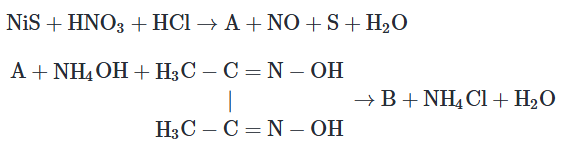
The number of protons that do not involve in hydrogen bonding in the product B is _______. 2024 Medium- (A) 12
- (B) 14
- (C) 16
- (D) 18
Show answer and solution
Correct Answer: (A)
\(3 NiS +2 HNO _3+6 HCl \rightarrow 3 NiCl _2+2 NO +3 S+4 H _2 O\)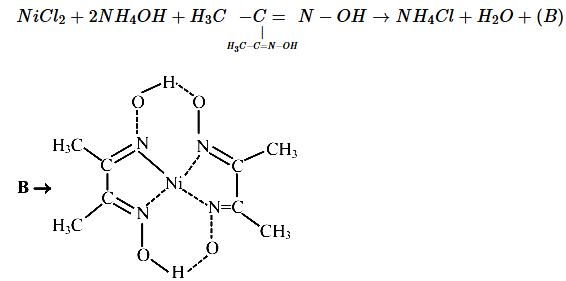
-
- (A) 0
- (B) 1
- (C) 2
- (D) 3
Show answer and solution
Correct Answer: (A)
If \(M ^{+2}= Co ^{+2}\)
then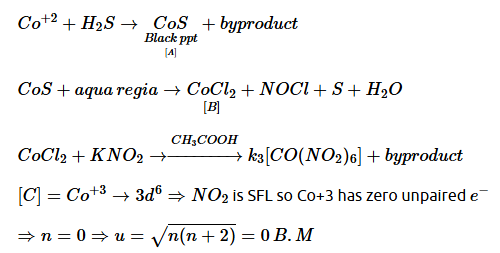
-
- (A) Both \((A)\) and \((R)\) are correct and \((R)\) is the correct explanation of \((A)\).
- (B) \((A)\) is correct but \((R)\) is not correct.
- (C) \((A)\) is not correct but \((R)\) is correct.
- (D) Both \((A)\) and \((R)\) are correct but \((R)\) is not the correct explanation of \((A)\).
Show answer and solution
Correct Answer: (C)
\(\left[\mathrm{Co}(\mathrm{en})_2 \mathrm{Cl}_2\right]^{+}\)has octahedral geometry with two geometrical isomers.
-
- (A) Both Statement \(I\) and Statement \(II\) are incorrect
- (B) Both Statement \(I\) and Statement \(II\) are correct
- (C) Statement \(I\) is incorrect but Statement \(II\) is correct
- (D) Statement \(I\) is correct but Statement \(II\) is incorrect
Show answer and solution
Correct Answer: (B)
\(\left[\mathrm{Ni}\left(\mathrm{H}_2 \mathrm{O}\right)_6\right]^{+2} \rightarrow\) Green colour solution due to d-d transition.\(\left[\mathrm{Ni}(\mathrm{CN})_4\right]^{-2} \rightarrow\) is diamagnetic and it is colourless.
-
- (A) Statement I is correct but Statement II is incorrect.
- (B) Statement I is incorrect but Statement II is correct.
- (C) Both Statement I and Statement II are correct.
- (D) Both Statement I and Statement II are incorrect.
Show answer and solution
Correct Answer: (A)
\(N\left( CH _3\right)_3\) and \(P \left( CH _3\right)_3\) both are Lewis base and acts as ligand, However, \(P\left( CH _3\right)_3\) has a \(\pi\)-acceptor character. - 226. Identify from the following species in which \(\mathrm{d}^2 \mathrm{sp}^3\) hybridization is shown by central atom: 2024 Hard
- (A) \(\left[\mathrm{Co}\left(\mathrm{NH}_3\right)_6\right]^{3+}\)
- (B) \(\mathrm{BrF}_5\)
- (C) \(\left[\mathrm{Pt}(\mathrm{Cl})_4\right]^{2-}\)
- (D) \(\mathrm{SF}_6\)
Show answer and solution
Correct Answer: (A)
\(\left[\mathrm{Co}\left(\mathrm{NH}_3\right)_6\right]^{+3}-d^2 \mathrm{sp}^3\) hybridization\(\mathrm{BrF}_5-\mathrm{sp}^3 \mathrm{~d}^2\) hybridization
\(\left[\mathrm{PtCl}_4\right]^{-2}-\mathrm{dsp}^2\) hybridization
\(\mathrm{SF}_6-\mathrm{sp}^3 \mathrm{~d}^2\) hybridization
-
- (A) Photography - \(\mathrm{AgBr}\)
- (B) Polythene preparation - \(\mathrm{TiCl}_4, \mathrm{Al}\left(\mathrm{CH}_3\right)_3\)
- (C) Haber process - Iron
- (D) Wacker process \(-\mathrm{Pt} \mathrm{Cl}_2\)
Show answer and solution
Correct Answer: (D)
The catalyst used in Wacker's process is \(\mathrm{PdCl}_2\) -
- (A) \(5\)
- (B) \(6\)
- (C) \(3\)
- (D) \(4\)
Show answer and solution
Correct Answer: (B)
Complex is\(\left[\mathrm{III}\left(\mathrm{NH}_3\right)_2(\mathrm{CN})_4\right]^{\Theta}\)\( x=2\)
\(y=4\)
\(\text { so } x+y=6\)
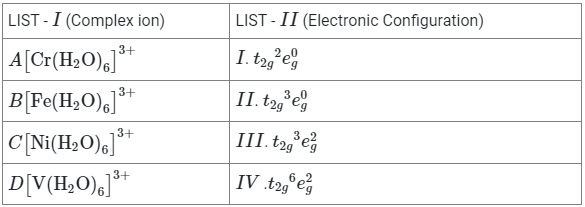
- 229. Match List \(I\) with List \(II\).Choose the correct answer from the options given below :
 2024 Hard
- (A) \(A-III, B-II, C-IV, D-I\)
- (B) \(A-IV, B-I, C-II, D-III\)
- (C) \(A-IV, B-III, C-I, D-II\)
- (D) \(A-II, B-III, C-IV, D-I\)
Show answer and solution
Correct Answer: (D)
\({\left[\mathrm{Cr}\left(\mathrm{H}_2 \mathrm{O}\right)_6\right]^{3+} \text { Contains } \mathrm{Cr}^{3+}:[\mathrm{Ar}] 3 \mathrm{~d}^3: \mathrm{t}_{2 \mathrm{~g}}^3 \mathrm{e}_{\mathrm{g}}^{\mathrm{o}}}\)\({\left[\mathrm{Fe}\left(\mathrm{H}_2 \mathrm{O}\right)_6\right]^{3+} \text { Contains } \mathrm{Fe}^{3+}:[\mathrm{Ar}] 3 \mathrm{~d}^5: \mathrm{t}_{2 \mathrm{~g}}^3 \mathrm{e}_{\mathrm{g}}^2}\)
\({\left[\mathrm{Ni}\left(\mathrm{H}_2 \mathrm{O}\right)_6\right]^{2+} \text { Contains } \mathrm{Ni}^{2+}:[\mathrm{Ar}] 3 \mathrm{~d}^8: \mathrm{t}_{2 \mathrm{~g}}^6 \mathrm{e}_{\mathrm{g}}^2}\)
\({\left[\mathrm{~V}\left(\mathrm{H}_2 \mathrm{O}\right)_6\right]^{3+} \text { Contains } \mathrm{V}^{3+}:[\mathrm{Ar}] 3 \mathrm{~d}^2: \mathrm{t}_{2 \mathrm{~g}}^2 \mathrm{e}_{\mathrm{g}}^{\circ}}\)
-
- (A) \((A)-(I), (B)-(IV), (C)-(II), (D)-(III)\)
- (B) \((A)-(IV), (B)-(III), (C)-(I), (D)-(II)\)
- (C) \((A)-(II), (B)-(IV), (C)-(I), (D)-(III)\)
- (D) \((A)-(II), (B)-(III), (C)-(I), (D)-(IV)\)
Show answer and solution
Correct Answer: (C)
\((A)\)\({\left[\mathrm{Cr}\left(\mathrm{NH}_3\right)_6\right]^{3+}}\)
\(\mathrm{Cr}^{3+}: 3 \mathrm{~d}^3\)
\(\mathrm{n}=3 \text { (unpaired electrons) }\)
\(\mu \simeq 3.87 \text { B.M. (II) }\)
\((B)\)
\({\left[\mathrm{NiCl}_4\right]^{2-}}\)
\(\mathrm{Ni}^{2+}: 3 \mathrm{~d}^8\)
\(\mathrm{n}=2\)
\(\mu \simeq 2.83 \text { B.M. (IV) }\)
\((C)\)
\({\left[\mathrm{CoF}_6\right]^{3-}}\)
\(\mathrm{Co}^{3+}: 3 \mathrm{~d}^6\)
\(\mathrm{n}=4\)
\(\mu \simeq 4.90 \text { B.M. (I) }\)
\((D)\)
\({\left[\mathrm{Ni}(\mathrm{CN})_4\right]^{2-}}\)
\(\mathrm{Ni}^{2+}: 3 \mathrm{~d}^8\)
\(\mathrm{n}=0\)
\(\mu=0 \text { B.M. (III) }\)
-
- (A) \(A-III, B-I, C-II, D-IV\)
- (B) \(A-III, B-II, C-IV, D-I\)
- (C) \(A-I, B-III, C-II, D-IV\)
- (D) \(A-III, B-I, C-IV, D-II\)
Show answer and solution
Correct Answer: (D)
\(\begin{gathered}+2 \\ \text { (A) } \mathrm{K}_2\left[\mathrm{Ni}(\mathrm{CN})_4\right] \\ \mathrm{Ni}^{2+}:[\mathrm{Ar}] 3 \mathrm{~d}^8 4 \mathrm{~s}^{\circ},\left(\mathrm{CN}^{-} \text {is S.F.L) }\right. \\ \text { Pre hybridization state of } \mathrm{Ni}^{+2}\end{gathered}\)
(B) \(\left[\mathrm{Ni}(\mathrm{CO})_4\right]\)
\(\mathrm{Ni}:[\mathrm{Ar}] 3 \mathrm{~d}^8 4 \mathrm{~s}^2\)
\(CO\) is \(S.F.L,\) so pairing occur
Pre hybridization state of \(\mathrm{Ni}\)
\(\begin{aligned} & \text { (C) }\left[\mathrm{Co}\left(\mathrm{NH}_3\right)_6\right] \mathrm{Cl}_3 \\ & \mathrm{Co}^{+3}:[\mathrm{Ar}] 3 \mathrm{~d}^6 4 \mathrm{~s}^0 \\ & \text { With } \mathrm{Co}^{3+}, \mathrm{NH}_3 \text { act as S.F.L }\end{aligned}\)
\(\begin{aligned} & \text { (d) } \mathrm{Na}_3\left[\mathrm{CoF}_6\right] \\ & \mathrm{Co}^{3+}:[\mathrm{Ar}] 3 \mathrm{~d}^6\left(\mathrm{~F}^{\Theta}: \text { W.F.L }\right)\end{aligned}\)
-
- (A) (A)-(III), (B)-(IV), (C)-(II), (D)-(I)
- (B) (A)-(IV), (B)-(III), (C)-(I), (D)-(II)
- (C) (A)-(III), (B)-(I), (C)-(IV), (D)-(II)
- (D) (A)-(I), (B)-(III), (C)-(IV), (D)-(II)
Show answer and solution
Correct Answer: (C)
(A)-(III), (B)-(I), (C)-(IV), (D)-(II) -
- (A) \(A-II\), \(B-IV\), \(C-I\), \(D-III\)
- (B) \(A-II\), \(B-III\), \(C-IV\), \(D-I\)
- (C) \(A-III\), \(B-II\), \(C-IV\), \(D-I\)
- (D) \(A-IV\), \(B-III\), \(C-I\), \(D-II\)
Show answer and solution
Correct Answer: (D)
Ziegler catalyst \(\rightarrow\) TitaniumBlood pigment \(\rightarrow\) Iron
Wilkinson catalyst \(\rightarrow\) Rhodium
Vitamin \(\mathrm{B}_{12} \rightarrow\) Cobalt
- 234. Number of ambidentate ligands among the following is _______.
\(NO _2^{-}, SCN ^{-}, C _2 O _4^{2-}, NH _3, CN ^{-}, SO _4^{2-}, H _2 O\). 2024 Medium- (A) 1
- (B) 2
- (C) 3
- (D) 4
Show answer and solution
Correct Answer: (C)
Ligands which have two different donor sites but at a time connects with only one donor site to central metal are ambidentate ligands.
Ambidentate ligands are \(NO _2^{-} ; SCN ^{-} ; CN ^{-}\) -
- (A) \(2\)
- (B) \(4\)
- (C) \(5\)
- (D) \(1\)
Show answer and solution
Correct Answer: (A)
\({\left[\mathrm{V}\left(\mathrm{H}_2 \mathrm{O}\right)_6\right]^{3+} \rightarrow \mathrm{d}^2 \mathrm{sp}^3}\)\({ }_{23} \mathrm{~V}:-[\mathrm{Ar}] 3 \mathrm{~d}^3 4 \mathrm{~s}^2\)
\(\mathrm{~V}^{+j}:-[\mathrm{Ar}] 3 \mathrm{~d}^2, \mathrm{n}=2 \text { (even number of unpaired e) }\)
\({\left[\mathrm{Cr}\left(\mathrm{H}_2 \mathrm{O}\right)_6\right]^{2+} \rightarrow \mathrm{sp}^3 \mathrm{~d}^2}\)
\({ }_{24} \mathrm{Cr}:-[\mathrm{Ar}] 3 \mathrm{~d}^5 4 \mathrm{~s}^1\)
\(\left.\mathrm{Cr}^{+2}:-[\mathrm{Ar}] 3 \mathrm{~d}^4, \mathrm{n}=4 \text { (even number of unpaired } \mathrm{e}^{-}\right)\)
\({\left[\mathrm{Fe}\left(\mathrm{H}_2 \mathrm{O}\right)_6\right]^{3+} \rightarrow \mathrm{sp}^3 \mathrm{~d}^2}\)
\(\mathrm{Fe}^{3+}:-[\mathrm{Ar}] 3 \mathrm{~d}^5 4 \mathrm{~s}^0\)
\(\mathrm{n}=5 \text { (odd number of unpaired } \mathrm{e}^{-} \text {) }\)
\({\left[\mathrm{Ni}\left(\mathrm{H}_2 \mathrm{O}\right)_6\right]^{3+} \rightarrow \mathrm{sp}^3 \mathrm{~d}^2}\)
\(\mathrm{Ni}:-[\mathrm{Ar}] 3 \mathrm{~d}^8 4 \mathrm{~s}^2\)
\(\mathrm{Ni}^{+3}:-[\mathrm{Ar}] 3 \mathrm{~d}^7, \mathrm{n}=3 \text { (odd number of unpaired } \mathrm{e}^{-} \text {) }\)
\({\left[\mathrm{Cu}\left(\mathrm{H}_2 \mathrm{O}\right)_6\right]^{2+} \rightarrow \mathrm{sp}^3 \mathrm{~d}^2}\)
\(\mathrm{Cu}:-[\mathrm{Ar}] 3 \mathrm{~d}^9 4 \mathrm{~s}^0\)
\(\mathrm{n}=1 \text { (odd number of unpaired } \mathrm{e}^{-} \text {) }\)

-
- (A) \(4\)
- (B) \(5\)
- (C) \(6\)
- (D) \(7\)
Show answer and solution
Correct Answer: (A)
cis \(-\left[\mathrm{Cr}(\mathrm{ox})_2 \mathrm{Cl}_2\right]^{3-} \rightarrow\) can show optical isomerism (no \(POS\) & \(COS\))\(\left[\mathrm{Co}(\mathrm{en})_3\right]^{3+} \rightarrow\) can show (no \(POS\) & \(COS\))
cis \(-\left[\mathrm{Pt}(\mathrm{en})_2 \mathrm{Cl}_2\right]^{2+} \rightarrow\) can show (no \(POS\) & \(COSV\))
cis \(-\left[\mathrm{Co}(\mathrm{en})_2 \mathrm{Cl}_2\right]^{+} \rightarrow\) can show (no \(POS\) & \(COS\))
trans \(-\left[\mathrm{Pt}(\mathrm{en})_2 \mathrm{Cl}_2\right]^{2+} \rightarrow\) can't show (contains \(POS\) & \(COS\))
trans \(-\left[\mathrm{Cr}(\mathrm{ox})_2 \mathrm{Cl}_2\right]^{3-} \rightarrow\) can't show (contains \(POS\) & \(COS\))
-
- (A) 2
- (B) 4
- (C) 5
- (D) 1
Show answer and solution
Correct Answer: (D)
Complex formed during brown ring test is
\(\left[Fe\left(H_2 O\right)_5 NO\right] SO_4 .\)
NO is present as \(NO ^{+}\)here.
\(\begin{array}{l}x+5 \times 0+1=+2 \\x=+1\end{array}\)
Oxidation state of Fe is +1 -
- (A) \(\left[\mathrm{Ni}(\mathrm{CO})_4\right]\) and \(\left[\mathrm{NiCl}_4\right]^{2-}\) both diamagnetic
- (B) \(\left[\mathrm{Ni}(\mathrm{CO})_4\right]\) and \(\left[\mathrm{NiCl}_4\right]^{2-}\) both paramagnetic
- (C) \(\left[\mathrm{NiCl}_4\right]^{2-}\) diamagnetic, \(\left[\mathrm{Ni}(\mathrm{CO})_4\right]\) paramagnetic
- (D) \(\left[\mathrm{Ni}(\mathrm{CO})_4\right]\) diamagnetic, \(\left[\mathrm{NiCl}_4\right]^{2-}\) paramagnetic
Show answer and solution
Correct Answer: (D)
\(\left[\mathrm{Ni}(\mathrm{CO})_4\right] \rightarrow\) diamagnetic, \(\mathrm{sp}^3\) hybridisation, number of unpaired electrons \(=0\)\(\left[\mathrm{NiCl}_4\right]^{2-}, \rightarrow\) paramagnetic, \(\mathrm{sp}^3\) hybridisation, number of unpaired electrons \(=2\)
- 239. The coordination environment of \(\mathrm{Ca}^{2+}\) ion in its complex with \(EDTA\) \(^{4-}\) is _______. 2024 Medium
- (A) tetrahedral
- (B) octahedral
- (C) square planar
- (D) trigonal prismatic
Show answer and solution
Correct Answer: (B)
\(EDTA\) \(^{4-} \rightarrow\) Hexadentate ligand\([\mathrm{Ca}(\mathrm{EDTA})]^{2-}\)
So Coordination environment is octahedral
-
- (A) Octahedral
- (B) Trigonal bipyramidal
- (C) Square pyramidal
- (D) Square planar
Show answer and solution
Correct Answer: (A)
\(\mathrm{Mn}_2(\mathrm{CO})_{10}\)Octahedral around Mn
-
- (A) Potassium tetraoxopermanganate \((VI)\)
- (B) Potassium tetraoxidomanganate \((VI)\)
- (C) Dipotassium tetraoxidomanganate \((VII)\)
- (D) Potassium tetraoxidomanganese \((VI)\)
Show answer and solution
Correct Answer: (B)
\( \mathrm{K}_2 \mathrm{MnO}_4 \)\( 2+\mathrm{x}-8=0 \)
\( \Rightarrow \mathrm{x}=+6\)
O.S. of \(\mathrm{Mn}=+6\)
\(IUPAC\) Name \(=\)
Potassium tetraoxidomanganate\((VI)\)
- 242. The correct \(IUPAC\) name of \(\left[\mathrm{PtBr}_2\left(\mathrm{PMe}_3\right)_2\right]\) is _______. 2024 Medium
- (A) bis (trimethylphosphine) dibromoplatinum\((II)\)
- (B) bis [bromo(trimethylphosphine)] platinum\((II)\)
- (C) dibromobis (trimethylphosphine) platinum\((II)\)
- (D) dibromodi (trimethylphosphine) platinum\((II)\)
Show answer and solution
Correct Answer: (C)
Dibromo bis(trimethylphosphine) platinum \((II)\) -
- (A) \(\mathrm{Cl}^{-}<-\mathrm{OH}<\mathrm{Br}^{-}<\mathrm{CN}^{-}\)
- (B) \(\mathrm{F}^{-}<\mathrm{Br}^{-}<\mathrm{I}^{-}<\mathrm{NH}_3\)
- (C) \(\mathrm{Br}^{-}<\mathrm{F}^{-}<\mathrm{H}_2 \mathrm{O}<\mathrm{NH}_3\)
- (D) \(\mathrm{H}_2 \mathrm{O}<{ }^{-} \mathrm{OH}<\mathrm{CN}^{-}<\mathrm{NH}_3\)
Show answer and solution
Correct Answer: (C)
Experimental order \(\mathrm{Br}^{-}<\mathrm{F}^{-}<\mathrm{H}_2 \mathrm{O}<\mathrm{NH}_3\) - 244. The correct sequence of ligands in the order of decreasing field strength is _______. 2024 Medium
- (A) \(\mathrm{CO}>\mathrm{H}_2 \mathrm{O}>\mathrm{F}^{-}>\mathrm{S}^{2-}\)
- (B) \({ }^{-} \mathrm{OH}>\mathrm{F}^{-}>\mathrm{NH}_3>\mathrm{CN}^{-}\)
- (C) \(\mathrm{NCS}^{-}>\mathrm{EDTA}^{4-}>\mathrm{CN}^{-}>\mathrm{CO}\)
- (D) \(\mathrm{S}^{2-}>-\mathrm{OH}>\mathrm{EDTA}^{+}>\mathrm{CO}\)
Show answer and solution
Correct Answer: (A)
According to spectrochemical series ligand field strength is \(\mathrm{CO}>\mathrm{H}_2 \mathrm{O}>\mathrm{F}^{-}>\mathrm{S}^{2-}\) -
- (A) \(A\), \(D\) only
- (B) \(A\), \(C\) only
- (C) \(B\), \(D\) only
- (D) \(B\), \(C\) only
Show answer and solution
Correct Answer: (D)
\(B\). VBT does not explain stability of complex\(C\). Hybridisation of \(\left[\mathrm{Ni}(\mathrm{CN})_4\right]^{-2}\) is \(\mathrm{dsp}^2\).
-
- (A) 2
- (B) 0
- (C) 4
- (D) 3
Show answer and solution
Correct Answer: (B)
Tetrahedral complex does not show geometrical isomerism. -
- (A) \(3\)
- (B) \(1\)
- (C) \(4\)
- (D) \(2\)
Show answer and solution
Correct Answer: (A)
\(\mathrm{TiCl}_4 \Rightarrow \mathrm{Ti}^{+4} \mathrm{e}^0 \mathrm{t}_2^0\)\(\mathrm{MnO}_4^{-} \Rightarrow \mathrm{Mn}^{+7} \mathrm{e}^0 \mathrm{t}_2^0\)
\(\mathrm{FeO}_4^{2-} \Rightarrow \mathrm{Fe}^{+6} \mathrm{e}^2 \mathrm{t}_2^0\)
\(\mathrm{FeCl}_4^{2-} \Rightarrow \mathrm{Fe}^{+2} \mathrm{e}^3 \mathrm{t}_2^3\)
\(\mathrm{CoCl}_4^{2-} \Rightarrow \mathrm{Co}^{+2} \mathrm{e}^4 \mathrm{t}_2^3\)
- 248. The number of unpaired d-electrons in \(\left[\mathrm{Co}\left(\mathrm{H}_2 \mathrm{O}\right)_6\right]^{3+}\) is _______. 2024 Medium
- (A) \(4\)
- (B) \(2\)
- (C) \(0\)
- (D) \(1\)
Show answer and solution
Correct Answer: (C)
\(\Rightarrow\left[\mathrm{Co}\left(\mathrm{H}_2 \mathrm{O}\right)_6\right]^{+3}\)No unpaired electrons

-
- (A) \(20\)
- (B) \(28\)
- (C) \(30\)
- (D) \(35\)
Show answer and solution
Correct Answer: (B)
\(\mathrm{NH}_3\) act as WFL with \(\mathrm{Ni}^{2+}\) \(\mathrm{Ni}^{2+}=3 \mathrm{~d}^8\)\(Image\)
No. of unpaired electron \(=2\)
\(\mu=\sqrt{n(n+2)}=\sqrt{8}=2.82 \mathrm{BM}\)
\(=28.2 \times 10^{-1} \mathrm{BM}\)
\(\mathrm{x}=28\)

-
- (A) \(1\)
- (B) \(2\)
- (C) \(3\)
- (D) \(0\)
Show answer and solution
Correct Answer: (D)
\(\mathrm{Pt}^{2+}\left(\mathrm{d}^8\right)\)
\(\mathrm{Pt}^{2+} \rightarrow \mathrm{dsp}^2\) hybridization and have no unpaired e-s.
\(\therefore\) Magnetic moment \(\mathrm{o} 0\)
No questions on this page match these filters.